
درباره سایت
آخرین مطالب
- استخدام أكسيد الليمونيت (الماغش) في صناعات الزجاج
- کاربرد اکسید لیمونیت (گل ماش) در صنایع شیشهسازی
- A Review of Daily Prices for Limonite Oxide (Ocher) in the Market
- چگونه خالص بودن اکسید لیمونیت (گل ماش) را تشخیص دهیم؟
- بررسی قیمت روز اکسید لیمونیت (گل ماش) در بازار
- Application of Limonite Oxide (Gole Mash) in Glassmaking Industries
- كيف تتعرف على نقاء أكسيد الليمونيت (جول ماش)؟
- How to Determine the Purity of Limonite Oxide (Gol Mash)?
- بررسی استانداردهای ایمنی کار با اکسید لیمونیت (گل ماش)
- Comprehensive Guide to Technical Analysis of Limonite Oxide (Gol Mash)
امکانات وب
Introduction to Dimensional Stability and the Role of Minerals in Polymer Industries
In mode manufacturing industries and polymer product processing, maintaining precise dimensions of parts during and after the production process is one of the main challenges for engineers and designers. Dimensional changes, unpredictable shrinkage, and warping of parts can severely affect the final product quality and impose heavy costs on production lines. For this reason, the use of efficient mineral additives to control these changes is of particular importance. Among widely used minerals, coated calcium carbonate is recognized as an advanced engineering solution that plays a significant role in improving the mechanical and physical properties of polymers. With its specific characteristics, this material contributes significantly to improving the dimensional stability of parts.
Polymer industries are always looking for compounds that, in addition to reducing the final product cost, also enhance its functional properties. The presence of minerals in the polymer matrix can transform the thermal and mechanical behavior of the part. The selection of the type of additive and its processing quality determines the level of success in achieving parts with stable dimensions and tight tolerances. Coated calcium carbonate, with its appropriate surface coating, establishes better interaction with polymer chains, which directly has a positive effect on the dimensional stability of the parts.
Technical studies show that using mineral fillers without proper coating caot create the necessary adhesion at the interface between the polymer and the filler. In contrast, coated calcium carbonate, with its surface modification, is well distributed in the polymer matrix and prevents particle agglomeration. This fundamental feature causes inteal stresses of the part to be reduced during cooling and operation, and the dimensional stability of the parts is significantly improved.
Kani Sang Amiran project, by producing various high-quality minerals, provides suitable solutions for compounding and granulation industries. A precise understanding of the mechanisms of coated calcium carbonate's effect on polymer properties allows manufacturers to supply higher-quality and more standardized products to the market and stay ahead of competitors.
Getting to Know Coated Calcium Carbonate and Its Structural Characteristics
Coated calcium carbonate is a type of calcium carbonate powder whose particle surface is covered with a layer of organic materials, usually fatty acids or stearic acid. This surface coating significantly changes the physical and chemical characteristics of the powder. To better understand this, it is suggested to read the specialized article Investigating the Impact of Stearic Acid in Coated Calcium Carbonate Coating to become more familiar with the scientific details of this process. This coating causes a reduction in the surface energy of the particles and an increase in their compatibility with non-polar polymers.
One of the most important parameters regarding this material is its mesh range, which varies between 450 and 3500 mesh. This diversity in particle size allows engineers to select coated calcium carbonate with the appropriate mesh for compounds, granules, and polymer parts. Choosing the correct mesh based on the type of application helps in the uniform distribution of particles and prevents the creation of weak points in the part's structure.
Hydrophobicity is another prominent feature of this material. Due to the presence of the coating layer, coated calcium carbonate particles absorb less moisture and, consequently, do not experience problems such as bubble formation or loss of mechanical properties in melting and extrusion processes. This contributes significantly to maintaining the structural stability of polymer granules and compounds.
Using this material in various formulations is an economic and at the same time technical approach to improving the final quality of products. The variety of the main applications of this product in compounding, polymer granules, profiles, cables, flooring, and PVC parts indicates its high flexibility in various industries, and each industry can benefit from the appropriate mesh range based on its needs.
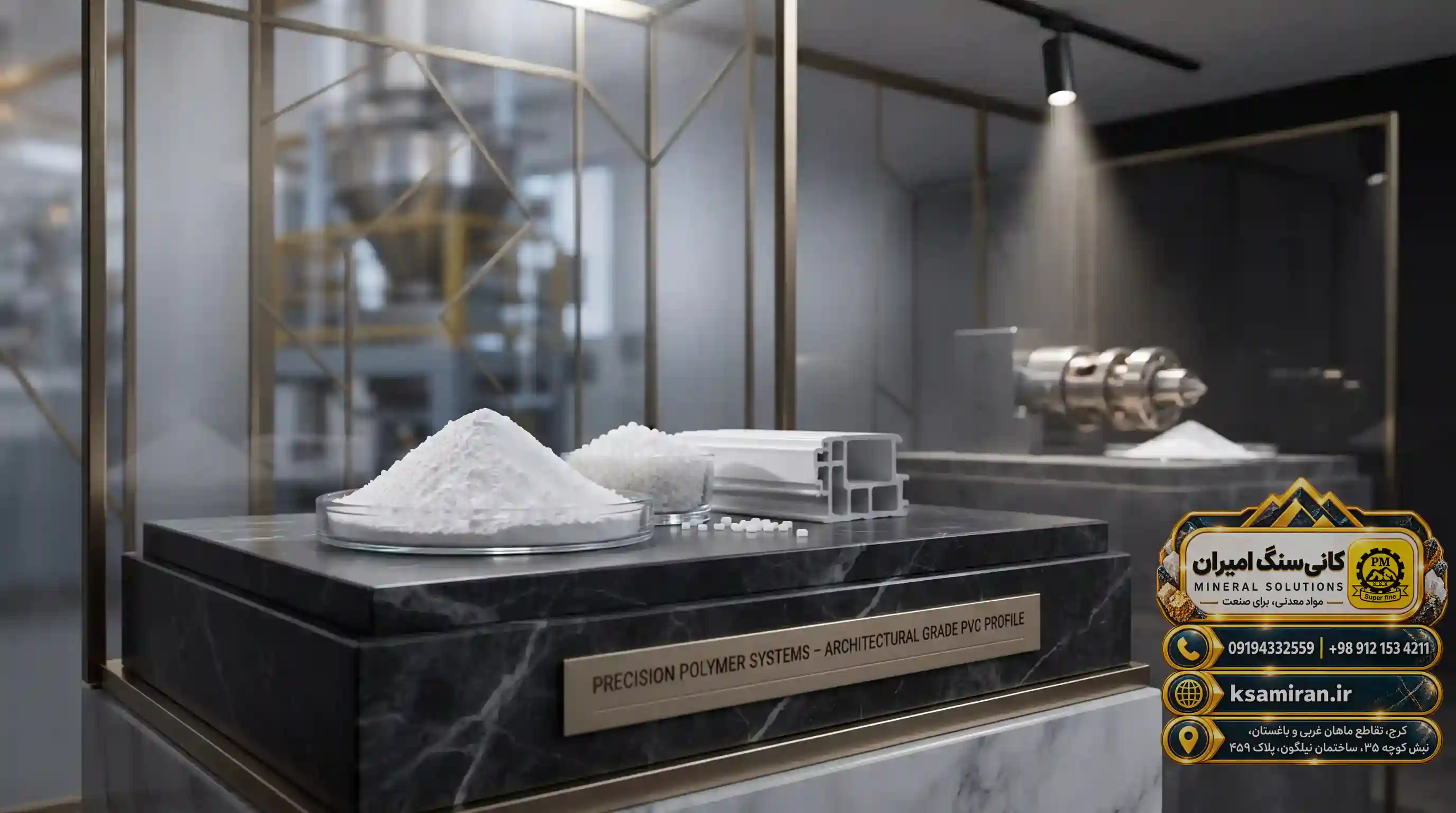
Mechanism of the Impact of Coated Calcium Carbonate on Improving Dimensional Stability of Parts
The dimensional stability of polymer parts is heavily influenced by thermal shrinkage and residual stresses during the forming process. When molten polymer cools, polymer chains tend to retu to their initial, coiled state, which causes dimensional shrinkage. Adding coated calcium carbonate to the polymer matrix acts like a rigid network and limits the excessive mobility of polymer chains; consequently, the overall shrinkage of the part is reduced significantly.
The surface coating on the particles improves the interfacial bond between the mineral filler and the polymer matrix. This optimal adhesion prevents the formation of voids or separation at the particle-polymer boundary and distributes the applied stresses uniformly throughout the part. As a result, during temperature changes or the application of mechanical loads, the polymer part maintains its geometric shape and dimensions with greater precision.
In addition, the presence of coated calcium carbonate reduces the Coefficient of Linear Thermal Expansion (CLTE) of polymer parts. This means that with changes in ambient temperature, the part expands or contracts less, which is considered a vital feature for parts with precise engineering tolerances. This thermal and dimensional stability greatly increases the efficiency of parts in sensitive applications.
PVC part, profile, and flooring manufacturers are always faced with the challenge of deformation caused by heat or mechanical stresses. Using coated calcium carbonate with the appropriate mesh in these products acts as a reliable solution, guarantees the dimensional stability of the parts, and prevents the occurrence of damage caused by deformation.
The Role of Coated Calcium Carbonate in Improving Thermal Properties and Dimensional Stability
The thermal behavior of polymer materials plays a decisive role in maintaining their dimensions during production processes and final application. To understand more deeply how coated calcium carbonate helps the thermal stability of polymers? one must pay attention to the thermal conductivity of the particles and their structural stability at high temperatures. By improving local thermal conductivity, this material helps the part cool more uniformly in the mold and prevents the creation of severe temperature gradients.
Heterogeneous temperature gradients in thick polymer parts usually cause residual stresses and, consequently, warping and deformation of the part after removal from the mold. Coated calcium carbonate, with its uniform distribution in the matrix, helps in faster and more homogeneous heat transfer, which directly improves the dimensional stability of parts during cooling stages.
Also, the thermal stability of the coated particles themselves prevents premature degradation of the polymer at high extrusion and injection temperatures. This feature ensures that the molecular structure of the polymer remains intact during the process and its mechanical and dimensional properties are maintained at the highest possible level.
Cable manufacturing and construction profile industries that are exposed to extreme temperature fluctuations benefit the most from this feature. Using coated calcium carbonate in these products guarantees dimensional stability against high heat and noticeably increases the useful life of the final product.
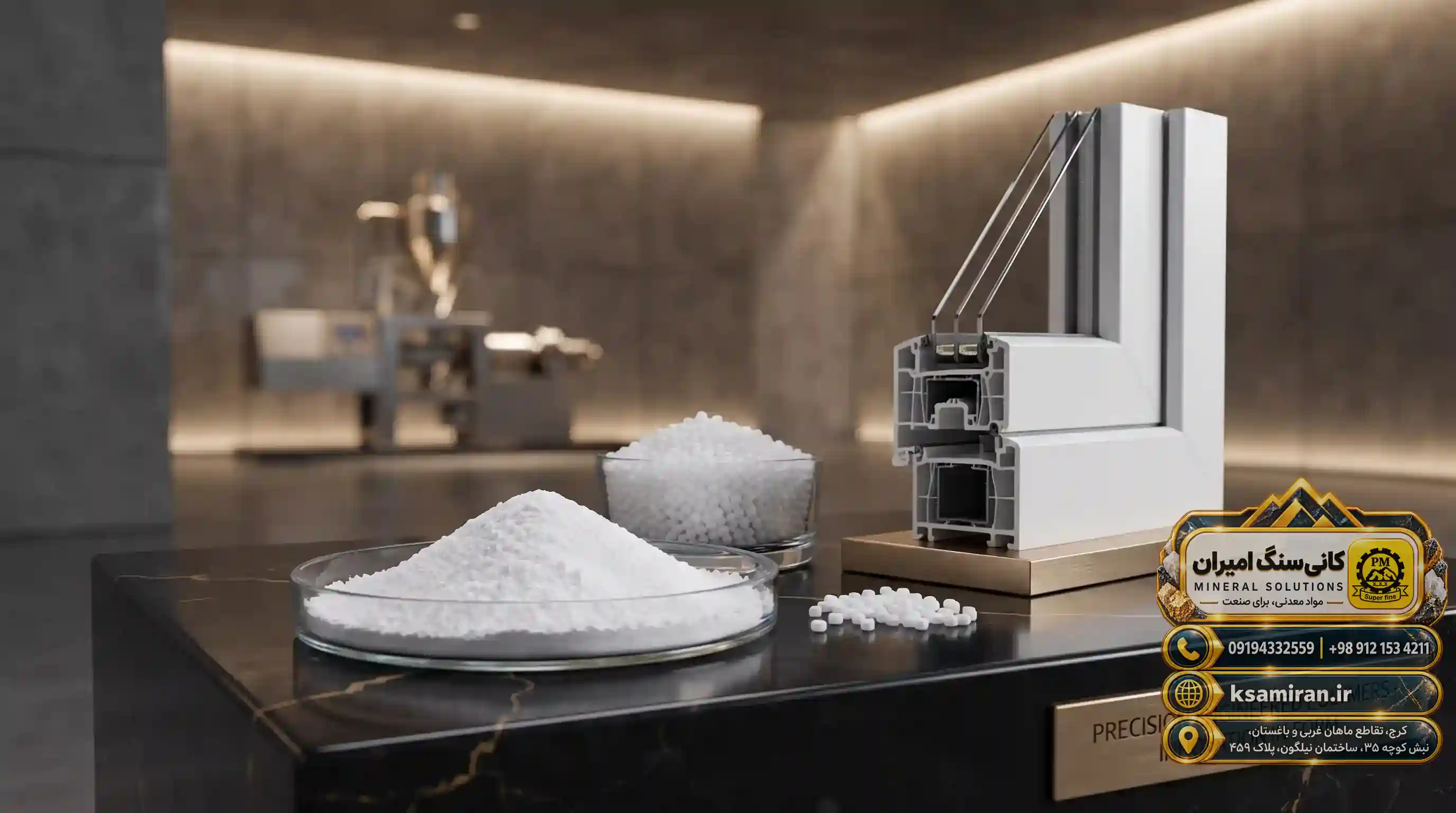
Increasing Mechanical Resistance and Dimensional Stability Using Coated Calcium Carbonate
Dimensional stability does not just mean the absence of thermal deformation, but resistance to applied mechanical forces and loads is also an important part of it. If you want to know how coated calcium carbonate increases the resistance of polymer products? you should look at the role of this filler in increasing the elastic modulus and hardness of the part. Coated calcium carbonate particles act as barriers against crack propagation and strengthen the toughness of the part.
When a polymer part is subjected to a mechanical load, the presence of particles distributed with an appropriate mesh (between 450 and 3500 mesh) causes stress transfer from the soft matrix to the rigid particles. This mechanism helps distribute stress and prevents local and permanent deformation of the part, which is essential for maintaining precise dimensions.
PVC parts and polymer flooring require high bending and tensile strength due to exposure to foot traffic and constant loads. Using coated calcium carbonate in the formulation of these products improves creep resistance. Creep means the gradual deformation of a part under a constant load over time, and inhibiting it is considered the key to long-term dimensional stability.
Kani Sang Amiran project, by supplying high-quality minerals suitable for compounding and polymer granules, helps industrial units produce parts with optimal mechanical resistance and reliable dimensional stability. This leads to end-customer satisfaction and a reduction in product retu rates.
Specialized Applications of Coated Calcium Carbonate in Compounding, Granule, and PVC Part Industries
Due to its unique features, coated calcium carbonate has found a special place in various polymer industries. In the production of polymer compounds and granules, the selection of the appropriate mesh (450 to 3500 mesh) is done based on the base polymer type and the final application. As a multi-purpose filler, this material, in addition to reducing production costs, improves the process and dimensional properties of the product.
In the door and window profile and PVC pipe manufacturing industry, maintaining precise dimensions over time and in various weather conditions is vital. By reducing linear shrinkage and increasing the rigidity of the part, coated calcium carbonate prevents the warping of profiles and keeps their dimensions within standard tolerances. This dimensional stability is necessary for the flawless assembly of parts.
Power and telecommunication cable manufacturing industries are also other major consumers of this material. In cable sheathing, flexibility along with maintaining the cross-sectional dimensions of the cable is highly important. Using coated calcium carbonate helps with better extrudability and uniformity of cable insulation thickness and guarantees the dimensional stability of the part during the production and curing process.
Also, in the production of polymer flooring, resistance to abrasion and dimensional deformation under foot or equipment is important. Granules containing this mineral create floorings with excellent flatness and optimal dimensional stability that do not deform or develop gaps in the seams due to ambient temperature changes.

Engineering Tips on Choosing Mesh and Processing Parts Containing Coated Calcium Carbonate
Choosing the appropriate mesh size is one of the most vital steps in designing a polymer formulation. The 450 to 3500 mesh range allows for product customization based on the type of extrusion and injection equipment. Finer particles (high meshes) are usually used for films and thin parts with polished surfaces, while lower meshes are used for compounds and thicker parts.
Particle Size Distribution (PSD) has a direct impact on the surface quality and dimensional stability of the parts. If particle distribution is inappropriate, particle agglomeration occurs, and weak points are created in the part, leading to inhomogeneous shrinkage. Coated calcium carbonate, with precise processing, offers a homogeneous particle size distribution that helps with optimal dispersion in the polymer matrix.
Processing parameters such as extruder cylinder temperature, shear speed, and screw design of the device also affect the final quality of the part. The presence of a fatty acid coating on the particles causes a reduction in the polymer melt viscosity in the extrusion process, which leads to better flowability, complete mold filling, and consequently, higher dimensional accuracy of injection-molded and extruded parts.
Production engineers must choose the best grade of coated calcium carbonate according to the type of polymer (such as PVC, polyethylene, or polypropylene) and the available equipment. Collaboration with reputable suppliers such as the Kani Sang Amiran project ensures access to raw materials with stable technical specifications and in compliance with industrial standards.
Economic and Qualitative Advantages Resulting from Improving the Dimensional Stability of Polymer Parts
Improving the dimensional stability of polymer parts is not just a technical achievement but also brings significant economic benefits to production units. When the shrinkage and deformation rate of parts are reduced, production waste is minimized, and production line efficiency increases. This directly reduces the final production costs and increases factory profitability.
Using coated calcium carbonate as an engineered filler allows for the replacement of a portion of expensive polymer resins without a loss in functional quality. This reduction in resin consumption, combined with improved dimensional stability, brings a product with high added value and competitive price to the market, which leads to customer satisfaction.
Integrated appearance and dimensional quality in produced parts increase the manufacturer's brand credibility. Industrial and end-customers are looking for parts that do not encounter problems during assembly and do not deform over time. Using high-quality raw materials guarantees the dimensional stability of parts and wins market trust.
Finally, the Kani Sang Amiran project, by providing standard products adapted to the needs of various industries, plays a key role in improving the quality of Iranian polymer products. Correct utilization of coated calcium carbonate in compounds and polymer parts is a sure way to achieve the highest quality and dimensional standards in the plastics industry.
| Question | Answer |
|---|---|
| What is coated calcium carbonate? | It is a type of calcium carbonate powder whose surface is covered with organic materials such as stearic acid to have better compatibility with polymers. |
| What is the mesh range of coated calcium carbonate? | This product is produced and supplied in the range of 450 to 3500 mesh. |
| What are the main applications of this material? | It is widely used in compounding, polymer granules, profiles, cables, flooring, and PVC parts. |
| How does it help the dimensional stability of parts? | By reducing thermal shrinkage, controlling residual stresses, and improving the interfacial bond with the polymer matrix. |
| What is the role of the stearic acid coating? | It causes an increase in hydrophobicity, better particle distribution, and reduction of polymer melt viscosity. |
| How to choose the appropriate mesh? | It is selected based on the type of base polymer, part thickness, and processing equipment (such as an extruder or injection machine). |
| Does this material affect the thermal properties of the polymer? | Yes, it helps with thermal stability by improving local thermal conductivity and reducing the Coefficient of Linear Thermal Expansion. |
| Which industries have the highest consumption? | PVC pipe and profile industries, cable manufacturers, polymer flooring, and compounding units. |
| How does it prevent the warping of parts? | By preventing severe temperature gradients and limiting the excessive mobility of polymer chains during cooling. |
| Which group is the main supplier of this product? | The Kani Sang Amiran project is a producer of various minerals and specialized powders. |
Specialized reference for minerals and polymer compounds - Kani Sang Amiran Project
برچسب: Coated Calcium Carbonate,The Impact of Coated Calcium Carbonate on Improving Dimensional Stability of Parts,
نویسنده: رساوب آفرین