
درباره سایت
آخرین مطالب
- انتخاب اکسید آهن قرمز (اخرا) برای بهبود کیفیت پیگمنت و پوششهای رنگی
- تامین کربنات کلسیم با دانهبندی دقیق جهت استفاده در مستربچ
- تأمین تخصصی سیلیس برای مصالح ساختمانی، شیشه و صنایع سرامیک
- ویژگیهای فنی بنتونیت کانی سنگ امیران برای کاربردهای خاص
- فلدسپات کانی سنگ امیران برای شیشه کاشی و سرامیک
- کاربرد تالک سفید درجه یک در فرمولاسیون پیشرفته رنگ و محصولات کاغذی
- اکسید آهن قرمز (اخرا) کاربردی جهت تولید محصولات سرامیکی و پوشش
- مشخصات فنی اکسید آهن قرمز (اخرا) مناسب برای پوشش و تولید پیگمنت
- مشاوره تخصصی خرید کربنات کلسیم بر اساس نیاز دقیق صنعت شما
- انتخاب تالک سفید صنعتی مناسب برای تولیدات کاغذ و مستربچ
امکانات وب
Introduction to the Importance of Industrial Talc in Mode Industries
Today's industries are constantly looking for efficient and high-quality minerals to improve the quality of their final products. In this regard, industrial talc is recognized as one of the most widely used fillers and additives that has gained a special position in manufacturing processes. With its unique physical and chemical properties, this mineral plays a significant role in improving the mechanical, thermal, and aesthetic properties of products. Understanding the diverse applications of this material can help manufacturers significantly increase the productivity of their production lines.
The structural properties of talc make it an ideal filler in various industries. From improving dimensional stability to increasing resistance to heat and abrasion, this mineral has set new standards in the industry. This is why a closer examination of its role and application in various economic sectors is of great importance.
To lea more about the technical details and how to purchase this high-quality product, you can visit the industrial talc page on the Kani Sang Amiran website and obtain complete information.
Also, for a better understanding of the impact of these materials on optimizing manufacturing processes, reading the article The Key Role of Industrial Talc in Improving the Quality of Manufactured Products is recommended, as it examines the various dimensions of this subject in detail.
Mineral producers always strive to provide a product that meets the current needs of the industry through precise processing. This has led to the use of this mineral becoming more widespread every day, allowing industries related to polymers, paints, and rubber to experience higher productivity.
The Role of Industrial Talc in the Polymer and Plastic Industry
The polymer and plastic industry is one of the main consumers of industrial talc. Adding this mineral to polymer compounds improves mechanical properties such as flexural modulus, hardness, and dimensional stability of manufactured parts. The 450 to 1000 mesh range of this product allows for its uniform distribution in the polymer matrix, which directly affects the surface quality of the final part.
In addition to improving mechanical properties, the use of talc in plastics helps significantly reduce the shrinkage rate of injection-molded parts. This feature is particularly vital in the production of automotive parts and household appliance housings that require high dimensional precision. Also, the presence of this material can help reduce the final cost of production without sacrificing quality.
In comparison to other minerals used in construction and engineering industries, examining other applications simultaneously, such as the role of kaolin in the pipe-making and concrete product industry, provides a more comprehensive view for engineers and industrial designers when choosing appropriate mineral fillers.
Adhering to production standards in preparing this mineral ensures that particles enter extrusion and plastic injection lines with minimal impurities, which prevents processing problems and the degradation of the product's final properties.
Overall, utilizing this mineral powder in polymer industries is an engineering solution for enhancing the performance of parts in harsh working and thermal conditions.
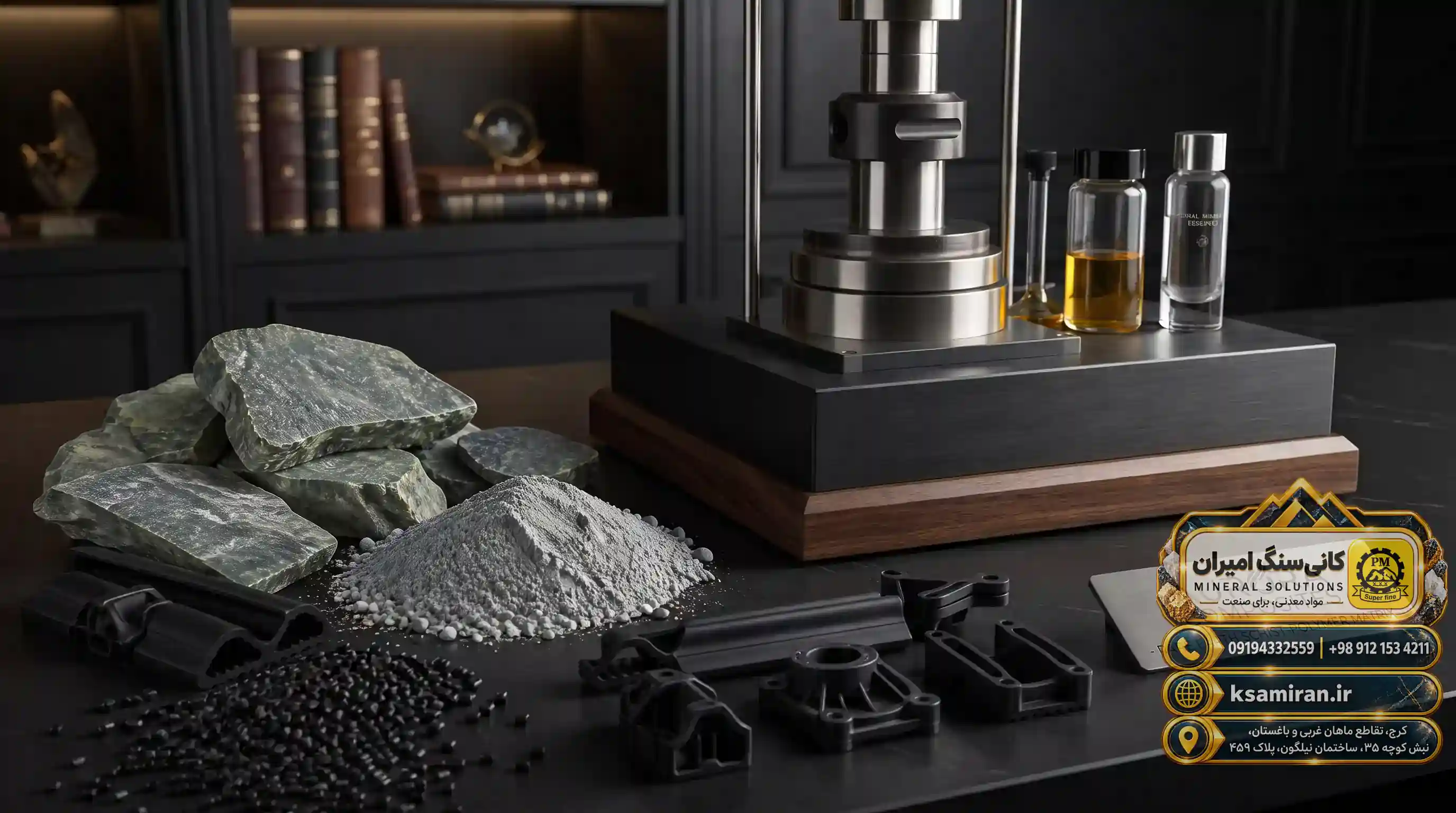
Application of Industrial Talc in the Rubber Industry
The rubber industry requires compounds that can increase flexibility, wear resistance, and the longevity of products. Industrial talc, due to its flaky structure and inherent softness, is used as a filler and curing process improver in rubber compounds. This material helps reduce the stickiness of raw rubber compounds and facilitates the calendering and extrusion process.
Using the appropriate mesh range (450 to 1000) in rubber products improves tensile strength and reduces the permeability of gases in tires and various types of gaskets and profiles. The homogeneous distribution of particles in the rubber structure covers structural weaknesses and increases product durability against environmental factors and mechanical stresses.
The Kani Sang Amiran project, by supplying high-quality minerals, enables rubber manufacturers to implement more optimized formulations. Precise knowledge of the physical and chemical properties of this material enables rubber engineers to bring products with high standards and stable performance to the market.
The intelligent application of this mineral in rubber manufacturing not only improves the dynamic properties of the product but also plays an effective role in optimizing production costs and managing the consumption of raw materials.
The Role of Industrial Talc in the Paint and Industrial Coatings Industry
In the paint industry, industrial talc is recognized as a key filler and reinforcing pigment. The layered structure of the particles in this material helps improve paint adhesion, increase opacity, and improve resistance to moisture and corrosion. The flaky-shaped talc particles create a parallel structure when the paint dries, which prevents the penetration of water and oxygen to the underlying layers.
Furthermore, using this mineral powder in paint formulations helps significantly in controlling gloss, improving sandability, and paint shelf stability. The 450 to 1000 mesh range ensures that particles are well-dispersed in solvents and resins, preventing flaking or hard settling.
The paint and coating industry requires raw materials that have high quality stability. The Kani Sang Amiran project, by continuously supplying this high-quality mineral, covers the needs of paint factories in the best way so that the produced paints remain stable against various weather conditions.
Alongside the paint and polymer industries, optimizing resources and mineral materials in other sectors is also important; for instance, reading about the role of bentonite in water and industrial wastewater treatment shows how various minerals can solve major industrial challenges.
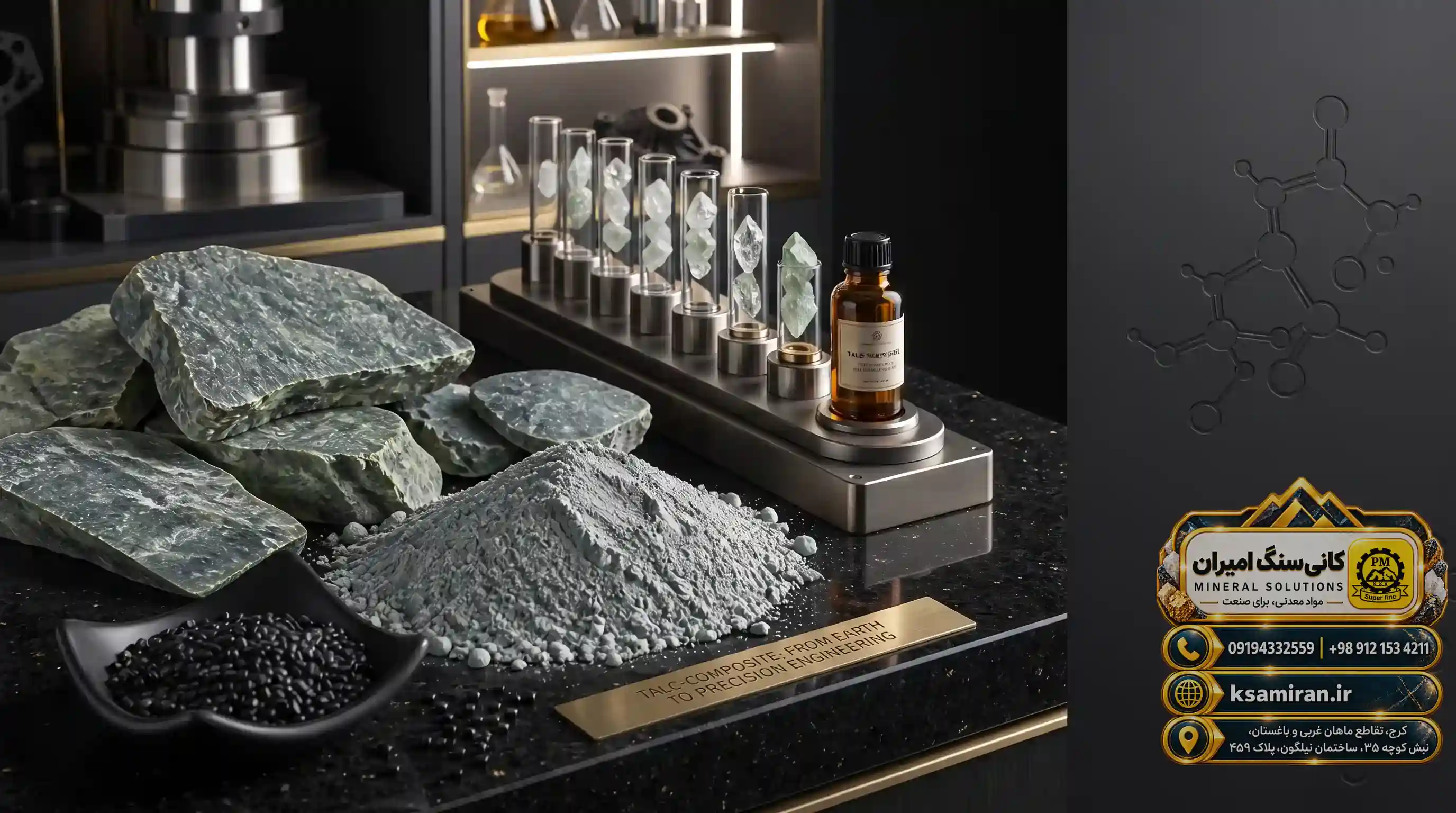
Technical Features and Physical Specifications of Industrial Talc
Precise knowledge of the technical and physical specifications of industrial talc before purchasing and using it in production lines is essential. This mineral is considered one of the softest minerals in terms of hardness (grade 1 on the Mohs scale), a distinct feature that causes minimal wear on milling equipment, extruders, and injection molds.
The mesh range offered for this product, namely 450 to 1000 mesh, indicates precise and controlled particle dimensions. The particle size distribution (PSD) has a direct impact on the final properties of products in which this powder is used. Chemical purity, appropriate whiteness, and the absence of abrasive impurities are other key parameters for evaluating the quality of this material.
Industrial manufacturers should note that the selection of the appropriate mesh depends entirely on the type of final application. For example, in the paint and thin coating industries, finer meshes are preferred, while in some polymer products, different ranges of this spectrum may be used.
The Kani Sang Amiran project, by utilizing standard processing equipment, provides manufacturers with a product with uniform and reliable technical specifications so they do not face any quality challenges in sensitive production processes.
Economic Benefits and Cost Optimization with Industrial Talc
In addition to technical and engineering benefits, the use of industrial talc brings high economic justification for manufacturing units. As an affordable mineral filler, this material can replace a significant portion of expensive resins and polymers without creating a noticeable drop in the final product quality.
Reducing the consumption of expensive base materials, improving production process speed, and reducing waste caused by quality degradation are factors that contribute to higher factory profitability. Optimal management of the raw material supply chain and precise selection of the appropriate mesh (450 1000) plays a direct role in reducing operational costs.
Polymer, rubber, and paint industries are always looking for solutions to be more competitive in the market. Using minerals processed by the Kani Sang Amiran project provides this competitive advantage to manufacturers through quality stability and reasonable prices.
Therefore, investing in the supply of standard mineral materials is not only a technical choice for improving product quality but also considered a smart strategy for managing costs and increasing the overall productivity of the production complex.
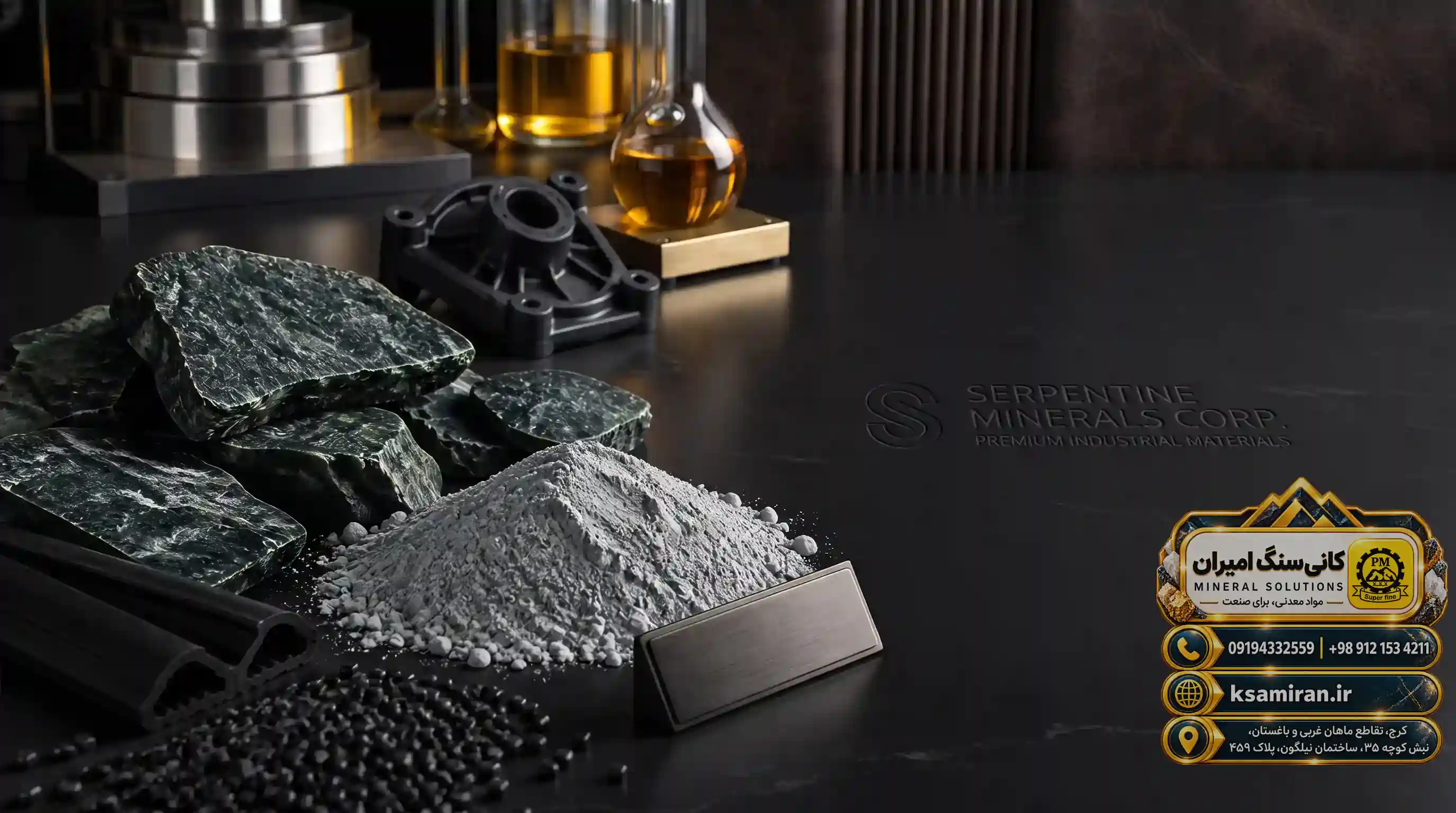
Important Tips for Selecting and Storing Industrial Talc
Proper maintenance and storage of industrial talc play an important role in preserving its quality and effectiveness on production lines. Given that this material is supplied as a micronized powder, it should be kept in a dry, covered environment away from direct moisture to prevent particle clumping.
When selecting this material for specific applications in polymer, rubber, or paint industries, carefully reviewing the Technical Data Sheet (TDS) is very important. The suitability of the mesh range (450 to 1000) with the type of injection or mixing equipment ensures uniform and trouble-free distribution of the powder in the raw material matrix.
Observing safety tips when working with micronized powders is another point that must be considered in workshop environments. The use of appropriate personal protective equipment by operators prevents respiratory problems caused by inhaling dust.
The Kani Sang Amiran project, by providing standard and durable packaging, has ensured that the product reaches consumers without quality loss and that its storage in factories is done with the least conce.
Future Outlook for Industrial Talc Consumption
With the increasing development of manufacturing technologies and the necessity of producing lighter, more durable, and more environmentally friendly products, the demand for high-quality minerals such as industrial talc is on the rise. The automotive, packaging, construction, and paint industries are constantly looking for raw materials that improve part efficiency.
Advancements in mineral processing technologies have made it possible to control the purity and accuracy of particle dimensions in various mesh ranges (450 to 1000) with higher precision. This trend allows design engineers to develop more advanced formulations for next-generation products.
The Kani Sang Amiran project, in line with mode industry needs, strives to play a significant role in improving the quality of the country's production chain by providing sustainable supply and offering standard mineral products. The future of the polymer, rubber, and paint industry is unimaginable without the presence of these efficient fillers.
Ultimately, the smart choice of mineral raw materials will be the key to the success of manufacturers in tomorrow's competitive markets, and the use of high-quality talc will further consolidate its position as a sustainable solution.

| Question | Answer |
|---|---|
| What is industrial talc? | It is a flaky and powdered mineral that is used as a filler in the polymer, rubber, and paint industries. |
| What is the mesh range of Amiran industrial talc? | This product is offered in the 450 to 1000 mesh range. |
| What are the main applications of industrial talc? | Polymer products, rubber products, paint, and various industrial products. |
| Why is talc added to plastic? | To improve mechanical properties, dimensional stability, and reduce part shrinkage. |
| What is the role of talc in the rubber industry? | Improving flexibility, wear resistance, and facilitating the curing process. |
| What is the effect of talc in paint manufacturing? | Increasing opacity, improving adhesion, and resistance to moisture and corrosion. |
| What is the hardness level of talc? | It has a hardness level of 1 on the Mohs scale and is very soft. |
| How can industrial talc be ordered? | Through the dedicated product page on the Kani Sang Amiran website. |
| What are the storage conditions for industrial talc? | It must be kept in a dry, covered environment away from moisture. |
| Is the use of talc economically justified? | Yes, it helps reduce the consumption of expensive materials and optimizes production costs. |
Kani Sang Amiran Project — Mineral production and supplier of various industrial talcs.

برچسب: Industrial Talc,The Important Role of Industrial Talc in the Plastic and Polymer Industry,
نویسنده: رساوب آفرین