
درباره سایت
آخرین مطالب
- انتخاب اکسید آهن قرمز (اخرا) برای بهبود کیفیت پیگمنت و پوششهای رنگی
- تامین کربنات کلسیم با دانهبندی دقیق جهت استفاده در مستربچ
- تأمین تخصصی سیلیس برای مصالح ساختمانی، شیشه و صنایع سرامیک
- ویژگیهای فنی بنتونیت کانی سنگ امیران برای کاربردهای خاص
- فلدسپات کانی سنگ امیران برای شیشه کاشی و سرامیک
- کاربرد تالک سفید درجه یک در فرمولاسیون پیشرفته رنگ و محصولات کاغذی
- اکسید آهن قرمز (اخرا) کاربردی جهت تولید محصولات سرامیکی و پوشش
- مشخصات فنی اکسید آهن قرمز (اخرا) مناسب برای پوشش و تولید پیگمنت
- مشاوره تخصصی خرید کربنات کلسیم بر اساس نیاز دقیق صنعت شما
- انتخاب تالک سفید صنعتی مناسب برای تولیدات کاغذ و مستربچ
امکانات وب
Introduction to the Application of White Talc in Mode Industries
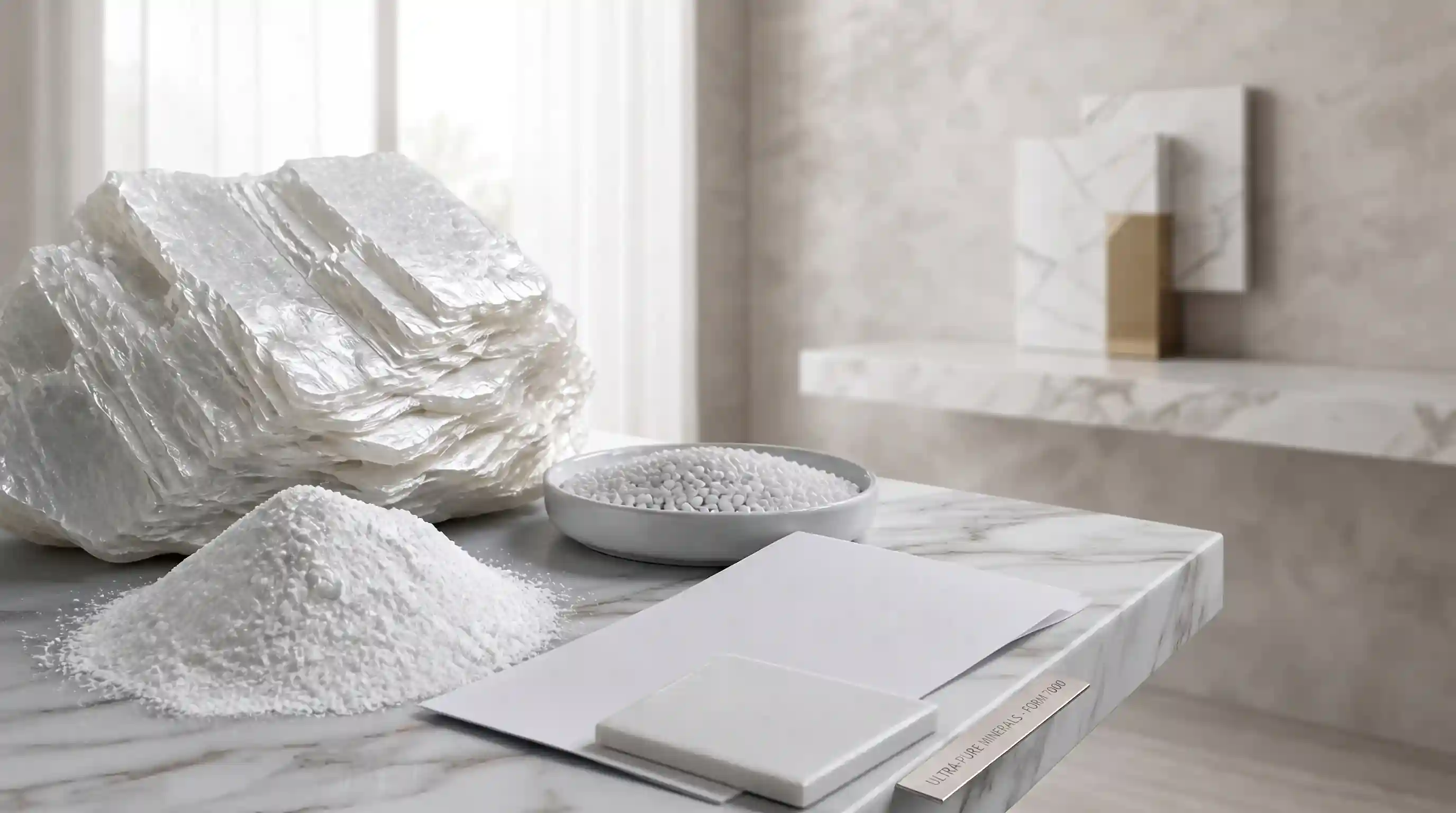
Minerals play a vital and decisive role in advancing various industries, and among them, white talc is recognized as one of the most practical and valuable mineral powders. With its unique physical and chemical characteristics, this mineral has found a special place in manufacturing processes. Kani Sang Amiran Mineral Project, as one of the leading mineral producers, supplies this valuable powder with appropriate quality standards.
A precise understanding of the properties and application methods of this mineral helps engineers and manufacturers significantly increase the productivity of their production lines. In mode industries, choosing high-quality raw materials directly affects the quality of the final product, and using this micronized powder can improve the mechanical, visual, and economic properties of products. To lea more about the specifications and ordering of this product, you can visit the white talc page and obtain complete information.
In addition to the plastics industry, proper raw material management requires compliance with warehousing and logistics principles, which bear a strong resemblance to the storage principles of other industrial powders. For instance, studying the comprehensive guide to warehousing and storage of industrial white barite powder can provide you with a comprehensive perspective on optimal warehousing methods for similar minerals to prevent any drop in material quality.
Specialized Review of Meshing and Technical Specifications of White Talc
One of the most important factors in selecting and purchasing powdered minerals is their granulation and meshing rate. White talc is produced and supplied in a mesh range from 450 to 2500 mesh, and this wide spectrum makes it possible to use it in various industries with different requirements. High-mesh micronized powders feature very fine particles that greatly help improve homogeneity and dispersion within the material matrix.
A correct understanding of the concept of granulation and its impact on the final product's properties is of utmost importance. As explained in the comprehensive guide to understanding granulation in industrial barite, particle size and its dimensional distribution directly affect viscosity, coverage, and mechanical properties of the product. Regarding this mineral powder as well, precise meshing between 450 and 2500 mesh guarantees optimal performance in industries such as paint manufacturing, masterbatch production, and compounding.
Choosing the appropriate mesh entirely depends on the type of final application; for example, in the paint and coating industry, much finer meshes might be required to create a completely smooth and uniform surface, whereas in certain plastic compounds, a different mesh range provides the desired efficiency.

The Key Role of White Talc in the Masterbatch and Compounding Industry
The polymer and plastics industry is constantly seeking efficient mineral additives to improve physical properties and reduce final production costs. White talc is considered one of the most widely used fillers in masterbatch and compound production. Adding this mineral powder to polymers increases flexural modulus, improves dimensional stability, and enhances thermal resistance in plastic parts.
Compared to other mineral fillers, this material can impart specific mechanical properties to plastic components due to its sheet-like structure. Of course, polymer engineers frequently use a combination of different materials based on their project requirements. For example, examining the application of coated calcium carbonate in the plastics industry demonstrates how precise additive selection can optimize features such as impact resistance and surface quality in plastic products.
Using the 450 to 2500 mesh range in masterbatch and compounds ensures that particles are distributed completely uniformly within the polymer matrix, preventing the formation of weak points or particle agglomeration, which directly elevates the quality of the final injected or extruded product.
Application of White Talc in the Paint and Industrial Coatings Industry
The paint manufacturing industry constantly requires pigments and fillers that, in addition to creating proper coverage, ensure the durability and stability of the paint film against atmospheric factors. White talc, as a high-quality mineral filler, plays a crucial role in the formulation of various architectural and industrial paints. Due to its favorable rheological property, this material helps adjust viscosity and improves the flow behavior of paint.
Besides improving flow properties, utilizing this micronized powder in paints increases durability, enhances resistance against peeling, and improves the anti-corrosion properties of the paint film. The sheet-like structure of the particles helps create a physical barrier against moisture and oxygen penetration to the substrate surface, which dramatically increases the lifespan of the coating.
Paint manufacturers can achieve various levels of gloss or matte finishes by utilizing different mesh sizes of this mineral powder. This high flexibility provides an extraordinary product for formulators in the paint industry, allowing them to meet their customers' desired quality standards in the best possible way.

Application of White Talc in the Paper-Making Industry
The paper-making industry is one of the traditional yet advanced consumer sectors of minerals, where filler quality is of utmost importance. White talc is used as an excellent filler and coating agent in the paper manufacturing process. This material significantly helps improve the whiteness, opacity, and surface smoothness of paper, while markedly upgrading printability quality.
One of the major challenges in paper-making is proper ink absorption and reducing its penetration to the back of the page; this mineral resolves this issue effectively by filling the empty pores among cellulosic fibers. Furthermore, utilizing this powder in paper pulp reduces the consumption of expensive wood fibers, offering very high economic justification for paper mills.
Given the proper dimensional distribution of particles within the standard mesh range, this material easily stabilizes within the paper fiber network and creates no issues during the dewatering and drying stages of the production line, which improves the overall productivity of the paper-making process.
The Role of White Talc in the Ceramic and Ceramic Products Industry
Ceramic manufacturing industries always require raw materials that can maintain their stability at high temperatures and improve the mechanical and visual properties of the body or glaze. White talc is considered a key component in the formulation of tile, ceramic, sanitary ware, and refractory bodies. This material acts as a weak flux and helps reduce firing temperatures and improve body compaction during ceramic firing.
Using this powder in ceramic bodies reduces the coefficient of thermal expansion, resulting in greater product resistance against thermal shocks and cracking. Also, in ceramic glazes, the presence of this material can help adjust the viscosity of the molten glaze and create a smooth, uniform, and flawless surface.
Precise control of impurities during the production process of this powder by Kani Sang Amiran Mineral Project guarantees that the final product will not change color after firing in the kiln and will maintain the desired whiteness and purity.

Economic and Technical Advantages of Using White Talc Produced by Kani Sang Amiran
Choosing the right mineral supplier has a direct impact on the continuity of production and industrial profitability. Utilizing rich mines and advanced processing technologies, Kani Sang Amiran Mineral Project releases white talc to the market with stable quality and standard technical specifications. This quality consistency allows consumer industries to manage their formulations without conce for unwanted raw material changes.
From a technical standpoint, high purity, uniform mesh distribution within the 450 to 2500 mesh range, and the absence of harmful impurities such as free iron or chromium stand out as prominent competitive advantages of this product. These features allow the powder to disperse effectively within polymers, paints, and other matrices, exhibiting the highest efficiency.
From an economic perspective, using high-quality domestic raw materials reduces import dependence, lowers production costs for manufacturers, and significantly increases their competitive edge in domestic and foreign markets.
Safety Guidelines, Packaging, and Storage of White Talc in Industrial Units
Proper and safe management of powdered minerals in workshop and industrial environments is of special importance. When working with white talc, observing personal safety principles and appropriate ventilation equipment is essential to prevent inhaling fine powder particles. The use of standard respiratory masks and safety goggles is recommended for production line operators.
The packaging type of this product must be designed to protect against moisture penetration and physical damage during transportation and warehousing. Storing the powder in indoor, dry warehouses away from direct moisture sources guarantees the preservation of the product's initial quality until the time of use on the production line.
By following these simple yet vital tips, industrial units can safeguard human health, prevent material waste, and achieve the highest productivity from this valuable mineral in masterbatch, compounding, paint, paper, and ceramic industries.
| Question | Answer |
|---|---|
| What is white talc and what are its applications? | This material is a micronized mineral powder widely used in masterbatch, compounding, paint, paper, and ceramic industries. |
| What is the mesh range of Kani Sang Amiran's white talc? | This product is produced and supplied in a mesh range of 450 to 2500 mesh. |
| Is this powder used in the plastics and masterbatch industry? | Yes, it is used as an excellent filler to improve flexural modulus, dimensional stability, and thermal resistance in compounds. |
| What is the role of white talc in the paint manufacturing industry? | It helps adjust viscosity, improve paint flow behavior, increase coverage, and enhance paint film durability. |
| How can this product be purchased? | For more information and to place an order, you can visit the product page on the Kani Sang Amiran website. |
| What is the application of white talc in the paper industry? | It improves whiteness, opacity, surface smoothness, and the printability quality of paper. |
| What is the advantage of using talc in the ceramic industry? | It lowers the firing temperature, improves body density, and increases resistance against thermal shocks. |
| Why is the purity of talc powder important? | High purity and the absence of impurities prevent final product discoloration in sensitive industries such as paint and ceramics. |
| What are the storage conditions for this powder in the warehouse? | It must be stored in a dry, indoor environment away from direct moisture. |
| Does working with this powder require safety precautions? | Yes, during unloading and use, it is recommended to use respiratory masks and proper ventilation. |
Kani Sang Amiran Project — Mineral and Industrial Production (ksamiran.ir)

برچسب: White Talc,Comprehensive Guide to the Application of White Talc in the Plastics Industry,
نویسنده: رساوب آفرین