
درباره سایت
آخرین مطالب
- سیلیس کانی سنگ امیران مناسب شیشه و سرامیک با دانهبندی ۱۰ تا ۴۵۰
- سفارش سیلیس کانی سنگ امیران در شیشه و سرامیک در مش ۱۰ تا ۴۵۰
- کائولن باکیفیت کانی سنگ امیران برای صنایع سرامیک مش 450 تا 1500
- سیلیس پروژه کانی سنگ امیران برای صنایع شیشه در مش ۱۰ تا ۴۵۰
- اکسید لیمونیت (گل ماش) دقت فنی در تولید پودر صنعتی شما
- خرید سیلیس کانی سنگ امیران مناسب صنعت شیشه دانهبندی ۱۰ تا ۴۵۰ مش
- سفارش کربنات کلسیم ۱۲۵۰ مش با دانهبندی دقیق برای کابل
- فلدسپات باکیفیت کانی سنگ امیران برای محصولات سرامیکی
- تالک صنعتی برای شراکت در فرمولاسیون
- استعلام قیمت کائولن کانی سنگ امیران کاغذسازی با مش 450 تا 1500
امکانات وب
An Introduction to Dolomite and the Importance of Its Purity in Construction Engineering
Dolomite, as a double carbonate of calcium and magnesium, holds a special place in various industries, particularly in construction and the production of building materials. A precise understanding of this mineral and an examination of its physical and chemical properties enable designers and engineers to make more optimal choices in construction processes. Given the importance of raw material quality, the examination of high-quality and pure Dolomite is raised as an industrial necessity that directly impacts the durability and stability of structures.
In this article, we examine the various dimensions of how the purity of this mineral affects the quality of final products. Since the mechanical and chemical properties of materials are strongly influenced by impurities in the raw materials, paying attention to the percentage of calcium and magnesium purity becomes doubly important. In the following discussions, we will attempt to unfold different aspects of this subject, relying on precise scientific and industrial data.
The construction industry is constantly looking for raw materials that, in addition to being cost-effective, meet the necessary quality standards. Becoming familiar with the nature of this mineral compound helps us have a better understanding of the production cycle of mode materials and enables us to evaluate the role of each component in the final product.
Mineral producers always strive to supply products with minimal impurities to the market. This is of critical importance, especially in applications that are highly sensitive to chemical changes. We will discuss these details further in the coming chapters.
The Fundamental Role of Dolomite in the Production of Mode Building Materials
Mode building materials require compounds that guarantee dimensional stability and resistance to environmental stress. In this context, what is the important application of dolomite in the construction and manufacturing industries is a topic that engineers and those involved in the construction industry pay special attention to. This material acts as a filler or additive, strengthening the overall structure of the products.
Using appropriate granulation in the 10 to 40 mesh range in the production of building materials helps to maintain the integrity of the final product's texture in a desirable maer. The presence of calcium and magnesium in the structure of this mineral significantly helps improve the thermal and acoustic properties of the materials and increases their efficiency in civil projects.
On the other hand, a more detailed look at industrial applications shows that the correct selection of raw materials plays a direct role in reducing maintenance costs and increasing the lifespan of structures. For this reason, civil engineers always monitor the quality of the minerals used to prevent future structural defects.
Sustainable development in the construction industry is not possible without relying on high-quality mineral resources. Utilizing suitable minerals such as this one, while maintaining environmental standards, helps promote the overall quality of the construction industry.

The Impact of Chemical Purity on the Mechanical and Physical Properties of Final Products
Mineral purity is one of the key parameters in determining the final quality of products. The presence of impurities such as free silica or unwanted iron oxides in this material can lead to a degradation of the mechanical properties of building materials, ceramic products, and the glass industry. Therefore, strict quality control during the extraction and processing stages is of high importance.
When talking about the 10 to 40 mesh range, particle size distribution and uniformity play an important role in the reactivity and physical behavior of the product. Impure particles may create weak points in the structure that are more vulnerable to pressure or temperature changes. Therefore, improving chemical purity directly leads to increased compressive and tensile strength.
Laboratory tests show that products manufactured with higher-quality minerals exhibit more stable behavior against weather and chemical factors. This stability means a reduction in the need for frequent repairs and an increase in the overall productivity of the project.
Manufacturers use advanced separation and granulation equipment to ensure a homogeneous product free of interfering materials reaches consumers, which in tu creates high added value for the supply chain.
Application of Dolomite in the Glass and Ceramic Industries with a Look at Purity Standards
The glass and ceramic industries are major consumers of minerals that are heavily dependent on the chemical composition and purity of raw materials. In glass production, the magnesium in the structure of this compound helps reduce the melting temperature and improve the chemical stability of the product. Also, in the ceramic industry, this material plays an important role as a flux or a firing temperature reducer.
Adherence to purity standards prevents the creation of unwanted colors or bubbles in the glass structure and ceramic body. Therefore, mineral suppliers must exercise sufficient care in product processing to ensure that the technical specifications required by these industries are fully met.
In addition to glass and ceramics, a simultaneous study of the effects of other minerals such as the key role of industrial talc in improving the quality of manufactured products provides a more comprehensive view of improving production processes. The smart combination of these materials significantly helps in optimizing industrial formulations.
Therefore, attention to chemical purity is not only a competitive advantage but also a technical necessity for achieving final products that are high-quality, transparent, and resistant to thermal and mechanical stress.

Economic Optimization and the Impact of Purity on Industrial Production Costs
Cost management in the mining and manufacturing industries has always been a primary conce for managers. Using high-quality minerals may seem expensive at first glance, but in the long run, it leads to a significant reduction in production costs and waste. To better understand this, studying the article on the impact of dolomite on reducing production costs in the mining industry will be helpful.
When raw materials have high purity, the efficiency of fuaces in the glass and ceramic industries increases, and less energy is consumed for thermal processes. This directly leads to lower fuel and energy costs and increases the overall productivity of the production line.
Reducing the amount of waste and final product failure are other economic benefits of using pure materials. When the structure of raw materials is uniform and predictable, human and technical errors in the production process are minimized.
Ultimately, optimizing the supply chain from the mine to the final product ensures the profitability of businesses and results in customer satisfaction, which strengthens business sustainability.
Technical Specifications and Granulation; The 10 to 40 Mesh Range and Its Impact on Performance
The physical properties of minerals are as important as their chemical characteristics. The 10 to 40 mesh range is one of the main granulation characteristics defined for various applications in building materials and ceramic products. Particle size determines the surface area, reaction speed, and rheological properties of the compound.
Particles in this size range create a good balance between filling properties and adhesive characteristics. In specific mortars and concrete, the use of precise granulation improves density and reduces the amount of air bubbles, which in tu increases mechanical strength.
Particle size control in processing lines is performed using precise screens to ensure the absence of excessively fine or coarse particles. This uniformity of granulation makes the product's behavior in industrial processes more predictable.
Production engineers, by accurately understanding the physical behavior of these granulations, can design more optimal formulations that ultimately lead to the production of products with the highest quality standards.
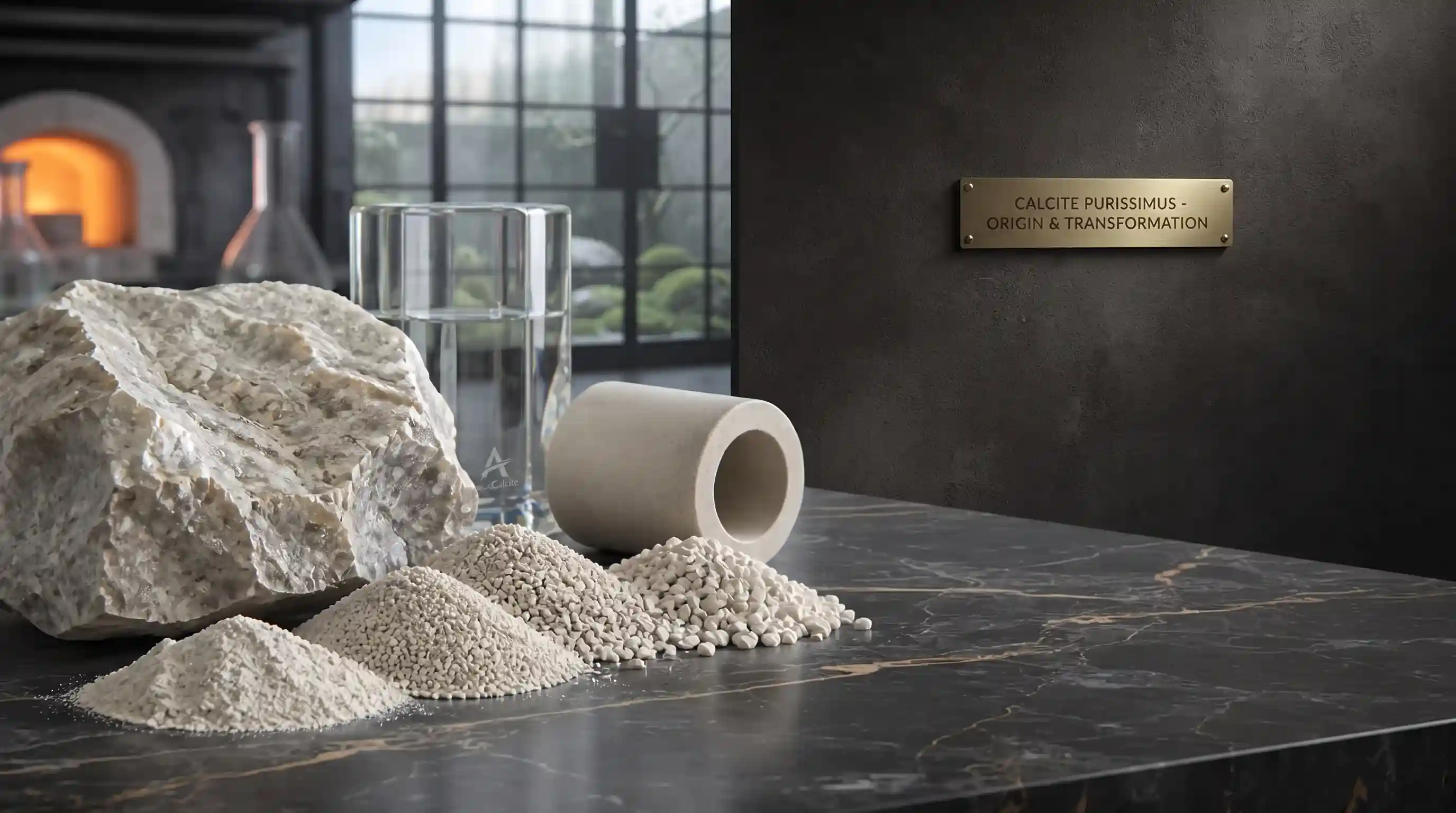
Quality Control Methods and Purity Assessment in the Supply Chain
Ensuring the quality of mineral products requires the implementation of strict quality control systems at all stages of extraction, crushing, granulation, and packaging. Mode chemical analysis methods such as X-ray fluorescence (XRF) and X-ray diffraction (XRD) allow for the precise identification of compound compositions and the percentage of material purity.
In the Kani Sang Amiran project, continuous monitoring of production lines ensures that the final product fully complies with the declared technical specifications. This includes continuous monitoring of the percentage of calcium and magnesium oxides and verification of the absence of harmful impurities.
Physical control of granulation in the 10 to 40 mesh range is also performed using standard laboratory equipment to ensure proper particle distribution. This precise monitoring eas the trust of consumer industries and guarantees the quality of their final products.
Creating transparency in the supply chain and providing valid analysis reports to customers improves industrial standards and paves the way for long-term and sustainable collaborations.
Future Outlook and the Importance of New Technologies in Mineral Processing
The mining and construction materials production industries are moving rapidly towards modeization and the use of advanced technologies. Upgrading crushing, granulation, and magnetic separation technologies has made it possible to achieve higher purity products, which has a direct impact on the final quality of construction products.
The future of this industry belongs to groups that can supply more homogeneous and higher-quality products to the market by relying on up-to-date technical knowledge and advanced equipment. Optimizing energy consumption and reducing the environmental impacts of mining are other challenges and opportunities ahead.
The Kani Sang Amiran project, by focusing on upgrading production processes, always strives to meet the needs of the glass, ceramic, and construction materials industries with the highest standards. This approach significantly helps the sustainable development of the industry.
Ultimately, investment in research and development (R&D) is the key to success in today's competitive market, and a more accurate understanding of the properties of minerals can create new iovations in related industries.

| Question | Answer |
|---|---|
| What is Dolomite? | It is a double carbonate mineral of calcium and magnesium that is used in the construction, glass, and ceramic industries. |
| What is the mesh range of this product? | This mineral is processed and supplied in the 10 to 40 mesh range. |
| What are the main applications of this material? | Glass industries, ceramic products, and building materials are its main applications. |
| Why is the purity of this material important? | Higher purity leads to improved mechanical properties, reduced melting temperature in glassmaking, and increased durability of materials. |
| What is the role of this material in the glass industry? | The magnesium it contains helps reduce the melting temperature and improves the chemical stability of the glass. |
| What is the effect of this mineral in ceramics? | It acts as a flux and a firing temperature reducer in the ceramic body. |
| How can production costs be reduced? | Using pure and high-quality raw materials increases fuace efficiency and reduces waste. |
| What is the role of the 10 to 40 mesh range? | This granulation creates a suitable balance between adhesion and filling properties in materials. |
| Where is the producer of this product? | The Kani Sang Amiran project, as a mineral producer, supplies this product. |
| How can I view the product page? | You can visit the official product page on the Kani Sang Amiran website. |
Specialized economic geology resources and industrial mineral processing standards.

برچسب: Dolomite,The Impact of Dolomite Purity on the Final Quality of Construction Products,
نویسنده: رساوب آفرین