
درباره سایت
آخرین مطالب
- Review of the Impact of Micronized Calcium Carbonate Particles in Manufacturing
- چگونه درخواست استعلام قیمت باریت سفید ثبت کنیم؟
- نقش تالک سفید در صنایع داروسازی و آرایشی بهداشتی
- Examining the Impact of Mesh Size on the Price of Industrial Calcium Carbonate
- دراسة تطبيق كربنات الكالسيوم في صناعات التعبئة والتغليف
- نقش کربنات کلسیم در صنایع تولید لولههای فشارقوی
- کاربرد تالک سفید در تولید کابلهای برق و عایقها
- Review of National and International Standards for Calcium Carbonate
- نقش بنتونیت در تثبیت بستر جادهها و راهسازی
- بررسی مزایای کاربرد کربنات کلسیم در صنایع تولیدی
امکانات وب
Introduction to Calcium Carbonate and Its Importance in Mode Industries
Calcium carbonate mineral is recognized as one of the most versatile and abundant compounds found in the Earth's crust, playing a key role in the development and advancement of various industries. Due to its unique physical and chemical characteristics, this valuable material is utilized as a filler and performance enhancer in numerous industrial products. A precise understanding of this mineral helps engineers and manufacturers elevate the quality of their final products by haessing its maximum potential. In large industrial projects, sourcing raw materials that meet specific quality standards is of utmost importance. For more information on sourcing processes, you can refer to the comprehensive guide to industrial raw material supply and calcium carbonate, which provides useful information in this regard. The application of this material in various industries depends on characteristics such as purity, particle size, and mesh range.
In polymer, paint, paper, and engineering products, choosing the appropriate type of this mineral directly impacts the final performance of the product. The Kani Sang Amiran project responds to the needs of various industries by focusing on the production and supply of this high-quality material. The variety in mesh range allows consumers to choose a product that suits their technical requirements. A detailed review of the technical specifications and industrial applications of this material provides a comprehensive perspective, which will be discussed in detail in the following sections. Using this material not only helps optimize production costs but also improves the mechanical and appearance properties of the products.
The role of calcium carbonate in the industrial economy and the mineral supply chain is very prominent. Manufacturers are constantly seeking reliable sources to supply their required raw materials with consistent quality. Understanding the characteristics of this mineral and its diverse applications in polymer and engineering industries is an effective step toward improving production processes. Later in this article, we will take a closer look at the technical specifications, mesh ranges, and specialized applications of this material across different industries to clarify the various dimensions of its usage.
Review of Technical Specifications and Mesh Range of Calcium Carbonate
One of the most important factors in choosing calcium carbonate for industrial applications is its mesh range and particle size. The mesh range of this product is between 100 and 3500 mesh, covering a wide spectrum of particle sizes from coarser meshes to very micronized powders. This variety in meshing enables the material to be used in various industries, from manufacturing polymer pipes to producing paint and paper. To lea more about how to purchase and optimally supply this product, reading the comprehensive guide to purchasing and supplying calcium carbonate minerals will be very beneficial. Choosing the appropriate mesh depends directly on the type of final application and the expected mechanical or aesthetic properties.
Particles with lower meshes are typically used as volumetric fillers in industries that do not require high micron accuracy, whereas high and micronized meshes are employed in paint making, masterbatch, and paper production. Particle size distribution plays a decisive role in the rheological behavior and viscosity of products. For instance, on the dedicated product page for calcium carbonate, you can view more details about the various meshes offered by the Kani Sang Amiran project. The precise match of the product mesh with the requirements of the production line guarantees optimal quality and efficiency.
Quality control of granulation and the uniformity of the produced powder are of high importance. Mode milling and granulation technologies help supply calcium carbonate to the market with minimal impurities and a standard particle size distribution. Industrial engineers and procurement officers can make the best decisions for their production processes by being aware of these technical specifications. In the following sections, we will examine the specific applications of this material in polymer and engineering industries.

Application of Calcium Carbonate in Polymer Industries, Profiles, and PVC/UPVC Pipes
The polymer industry, and particularly the production of PVC and UPVC profiles and pipes, is one of the largest consumers of calcium carbonate. In these applications, this material not only acts as an inexpensive filler but also improves important mechanical properties such as impact strength, rigidity, and dimensional stability. Using appropriate meshes of this material in pipe and fitting formulations significantly helps reduce thermal shrinkage and improves processability in extruders. Timely procurement of high-quality raw materials is vital for these industries, and sometimes comparing it with other minerals such as the comprehensive guide to buying high-quality bentonite in the market can also provide a better perspective on mineral suppliers.
In addition to pipes and profiles, this mineral also plays a key role in the production of polymer masterbatches. Filler and whitening masterbatches contain high amounts of micronized calcium carbonate, which are used as carriers in the plastics manufacturing industry. Homogeneous dispersion of particles within the polymer matrix is essential for achieving the best results. By increasing the modulus of elasticity, thermal stability, and improving the surface quality of polymer parts, this material brings high added value to manufacturers.
Selecting the appropriate grade of calcium carbonate for engineering and polymer products requires a precise understanding of technical parameters. By offering high-quality products within a standard mesh range, the Kani Sang Amiran project effectively covers the needs of polymer industries. Close cooperation with reputable mineral suppliers ensures production continuity and consistent quality of polymer products. Next, we will discuss the role of this material in the paint and industrial coatings industry.
The Role of Calcium Carbonate in Paint, Resin, and Adhesive Industries
The paint and surface coatings industry heavily depends on quality fillers, and calcium carbonate holds a special place in this field. Due to its high whiteness, good chemical stability, and favorable refractive index, this material is used as a reinforcing pigment and filler in the formulation of various architectural and industrial paints. Using fine and micronized meshes of this material in plastic and acrylic paints helps improve hiding power, control gloss, and increase paint durability. By providing a variety of meshes, the Kani Sang Amiran project precisely meets the formulation needs of paint manufacturers.
In the production of adhesives and sealants, this mineral also plays a vital role. Adding this powder to the adhesive formulation adjusts viscosity and strengthens the mechanical bonding properties. Additionally, this material helps reduce the final production costs of adhesives without sacrificing quality. Resistance to weather conditions and non-reactivity with other formulation components are other advantages of using this material in the adhesive and resin industry.
Paint and adhesive manufacturers require raw materials that are completely uniform in terms of purity and particle size distribution to maintain product quality. Calcium carbonate produced to strict standards helps prevent undesirable settling and improves the flow properties of the paint. A careful review of these characteristics shows why this material is considered an inseparable component of the chemical and engineering industries.

Application of Calcium Carbonate in the Papermaking Industry and Cellulose Products
The papermaking industry is one of the traditional yet advanced consumers of calcium carbonate. In the past, the paper manufacturing process was carried out in acidic environments, but with the advent of mode technologies and the use of precipitated and powdered calcium carbonate in neutral and alkaline environments, a major transformation occurred in this industry. This material is used as a filler and coating agent in the manufacturing of various types of paper, significantly helping to improve whiteness, transparency, surface smoothness, and the printability of the paper.
Using this mineral instead of a portion of expensive cellulosic fibers leads to a dramatic reduction in paper production costs without causing any noticeable drop in print quality or paper strength. The appropriate mesh range of this material allows particles to easily penetrate among the cellulose fibers, creating a uniform and dense structure. The Kani Sang Amiran project supplies the needs of this important industry by offering suitable products.
In addition to improving appearance and printability features, the presence of this material in paper helps increase durability and resistance to yellowing over time. This feature is of particular importance for the production of high-quality printing and writing paper. In the next chapter, we will cover the applications of this material in cable manufacturing, synthetic leather, and engineered stones.
Application in Cable Manufacturing, Synthetic Leather, and Engineered Stones
In addition to well-known applications in polymers, paints, and papers, calcium carbonate plays a very important role in other specialized industries such as cable manufacturing, synthetic leather, and engineered stone production. In the cable industry, this material is used as a filler in polymer cable sheathing to improve the insulation properties and thermal stability of the sheath, besides reducing the final price. Proper particle distribution in this application prevents dielectric weaknesses.
In the synthetic leather industry, adding this mineral powder to PVC or polyurethane layers helps improve the hand feel, flexibility, and abrasion resistance of the final product. Also, in the manufacture of engineered stones and artificial quartz, this material is used as the primary filler phase alongside polymer resins to create an appearance similar to natural stones with high mechanical strength. The Kani Sang Amiran project supports these industries by supplying high-quality powders in diverse mesh ranges.
These diverse applications demonstrate the high flexibility of this mineral in industrial formulations. Production engineers can precisely control the physical and mechanical properties of manufactured parts by adjusting the consumption percentage of this material. Understanding these applications greatly assists in the better utilization of mineral products.
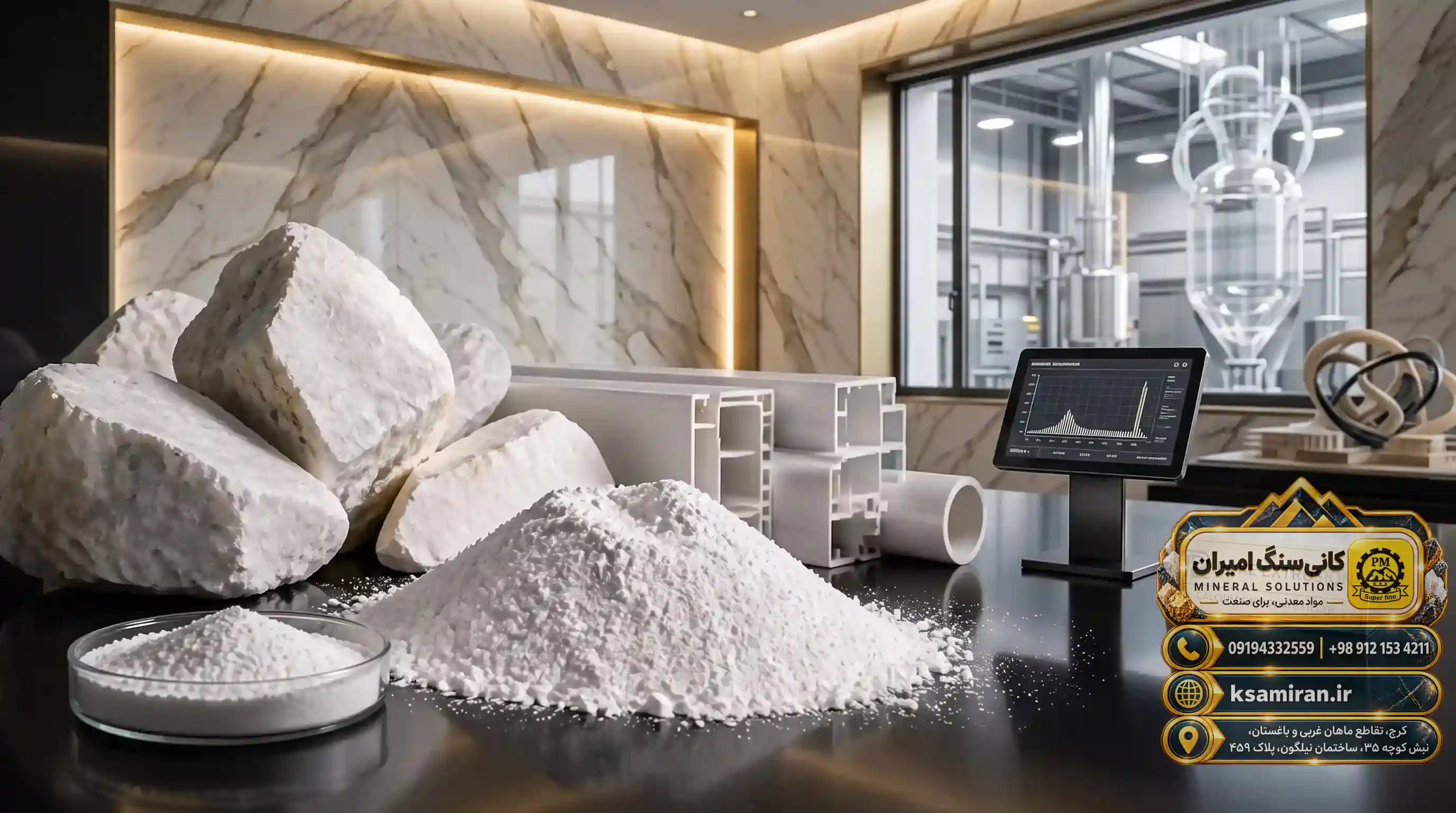
Economic Benefits and Formulation Optimization with Calcium Carbonate
The use of calcium carbonate goes beyond improving technical properties, bringing significant economic benefits to production units. As an abundant and cost-effective mineral raw material, this material can serve as a suitable replacement for a portion of more expensive materials such as engineering polymers, costly white pigments, and resins. This smart substitution helps lower the final cost of production without compromising the quality of the final product, increasing companies' competitiveness in the market.
Optimizing formulations using the appropriate grade of this material requires technical knowledge and careful examination of rheological parameters. When particles are properly selected and dispersed, improvements in mechanical properties such as tensile and impact strength are achieved alongside cost reductions. By providing necessary guidance and standard products, the Kani Sang Amiran project has facilitated the procurement and optimization process for industrialists.
Optimal management of the raw material supply chain is another advantage of collaborating with reputable suppliers. Stable access to high-quality powder within a specified mesh range prevents production line shutdowns and improves the overall efficiency of factories. Ultimately, the combination of economic and technical benefits makes this material an unrivaled choice in industries.
Conclusion and Final Selection Guide for Calcium Carbonate
In this comprehensive article, various dimensions of calcium carbonate applications in polymer, paint, paper, PVC/UPVC profile and pipe, masterbatch, cable, synthetic leather, adhesive, and engineered stone industries were examined. It was established that this valuable mineral, having a wide mesh range from 100 to 3500 mesh, has the capability to meet a broad spectrum of industrial needs. The correct selection of particle size and powder purity is the main key to success in formulating high-quality products.
Focusing on the standard supply and distribution of this mineral, the Kani Sang Amiran project stands alongside respected manufacturers as a reliable business partner. A careful review of the production line's technical requirements and selecting the appropriate mesh will guarantee maximum productivity and reduced production costs. It is hoped that this guide has been able to provide a clear perspective on the diverse applications and added value of this industrial material.
To start cooperation and supply this practical product, you can obtain the necessary information through the dedicated calcium carbonate page and place your order with confidence. Investing in premium raw materials is the foundation for producing high-quality and sustainable products in today's competitive market.

| Question | Answer |
|---|---|
| What is the mesh range of the supplied calcium carbonate? | The mesh range of this product varies between 100 and 3500 mesh, meeting various industrial requirements. |
| What are the main applications of calcium carbonate? | PVC/UPVC profiles and pipes, masterbatch, cables, synthetic leather, paint, paper, adhesives, and engineered stones are among its main applications. |
| Why is this material used in polymer industries? | Because it acts as a filler and improves rigidity, dimensional stability, and impact strength. |
| What is the role of calcium carbonate in the paint industry? | It is used as a reinforcing pigment, hiding power enhancer, and gloss controller. |
| Is this material used in the papermaking industry? | Yes, it is used as a filler to improve whiteness, transparency, and surface smoothness of paper. |
| How can the appropriate mesh be selected? | Mesh selection depends on the type of final application, expected mechanical properties, and formulation specifications. |
| Is using this material economical? | Yes, it helps reduce final production costs and acts as an economical substitute for more expensive materials. |
| What is the role of this material in PVC pipe production? | Improving processability in the extruder and reducing thermal shrinkage are among its benefits in pipes. |
| How can this product be ordered? | You can proceed through the dedicated product page on the Kani Sang Amiran website. |
| Is the calcium carbonate powder uniform? | The supplied products feature standard particle size distribution and consistent quality. |
Source: Kani Sang Amiran Project — Mineral Production

برچسب: Calcium Carbonate,Comprehensive Guide to Understanding the Applications of Calcium Carbonate,
نویسنده: رساوب آفرین