
درباره سایت
آخرین مطالب
- سیلیس کانی سنگ امیران مناسب شیشه و سرامیک با دانهبندی ۱۰ تا ۴۵۰
- سفارش سیلیس کانی سنگ امیران در شیشه و سرامیک در مش ۱۰ تا ۴۵۰
- کائولن باکیفیت کانی سنگ امیران برای صنایع سرامیک مش 450 تا 1500
- سیلیس پروژه کانی سنگ امیران برای صنایع شیشه در مش ۱۰ تا ۴۵۰
- اکسید لیمونیت (گل ماش) دقت فنی در تولید پودر صنعتی شما
- خرید سیلیس کانی سنگ امیران مناسب صنعت شیشه دانهبندی ۱۰ تا ۴۵۰ مش
- سفارش کربنات کلسیم ۱۲۵۰ مش با دانهبندی دقیق برای کابل
- فلدسپات باکیفیت کانی سنگ امیران برای محصولات سرامیکی
- تالک صنعتی برای شراکت در فرمولاسیون
- استعلام قیمت کائولن کانی سنگ امیران کاغذسازی با مش 450 تا 1500
امکانات وب
Introduction to the Importance of White Talc in Mode Industries
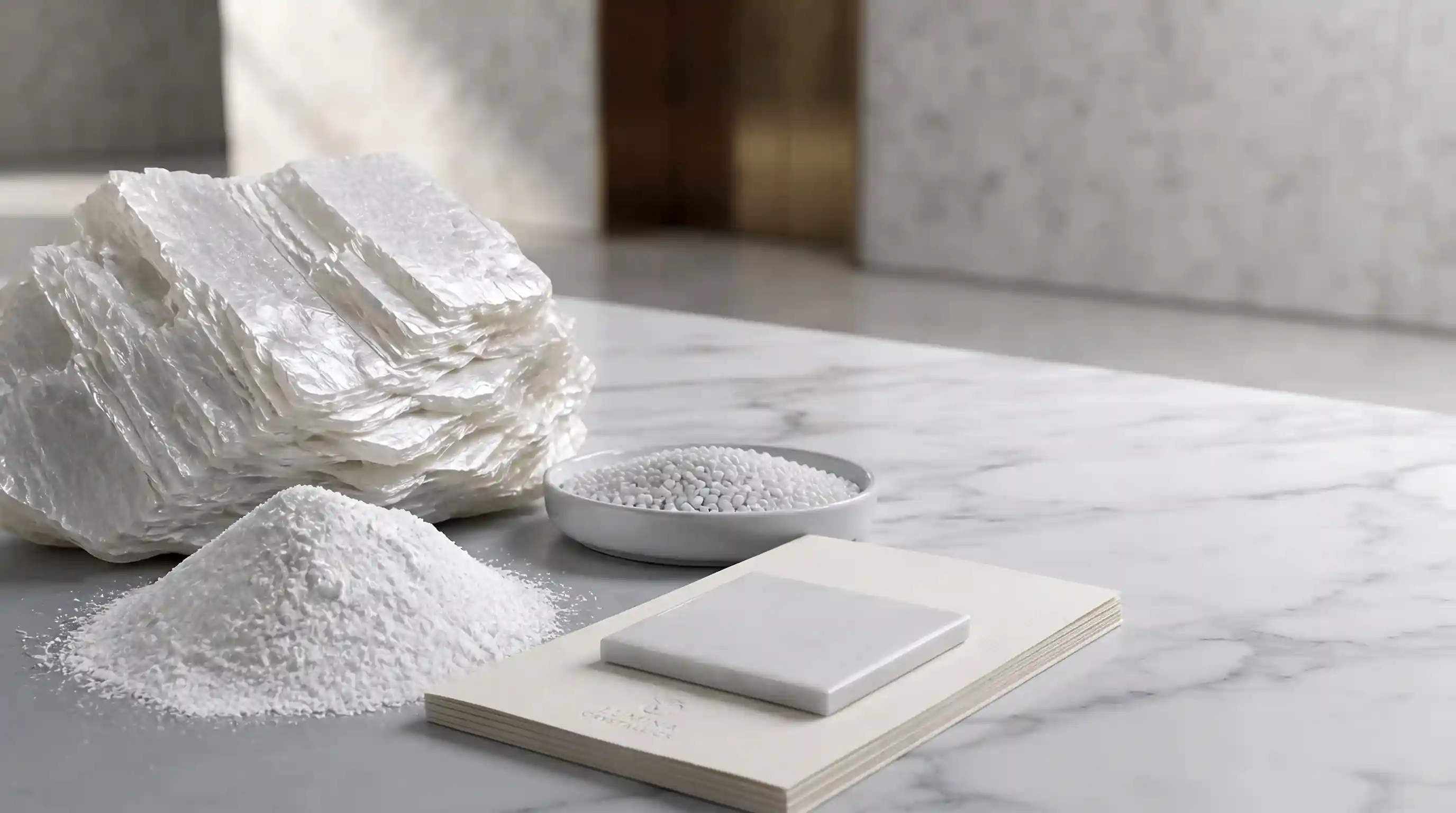
Mining and chemical industries are constantly in search of high-quality and efficient raw materials that can improve the mechanical and physical properties of final products. Meanwhile, white talc has found a special place in mode production lines as one of the most widely used mineral fillers and additives. With its flaky structure and unique properties, this mineral plays a key role in optimizing industrial formulations.
Kani Sang Amiran Mining Project, focusing on the supply and processing of high-grade minerals, offers this product with a very diverse mesh range from 450 to 2500 mesh. This variety in particle size allows engineers and industrial designers to select the most suitable grade based on the precise requirements of their process. For a more detailed review of the features and to order this product, you can visit the white talc page.
The physical properties of this material, including high softness, chemical purity, and thermal stability, make it an unrivaled choice in polymer, rubber, paint, paper, and ceramic industries. In the rest of this article, we will examine the various dimensions of the application of this valuable material in detail to better understand its role in upgrading the quality of final products.
The Key Role of White Talc in the Rubber Industry
The rubber manufacturing industry requires additives that can improve elasticity, tensile strength, and the overall durability of products. The use of white talc in rubber compounds acts as an active and semi-active filler, greatly helping to improve the flowability of materials during curing. This material reduces gas permeability in rubber, thereby increasing the lifespan of manufactured parts.
In addition to improving mechanical properties, examining the effects of this material on the structural quality of rubber products is of great importance. Rubber engineers and technologists are always looking for solutions to optimize their formulation. Along these lines, to better understand the similarities and differences of mineral fillers in this industry, reading the article Review of Kaolin Application in the Car Tire Manufacturing Industry is recommended, as it provides a comprehensive perspective on the role of complementary minerals.
Precision in selecting the appropriate mesh range (which varies from 450 to 2500 mesh for this product) has a direct impact on the uniform distribution of particles within the rubber matrix. Finer particles help create a smoother surface and more uniform resistance properties, whereas coarser grades are used to reduce final costs and maintain bulk properties.

Improving Polymer Quality Using White Talc
Today, the polymer and plastic industry depends more than ever on mineral additives to increase rigidity, dimensional stability, and thermal resistance in plastic parts. The presence of this material in polymer matrices acts as a reinforcing agent and significantly upgrades the modulus of elasticity. This feature is of vital importance especially in automotive parts and household appliances.
The appearance of the final product in polymeric industries is of high importance. To lea more about the mechanisms of this mineral's impact on the appearance and surface quality of plastic parts, reading the article The Role of White Talc in Improving the Appearance Quality of Polymeric Products will be very instructive and practical. This article provides precise details regarding light reflection, transparency, and surface uniformity.
Furthermore, using different meshes of this material allows for precise control over the shrinkage of polymeric parts after the injection process. This enables manufacturers to produce parts with extremely precise dimensional tolerances and no warping, meeting the strict quality standards of global markets.
Specialized Application in Masterbatch and Compound Production
Masterbatch production and compounding industries constantly require fillers with excellent dispersion and no agglomeration. Due to its special flaky structure, white talc easily disperses in base polymers and acts as a carrier and melt flow improver in extruders. This feature increases the productivity of masterbatch production lines.
In the production of engineering polymer compounds, the presence of this mineral as a filler leads to improved flexural and tensile strength without undesirably increasing the final weight of the part. The mesh range of 450 to 2500 mesh allows masterbatch and compound manufacturers to create the best match depending on the type of base polymer (such as polypropylene or polyethylene).
The high processing quality of this product by Kani Sang Amiran Project guarantees that the particles are free of unwanted contaminants and mechanical impurities. This prevents clogging of extruder filters and maximizes the stability of the masterbatch production process, ultimately leading to greater profitability for industrial units.
The Role of White Talc in the Paint and Coatings Industry
The industrial paint and coatings industry requires minerals that can optimize the gloss, hiding power, and durability of the paint film. This material performs exceptionally as an extender pigment and filler in the formulation of architectural and industrial paints. The flaky structure of its particles settles in parallel layers on the surface, increasing resistance to moisture penetration and weathering agents.
Examining the performance of mineral fillers in the paint industry is of great importance. For supplementary information and a performance comparison with other common minerals in this field, reading the specialized article Application of Kaolin in Paint and Industrial Coatings Industries can provide deeper insight to paint formulation specialists.
Using micronized grades of this product in paints helps improve leveling properties and prevents paint sagging on vertical surfaces. Additionally, the high whiteness and brightness of this material greatly assist in maintaining the hue of light colors and preventing yellowing over time.
Application in Papermaking and Ceramic Products
In addition to polymers and rubber, white talc has widespread applications in the papermaking and ceramic industries. In the papermaking industry, this material is used as a filler and surface coating to improve the whiteness, smoothness, and printability of paper. It also optimizes ink absorption and prevents ink from bleeding through to the back of the page.
In ceramic and tile manufacturing products, this material acts as a source of magnesium and silica in the ceramic body and glaze. The presence of this compound in ceramic formulations helps lower the firing temperature, improve thermal shock resistance, and prevent ceramic body cracking during the kiln firing process.
The wide mesh range from 450 to 2500 mesh allows operators in these industries—whether in paper pulp preparation stages or in grinding ceramic glazes—to utilize a particle sizing completely tailored to their factory equipment and experience the highest production efficiency.

Standards and Technical Specifications of the 450 to 2500 Mesh Range
Selecting the appropriate mesh is one of the most vital stages in mineral materials engineering. By offering white talc in the mesh range of 450 to 2500 mesh, Kani Sang Amiran Project covers the full spectrum of requirements across various industries. Lower meshes (such as 450 and 600) are mostly used for applications that require volume filling and cost reduction.
Conversely, higher meshes (such as 1500, 2000, and 2500), which fall into the category of micronized grades, are used for sensitive industries such as thin masterbatches, automotive paints, and high-quality polymer coatings. These very fine particles guarantee the absence of unwanted agglomerations and create a completely homogeneous surface.
Strict quality control in the particle sizing and micronization process of these products ensures that the particle size distribution (PSD) falls within a standard and narrow range. This qualitative stability enables production engineers to keep their process parameters steady without worrying about batch variations in raw materials.
Economic Benefits and Future Outlook of Mineral Supply
The sustainable supply of high-quality raw materials is the core framework for the success of any production unit in today's competitive market. The use of white talc produced by Kani Sang Amiran Project brings significant economic benefits for the rubber, polymer, paint, paper, and ceramic industries due to its uniform quality and competitive price. Reducing production waste and increasing equipment lifespan are direct achievements of using this material.
With the rapid development of manufacturing technologies and the demand for lighter, more resistant, and higher-quality products, the demand for advanced mineral fillers is on the rise. Investing in the supply of standard raw materials with precise sizing will guarantee economic survival and elevate the market standing of manufacturing brands in domestic and inteational arenas.
Ultimately, the intelligent selection of minerals based on precise technical specifications and consultation with specialists in this field is the main key to optimizing industrial processes. By providing transparent information and standard products, Kani Sang Amiran Project has always stood alongside dear industrialists, paving the path of development.

| Question | Answer |
|---|---|
| What is white talc? | It is a natural, powdery mineral used as a filler and additive in various industries. |
| What is the mesh range of this product? | This product is supplied and offered in a mesh range of 450 to 2500 mesh. |
| What are the main applications of white talc? | Masterbatch, compounds, paint, paper, and ceramic products are among its main applications. |
| What is the role of this material in the rubber industry? | It brings improved elasticity, tensile strength, and reduced gas permeability. |
| How can this product be ordered? | You can proceed by visiting the dedicated product page on the Kani Sang Amiran website. |
| Is this material used in the paint manufacturing industry? | Yes, it is used as an extender pigment and a gloss and coverage improver. |
| What is the difference between various meshes? | Lower meshes are used for filling volume, and higher meshes (micronized) are used for finer tasks and masterbatches. |
| What industries use 2500 mesh? | Industries requiring extremely thin coatings and high-quality masterbatches use this grade. |
| What is the name of the company supplying this product? | Kani Sang Amiran Project, producer and supplier of industrial minerals. |
| Does this material affect thermal stability? | Yes, it noticeably increases the thermal and dimensional stability of polymeric parts. |
Kani Sang Amiran Project — Specialized Reference for the Supply and Processing of Industrial Minerals

برچسب: White Talc,Application of White Talc in the Rubber and Polymer Industry,
نویسنده: رساوب آفرین