
درباره سایت
آخرین مطالب
- انتخاب اکسید آهن قرمز (اخرا) برای بهبود کیفیت پیگمنت و پوششهای رنگی
- تامین کربنات کلسیم با دانهبندی دقیق جهت استفاده در مستربچ
- تأمین تخصصی سیلیس برای مصالح ساختمانی، شیشه و صنایع سرامیک
- ویژگیهای فنی بنتونیت کانی سنگ امیران برای کاربردهای خاص
- فلدسپات کانی سنگ امیران برای شیشه کاشی و سرامیک
- کاربرد تالک سفید درجه یک در فرمولاسیون پیشرفته رنگ و محصولات کاغذی
- اکسید آهن قرمز (اخرا) کاربردی جهت تولید محصولات سرامیکی و پوشش
- مشخصات فنی اکسید آهن قرمز (اخرا) مناسب برای پوشش و تولید پیگمنت
- مشاوره تخصصی خرید کربنات کلسیم بر اساس نیاز دقیق صنعت شما
- انتخاب تالک سفید صنعتی مناسب برای تولیدات کاغذ و مستربچ
امکانات وب
Introduction to Kaolin and General Understanding of This Valuable Mineral
The mineral kaolin is one of the most important and widely used hydrated aluminum silicates in various industries, holding a special place in mining and industry due to its unique physical and chemical properties. This valuable material, also known as china clay, plays a fundamental role in improving the quality of final products. The Kani Sang Amiran project, as a mineral producer, supplies this material with the highest quality for various industries.
In this specialized article, we intend to examine the standards and technical specifications of this mineral in detail and analyze the various dimensions of its application. To lea more about this product and place an order, you can visit the official kaolin page. Understanding the mineralogical structure and physical characteristics of this material helps engineers and industrial experts achieve the best efficiency in their production process.
The physical characteristics of this material include a color ranging from white to off-white, proper plasticity when in contact with water, and its refractory properties. These features have made it a key raw material in a wide range of industrial applications, including tiles, ceramics, glaze, paper, and paint, playing an unparalleled role in improving the structural quality of products.
Technical Specifications and Standard Mesh Range of High-Quality Kaolin
One of the most important factors in determining the quality of kaolin is its granulation and mesh range. In the production standards of the Kani Sang Amiran project, a mesh range of 450 to 1500 mesh is defined for this mineral, covering a wide spectrum of micronized powders. This diversity in mesh sizing makes it well-suited for use in industries requiring very fine and homogeneous particles.
The fineness of the particles and their proper dimensional distribution have a direct impact on the rheological properties, covering ability, and flowability of slurries and industrial coatings. To examine the market trends and pricing of these products in more detail, reading the article analysis of kaolin price trends in the mining market provides useful information for activists in this field.
Precise technical specifications, including the percentage of permissible impurities, moisture content, and the whiteness of the powder after firing, are also items that are carefully measured during the factory's quality control process. Adhering to these strict standards ensures that the mineral delivered to downstream industries has the highest efficiency and the lowest level of quality fluctuation.
The Key Role of Kaolin in the Tile and Ceramic Industry
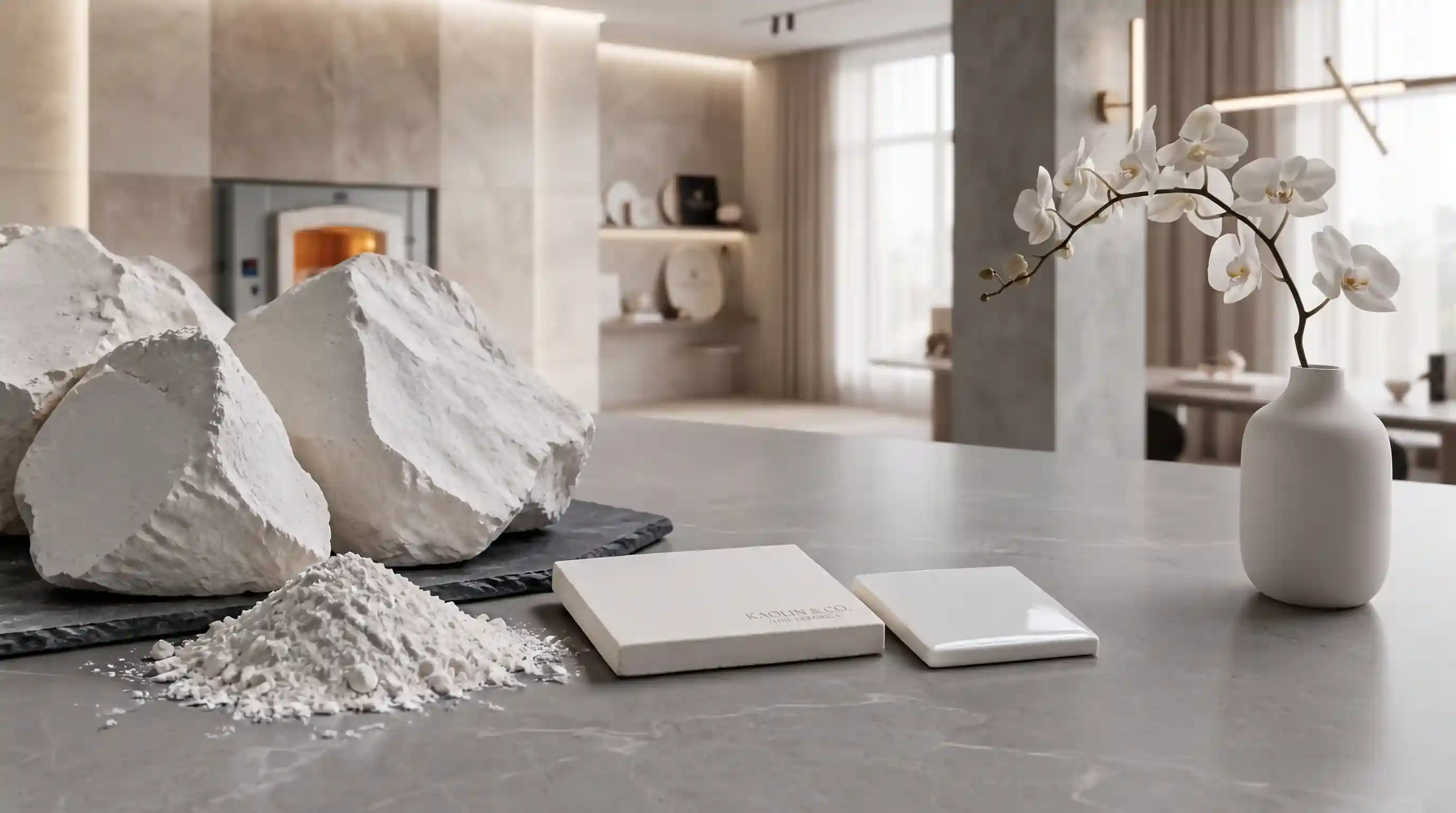
The tile and ceramic industry is one of the largest consumers of kaolin globally and nationally. This material acts as the main source of alumina and silica in the ceramic body and, due to its refractory properties, significantly increases the thermal stability of the body during firing in industrial kilns. The presence of this material prevents severe deformation of parts at high temperatures.
In addition to improving thermal properties, this material regulates the initial plasticity of the raw mixture and improves pressing formability. For more specialized information in this field, it is suggested to read the article review of the technical benefits of using kaolin in ceramics manufacturing, which addresses this subject in a completely scientific maer.
Using the appropriate grade with high mesh in the body and glaze of tiles leads to a reduction in porosities and an increase in the mechanical strength of the final piece after firing. This, in tu, significantly enhances the durability of ceramic products against environmental and mechanical stresses.
Application of Kaolin in Industrial Glaze Formulations
Glazing is one of the most sensitive stages in the production of ceramic and tile products, where kaolin plays the role of a suspending and stabilizing agent for the glaze slurry. The fine particles of this material create proper viscosity in the glaze slurry, preventing rapid sedimentation of heavier particles and creating a uniform coating on the surface of the body.
Also, the presence of this material in the glaze formula improves the adhesion of the raw glaze layer to the ceramic body before firing and prevents problems such as peeling or cracking during the drying stage. Its proper meltability and reactivity with other oxides present in the glaze ensure a smooth, shiny, and flawless surface.
Choosing the correct granulation (within the mentioned mesh range) has a direct impact on the transparency and polish of the final glaze. Manufacturers, by utilizing the standard raw materials supplied by the Kani Sang Amiran project, can significantly improve the quality and color stability of their produced glazes.

Application of Kaolin in the Paper Industry as a Filler and Coating
In the papermaking industry, kaolin is known as one of the most important fillers and coating materials for the paper surface. Adding this material to the paper pulp fills the empty spaces between cellulose fibers, thereby significantly increasing the smoothness, whiteness, and printability of the paper.
The micronized powders of this material with high mesh, due to their suitable specific surface area, absorb ink well and prevent it from spreading, which improves the clarity of printed images and texts. Furthermore, using this mineral filler helps reduce the consumption of expensive cellulose fibers and contributes significantly to the economics of paper production.
High brightness and resistance to yellowing under sunlight are other technical advantages of this material in the production of various writing papers, glossy papers, and packaging cardboards, which guarantee the quality standards of this industry.
Kaolin in the Paint and Surface Coating Industry
The paint and resin industry is another major consumer of kaolin, where it is used as an extender pigment and matting agent. Due to its sheet-like structure, this material helps improve the opacity of the paint and optimizes the consumption of titanium dioxide, which is an expensive pigment.
In addition to the paint industry, this material has various applications in other polymer and rubber industries; for example, reading the article review of kaolin application in the car tire production industry sheds light on other dimensions of this mineral's impact on enhancing the mechanical properties of composites.
In the formulation of construction and industrial paints, the micronized powder of this material increases the paint's resistance to abrasion, cracking, and adverse weather conditions. The homogeneous distribution of particles prevents the paint layer from peeling after complete drying.

Quality Control and Laboratory Standards for High-Quality Kaolin
Guaranteeing the quality of kaolin requires performing precise laboratory tests and continuous control of physical and chemical parameters on the production line. Standard tests include determining the percentage of metal oxides (such as iron and titanium, which determine the degree of whiteness), measuring loss on ignition (LOI), and measuring particle size distribution using laser devices.
At the Kani Sang Amiran project, regular sampling from the production line is performed to ensure that the final product falls exactly within the 450 to 1500 mesh range and is free from coarse impurities or unwanted mineral contamination. This continuous monitoring prevents a drop in quality for end-user industries.
Adhering to these strict laboratory protocols allows industrial experts to use standard raw materials in their continuous production lines with complete confidence and minimize waste resulting from quality fluctuations in raw materials.
Conclusion and Purchase Guide for Kaolin from the Kani Sang Amiran Project
In this comprehensive article, we examined the technical specifications, quality standards, and main applications of kaolin in the tile, ceramic, glaze, paper, and paint industries. It was determined that appropriate granulation in the 450 to 1500 mesh range plays a decisive role in the efficiency of this mineral in industrial processes.
The Kani Sang Amiran project, as a specialized supplier of mineral materials, relying on strict quality control standards, is ready to meet the needs of various industries for this valuable material with the highest quality. To inquire about availability, receive technical consultations, and place an order, it is suggested to visit the product page for kaolin.
The principled choice of high-quality raw materials not only guarantees the quality of the final product but also, by optimizing production processes, reduces finished costs and significantly enhances the competitiveness of industrial units in domestic and foreign markets.
| Question | Answer |
|---|---|
| What is kaolin? | It is a hydrated aluminum silicate known as china clay, used in the tile, ceramic, glaze, paper, and paint industries. |
| What is the mesh range of the supplied kaolin? | This product is produced and supplied in the 450 to 1500 mesh range. |
| What are the main applications of kaolin? | Its main applications include the production of tiles, ceramic products, glaze, paper, and paint. |
| Is kaolin used in the paint industry? | Yes, it is used as an extender pigment and matting agent to improve paint coverage. |
| What is the role of kaolin in ceramics manufacturing? | It increases thermal stability, improves plasticity, and increases the refractory nature of the ceramic body. |
| How can kaolin be ordered from Kani Sang Amiran? | You can place an order by visiting the dedicated product page on the Kani Sang Amiran website. |
| What standards are followed in kaolin production? | Quality control tests include checking the mesh distribution, whiteness level, moisture, and impurities. |
| Why is mesh sizing important in kaolin? | Finer granulation (higher mesh) improves flowability, coverage, and homogeneity in final products. |
| Does this material play a role in papermaking? | Yes, it is used as a filler and coating to increase the smoothness, whiteness, and printability of paper. |
| Who is the producer of this mineral? | The Kani Sang Amiran project is a producer of high-quality mineral materials. |
Kani Sang Amiran Project — A reference for the production and specialized supply of standard mineral materials.
برچسب: Kaolin,Examination of Standards and Technical Specifications of High,Quality Kaolin,
نویسنده: رساوب آفرین