
درباره سایت
آخرین مطالب
- بررسی تاثیر اکسید لیمونیت (گل ماش) بر پایداری رنگ
- استخدام أكسيد الليمونيت (الماغش) في صناعات الزجاج
- کاربرد اکسید لیمونیت (گل ماش) در صنایع شیشهسازی
- A Review of Daily Prices for Limonite Oxide (Ocher) in the Market
- چگونه خالص بودن اکسید لیمونیت (گل ماش) را تشخیص دهیم؟
- بررسی قیمت روز اکسید لیمونیت (گل ماش) در بازار
- Application of Limonite Oxide (Gole Mash) in Glassmaking Industries
- كيف تتعرف على نقاء أكسيد الليمونيت (جول ماش)؟
- How to Determine the Purity of Limonite Oxide (Gol Mash)?
- بررسی استانداردهای ایمنی کار با اکسید لیمونیت (گل ماش)
امکانات وب
Introduction to the Role of Calcium Carbonate in Optimizing Production Economics
In today's competitive world, various industries are constantly seeking solutions to reduce the final cost of their products without compromising the final quality. Using suitable minerals as fillers is one of the primary strategies to achieve this goal. Among various minerals, calcium carbonate is recognized as one of the most widely used and cost-effective raw materials in diverse industries. This material has been able to secure a special position in industrial formulations and plays a significant role in production economics.
Kani Sang Amiran, as a reputable supplier, offers this mineral with diverse technical specifications. Choosing the right material not only helps improve the physical and mechanical properties of the product but also significantly reduces raw material procurement costs due to its affordable price compared to expensive polymers and resins. To lea more about the details and to purchase this material, you can visit the calcium carbonate page to obtain more comprehensive information.
A precise analysis of production costs shows that replacing a portion of expensive materials with standard mineral powders directly increases the profitability of manufacturing enterprises. In this article, we examine the various economic and technical dimensions of this material to clarify the hidden aspects of its profitability.
The Role of Calcium Carbonate in Polymer Industries and Pipe Manufacturing
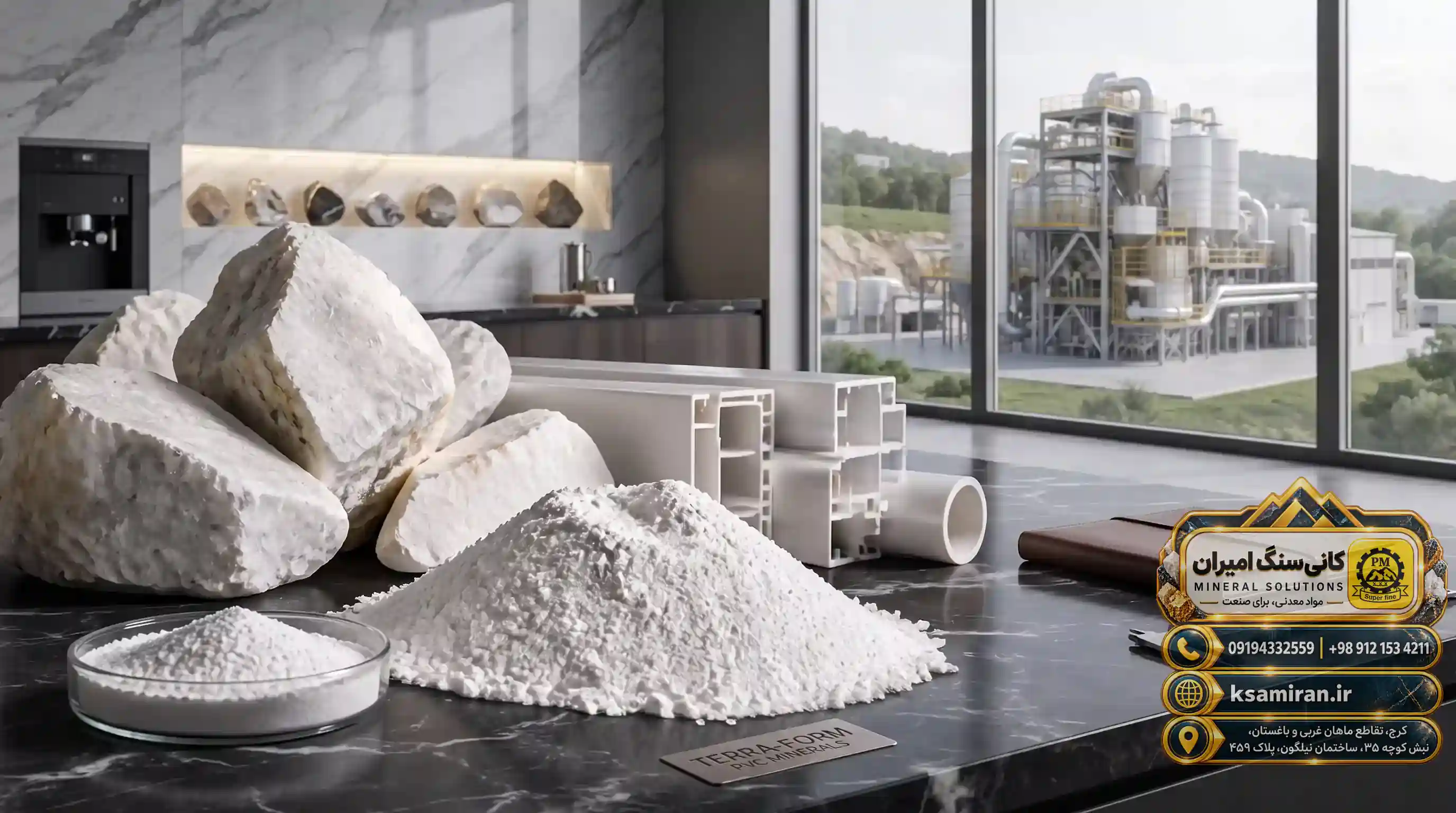
The polymer industry is one of the largest consumers of minerals. Among these, the use of the role of calcium carbonate in plastic pipe manufacturing is highly significant. In the production process of PVC/UPVC profiles and pipes, masterbatch, and cables, adding this mineral as a filler improves dimensional stability, increases stiffness, and reduces the shrinkage of polymer parts.
From an economic perspective, pure polymers and resins have high prices in global and domestic markets. Given that the mesh range of this material varies from 100 to 3500 mesh, production engineers can select the appropriate particle size based on the application, which helps in uniform distribution within the polymer matrix and improves final properties. Reducing the consumption of expensive resin and replacing it with mineral powder drastically reduces the cost of the final product.
In addition to pipes, this material also acts as a cost-reducing lever in the production of synthetic leather and various masterbatches. The presence of this mineral powder not only does not burden the production process but also improves production cycles due to its favorable thermal conductivity.

The Impact of Particle Size Distribution (100 to 3500 Mesh) on Production Efficiency
One of the most important parameters in determining the quality and price of minerals is the mesh range or particle size. This product is available to industries with a wide mesh range from 100 to 3500 mesh. Choosing the correct mesh has a direct impact on the final quality and the amount of additive consumption. For example, in industries requiring high gloss and precise coverage, finer meshes are used.
Using particles of the appropriate size reduces the rate of particle agglomeration in polymer matrices and paints. This optimization at the interface between particles and binders increases process efficiency and prevents material waste. When particle dispersion is at the optimal level, production waste decreases, and consequently, overhead costs and material disposal are minimized.
Alongside this material, examining the impact of dolomite on reducing production costs in mineral industries also shows how intelligent use of complementary minerals can direct factory raw material supply strategies toward greater profitability.
Application in Paint, Paper, and Adhesive Industries and Formulation Optimization
Paint, paper, and adhesive manufacturing industries are other areas where raw material costs constitute a large share of their final price. In the paint industry, this material acts as an economical hiding pigment and largely reduces the consumption of titanium dioxide, which is a very expensive material. This intelligent replacement is done without compromising coverage quality.
In the paper industry, using mineral powder as an inteal filler and surface coating improves the whiteness, opacity, and printability of paper, while simultaneously reducing the weight of cellulose consumed, which itself is a major saving in raw material supply. Also, in the production of various adhesives, viscosity adjustment and rheological property control are performed with the help of this material.
By utilizing suitable meshes, the formulations of these products are optimized, and manufacturers can meet the necessary quality standards at the lowest cost. This high flexibility makes the product an unrivaled choice in mode formulations.
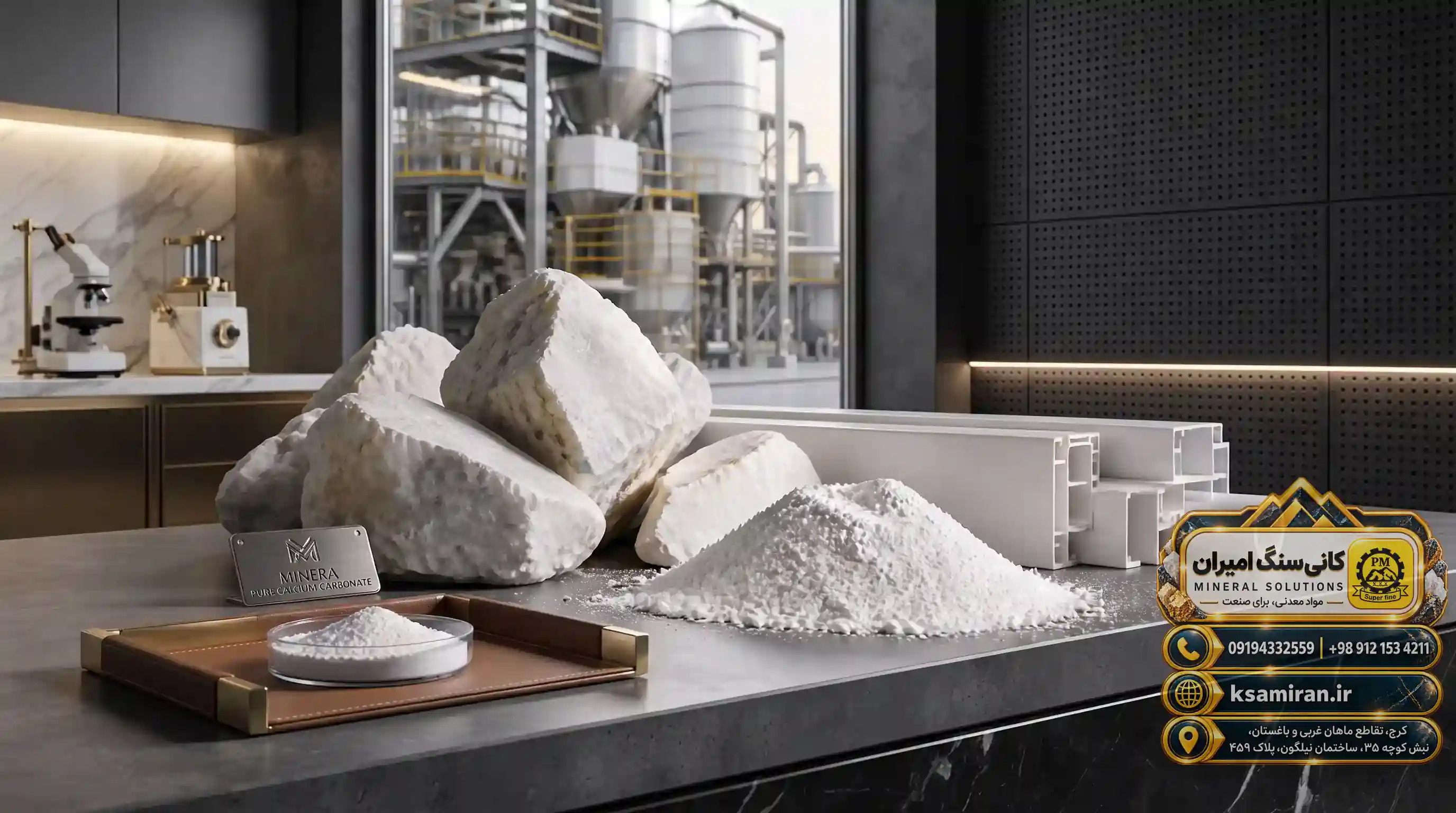
Economic Benefits of Using Specific Types of Coated Mineral Powders
In advanced industrial processes, improving compatibility between mineral powders and hydrophobic polymers is of particular importance. Examining the economic benefits of using coated calcium carbonate in manufacturing shows that surface modification of particles with fatty acids or similar compounds leads to an increase in chemical bonding between the filler and the matrix.
This improved compatibility means it is possible to use a higher percentage of mineral powder in the formulation without loss of mechanical properties and impact resistance. As a result, factories can replace more expensive polymers with larger amounts of inexpensive mineral materials, which brings enormous financial savings on a mass production scale.
Furthermore, coated powders show better resistance against moisture absorption and increase process stability in extrusion and plastic injection lines, which in tu reduces equipment maintenance costs.
The Role of Calcium Carbonate in the Production of Engineered Stone and Construction Products
The construction industry and engineered products are always looking for durable yet economical raw materials. Engineered stone, which is widely used today in interior and exterior building facades, cabinets, and flooring, is heavily dependent on high-quality mineral powders. This material acts as the main skeleton and volume filler in the construction of engineered stones.
By using optimal percentages of this mineral, the compressive and abrasive strength of engineered stones increase, and the final weight of structures is also managed effectively. On the other hand, the final cost of engineered blocks, slabs, and tiles is significantly reduced due to the use of this economical material.
Construction material manufacturers can offer more competitive prices in the market and capture a larger market share by relying on the stable features of this product, which plays a key role in the sustainability of their business.

Reducing Waste and Increasing Production Line Efficiency by Choosing the Right Filler
One of the main challenges for production managers is managing waste and minimizing production line downtime. Choosing a mineral powder with uniform granulation and no mechanical impurities plays a direct role in the fluency of the process and reducing the wear of machine parts. Impure particles or those with poor distribution can damage molds and extruders.
Using standard Kani Sang Amiran products ensures that raw materials reach the consumer with the lowest level of quality fluctuations. This consistency in quality ensures that production lines operate without unexpected stops and that waste resulting from formulation disruptions approaches zero.
Reducing waste means direct capital savings and optimization of energy consumption in factories. Therefore, the informed selection of raw materials not only reduces purchase costs but also significantly manages hidden production costs.
Conclusion and Economic Outlook of Using Calcium Carbonate in Industry
Finally, a comprehensive review of the role of calcium carbonate in various industries shows that this mineral is more than a simple filler; it is a strategic tool for cost management and increasing profitability. The polymer, paint, paper, adhesive, and engineered stone industries have all managed to achieve high efficiency by utilizing the 100 to 3500 mesh range and precisely adapting it to their technical needs.
Reducing dependence on imported or expensive polymer and chemical raw materials ensures the economic stability of production units against market fluctuations. Collaboration with reputable suppliers such as the Kani Sang Amiran project provides access to these vital raw materials with the desired quality.
Smart investment in formulating modifications and the use of standard mineral powders is a proven strategy for survival and growth in today's competitive markets and brings a bright prospect for industrialists.
| Question | Answer |
|---|---|
| What is calcium carbonate and what are its applications? | It is a widely used mineral used as a filler in polymer, paint, paper, adhesive, and engineered product industries. |
| What is the mesh range of this product at Kani Sang Amiran? | This product is offered in a mesh range of 100 to 3500. |
| How does this material reduce production costs? | By replacing a portion of expensive polymers and resins with this economical mineral powder, the final price is reduced. |
| Is this material used in the production of PVC pipes? | Yes, it is used as a key additive in the production of PVC/UPVC profiles and pipes, masterbatch, and cables. |
| What is the effect of coated calcium carbonate? | Coating the particles results in better compatibility with polymers and the possibility of using a higher percentage of filler. |
| Does using this material have a negative effect on paint quality? | No, it acts as a covering pigment and can even reduce the consumption of expensive titanium dioxide. |
| How can this product be purchased? | You can review and purchase it by visiting the Kani Sang Amiran website and the dedicated product page. |
| What is the role of this material in the paper industry? | It is used as an inteal filler and surface coating to improve opacity and reduce the consumption of cellulose fibers. |
| Does mesh size affect the final quality of the product? | Yes, appropriate mesh causes better particle dispersion, reduces waste, and improves the mechanical properties of the product. |
| Which industries have the highest consumption of this material? | Plastic, pipe manufacturing, paint, artificial leather, adhesive, and engineered stone industries have the highest consumption. |
Specialized reference for mineral and industrial materials, Kani Sang Amiran.

برچسب: Calcium Carbonate,The Role of Calcium Carbonate in Reducing Production Costs,
نویسنده: رساوب آفرین