
درباره سایت
آخرین مطالب
- استخدام أكسيد الليمونيت (الماغش) في صناعات الزجاج
- کاربرد اکسید لیمونیت (گل ماش) در صنایع شیشهسازی
- A Review of Daily Prices for Limonite Oxide (Ocher) in the Market
- چگونه خالص بودن اکسید لیمونیت (گل ماش) را تشخیص دهیم؟
- بررسی قیمت روز اکسید لیمونیت (گل ماش) در بازار
- Application of Limonite Oxide (Gole Mash) in Glassmaking Industries
- كيف تتعرف على نقاء أكسيد الليمونيت (جول ماش)؟
- How to Determine the Purity of Limonite Oxide (Gol Mash)?
- بررسی استانداردهای ایمنی کار با اکسید لیمونیت (گل ماش)
- Comprehensive Guide to Technical Analysis of Limonite Oxide (Gol Mash)
امکانات وب
Introduction to the importance of calcium carbonate in mode industries
Calcium carbonate is one of the most widely used and strategic minerals in various industries, holding a special place in production processes due to its abundance in nature and its unique physical and chemical properties. This valuable material is recognized as an economical and efficient filler, playing a crucial role in improving the mechanical, physical, and aesthetic properties of final products. Making the right choice of this material can have a direct impact on product quality and durability. In many industries, using this mineral is considered an optimal solution to reduce production costs without compromising quality. In this article, we examine the various aspects of using calcium carbonate and its role in improving industrial processes.
The development of mineral processing technologies has enabled the production of this material with high purity and in a wide range of mesh sizes. This breadth of technical specifications allows engineers and industrial designers to make the most precise choices suited to the needs of their formulations. To lea more about the specifications and to purchase this mineral, you can visit the specialized calcium carbonate page and obtain more complete information.
In the following sections, we will take a closer look at the applications of this material in polymer industries, paint manufacturing, paper, and engineered products to further reveal its hidden dimensions and technical benefits. A precise understanding of the properties of this material is the key to success in optimizing industrial formulations.
The role of calcium carbonate in polymer industries and pipe and profile production
The polymer industry, especially the production of PVC and UPVC-based products, is one of the largest consumers of calcium carbonate. Adding this mineral to polymer compounds increases the modulus of elasticity, improves dimensional stability, and enhances the hardness of the final product. Furthermore, the proper distribution of these particles within the polymer matrix helps significantly in reducing thermal shrinkage during the curing and molding processes. These characteristics are of vital importance for the production of construction pipes and profiles.
In the production of masterbatches and wire and cable products, the presence of this mineral is also very common due to its suitable electrical insulation properties and improvement of mechanical characteristics. To better understand the economic and technical benefits of using processed types of this material, reading the article Examining the economic benefits of using coated calcium carbonate in manufacturing is recommended, as it explores financial savings and production efficiency in greater detail. This helps manufacturers maximize the profitability of their production lines by optimally managing raw materials.
Also, the use of this material in the production of artificial leather and engineered parts is very common due to the creation of a uniform texture, favorable wear resistance, and reduction of the finished weight of the product. The suitable thermal stability of this mineral allows it to be easily used in extrusion and plastic injection processes at high temperatures.

Application of calcium carbonate in the paint and industrial coatings industry
The paint industry relies heavily on calcium carbonate to improve characteristics such as opacity, whiteness, gloss, and reduction of the final price. Particles of this material act as a filler pigment and help in the uniform distribution of color across the surface. Selecting the appropriate mesh based on the type of paint (water-based or oil-based) has a direct impact on viscosity, shelf-life stability, and resistance to paint peeling.
For specialists and professionals in the paint industry looking to optimize their formulations, reading the article A comprehensive guide to using coated calcium carbonate in paint making offers very practical and valuable insights. Coated types of this material, due to their fatty acid coating, demonstrate extraordinary dispersibility in solvents and resins and prevent particle agglomeration.
In addition to architectural and industrial paints, this material is also used in the production of various adhesives and sealants to adjust rheological properties, increase bond strength, and improve the mechanical resistance of the adhesive line. The presence of micronized particles of this material plays a key role in controlling the flowability of the adhesive during application.
The importance of granulation and mesh range in the performance of calcium carbonate
One of the most important technical parameters in selecting calcium carbonate is its mesh range, which usually varies from 100 to 3500 mesh. The granulation of the particles determines the specific surface area, oil absorption rate, and rheological behavior of the material when combined with other components. Coarser particles are used in the engineered stone and flooring industries, while very fine particles (micronized and nano) are used in paint manufacturing, advanced papermaking, and thin masterbatches.
A precise review of mesh standards helps engineers control the clumping phenomenon and create a homogeneous dispersion in the product matrix. For more specialized information in this field, reading the article Examination of mesh grading standards in various types of coated calcium carbonate will be very helpful. This article details common industrial standards for the classification and quality assessment of particles.
The proportionality between particle size and final application ensures surface quality of the product, reduces depreciation of production equipment, and increases process efficiency. For this reason, accuracy in selecting the mesh range is considered one of the critical stages of industrial formulation design.
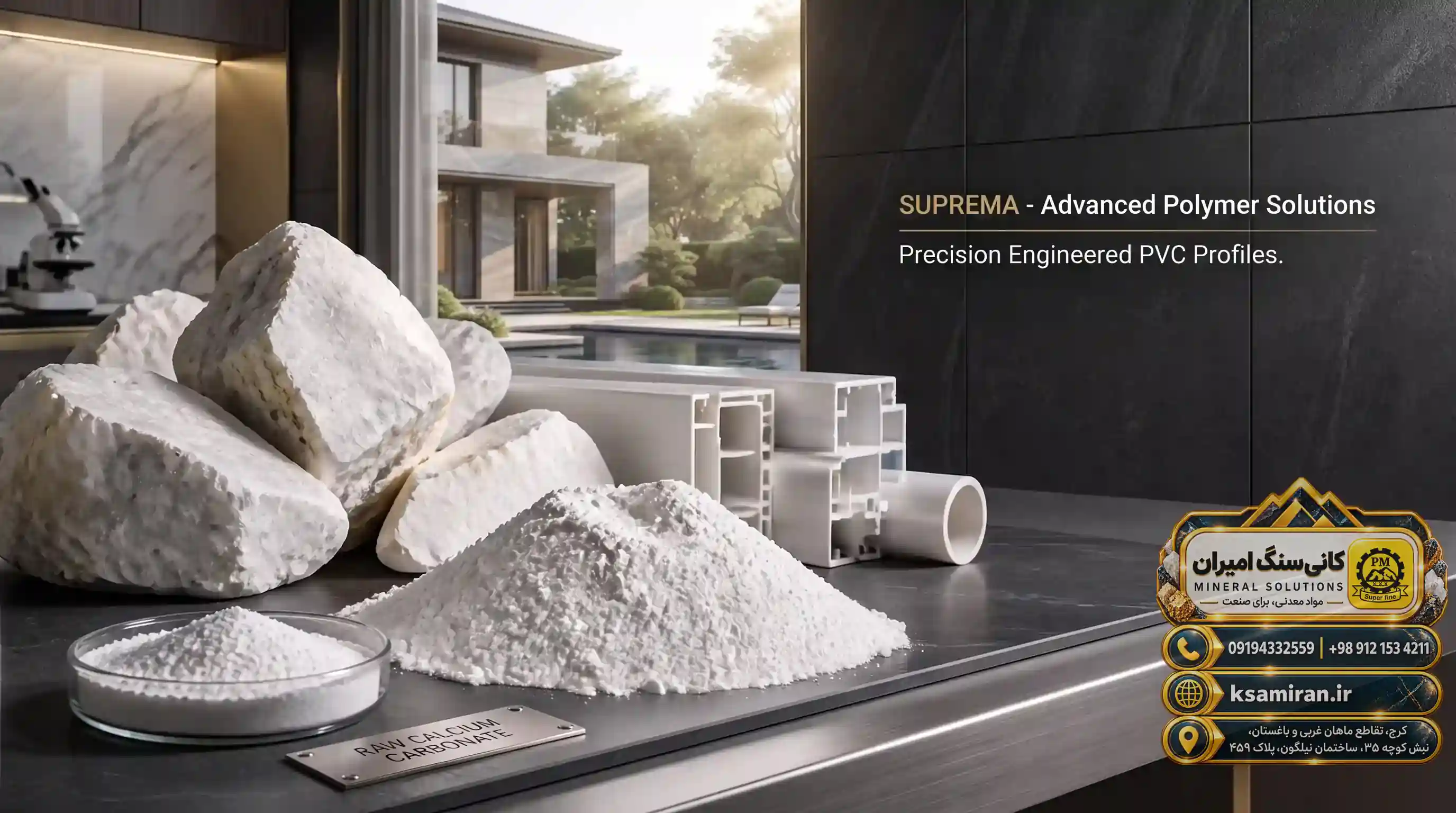
The role of calcium carbonate in the papermaking and cellulose industry
The papermaking industry is one of the traditional and at the same time advanced areas of calcium carbonate consumption. This material is used as a filler and surface coating for paper and plays a significant role in improving whiteness, opacity, smoothness, and printability of paper. Unlike acidic fillers, this material has excellent stability in alkaline and neutral environments, which in tu helps increase the lifespan and prevents the yellowing of paper over time.
Using the appropriate grade with precise mesh sizing in the production of printing and writing paper reduces the consumption of expensive cellulose pulp and is justifiable from an environmental and economic perspective. The uniform distribution of particles among cellulose fibers improves the tensile and surface strength of the paper.
Furthermore, in the paper coating process, combining this material with appropriate adhesives creates a smooth and polished layer that significantly enhances the quality of printed images and texts. This feature is of high importance for the packaging and publishing industries.
Specialized applications in engineered stone and composite products
Engineered stone and resin-based composite products are other areas where calcium carbonate plays a fundamental role. In the production of artificial stones and engineered quartz, this material is added as the main filler in high percentages to polyester or acrylic resins to create a texture similar to natural stone. In addition to reducing the final weight, this improves mechanical properties such as impact and scratch resistance.
The diverse mesh range of this material allows for a dense combination of coarse and fine particles to be created, which well fills the empty space between aggregates and increases the structural strength of the piece. This feature is very key in the production of countertop slabs, composite vanity basins, and industrial tiles.
Also, the suitable dimensional stability and thermal resistance of this material mean that composite products do not undergo warping or deformation due to environmental temperature changes and have a long useful life.

Environmental and economic benefits of using calcium carbonate
The use of calcium carbonate goes beyond technical advantages; it has significant economic and environmental justifications. As an abundant mineral source, this material is a very suitable substitute for expensive petrochemical polymers and chemicals, directly reducing final production costs without compromising quality.
From an ecological perspective, using this material as a filler is known as environmentally friendly; because it reduces the carbon footprint of manufactured products and facilitates the recycling process of plastics and composites. This feature is of increasing importance for industries seeking sustainable development standards.
Optimal management of mineral consumption in production lines minimizes waste and increases energy efficiency in extrusion and mixing machinery. These multidimensional benefits have made this mineral the first choice for engineers in various industries.
Conclusion and future outlook of the calcium carbonate market
Ultimately, as a strategic mineral, calcium carbonate plays an undeniable role in enhancing quality, reducing costs, and improving the final properties of products in the polymer, paint, paper, adhesive, and engineered stone industries. Precise understanding of technical characteristics, selecting the correct mesh range, and utilizing coated grades are the keys to success in achieving optimal formulations.
With the advancement of new technologies in mineral processing and the production of high-purity micronized powders, it is expected that the applications of this material in high-tech industries will expand more than ever. Investing in research and development of formulations containing this material will provide a sustainable competitive advantage for manufacturers.
To supply high-quality raw materials and receive specialized consultations, experts at the Kani Sang Amiran project are ready to provide services to esteemed industrialists so they can make the best choice for their production lines.

| Question | Answer |
|---|---|
| What are the applications of calcium carbonate in industry? | It is used in the production of PVC/UPVC profiles and pipes, masterbatches, cables, artificial leather, paint, paper, adhesives, and engineered stone. |
| What is the mesh range of Kani Sang Amiran's calcium carbonate? | This product is offered in a mesh range of 100 to 3500. |
| Why is calcium carbonate used in the plastic industry? | It is used to improve hardness, dimensional stability, reduce shrinkage, and lower production costs. |
| Is this material used in the paint industry as well? | Yes, it is used to improve opacity, gloss, and adjust the viscosity of paints. |
| What is the role of calcium carbonate in papermaking? | It is used as a filler to increase whiteness, opacity, and improve paper printability. |
| What is the difference between coarse and fine meshes? | Coarse meshes are used in engineered stone and flooring, and fine meshes are used in paint, paper, and masterbatches. |
| Why is the coated type of this material popular? | Because the fatty acid coating causes better dispersibility in resins and solvents. |
| Is using this material economical? | Yes, as an abundant filler, it significantly reduces the finished production costs. |
| How can one choose the appropriate mesh? | It is determined based on formulation requirements, application type, and industrial standards. |
| How can this product be obtained? | It can be ordered through the dedicated product page on the Kani Sang Amiran website. |
Kani Sang Amiran Project — Mineral production and specialized processing of calcium carbonate

برچسب: Calcium Carbonate,Why is the use of calcium carbonate important?,
نویسنده: رساوب آفرین