
درباره سایت
آخرین مطالب
- مشخصات فنی و آنالیز سیلیس مناسب ریختهگری و سرامیک از امیران
- استعلام قیمت اکسید لیمونیت (گل ماش) مخصوص پیگمنتهای معدنی
- انتخاب دقیق دولومیت برای ارتقای کیفیت مصالح ساختمانی و شیشه
- فلدسپات با دانهبندی دقیق برای تولید شیشه و لعاب
- نقش بنتونیت در افزایش کیفیت چسبانندهها و مواد جاذب صنعتی
- انتخاب تالک صنعتی مناسب برای ارتقای کیفیت محصولات پلیمری و رنگ
- خرید کائولن با مش ۴۵۰ تا ۱۵۰۰ از کانی سنگ امیران برای تولید لعاب
- کائولن مرغوب کانی سنگ امیران؛ انتخابی ایدهآل برای صنعت کاغذ و رنگ
- بهترین تالک سفید صنعتی با مش ۴۵۰ تا ۲۵۰۰ جهت کاربردهای سرامیکی
- کاربرد تخصصی کربنات کلسیم در ساخت چرم مصنوعی و محصولات پلیمری
امکانات وب
Introduction to the Application of Calcium Carbonate in Polymer Industries
Polymer industries today are one of the most dynamic and expansive industrial sectors globally, requiring high-quality and cost-effective raw materials. In this context, mineral materials play a very prominent role as fillers and performance enhancers. Among all mineral materials, calcium carbonate is recognized as one of the most strategic and widely used additives, which, due to its unique physical and chemical properties, has found a special place in various formulations. The Kani Sang Amiran project, through the specialized production of this mineral, has enabled industries to access a variety of grades.
The use of this material is not solely for reducing the cost of finished polymer products, but also for improving the mechanical, dimensional, and aesthetic properties of the manufactured parts. For instance, in advanced manufacturing processes, the role of calcium carbonate in the production of plastic pipes is very significant, contributing significantly to dimensional stability and thermal resistance. Choosing the correct particle size and appropriate mesh range is the key to success in the optimal use of this material, which we will detail further.
The diversity of applications, from construction profiles to masterbatches and engineering plastics, demonstrates the high flexibility of this mineral. To lea more about the technical specifications and purchase of this product, you can visit the dedicated calcium carbonate page to obtain complete information about the mesh range and its specialized applications. In the next sections of the article, we will examine the various technical and economic dimensions of this material under a microscope.
The Role of Calcium Carbonate in PVC/UPVC Pipe and Profile Production
The plastic pipe and UPVC door and window profile manufacturing industry is considered one of the major consumers of mineral materials in the market. In this regard, the use of calcium carbonate with an appropriate mesh range (typically between 100 to 3500 mesh) allows formulators to achieve an ideal balance between mechanical and economic properties. This material acts as a stabilizer and filler, improving the modulus of elasticity of the profiles.
Specialized studies show that to better understand the importance of this additive in urban and industrial infrastructure, studying the specialized article the role of calcium carbonate in plastic pipe production will be very helpful. In this process, mineral particles must be well dispersed in the polymer matrix to prevent structural weaknesses. The presence of this mineral powder also regulates the thermal conductivity of the polymer compound during extrusion.
In addition to mechanical resistance, optimal use of this material improves the surface quality of UPVC profiles. Gloss, color uniformity, and resistance to atmospheric conditions are among other advantages of adding micronized calcium carbonate powders, which are supplied by the Kani Sang Amiran group with the highest granulation standards.

Review of Economic and Technical Benefits of Masterbatches and Compounds
In the masterbatch and polymer compound manufacturing industry, cost control while maintaining final quality is of vital importance. Calcium carbonate, as a cost-effective mineral filler, makes it possible to reduce the consumption of expensive base polymers without significant loss in quality. In this area, a precise examination of the financial aspects of production is very important, and the article reviewing the economic benefits of using coated calcium carbonate in manufacturing clarifies these dimensions well.
The use of coated grades (coated with fatty acids or similar materials) improves the compatibility between mineral particles and hydrophobic polymers like polyethylene and polypropylene. This surface coating prevents particle agglomeration and facilitates their uniform distribution (dispersion) inside the extruder. As a result, the production line speed increases and equipment wear is reduced.
The Kani Sang Amiran group, by offering powders in the 100 to 3500 mesh range, fully covers the needs of specialized masterbatch manufacturers. These products help increase the heat transfer coefficient during melting and molding processes, making the production cycle more efficient.
Application of Calcium Carbonate in Cable and Artificial Leather Industries
The electrical cable and artificial leather manufacturing industry requires raw materials with high flexibility, thermal stability, and flame retardancy properties. In the formulation of cable sheaths based on PVC or engineering rubbers, the presence of calcium carbonate as an active or inactive filler regulates the electrical and mechanical properties of the sheath. Proper particle distribution in this product prevents the formation of microscopic voids in the insulation texture.
On the other hand, in the artificial leather manufacturing industry, using this mineral powder in foam layers and linings helps create a desirable hand-feel, appropriate flexibility, and reduced finished weight. To achieve a homogeneous and flawless texture in these products, precise selection of particle size (high and micronized mesh) is vital. The Kani Sang Amiran project's expertise in producing high-mesh powders meets the precise needs of these sensitive industries.
It is worth noting that in some complex engineering formulations, polymer industry specialists and manufacturers of special parts, in addition to calcium carbonate, also utilize other complementary mineral fillers to adjust the final properties of the product. In this regard, reading the article the key role of industrial talc in improving the quality of manufactured products can provide a comprehensive perspective on the synergy between different mineral materials for engineers and formulation designers.
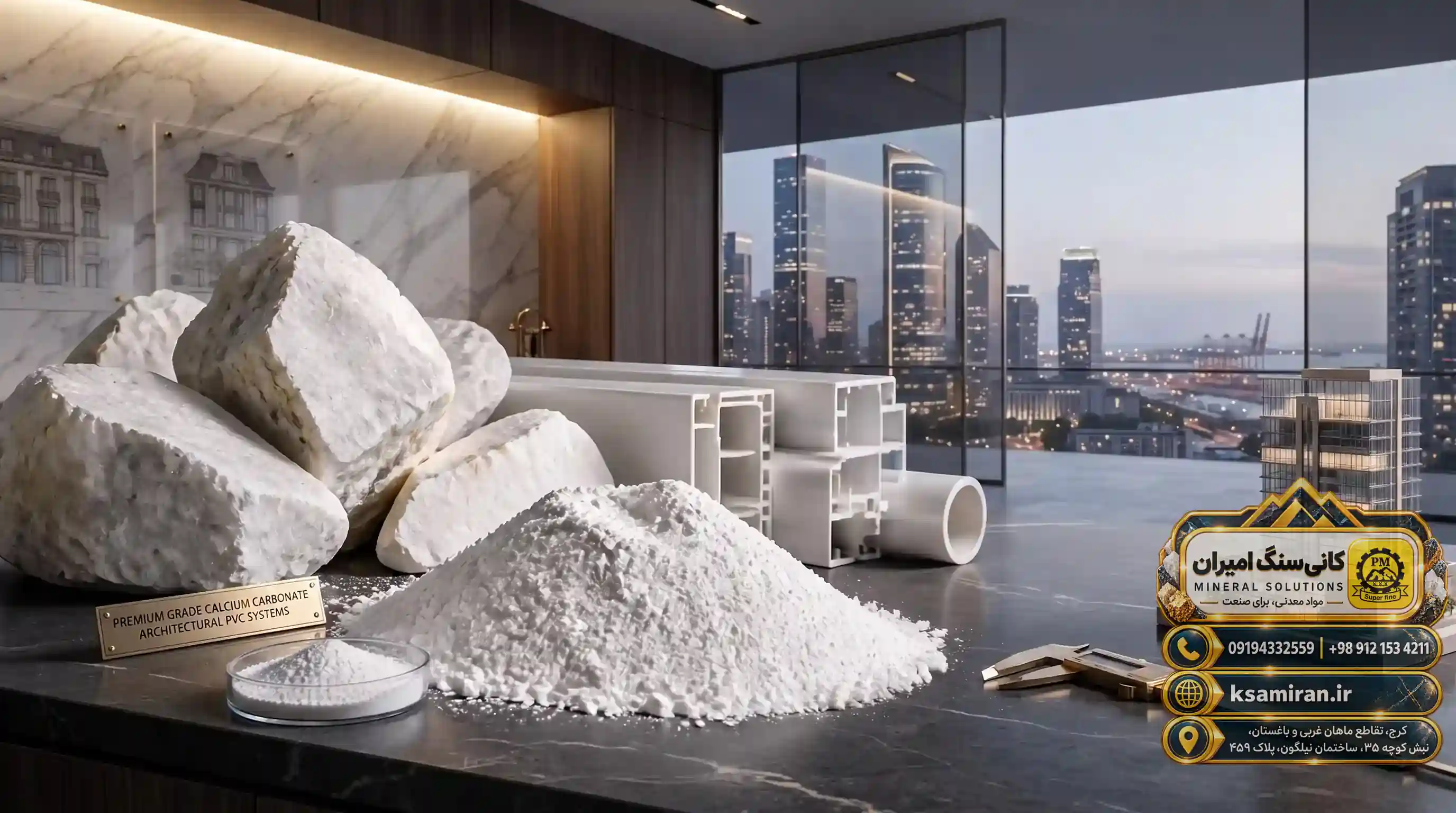
The Role of Calcium Carbonate in Paint, Paper, Adhesives, and Engineered Stone
Beyond pure polymer industries, the application of calcium carbonate in paint, paper, adhesive, and engineered stone industries is very extensive. In the paint industry, this material acts as an economical whitening pigment, improving opacity and paint whiteness, while acting as a bulk filler. In the paper industry, its use as a filler and paper surface coating reduces the consumption of expensive cellulose fibers while simultaneously increasing the printability and whiteness of the paper.
In the formulation of various adhesives and sealants, this mineral powder acts as a viscosity controller and improves the shear strength of the adhesive. Also, in the construction of engineered stones (artificial quartz or engineered marble stones), calcium carbonate particles are combined with polymer resins as a major part of the stone's volume, creating a product with a luxurious appearance and exceptional mechanical strength.
The diversity in the 100 to 3500 mesh range allows players in these industries to benefit from Kani Sang Amiran's products exactly according to their technological needs (from coarser meshes for engineered stone to very fine micronized meshes for specialized paints and papers).
The Effect of Mesh Range (100 to 3500 Mesh) on Final Product Properties
Selecting particle size, or the mesh range, is one of the most important engineering decisions when using calcium carbonate in various industries. The mesh range of the products offered varies from 100 mesh (coarser particles suitable for filling high volumes and engineered stone) to 3500 mesh (very fine and micronized particles suitable for premium paints, thin masterbatches, and polymer films).
The finer the particle size (higher mesh), the higher the Specific Surface Area of the particles, resulting in a stronger interaction between the mineral particles and the polymer matrix. This leads to improved impact resistance, improved tensile properties, and a completely smooth and polished surface in polymer parts. However, using very high meshes requires strong dispersing equipment and the use of coating additives to prevent particle aggregation.
The Kani Sang Amiran group, by utilizing advanced milling and granulation technologies, is capable of offering powders with a perfectly controlled and uniform Particle Size Distribution (PSD) in all requested ranges, which guarantees consistency of quality in industrial production lines.

Principles of Maintenance, Warehousing, and Mineral Powder Processing Techniques
Proper management of warehousing and the process of feeding raw materials to production lines has a direct impact on the final efficiency. Calcium carbonate powder, due to its powdery nature and high specific surface area, is susceptible to absorbing environmental moisture (especially in very fine micronized grades) and clumping. Therefore, storing bags in covered, dry environments away from direct sunlight and floor moisture is considered a basic principle of warehousing.
In polymer production lines, the use of accurate Loss-in-Weight Feeders for injecting the powder into extruders is essential to maintain the proportional weight percentage of the materials. Also, proper workshop ventilation and the use of Dust Collection Systems are necessary to maintain operator health and workspace cleanliness.
Adherence to safety and hygiene standards when working with micronized mineral materials ensures a safe and stable working environment. The Kani Sang Amiran project, with standard and moisture-resistant packaging, guarantees the safety and quality of the product until the moment of use in customers' factories.
Market Outlook and the Importance of Choosing a Reliable Supplier
With the increasing growth of polymer, paint, and engineering industries, the demand for high-quality and standard raw materials is always on the rise. The final quality of a polymer product depends directly on the chemical purity and physical uniformity of the filler materials. Fluctuations in the purity percentage of calcium carbonate or impurities present in it can cause severe quality degradation, color changes, or damage to extruder equipment.
Choosing a reliable and experienced supplier like the Kani Sang Amiran project gives production managers the peace of mind that the powder being used always has stable technical specifications, high purity, and precise granulation. This quality consistency minimizes hidden production costs, workshop waste, and unintended production line stoppages.
Ultimately, combining the technical knowledge of polymer engineers with high-quality mineral materials is the key to competitiveness in domestic and inteational markets. Smart investment in standard raw materials brings high added value to manufacturing industries and paves the way for sustainable development.

| Question | Answer |
|---|---|
| What is calcium carbonate and what are its applications? | It is a widely used mineral material used in polymer, paint, paper, adhesive, cable, and engineered stone industries. |
| What is the mesh range of Kani Sang Amiran products? | Products are produced and supplied in the 100 to 3500 mesh range. |
| What is the role of this material in PVC pipes? | It acts as a filler and stabilizer, improving the mechanical and dimensional resistance of the pipes. |
| Why is coated calcium carbonate used in masterbatches? | To improve compatibility with the polymer, prevent clumping, and ensure uniform distribution of particles in the polymer matrix. |
| Is this material also used in the paint industry? | Yes, as an economical whitening pigment, it increases the coverage coefficient and whiteness of the paint. |
| What is the effect of high meshes (micronized) on polymers? | It leads to improved tensile properties, impact resistance, and surface smoothness of the final part. |
| What should the storage conditions for mineral powder be? | It must be stored in dry, covered environments away from moisture. |
| Which industries use engineered stone and what is the role of this powder? | It is used in construction and decorative industries, and this powder forms the main volume of the stone structure. |
| How can this product be ordered? | By visiting the calcium carbonate product page on the Kani Sang Amiran website. |
| Why is choosing a reliable supplier important? | To maintain quality consistency, prevent waste, and ensure stable technical specifications in production lines. |
Kani Sang Amiran project, a specialized reference for supplying mineral and industrial materials.
برچسب: Calcium Carbonate,The Role of Calcium Carbonate in the Production of Polymer Products,
نویسنده: رساوب آفرین