
درباره سایت
آخرین مطالب
- انتخاب اکسید آهن قرمز (اخرا) برای بهبود کیفیت پیگمنت و پوششهای رنگی
- تامین کربنات کلسیم با دانهبندی دقیق جهت استفاده در مستربچ
- تأمین تخصصی سیلیس برای مصالح ساختمانی، شیشه و صنایع سرامیک
- ویژگیهای فنی بنتونیت کانی سنگ امیران برای کاربردهای خاص
- فلدسپات کانی سنگ امیران برای شیشه کاشی و سرامیک
- کاربرد تالک سفید درجه یک در فرمولاسیون پیشرفته رنگ و محصولات کاغذی
- اکسید آهن قرمز (اخرا) کاربردی جهت تولید محصولات سرامیکی و پوشش
- مشخصات فنی اکسید آهن قرمز (اخرا) مناسب برای پوشش و تولید پیگمنت
- مشاوره تخصصی خرید کربنات کلسیم بر اساس نیاز دقیق صنعت شما
- انتخاب تالک سفید صنعتی مناسب برای تولیدات کاغذ و مستربچ
امکانات وب
Introduction to the Importance of Kaolin in Mineral and Welding Industries
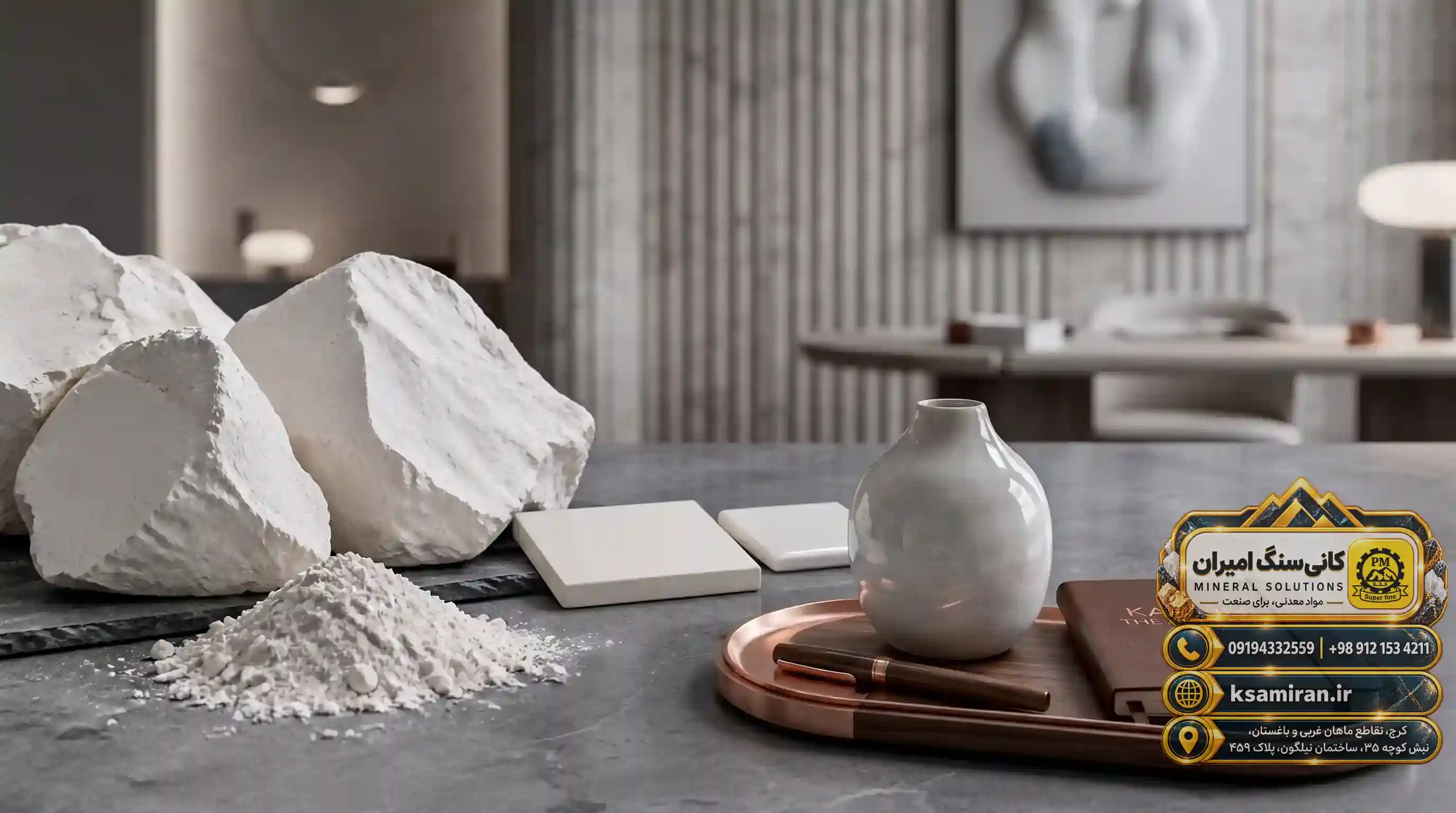
Introduction: Mineral industries have always been recognized as the foundation of many manufacturing processes in the world. Among various minerals, kaolin holds a special place due to its unique physical and chemical characteristics. Known as a hydrated aluminum silicate, this material is widely used not only in traditional products but also in advanced industries. A precise understanding of this material's properties helps engineers and manufacturers significantly increase the productivity of their production lines.
The stable chemical composition and sheet-like structure of this mineral have enabled it to play a role in various industries such as tiles and ceramics. In addition to well-known applications, examining this material in more specialized fields such as the manufacture of welding electrodes presents new challenges and opportunities for industrialists. In this article, we intend to examine the various dimensions of using this mineral and scrutinize its technical details.
Mining and processing this material require advanced techniques to provide the purity and particle size distribution required by various industries. Leading companies in this field use mode equipment to produce powders with precise specifications suitable for sensitive applications. Detailed study of the thermal and mechanical behavior of this material is the key to success in mode industrial formulations.
Further in the discussion, the necessity of using high-quality minerals and particle sizing standards will be examined. Manufacturers are constantly seeking raw materials that provide the necessary thermal stability under harsh industrial conditions. Accurate identification of these parameters lays the groundwork for developing higher-quality products in today's competitive market.
Technical Characteristics and Mesh Size of Kaolin in Industrial Applications
Physical specifications and particle size distribution of minerals are among the most important factors in determining the final product quality. Kaolin powder is supplied in a mesh range of 450 to 1500 mesh, and this variety in mesh size makes it possible to use it in a wide spectrum of industries. The fine and uniform particle size of these powders significantly helps improve the rheological and coating properties of materials.
Micronized powders with high mesh sizes are usually used in applications requiring a larger contact area and very fine particles. The particle size distribution in these products is controlled to achieve the lowest level of impurities and the highest stability against heat and chemical reactions. These features are of vital importance for complex industrial processes.
Kani Sang Amiran mineral project, as a reputable mineral producer, has provided access to these products with precise technical specifications. You can visit the official kaolin page for more information and to view product details to check the complete specifications. Careful selection of the appropriate mesh based on production line requirements prevents quality issues during manufacturing steps.
Laboratory investigations show that dimensional stability and resistance to thermal stresses are prominent advantages of using powders with standard particle sizes. These powders act as fillers or main ingredients in formulations and improve the mechanical and appearance properties of the product.
The Role of Kaolin in the Tile, Ceramic, and Glaze Industry
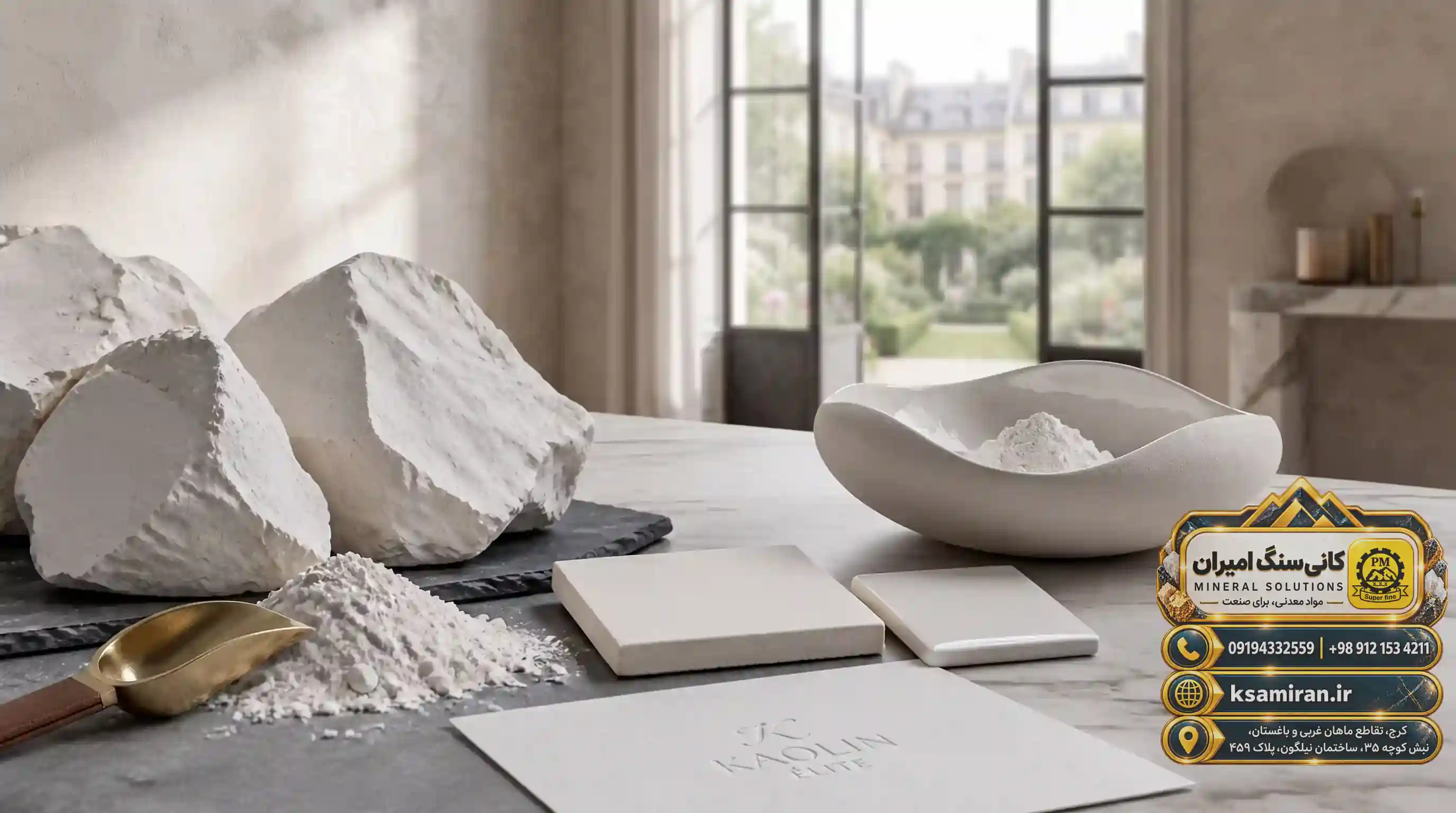
The tile and ceramic industry is considered one of the largest consumers of minerals in the world. The structural characteristics of kaolin have made this material used as a primary component in tile bodies, ceramic products, and glazes. Suitable plasticity in the wet state and desirable firing capability in industrial kilns are key advantages of this material in ceramics.
In glaze production, the use of high-mesh micronized powders helps create a smooth, uniform, and defect-free surface. This material acts as a weak flux and adjusts the glaze viscosity at high temperatures, resulting in a glossy and abrasion-resistant coating formed on the ceramic surface. The color-reception quality of the glaze is also improved with the presence of this material.
Ceramic body formulation requires precise control of thermal expansion. The presence of this mineral in the body composition increases thermal stability and prevents warping or cracking of products during the firing process. This greatly increases production line efficiency and minimizes factory waste.
Manufacturers can produce tiles and ceramics with inteational standards by utilizing high-quality mineral resources. Continuity in raw material quality is the key to maintaining market share in the ceramic industry, which doubles the importance of using processed minerals.
Diverse Applications of Kaolin in the Paper and Paint Industries
In addition to the ceramic industry, the papermaking and dyeing industries also account for a major share in the consumption of this mineral. In the paper industry, kaolin is used as a filler and coating to significantly increase the whiteness, brightness, and smoothness of the paper surface. These features bring print quality on paper to the highest possible level.
In the paint and industrial coatings industry, this material is used due to its suitable optical properties and high hiding power. The fine particles of this material help distribute the pigment uniformly and prevent them from settling inside containers. Also, resistance to weather and chemical factors of paints is improved by adding this material.
It is worth noting that the applications of this mineral are not limited to the mentioned industries; rather, it has expanded to other specialized fields. For example, to gain more information about engineering applications, reading the article Reviewing the Application of Kaolin in the Car Tire Manufacturing Industry is recommended, which gives you a more comprehensive perspective.
Industrial research has also shown that using these powders in advanced formulations can enhance the barrier and mechanical properties of coatings. This high flexibility makes the desired material one of the most versatile mineral items in the supply chain of various industries.
The Importance of Minerals in Electrode Production and Welding Industries
The welding industry requires very precise consumable materials that can maintain stability at extremely high temperatures and create a stable electric arc. The electrode coating, commonly referred to as flux, consists of a mixture of various minerals, each performing a specific task. Slag control, protection of the molten pool against oxidation, and arc stabilization are among these tasks.
Meanwhile, the use of high-quality mineral fillers and stabilizers in the electrode coating is of vital importance. Although kaolin is not directly introduced as the main flux material for all electrodes, its silicate characteristics and thermal stability pave the way for examining the applications of similar mineral derivatives in related industries. Electrode manufacturers are constantly looking to improve weld mechanical properties and reduce smoke and spatter.
In addition to the welding industry, examining the role of this material in other heavy and infrastructural industries is also important. For instance, studying the article The Role of Kaolin in the Pipe Making and Concrete Products Industry sheds light on new dimensions of this material's application in strengthening industrial structures.
A precise understanding of mineral behavior under severe thermal conditions enables engineers to develop more optimal formulations for heat-resistant coatings and specialized electrodes. This dramatically improves the quality of welded joints in civil and industrial projects.
Development of Mode Technologies and Chemical Catalysts with Kaolin
With the advancement of materials science and mode technologies, the demand for using minerals with specific structures has increased. The layered structure and high specific surface area in kaolin have led researchers to consider this material as a support or precursor in the synthesis of advanced chemical catalysts. These catalysts play a key role in refinery and petrochemical processes.
To better understand this subject and get acquainted with related chemical processes, reading the article The Role of Kaolin in Advanced Chemical Catalyst Production provides useful information for enthusiasts. These applications demonstrate the high potential of this mineral beyond its traditional uses.
Purification and activation of this material for use in high-tech industries require complex chemical and thermal processes that optimize its crystal structure. These structural changes lead to increased reactivity and improved efficiency of catalytic reactions in industrial reactors.
Investing in research and development (R&D) on base minerals like this material paves the way for achieving indigenous technologies and industrial self-sufficiency. Manufacturing companies respond to the growing needs of advanced industries by upgrading their processing technology.
Quality Control and Production Standards of Micronized Powders
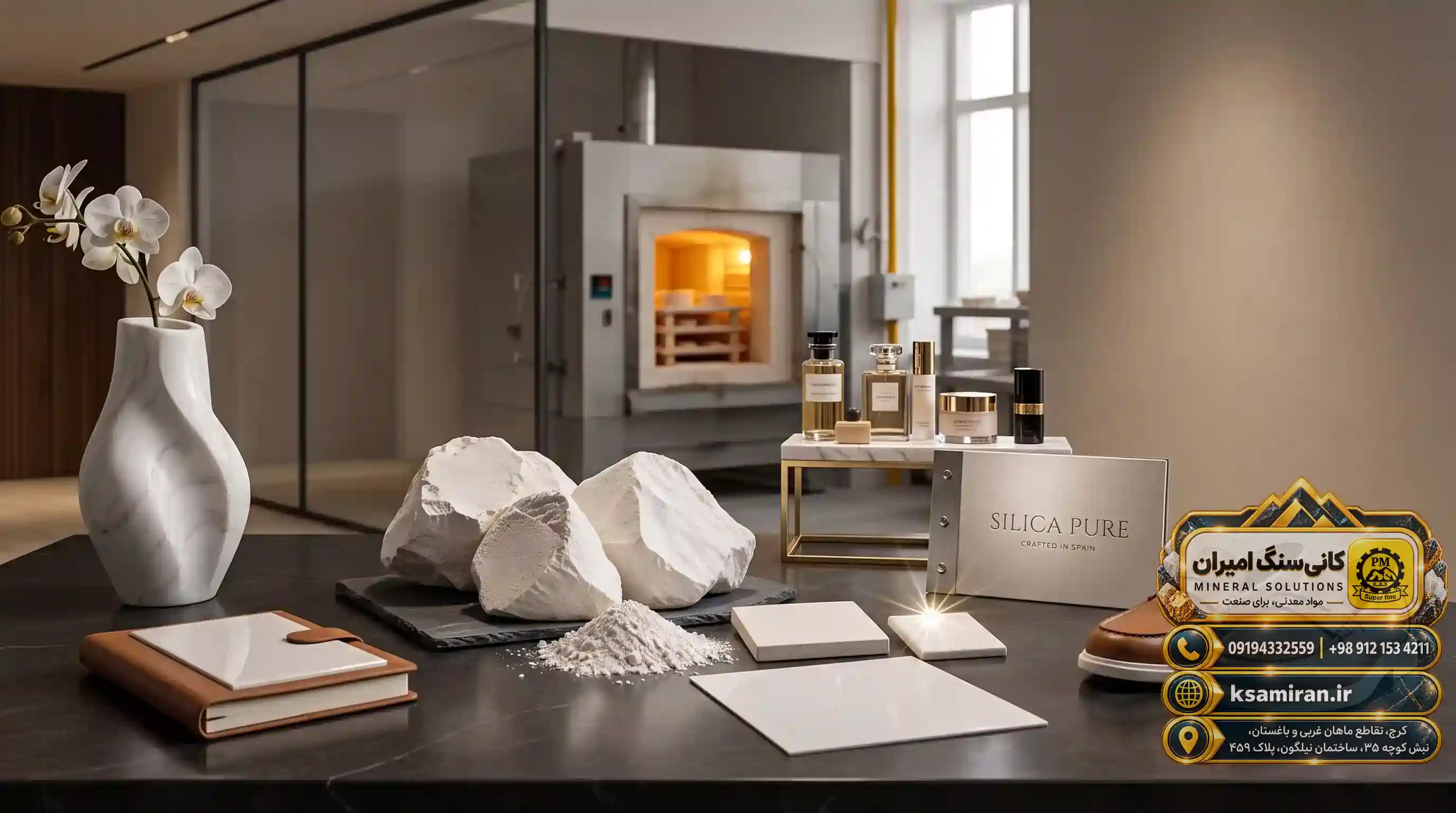
Quality assurance in mineral production lines is a vital step that directly affects the performance of the final product in industry. The production process of kaolin includes stages of extraction, primary crushing, drying, and finally micronization using advanced mills to achieve the mesh range of 450 to 1500 mesh. At each stage, strict quality control is performed to ensure the absence of metallic and mineral impurities.
Particle size distribution (PSD) tests, moisture content measurement, whiteness percentage determination, and chemical tests are among the measures performed in quality control laboratories. These standards ensure that the powder delivered to customers has a uniform and stable performance. Fluctuations in raw material quality can cause irreparable damage to tile, paint, or ceramic production lines.
Kani Sang Amiran project, relying on up-to-date technical knowledge and mode laboratory equipment, applies strict standards in the production process. The main goal is to provide a high-quality product consistent with daily industry needs that brings consumer satisfaction.
Observing environmental and workshop safety standards is another priority for mineral producers. Waste management and dust emission reduction in processing units demonstrate the mining industry's commitment to sustainable development and community health preservation.
Conclusion and Future Outlook of the Mineral and Welding Market
A comprehensive review of the applications and properties of kaolin shows that this mineral is recognized as a key component in the supply chain of various industries including tiles, ceramics, glazes, paper, and paint. Given the mesh range variety from 450 to 1500 mesh, access to quality products for various industries has been facilitated more than ever.
The welding industry and its consumable materials production also require high-quality and stable raw materials to ensure the quality standards of metal structures. Although production technologies are constantly changing and updating, the role of base minerals in improving the physical and mechanical properties of final products is undeniable. The development of mode processing methods heralds the emergence of new applications for this valuable material in the near future.
Ultimately, choosing reputable and committed suppliers such as Kani Sang Amiran project guarantees stable access to high-quality raw materials. Close cooperation between research centers and the mining industry can pave the way for solving existing technical challenges and laying the groundwork for producing more advanced products in the country.
It is hoped that this article has been able to provide a clear and practical perspective of the various technical and industrial dimensions of this mineral and help improve production processes in various industries.
| Question | Answer |
|---|---|
| What is kaolin and what is its composition? | It is a hydrated aluminum silicate recognized as a widely used mineral in various industries. |
| What is the mesh range of the produced kaolin powder? | This product is produced and supplied in a mesh range of 450 to 1500 mesh. |
| What are the main applications of this mineral? | Its main applications include tiles, ceramic products, glazes, paper, and paint. |
| How can the complete specifications of this product be viewed? | By visiting the official product page on the Kani Sang Amiran website, you can review complete information. |
| What is the role of this material in the tile and ceramic industry? | It acts as a primary component of the body and glaze and improves plasticity and thermal stability. |
| Why is the particle size and mesh of the powder important? | Proper particle sizing helps improve coating properties, rheology, and stability in the final product. |
| Is this material also used in the papermaking industry? | Yes, it is used as a filler and coating to increase the whiteness and smoothness of the paper surface. |
| What is the role of kaolin in paint and coating industries? | It increases hiding power and helps uniform pigment distribution. |
| Does this material play a role in the production of chemical catalysts? | Yes, its layered structure is used as a support in synthesizing advanced catalysts. |
| Which organization supplies this mineral? | Kani Sang Amiran project supplies these products as a mineral producer. |
Specialized reference for mineral information and industrial products of Kani Sang Amiran.
برچسب: Kaolin,The Role of Kaolin in the Welding Industry and Electrode Production,
نویسنده: رساوب آفرین