
درباره سایت
آخرین مطالب
- Why is choosing Limonite Oxide (Gole Mash) important for industries?
- چگونه بهترین فرمولاسیون با اکسید لیمونیت (گل ماش) بسازیم؟
- لماذا يعد اختيار أكسيد الليمونيت (أوكر أصفر/كلماش) مهماً للصناعات؟
- دور أكسيد الليمونيت (الجول ماش) في إنتاج الطوب والفخار
- Examining the Effect of Limonite Oxide (Gol Mash) on Color Stability
- مراجعة مزايا الشراء بالجملة لأكسيد الليمونيت (غل ماش)
- دور أكسيد الليمونيت (الغل ماش) في الصناعات الدوائية ومستحضرات التجميل
- بررسی میزان سختی و سایش اکسید لیمونیت (گل ماش)
- Application of Limonite Oxide (Gole Mash) in Anti-Rust Industries
- نقش اکسید لیمونیت (گل ماش) در تولید پوششهای محافظ
امکانات وب
Introduction to the Role of Silica in Industrial Concrete Engineering
Industrial concrete is one of the primary materials in mode construction, heavy structures, bridges, and infrastructure projects. To enable these structures to withstand severe mechanical stresses, weathering agents, and continuous loading, improving the physical and chemical properties of concrete is of utmost importance. In this regard, the use of quality-driven mineral additives and fillers plays a decisive role. Silica, as one of the most fundamental minerals, holds a special place in the formulation of building and industrial materials.
In this article, we examine the impact of silica quality on the durability and strength of industrial concrete. Possessing unique structural characteristics, this mineral has successfully enhanced material quality standards. A precise understanding of its properties helps engineers make more optimal choices in their civil projects. Furthermore, exploring related processes such as A Comprehensive Review of Industrial Silica Production and Processing sheds more light on the technical dimensions of this field.
In addition to its widespread application in construction materials, this substance plays a key role in other industries as well. The glass industry, foundry products, and ceramic products are among the sectors directly associated with this mineral. Understanding this industrial value chain demonstrates how significantly raw material quality affects the final product and how it can improve structural performance.
Physical and Chemical Properties of Silica in Building Materials
The physical and chemical properties of raw materials used in concrete determine the ultimate behavior of the structure after setting and hardening. Mineral powders and grains create a denser structure by filling the inter-granular voids. In this context, the structural quality of this material plays a direct role in reducing concrete permeability and consequently increasing its long-term stability. To better understand the importance of filler minerals in various industries, comparing their behavior with other additives such as Reviewing the Physical and Mechanical Properties of Industrial Talc Powder will be very enlightening.
Mesh sizing and particle grading of minerals are key factors in construction engineering. The standard mesh range is of great importance for various applications. This material is supplied in a mesh range of 10 to 450 mesh, and this broad coverage enables its use in diverse construction, ceramic, and glass-making formulations. The precise selection of particle size greatly contributes to the uniform distribution of materials within the concrete matrix.
A stable chemical composition and appropriate purity are other features that make this mineral an ideal choice. The presence of high-quality particles in the industrial concrete structure prevents undesirable alkali-aggregate reactions and significantly increases the compressive and flexural strength of the structure in corrosive industrial environments.

The Role of Silica in Enhancing Compressive and Mechanical Strength of Concrete
Compressive strength is the primary parameter in the design and evaluation of concrete structures. Due to bearing heavy loads, industrial concrete requires a compact matrix free from air bubbles and micro-cavities. The presence of fine-grained mineral particles with appropriate mesh distribution improves the structural density of concrete. This directly leads to an increase in the ultimate compressive strength of the structure at various ages.
In addition to compressive strength, the overall mechanical strength of concrete—including flexural and shear strength—is improved under the influence of raw material quality. When mineral particles react with cement and other additives or act as active filters, stronger intermolecular bonds are formed within the cement matrix structure. This phenomenon distributes incoming stresses more uniformly throughout the entire volume of concrete.
Alongside concrete, the ceramic and foundry industries also benefit from these mechanical features. In ceramic products, thermal stability and structural strength heavily depend on raw material quality. Moreover, in foundry products, molds prepared with this material can withstand extremely high temperatures without deformation or loss of stability and strength.
The Effect of Mesh Quality on Durability and Permeability of Industrial Concrete
The durability of industrial concrete depends on its resistance to destructive environmental factors such as water infiltration, aggressive ions, chlorides, and sulfates. Low permeability is the main indicator of high-quality concrete. If the consumed materials lack proper grading and mesh sizing, capillaries and open pores will remain within the concrete structure, paving the way for corrosive agents to enter.
The mesh range from 10 to 450 mesh allows engineers to select the optimal mesh according to the project type and the required degree of compaction. Finer particles effectively block micro-capillary pores and prevent the movement of destructive fluids inside the concrete. This mechanism is especially vital in hydraulic structures, water reservoirs, and marine jetties.
Compared to surface coatings that require visual beauty and resistance to weather conditions—similar to what is examined in Examining the Effect of Kaolin on Gloss and Durability of Industrial Coatings—the main focus in industrial concrete is on bulk integrity, inteal density, and resistance to deep permeability, which is achieved through the precise grading of minerals.

Key Applications of Silica in Glass, Foundry, and Ceramic Industries
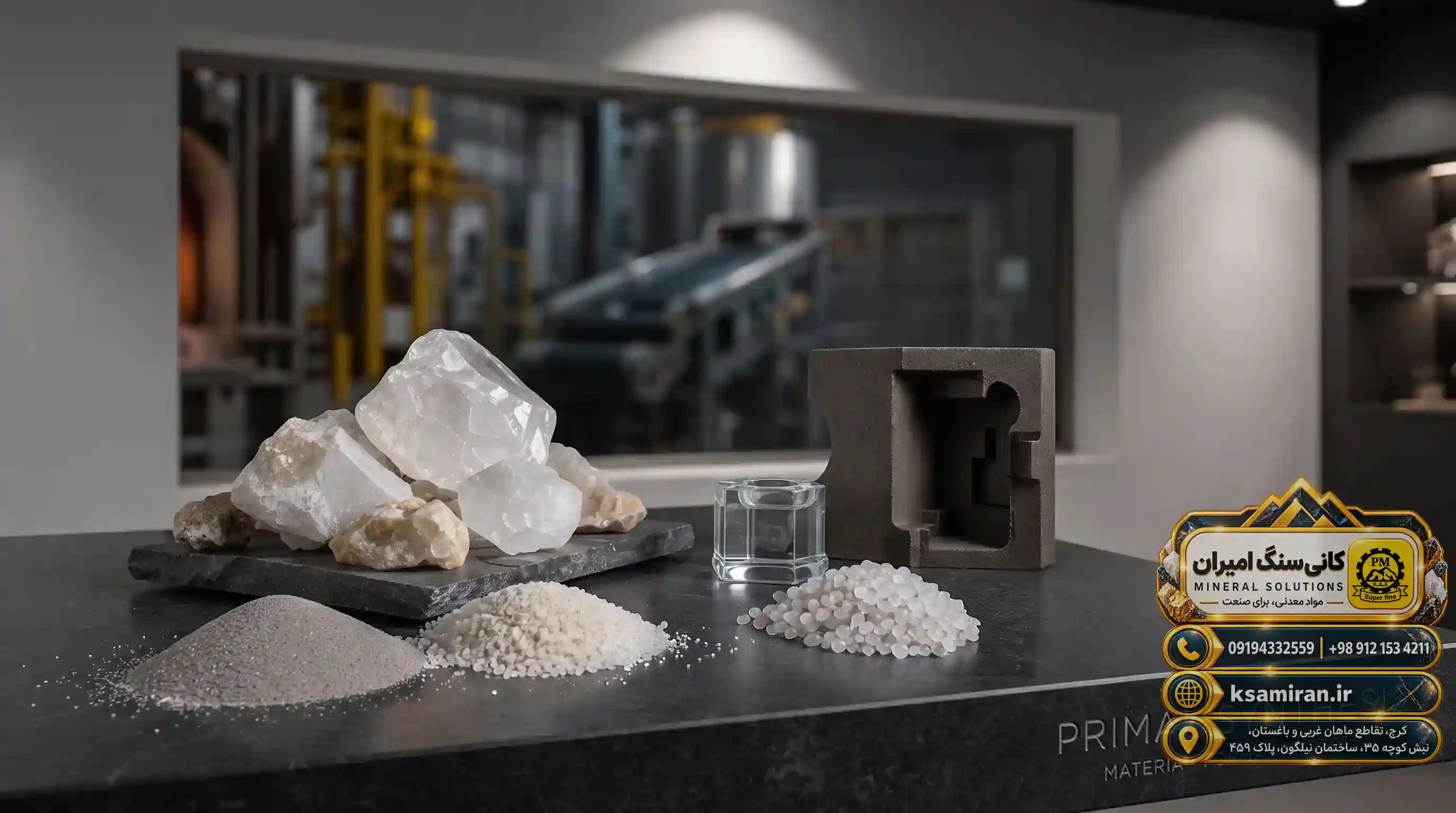
Beyond the construction industry, this mineral has wide applications across various industrial sectors. The glass manufacturing industry is one of the largest consumers of this material, where purity and particle size directly affect the transparency, melting point, and overall quality of the produced glass. The presence of impurities can cause unwanted bubbles or pigments in the glass.
In the foundry industry, this material is extensively used to make molding sand and foundry cores. The high thermal stability of this material ensures that the molds retain their shape against molten metal and do not suffer from collapse or destructive chemical reactions. This brings the dimensional accuracy of cast parts to the highest level.
Ceramic products are also heavily dependent on this material. In the body and glaze of tiles, ceramics, and sanitary ware, this material acts as a mineral skeleton and prevents the deformation of parts in firing kilns. Matching raw material quality with the standards of each industry guarantees higher efficiency and reduced production waste.
Quality Control Methods and Purity Evaluation at Kani Sang Amiran Project
The production of standard minerals requires rigorous quality control processes at all stages of extraction, crushing, sizing, and packaging. Relying on technical knowledge and advanced equipment, the Kani Sang Amiran project supplies its mineral products to the market with the highest quality standards to best cover the needs of various industries.
Evaluation of chemical purity, measurement of accompanying oxides, and precise determination of mesh data are among the measures carried out in quality control laboratories. The absence of harmful impurities such as iron compounds or high moisture in these materials provides peace of mind for end-users in sensitive industries like glass manufacturing and ceramics.
Precise control of particle size distribution within the range of 10 to 450 mesh helps ensure that the production line output is completely homogeneous and compliant with customer orders. This consistency in quality allows civil engineers and industrial designers to implement their formulations with minimal possible error and achieve stable, reliable results.
The Effect of Raw Material Quality on the Lifespan and Stability of Industrial Structures
The useful lifespan of industrial structures is directly related to the quality of the materials used in them. In harsh industrial environments such as chemical plants, refineries, and power plants, concrete is constantly exposed to chemical attacks, acids, mechanical abrasion, and severe thermal cycles. The use of high-quality additives and fillers can significantly increase concrete's resistance to these destructive agents.
When the concrete matrix becomes denser due to the use of high-grade and standard mineral particles, the penetration rate of corrosive agents into the concrete is minimized. Consequently, the reinforcing rebars inside the concrete are protected from corrosion and rusting, preventing premature failures and exorbitant repair costs.
Therefore, investing in the preparation of standard and high-grade raw materials is not an extra cost, but an economical solution to guarantee structural stability in the long term. The careful selection of appropriate mesh and ensuring material purity will guarantee the optimal performance of industrial concrete under harsh operational conditions.
Conclusion and Future Outlook of Silica Consumption in Concrete Engineering
As a strategic mineral, silica quality plays a decisive role in enhancing durability, compressive strength, and reducing the permeability of industrial concrete. The breadth of this material's application—from the glass, foundry, and ceramic industries to construction materials—demonstrates its irreplaceable importance in the industrial supply chain. The precise matching of mesh sizes between 10 to 450 mesh with the needs of various projects provides engineers with high flexibility.
With advancements in construction technologies and increasing environmental and structural durability standards, the use of high-quality and standard minerals becomes even more important. By producing and specially processing these products, the Kani Sang Amiran project plays a significant role in supplying high-grade raw materials for the country's industries.
Ultimately, paying attention to technical details such as chemical purity, particle size distribution, and processing conditions is the key to success in implementing sustainable civil and industrial projects. Utilizing this technical knowledge will bring a safer, higher-quality, and more economical future for the country's construction and manufacturing industry.

| Question | Answer |
|---|---|
| What is silica and what are its applications? | It is a vital mineral compound introduced for glass, foundry, ceramics, and construction materials. |
| What is the silica mesh range offered by Kani Sang Amiran? | These products are supplied in a mesh range of 10 to 450 mesh. |
| What are the main applications of this mineral? | Main applications include glass, foundry products, ceramic products, and construction materials. |
| How does the quality of this material affect industrial concrete durability? | By filling cavities, densifying the concrete structure, and reducing permeability against destructive environmental factors. |
| Why are grading and mesh sizing important in concrete? | Proper mesh sizing leads to uniform particle distribution and increases the compressive and mechanical strength of the structure. |
| What is the role of this material in the foundry industry? | It is used to make molding sand and maintain the thermal stability of the mold against molten metal. |
| Is chemical purity important in the glass manufacturing industry? | Yes, high purity prevents the formation of unwanted bubbles and pigments and ensures glass transparency. |
| How does raw material quality prevent rebar corrosion? | By reducing concrete permeability, it prevents water and aggressive ions from entering the ier layers and rusting the reinforcements. |
| In what fields are Kani Sang Amiran products applied? | They have widespread applications in mineral, construction, glass, ceramic, and foundry industries. |
| How can one obtain more information and order the product? | You can visit the Kani Sang Amiran website at https://ksamiran.ir/products/silica/ to receive complete information. |
Kani Sang Amiran Project — Production of Mineral and Industrial Materials. https://ksamiran.ir/products/silica/

برچسب: Silica,The Impact of Silica Quality on the Durability and Strength of Industrial Concrete,
نویسنده: رساوب آفرین