
درباره سایت
آخرین مطالب
- استخدام أكسيد الليمونيت (الماغش) في صناعات الزجاج
- کاربرد اکسید لیمونیت (گل ماش) در صنایع شیشهسازی
- A Review of Daily Prices for Limonite Oxide (Ocher) in the Market
- چگونه خالص بودن اکسید لیمونیت (گل ماش) را تشخیص دهیم؟
- بررسی قیمت روز اکسید لیمونیت (گل ماش) در بازار
- Application of Limonite Oxide (Gole Mash) in Glassmaking Industries
- كيف تتعرف على نقاء أكسيد الليمونيت (جول ماش)؟
- How to Determine the Purity of Limonite Oxide (Gol Mash)?
- بررسی استانداردهای ایمنی کار با اکسید لیمونیت (گل ماش)
- Comprehensive Guide to Technical Analysis of Limonite Oxide (Gol Mash)
امکانات وب
Introduction to the Importance of Standards in White Talc Production
White talc is one of the most widely used industrial minerals in today's world. The crystalline structure of this material, composed of hydrated magnesium silicate, gives it unique properties such as very high softness, a greasy surface, bright white color, good thermal stability, and good chemical resistance. These very properties have given white talc a key position in a wide range of industries, from the production of masterbatch and polymer compounds to the paint, paper, and ceramics industries.
In the Kani Sang Amiran Project, white talc is produced and offered in different milling grades in the range of 450 to 2500 mesh to cover the diverse needs of various industries. To get acquainted with the exact specifications of this product, you can visit the White Talc page. However, the breadth of application and the variety of mesh grades raise an important issue: without clear and reliable standards, producers and consumers can never reach a common language to define quality.
Standardization in white talc production is important for several basic reasons. First, the talc mineral is naturally impure in the mine; heavy metals, iron oxide, carbonates, and other accompanying minerals can severely affect the final quality of the product. Standards specify the permissible level of these impurities and how they should be measured. Second, properties such as whiteness, particle size distribution, moisture, and oil absorption directly affect the performance of talc in the final process; for example, a masterbatch producer needs talc with high whiteness and uniform particle distribution so that the color of the final product does not degrade.
The third reason is safety and environmental issues. Talc faces health questions in some applications, and inteational standards provide guidelines for controlling contaminants such as asbestos-series minerals. Ultimately, standardization is the bridge between the mine, the processing plant, and the final industry, and it prevents commercial disputes. From an economic perspective, complying with standards means access to larger markets and creating long-term trust among industrial buyers. In this article, an attempt is made to comprehensively review the national and inteational standards for white talc production so that producers, importers, and industrial consumers have a clear view of the quality of this mineral.
Iranian National Standards in White Talc Production
In Iran, the responsible body for developing and publishing standards is the Iran Organization for Standardization, formerly known as the Institute of Standards and Industrial Research of Iran. This organization is tasked with developing national standards for mineral and industrial products in collaboration with specialized technical committees. In the field of industrial minerals, including talc, national standards generally address test methods, permissible impurity limits, physical properties, and packaging and labeling conditions.
One of the basic approaches in national standards is defining the sampling method from a stockpile or shipment. Sampling of powdered talc must be done in such a way that the sample represents the entire shipment; otherwise, the results of subsequent tests will be invalid. Standards also specify test methods for parameters such as moisture, loss on ignition (LOI), whiteness, and particle size so that the reported results from different laboratories are comparable. This methodological harmonization is the foundation of qualitative validations in the supply chain.
Alongside product standards, talc processing plants are typically evaluated based on quality management system standards such as ISO 9001. These standards ensure that production, testing, and quality control processes are documented and auditable. For producers intending to export white talc, having certificates based on national and inteational standards is often a condition for entering new markets and obtaining necessary licenses.
An important part of national standards is dedicated to packaging, transportation, and labeling conditions. Due to its low bulk density and dust generation potential, powdered talc must be offered in suitable packages and with a label including full product specifications, mesh grade, production date, and shipment identifier. These measures help track the product in the market and prevent mixing with non-standard products.
An important point regarding national standards is that these documents are continuously updated; old versions may not be aligned with the needs of today's industries. Therefore, producers and consumers of white talc must always ensure they are using the latest published version of the relevant standards. Also, in some cases, Iranian national standards are developed as equivalents to inteational standards to create greater alignment with global markets. This alignment is of particular importance for a company like the Kani Sang Amiran Project, which operates in the supply chain of the polymer, paint, paper, and ceramics industries, because industrial buyers often request precise and up-to-date standard documentation as part of their purchase contracts.

Inteational Standards in White Talc Production
Inteationally, several specialized bodies have developed standards for talc and similar industrial minerals. The Inteational Organization for Standardization (ISO), ASTM Inteational, and the European Committee for Standardization (CEN) are among the recognized authorities. These standards are divided into two general categories: "product standards" and "test method standards," each playing a distinct role in the white talc value chain.
In the paint industry, the ISO 3262 series of standards, dedicated to "extenders for paints," is one of the most well-known references. This series of standards specifies the requirements and test methods for mineral fillers, including talc. In the polymer and plastics sector, ISO standards related to mineral fillers cover properties such as particle size distribution, oil absorption, and moisture, which are vital for masterbatch and compound production. In the papermaking sector, standards related to filler materials and test methods for ash, brightness, and opacity are applicable.
In the United States, ASTM has published specific standards for talc in various applications. These documents address chemical, physical properties, and even packaging and labeling requirements. In Europe, chemical regulations such as REACH are important for controlling the safety of imported materials, including talc, and foreign producers intending to export to the European market must comply with these frameworks. Inteational technical committees, with the participation of mining, chemistry, and materials engineering experts, update these documents based on the latest scientific findings and industry needs.
One of the most important issues in inteational talc standards is asbestos contamination control. Since talc is sometimes found in nature alongside asbestos-series minerals, many national and inteational standards and regulations require that talc used in sensitive industries be asbestos-free, and this must be confirmed with analytical methods such as X-ray Diffraction (XRD). Harmonizing national standards with inteational documents helps producers bring their products to global markets without the need for duplicate testing.
For producers like the Kani Sang Amiran Project, which offers white talc in a wide range from 450 to 2500 mesh for various industrial applications, a precise understanding of these standards means the ability to respond to the needs of domestic and foreign buyers. Also, industrial customers can use these documents as a clear criterion for evaluating different suppliers and reducing quality risk in their supply chain.
Standard Physical and Chemical Indicators of White Talc
The quality of white talc depends on a set of physical and chemical indicators that national and inteational standards define and limit for each. Familiarity with these indicators is essential for industrial consumers, as choosing incorrectly can severely affect the final product's quality. For a more detailed examination of these properties, the article Review of Physical and Chemical Properties of High-Quality White Talc is a good source, but the most important parameters are briefly introduced below.
The first indicator is "Whiteness." In applications such as masterbatch, paint, and paper, high whiteness is a fundamental requirement, because talc must fit into the final formulation without causing color change. Whiteness measurement is usually done with colorimeters and based on standard color scales. The second indicator is "purity grade"; pure talc in its chemical structure contains magnesium, silicon, oxygen, and hydrogen, but impurities such as iron oxide, calcium carbonate, and alumina can be present in the mine. The iron content is particularly important because it negatively affects the final color of the product.
The third indicator is "moisture." Powdered talc must have controlled moisture so that it does not encounter problems such as improper dispersion or quality loss in polymer processes and masterbatch production. The fourth indicator is "Loss on Ignition" or LOI, which indicates the amount of volatile materials and organic impurities. The fifth indicator is "Oil Absorption," which is important in the paint and coating industry and determines how much oil is needed to completely wet the surface of the talc particles. This parameter has a direct effect on the viscosity and stability of formulations.
Alongside these, pH, bulk density, particle shape (platy or acicular), and light reflection are among the indicators mentioned in product Data Sheets. Bulk density and angle of repose of talc are important in the design of silos and conveying systems in consumer plants, and the platy shape of talc particles helps reinforce mechanical properties in polymer compounds.
Professional producers, by controlling these parameters during processing, offer white talc that matches the needs of each industry. For example, the talc needed by a paper mill differs significantly in mesh grade, whiteness, and oil absorption from the talc used by a masterbatch producer, and standards provide a framework for this differentiation. Consequently, requesting a complete data sheet and matching it with the requirements of one's own process is the first option in selecting a supplier.
Particle Size and Mesh Grade Standards in White Talc
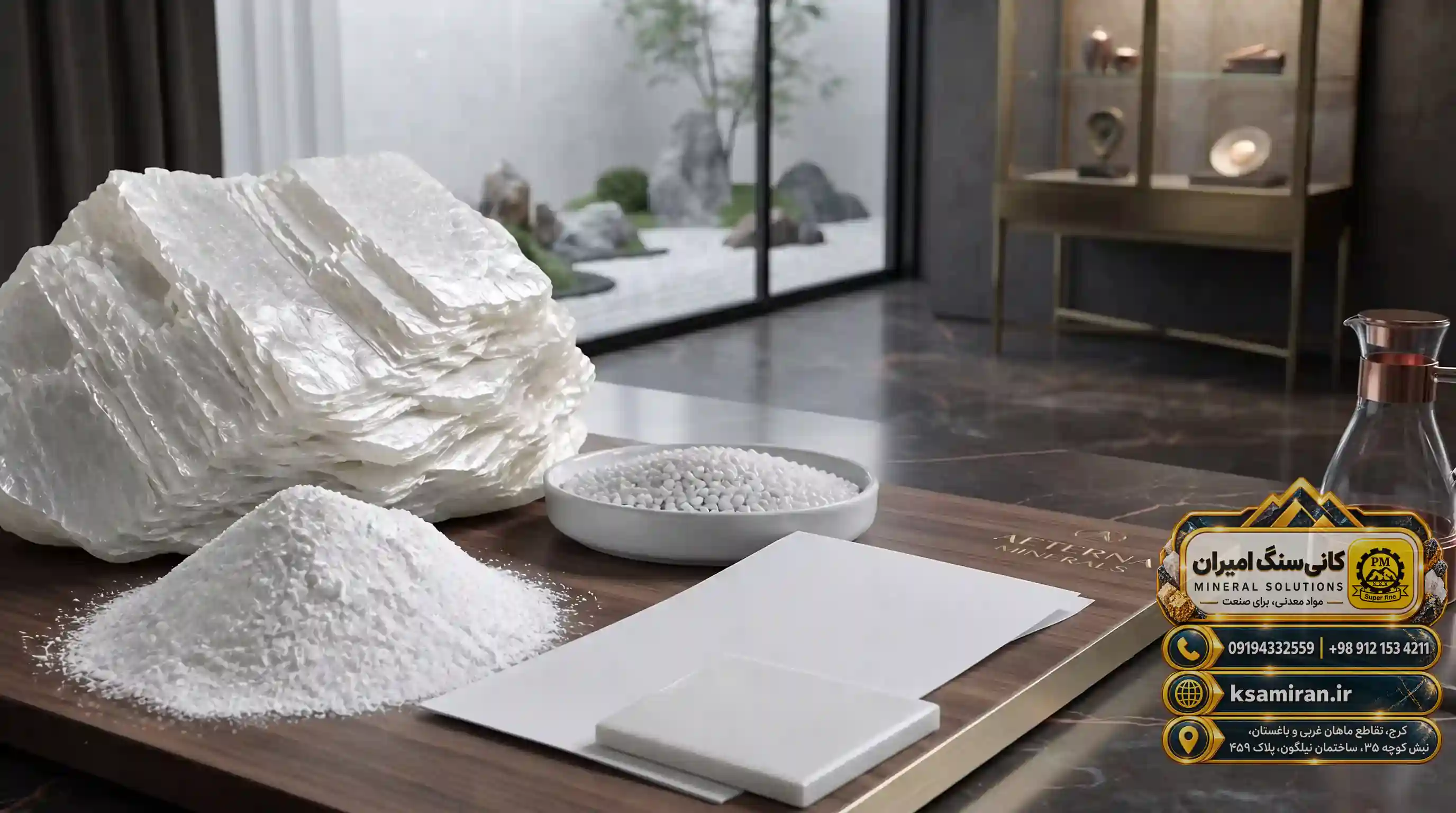
One of the most important factors in choosing white talc for any industrial application is the particle size or mesh grade of the product. The talc offered by the Kani Sang Amiran Project is produced in the range of 450 to 2500 mesh; a wide range that includes from relatively coarse particles for the ceramics and paper industries to very fine particles for masterbatch and paint. But how is the concept of "mesh" defined in standards?
In the simplest case, the mesh number means the number of holes per unit area of the sieve; for example, 450 mesh means its particles have passed through a sieve of that mesh. But in mode standards, the mesh number alone is not sufficient. Inteational standards often use statistical parameters like D50 and D90 instead. D50 is the size at which 50% of the particle volume is smaller than it, and D90 indicates the size below which 90% of the particles lie. These parameters are measured with mode methods like Laser Diffraction and provide a more accurate picture of "particle size distribution."
The importance of particle size distribution in talc applications is very great. In masterbatch, fine particles cause better dispersion and a smoother surface in the final product. In polymer compounds, particles must be chosen so that mechanical properties are reinforced, rather than becoming stress concentration points. In the ceramics and paper industries, particle size affects density, adhesion, and opacity. For further reading in this field, the article Review of Physical and Mechanical Properties of Industrial Talc Powder contains practical tips.
The noteworthy point is that producing very fine particles (like 2500 mesh) requires advanced milling and precise temperature control, because the high heat generated from friction can change the talc structure or cause particles to stick together (Agglomeration). Therefore, standardization is not limited to particle size, but also covers the production method and quality control during processing. The particle size distribution report must be presented along with the measurement method and sampling conditions so that it is comparable with data from other suppliers.
Industrial buyers are advised to request a complete product data sheet, including D50, D90, and the measurement method, rather than just the mesh number, in order to make decisions based on precise data. This approach prevents quality discrepancies in the final product, especially in high-volume shipments, and makes evaluating price and performance based on scientific data possible.
Application Standards of White Talc in Various Industries
Every industry that uses white talc has its own specific set of requirements based on the needs of the process and the final product. In the plastics and masterbatch industries, talc must be compatible with the base polymer (such as polypropylene or polyethylene), have uniform particle distribution, and have controlled moisture to provide stable performance during extrusion. In technical compounds, talc acts as a reinforcing filler, and related standards pay special attention to the final mechanical properties of the product, such as tensile strength, hardness, and impact resistance.
In the paint and coatings industry, white talc is used as a filler and volume extender. Standards in this sector emphasize parameters such as oil absorption, color, particle surface chemistry, and behavior in organic media. In the papermaking industry, talc is used as a filler and in some cases as a coating material; in this application, brightness, opacity, low abrasiveness, and particle size distribution are among the most important quality indicators. In ceramic products, talc acts as one of the magnesium raw materials and affects the thermal behavior, firing shrinkage, and final density of the product.
Interestingly, other mineral materials like kaolin play a similar role in many of these industries. For example, in the automotive tire industry, kaolin is used as an industrial filler, and you can read an example in the article Review of Kaolin Application in the Automotive Tire Industry. Comparing the behavior of different minerals in a specific application helps materials engineers choose the best option for their formulation.
Application standards are typically developed by industrial associations and technical committees and are often defined based on field test results and purchase contracts. For this reason, a talc producer must be familiar with the needs of each industrial sector to be able to offer a product suited to it. For instance, talc used in paintmaking requires balanced oil absorption, and talc used in paper requires high brightness and opacity, while the ceramics industry prioritizes chemical uniformity and thermal behavior.
The variety of mesh grades from 450 to 2500 mesh in the Kani Sang Amiran Project is exactly the answer to these diverse needs and allows the product to be matched with the requirements of each industry. Customers can precisely define their process needs, choose the appropriate grade, and guarantee the quality of the final product.
Quality Control and Standard Testing of White Talc
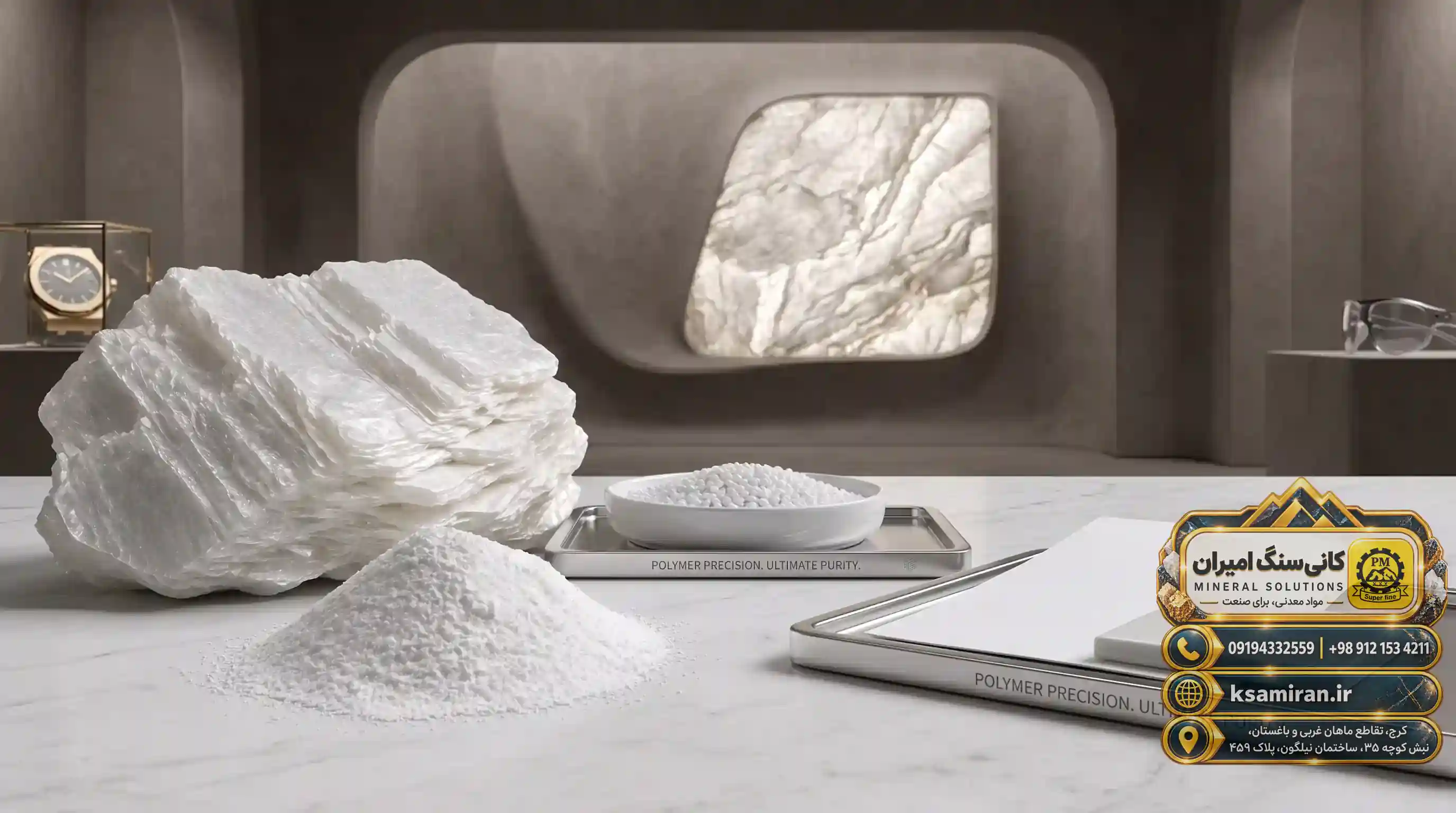
Quality control in white talc production is a continuous process that starts from the mine and continues until the packaging of the final product. Standards define specific test methods for each stage of this path so that the results are reliable and comparable. Familiarity with these tests helps industrial buyers correctly interpret product data sheets and make precise comparisons between different suppliers.
One of the most important tests is mineralogical analysis using X-ray Diffraction (XRD). This method identifies the types of minerals present in the sample and the amount of impurities, and plays a key role in examining issues such as the presence of unwanted minerals. Alongside it, the X-ray Fluorescence (XRF) method quantitatively measures the chemical composition of the sample and determines the amounts of silicon, magnesium, iron, calcium, and other elements. These two methods are complementary and form the main framework of purity control.
For particle size determination, laser diffraction is the mode gold standard, which is fast and reproducible. In the past, laboratory sieves were used, but these methods lack sufficient precision for very fine particles. Whiteness and color measurement is also done with colorimeters/spectrophotometers and is reported based on standard color scales. Moisture is usually measured by the gravimetric method at controlled temperature, and the amount of volatile matter is determined by the loss on ignition (LOI) method. For sensitive applications, oil absorption is also measured according to standard methods.
Periodic calibration of devices, use of standard reference materials, and training of laboratory persoel are other requirements of the quality control system. Without calibration, even the best test method produces reliable results. Complete documentation of results, so that each shipment has a specific identifier and test record, creates the necessary transparency for buyer inspections.
In addition to laboratory tests, quality management system standards like ISO 9001 address documentation processes, shipment tracking, and periodic inspections. These standards ensure that every shipment of white talc leaving the factory is produced with the same level of quality promised to the customer. In the Kani Sang Amiran Project, complying with these quality control frameworks means offering a consistent product for the masterbatch, compound, paint, paper, and ceramics industries.
Challenges, Trends, and Conclusion of White Talc Production Standards
Standardization in the field of white talc faces numerous challenges. First, talc mineral resources in nature are heterogeneous; each mine, and even each part of a mine, can have different chemical and physical properties. This heterogeneity makes quality control a permanent process. The second challenge is the difference in test methods and reporting; naming mesh grades in different markets can be confusing, and this issue increases the importance of standardizing measurement methods.
The third challenge is environmental and safety issues. Controlling asbestos contamination, managing dust during processing, and recycling water in processing plants are among the topics that newer standards increasingly emphasize. Mineral waste management and optimal energy consumption in milling have also come into focus for standards developers.
In the future, it is predicted that standards will move towards product life-cycle assessment, production process sustainability, and reducing environmental impacts. Other trends include the development of very fine powders (such as 2500 mesh and higher) and particle surface modification for advanced applications in the polymer and paint industries. Digitalization of quality control, use of online particle size analysis, and shipment tracking with digital identifiers are also emerging trends.
From the perspective of an industrial buyer, the main message of this article is clear: choosing white talc should not be done based solely on price or mesh number. Knowing national and inteational standards, familiarizing oneself with physical and chemical indicators, and verifying the producer's test methods help you choose a product suited to your needs. Requesting a test sample, reviewing the data sheet, and negotiating based on standard parameters are the practical steps of any professional buyer. Professional producers must also employ these standards as a tool for continuous quality improvement and building trust in the market.
Ultimately, white talc, as a multipurpose industrial mineral, gains increasing importance with the expansion of the polymer, paint, paper, and ceramics industries. The Kani Sang Amiran Project, by offering this product in the 450 to 2500 mesh range and with a focus on quality control and up-to-date standards, strives to cover part of the needs of these industries in a specialized maer. We hope this review has helped in better understanding the role of standards in white talc quality and serves as a useful guide for your industrial decisions.
| Question | Answer |
|---|---|
| What is white talc and in which industries is it used? | White talc is a hydrated magnesium silicate with a light color and high softness, used in the production of masterbatch, compound, paint, paper, and ceramic products. |
| What is the mesh range of white talc offered by the Kani Sang Amiran Project? | This product is produced and offered in the range of 450 to 2500 mesh to cover the needs of various industries, from ceramics and paper to masterbatch and paint. |
| What is the difference between mesh number and D50 and D90 parameters? | Mesh number is a sieve-based criterion, while D50 and D90 are statistical parameters of particle size distribution, measured with laser diffraction and with higher precision. |
| Why is whiteness important in white talc? | In applications such as masterbatch, paint, and paper, high whiteness prevents color change in the final product and guarantees the visual quality of the formulation. |
| How is asbestos contamination control done in talc? | The presence of asbestos-series minerals is usually investigated and confirmed in equipped laboratories using X-ray Diffraction (XRD). |
| What are the most important test methods for white talc? | X-ray Diffraction (XRD), X-ray Fluorescence (XRF), laser diffraction, colorimetry, and gravimetric methods for moisture and LOI are the most important methods. |
| What characteristics should talc used in masterbatch have? | High whiteness, uniform distribution of fine particles, controlled moisture, and compatibility with the base polymer are the most important requirements for this application. |
| What is the difference between talc applications in the paint and paper industries? | In the paint industry, oil absorption and particle behavior in organic media are important, but in papermaking, brightness, opacity, and low abrasiveness are higher priorities. |
| What role does the ISO 9001 standard play in talc production? | This standard makes the quality management system documented and auditable, ensuring that production and quality control processes are carried out uniformly. |
| How to choose the right white talc for our industry? | First, determine your process requirements (mesh grade, whiteness, moisture, and oil absorption), then match the supplier's data sheet and test results to them. |
Source: Iran Organization for Standardization and inteational ISO and ASTM standards regarding test methods and specifications for industrial minerals.

برچسب: White Talc,Review of National and International Standards in White Talc Production,
نویسنده: رساوب آفرین