
درباره سایت
آخرین مطالب
- استخدام أكسيد الليمونيت (الماغش) في صناعات الزجاج
- کاربرد اکسید لیمونیت (گل ماش) در صنایع شیشهسازی
- A Review of Daily Prices for Limonite Oxide (Ocher) in the Market
- چگونه خالص بودن اکسید لیمونیت (گل ماش) را تشخیص دهیم؟
- بررسی قیمت روز اکسید لیمونیت (گل ماش) در بازار
- Application of Limonite Oxide (Gole Mash) in Glassmaking Industries
- كيف تتعرف على نقاء أكسيد الليمونيت (جول ماش)؟
- How to Determine the Purity of Limonite Oxide (Gol Mash)?
- بررسی استانداردهای ایمنی کار با اکسید لیمونیت (گل ماش)
- Comprehensive Guide to Technical Analysis of Limonite Oxide (Gol Mash)
امکانات وب
Introduction to Red Iron Oxide (Ochre) and Its Position in the Mineral Industries
Red iron oxide (ochre), also known as hematite in technical and industrial literature, is one of the most important and most widely used mineral pigments in the world. This material is extracted naturally from iron ore and, after physical and chemical processing, is offered in various purities and particle size distributions for industrial uses. The characteristic red color of this product results from its crystal structure and chemical composition, and for this reason it has been used for decades as a stable, cost-effective, and environmentally friendly pigment in various industries.
In today's industries, red iron oxide (ochre) is well recognized; because alongside stable color, it exhibits high resistance to ultraviolet radiation, atmospheric conditions, and relatively high temperatures. These features have tued this product into a standard option for producing pigment, protective coatings, cement coloring, and ceramic products. In the Kani Sang Amiran project, this product is produced and supplied with a focus on the quality and purity appropriate for these industries, and interested parties can view its details on the Red Iron Oxide (Ochre) page.
One of the strengths of this mineral is its very wide range of applications. From industrial and architectural coloring to tiles, ceramics, colored concretes, and anti-corrosion coatings, all can benefit from the properties of this pigment. This is why an accurate understanding of the properties, purity, and particle size of this product before purchase is extremely important; because a wrong choice can severely affect the quality of the final product and production costs.
In the remainder of this article, we examine all aspects related to buying high-quality, high-purity red iron oxide (ochre); from chemical structure and the concept of purity to the importance of particle size, specialized applications in the pigment, coating, cement, and ceramic industries, and finally the key points in selecting a supplier and storing the product properly. The goal is for you to make the best purchasing decision based on the real needs of your production line, with complete and professional insight.
Purity of Red Iron Oxide (Ochre); The Main Quality Criterion or a Marketing Number?
Purity is one of the most important factors to consider when buying red iron oxide (ochre). Simply put, purity shows what percentage of the powder you receive consists of red iron oxide and what portion includes impurities such as silica, alumina, calcium, soluble salts, or moisture. The higher the purity, the greater the coloring power, the better the color tone uniformity, and the lower the risk of undesirable reactions with other formulation materials. This is why in more sensitive industries such as ceramics and high-quality pigments, purity is always a priority.
The impurities present in red iron oxide (ochre) can create serious consequences in the production process. For example, the presence of hard silica particles can cause wear in mill and mixer equipment, or soluble salts and calcium and magnesium ions in water-based and coloring systems can reduce suspension stability and cause sedimentation or caking. In the ceramic industry as well, metallic impurities can cause undesirable spots on the tile surface after firing and lead to a drop in the visual quality of the final product.
The important point is that high purity alone is not sufficient; unless it is accompanied by uniformity in production. A professional supplier must be able to keep the product's purity at an acceptable and stable level across different batches. Professional buyers usually inquire about the product's purity range and, if possible, evaluate different samples for color variation and process behavior. It should also be noted that quality reports are a supporting document and caot replace practical testing of the product in your production line.
As a summary of this section, it can be said that high purity determines the value of buying a quality product, but only if it is accompanied by appropriate particle size and production uniformity. Otherwise, even high purity caot guarantee the quality of your final product. Therefore, when inquiring, always assess purity, mesh range, and the product's proposed application type together.
Mesh Range 450 to 1500; The Importance of Particle Size in Red Iron Oxide (Ochre)
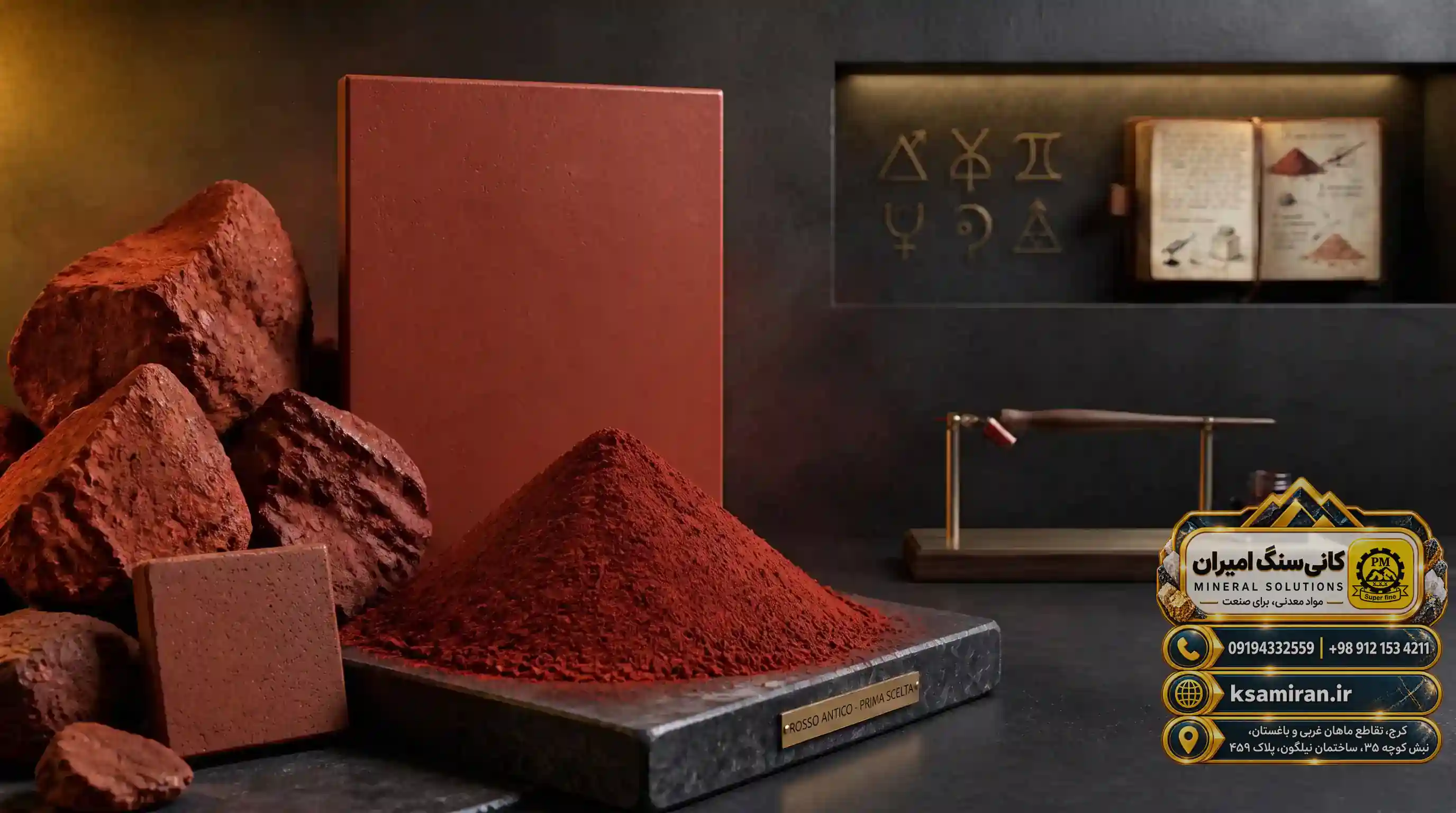
In mineral powder products, one of the most important technical specifications is the particle size, or the product's "mesh." In the Kani Sang Amiran project, red iron oxide (ochre) is produced and offered in the mesh range of 450 to 1500. This range means the product can be available from relatively coarser particles (close to 450 mesh) to very fine and extremely powdery particles (close to 1500 mesh). Choosing the appropriate particle size has a direct effect on the product's behavior in the production process and on its final quality.
The higher the mesh number, the finer the particles. Finer particles have more contact surface with other formulation materials and, as a result, create better dispersion, higher coloring power, and greater color uniformity. For this reason, in applications where surface appearance and color homogeneity come first—such as pigments, fine coatings, or ceramic glaze—using higher meshes is preferred. However, it should be noted that as the mesh increases, the product tends more toward moisture absorption and caking.
On the other hand, in applications such as coloring concrete and cement or industrial fillers, mid-range or even lower meshes within this range are usually usable; because in these industries, coloring power and finished cost matter more than particle dimension precision. In these applications, coarser particles can disperse easily in cement and concrete mixtures and in some cases even help fill spaces better. Therefore, mesh selection should not be done merely based on the highest available number; rather, it should be determined according to your process's needs.
Another key point is the uniformity of particle size distribution within one batch. A product containing particles of very different dimensions will not exhibit the same behavior in mixing, dispersion, and final color. For this reason, particle size quality control and its reporting are among the main criteria for evaluating a supplier. Finally, it is recommended to inquire about the exact mesh range of the desired product before purchasing large quantities and, if possible, to test its performance in your process with a small sample.
Application of Red Iron Oxide (Ochre) in Pigments and Coatings
The primary application of red iron oxide (ochre) is in the pigment and paint industry. Due to its warm and stable red color, this material is widely used in producing architectural paints, industrial paints, plastic paints, and even wood and paper products. Iron oxide pigments usually have a lower finished cost than organic and synthetic colors and at the same time show far higher resistance to sunlight, moisture, and temperature changes.
In the coatings and paint industry, one of the main challenges is proper dispersion of the pigment in the polymer and solvent. High-mesh red iron oxide, thanks to its fine particle dimensions, disperses well in water-based and solvent-based systems and contributes to the color uniformity of the final product. Also, this pigment in combination with other iron oxides can produce a wide range of yellow, orange, brown, and black colors, enabling paint manufacturers to develop diverse products. To lea about the differences and choose the appropriate type, you can read the article Comparison of Red Iron Oxide (Ochre) Types in the Paint and Resin Industries.
In producing protective and anti-corrosion coatings, red iron oxide also plays an important role. The particles of this pigment can act as an active filler that helps fill the coating's surface pores and create a protective layer. This feature makes the final coating more resistant to moisture penetration and corrosion. In these types of applications, dispersion quality and purity level directly affect the coating's performance.
For buyers in this industry, the important point is that red iron oxide (ochre) must be selected according to the type of paint system (water-based, solvent-based, or powder). Oil absorption rate, pH, and dispersion behavior can all affect the final formulation. Therefore, always request the product's complete specifications from the supplier and conduct a real formulation test before bulk purchase.
Application of Red Iron Oxide (Ochre) in the Cement and Concrete Industry
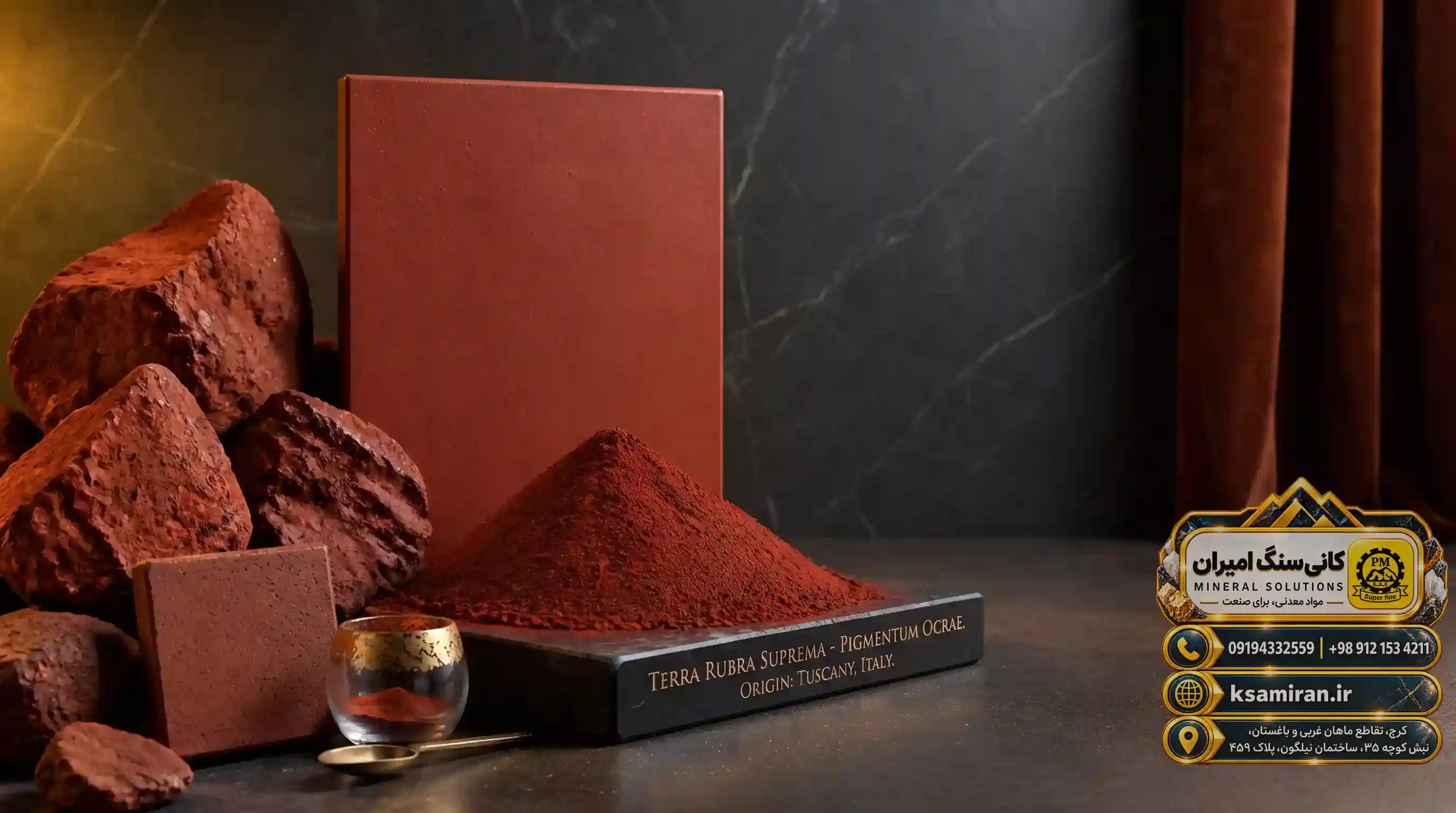
One of the well-known applications of red iron oxide (ochre) is its use in the cement and concrete industry. As a stable mineral pigment, this product is used for coloring concrete products such as paving stones, concrete blocks, industrial floorings, prefabricated walls, and even architectural concretes. The main reason for this use is color stability under sunlight and over time; such that the color of concrete products changes little after years.
In the concrete coloring process, the pigment is usually added during the dry mix preparation stage or at the time of mixing with water. Red iron oxide should be selected so that it disperses well in the mixture and does not create color spots or streaks. The product's mesh range is of high importance here; because coarse particles can cause surface color non-uniformity, while very fine particles may also face difficult dispersion due to water absorption and caking.
One important technical point is that the amount of pigment consumed in concrete has a direct effect on its final strength. Excessive use of any pigment can change the water-to-cement ratio and cause a drop in strength. For this reason, professional producers usually determine the consumption percentage based on the cement type, the desired color, and curing conditions. Meanwhile, purchasing a product with high purity and uniformity helps you achieve the same color with a lower consumption amount.
Attention should also be paid to the fact that in large concrete projects, stable and uniform color supply throughout the project is extremely vital. Changes in pigment quality between different batches can cause color differences in different parts of a project, which is very difficult and costly to compensate for. Therefore, choosing a supplier with stable quality control is of special importance in this industry.
Application of Red Iron Oxide (Ochre) in Ceramic Products
The ceramic industry is one of the fields in which red iron oxide (ochre) has very broad application. From wall and floor tiles to ceramic ware, facade bricks, and decorative products, all can use this pigment to create warm and beautiful colors. In ceramics, this product is generally used in two overall forms: coloring the ceramic body and coloring the glaze or surface engobe.
When red iron oxide is used in the ceramic body, it is usually added during the slip preparation stage so that, after firing, it creates a uniform color throughout the product's thickness. In this case, uniformity of pigment dispersion is very important; because any particle accumulation can appear as dark or light spots on the product's surface after firing. For this task, products with high mesh and appropriate purity are usually preferred.
In glaze production as well, red iron oxide is known as a colorant. The behavior of this material at different firing temperatures can produce different colors; from red and brown to tones close to black. For this reason, precise control of the pigment's purity and chemical composition is vital for achieving a reproducible color in mass tile and ceramic production. Metallic impurities or carbonates can create unpredictable reactions in the kiln and cause a drop in product quality.
Also, in producing facade bricks and decorative ceramic products, red iron oxide can give the product a natural and warm color that is highly appreciated in mode architecture. In these applications, the color's resistance to atmospheric conditions and UV radiation is very important, and iron oxide fulfills this requirement well. In any case, the selection of mesh and purity must be done according to the firing temperature, body type, and desired color.

Guide to Buying High-Quality, High-Purity Red Iron Oxide (Ochre)
Buying high-quality, high-purity red iron oxide (ochre) requires attention to a set of technical and commercial factors. The first step is to precisely determine your production line's needs: in which industry the product is used, what mesh you need, what the monthly consumption is, and what expectations you have from color uniformity. Without knowing these, choosing the right product will be mere guesswork. For example, the ceramic industry's needs are completely different from those of a paint factory.
The second step is evaluating the supplier. A reliable supplier must be able to provide transparent technical information about the mesh range, purity, and proposed applications of the product and, if needed, make test samples available to you. The Kani Sang Amiran project, as a mineral materials producer, offers this product with a mesh range of 450 to 1500 for pigment, coating, cement, and ceramic product applications; but in any case, final quality confirmation must be carried out by your own laboratory and production line.
The third step is paying attention to supply uniformity and stability. In mass production, quality variations between batches can be far more costly than the initial price difference. For this reason, before purchasing large quantities, be sure to test a sample and, if possible, fix the product's technical specification range contractually. Also pay attention to packaging and transport conditions; because moisture and pressure during transport can affect the product's quality.
The fourth point is comparing the product with alteative options. Red iron oxide (ochre) differs from other types of iron oxides such as yellow oxide (limonite) or black oxide, and each has its own applications and prices. If you are at the stage of choosing the appropriate oxide type, the article Guide to Buying Limonite Oxide with the Best Quality can give you a good perspective. Ultimately, buying from a reputable domestic production source usually brings advantages such as lower finished cost, more stable supply, and faster access to samples.
Storage, Preventing Caking, and Conclusion
After buying red iron oxide (ochre), storing it properly is extremely important. This product, especially in high meshes, has a strong tendency to absorb moisture from the environment, and if stored improperly, it can cake and lose its quality. To prevent this problem, the product must be kept in a dry, covered place, away from direct contact with moisture, rain, or severe temperature changes. Also, the bags and sacks should be placed on pallets so that they do not have direct contact with the ground surface.
Another important point is preventing excessive pressure and compaction in storage. Stacking sacks indiscriminately can compress the powder and harden the clumps. In addition, after opening each package, it should be resealed well to prevent the penetration of air and moisture. To become familiar with more specialized solutions in this area, read the article How to Prevent Red Iron Oxide (Ochre) from Caking?. Also, at the time of use, stirring and sieving the product according to the process's needs can help maintain its uniformity.
As a summary of this guide, it should be said that buying high-quality, high-purity red iron oxide (ochre) goes beyond a simple transaction; it is a technical decision that directly affects the quality of your final products in the pigment, coating, cement, and ceramic industries. Knowing the purity, choosing the appropriate mesh range (450 to 1500 mesh), and cooperating with a supplier that has stable quality control are the three main pillars of this decision-making.
Finally, it is recommended to sample and test before bulk purchase and to transparently share your desired technical specifications with the supplier. The Kani Sang Amiran project, as a mineral materials producer, offers this product with a wide particle size range for the mentioned industrial applications, and you can contact its sales department for more information and to inquire about the product's exact specifications.
| Question | Answer |
|---|---|
| What is red iron oxide (ochre)? | It is a natural mineral pigment based on hematite used for coloring in the pigment, coating, cement, and ceramic industries. |
| What is the mesh range of this product? | This product is offered in the mesh range of 450 to 1500, and the mesh choice depends on your process's needs. |
| Which mesh is more suitable for the ceramic industry? | For ceramic glaze and body, higher meshes are usually preferred due to better dispersion and color uniformity. |
| What effect does high purity have? | High purity leads to greater coloring power, reduced undesirable reactions, and improved final product quality. |
| Can this product be used in concrete and cement? | Yes, red iron oxide is suitable for coloring concrete and cement products due to its color stability against UV. |
| How can we prevent the product from caking? | Storing in a dry environment, using pallets, preventing excessive pressure, and resealing packages after opening are effective. |
| How much pigment should be consumed in concrete? | The consumption amount depends on the desired color and cement type; excessive consumption can reduce concrete strength. |
| Why is uniformity between batches important? | Quality changes between batches cause color inconsistency in mass production, and compensating for it is costly. |
| Is sampling necessary before bulk purchase? | Yes, testing the sample in your production line is the only way to finally confirm the product's performance. |
| Where can this product be obtained? | This product is produced and offered by the Kani Sang Amiran project, and its details are viewable on the product page. |
The technical specifications of red iron oxide (ochre) presented in this article are taken from the Kani Sang Amiran project's product page: https://ksamiran.ir/products/red-iron-oxide/
برچسب: Red Iron Oxide (Ochre),Buying Guide for High,Quality,High,Purity Red Iron Oxide (Ochre),
نویسنده: رساوب آفرین