
درباره سایت
آخرین مطالب
- انتخاب اکسید آهن قرمز (اخرا) برای بهبود کیفیت پیگمنت و پوششهای رنگی
- تامین کربنات کلسیم با دانهبندی دقیق جهت استفاده در مستربچ
- تأمین تخصصی سیلیس برای مصالح ساختمانی، شیشه و صنایع سرامیک
- ویژگیهای فنی بنتونیت کانی سنگ امیران برای کاربردهای خاص
- فلدسپات کانی سنگ امیران برای شیشه کاشی و سرامیک
- کاربرد تالک سفید درجه یک در فرمولاسیون پیشرفته رنگ و محصولات کاغذی
- اکسید آهن قرمز (اخرا) کاربردی جهت تولید محصولات سرامیکی و پوشش
- مشخصات فنی اکسید آهن قرمز (اخرا) مناسب برای پوشش و تولید پیگمنت
- مشاوره تخصصی خرید کربنات کلسیم بر اساس نیاز دقیق صنعت شما
- انتخاب تالک سفید صنعتی مناسب برای تولیدات کاغذ و مستربچ
امکانات وب
Introduction to Kaolin and its Position in the Mining Industry
Kaolin, also known in Persian as “China clay”, is one of the most important and widely used industrial minerals throughout the world. Due to its very high white color, stable chemical structure, and unique physical properties, this mineral is used in a wide range of industries including tile production, ceramic products, glaze, paper, and paint. Kaolin is actually the name of a group of hydrous aluminum silicate minerals, of which kaolinite is the most important and abundant member.
The history of kaolin use dates back thousands of years. The Chinese were the first to use this fine white clay to make delicate ceramic wares and porcelain, which is why the name “China clay” became common for it. Today, significant deposits of kaolin are identified and extracted in various countries including China, the United States, Brazil, India, Turkey, and Iran.
In mode industry, the role of kaolin is very vital. In the papermaking industry, kaolin is used as a filler and surface coating agent for paper, significantly increasing print quality and paper whiteness. In the ceramic and tile industries, kaolin forms the main backbone of the body and improves the strength, plasticity, and transparency of the final product. In the paint industry, kaolin acts as a filler and extender pigment, enhancing the covering power of paint.
The quality of kaolin depends on several factors, the most important of which include chemical purity, whiteness and brightness degree, particle size distribution, and the amount of aluminum oxide (alumina) in its composition. High-quality kaolin must have a high percentage of pure kaolinite and a low percentage of mineral impurities such as iron and titanium oxides to retain its natural white color.
Amiran Stone Mineral Project, as a producer of high-quality minerals, supplies high-quality kaolin for various industrial applications. In the rest of this article, we will comprehensively and expertly examine the chemical, mineral, and physical properties of high-quality kaolin and fully explore the industrial applications of this valuable mineral.
Chemical Structure and Mineralogy of Kaolin
The chemical structure of kaolin is generally represented by the formula Al2Si2O5(OH)4. This composition shows that kaolin is a hydrous aluminum silicate composed of silicon oxide (SiO2) and aluminum oxide (Al2O3) along with water molecules. In the crystal structure of kaolinite, each unit cell consists of an octahedral layer of aluminum-oxygen-hydroxyl and a tetrahedral layer of silicon-oxygen; these two layers are coected to each other, creating a regular layered structure.
Mineralogically, kaolin belongs to the clay mineral group, which includes various members such as kaolinite, nacrite, dickite, and halloysite. Kaolinite, with the chemical formula Al2Si2O5(OH)4, is the most common and industrially most important member of this group. The main difference between these minerals lies in the arrangement of structural layers and their amount of water of crystallization. For example, halloysite has extra water between layers and a tubular structure.
The chemical composition of pure kaolin approximately includes 46.5% SiO2, 39.5% Al2O3, and 14% water (H2O). However, in nature, kaolin is rarely found with this purity, and impurities such as iron oxide (Fe2O3), titanium oxide (TiO2), calcium oxide (CaO), magnesium oxide (MgO), and potassium oxide (K2O) are usually present in it. The amount of these impurities directly affects the quality and application of kaolin.
The formation of kaolin in nature occurs mainly through the chemical weathering process of rocks containing feldspar, especially potassium and sodium feldspar. In this process, called “kaolinization”, water along with carbon dioxide decomposes feldspar and creates kaolinite. This process takes place in warm and humid climatic conditions over long geological periods.
The layered structure of kaolin is the reason for many of its physical and chemical properties. Weak bonds between layers give kaolin good plasticity (moldability) when mixed with water. Also, the high specific surface area and surface charge of kaolin make it a suitable material for absorption and coating in various applications. Hydrogen bonding between layers also contributes to its structural stability.
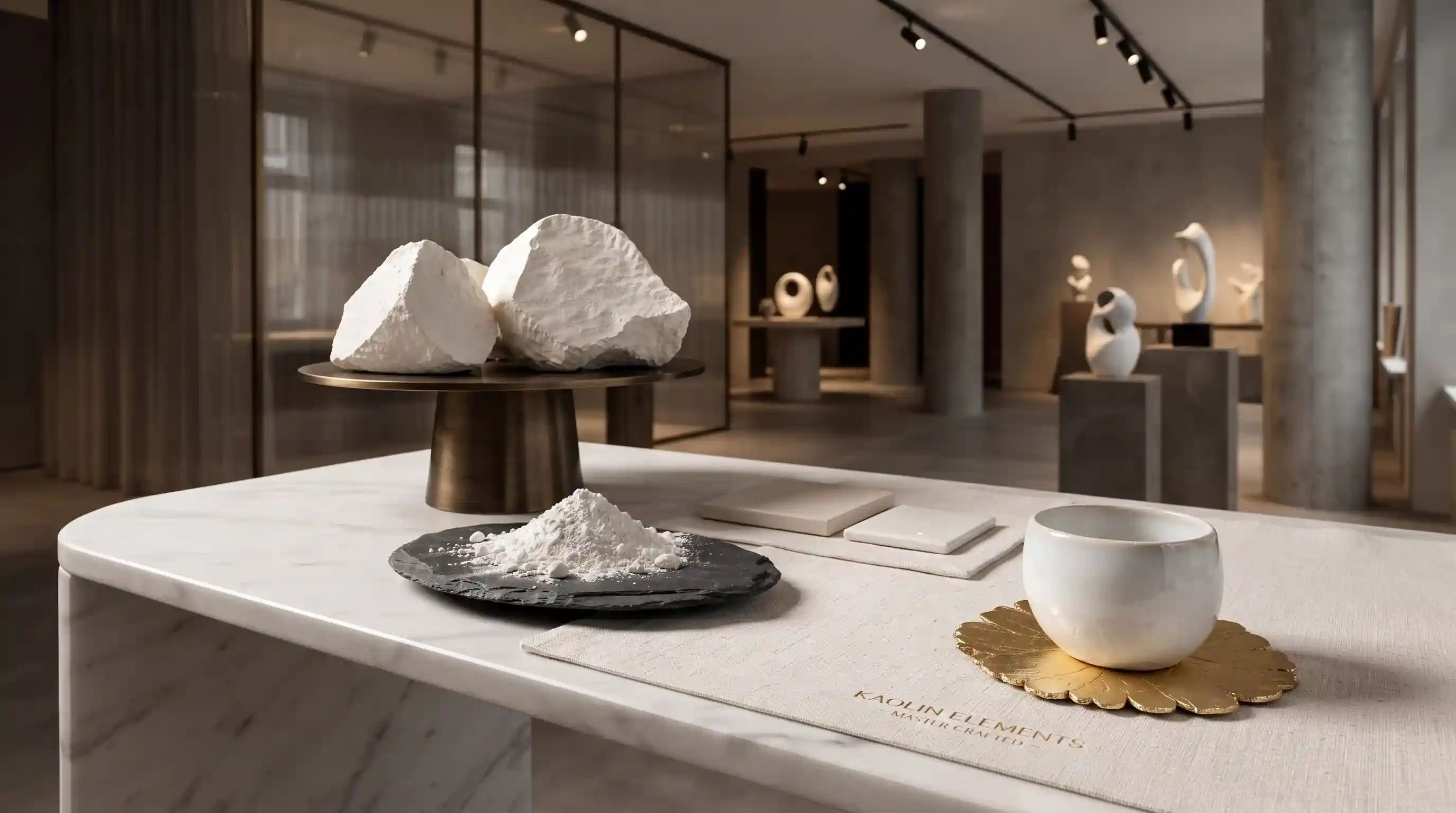
Physical and Chemical Properties of High-Quality Kaolin
High-quality kaolin has a set of physical and chemical properties that make it a very valuable mineral for various industries. Accurate knowledge of these properties helps industry engineers and specialists to make the best use of this material. Below, we examine the most important properties of high-quality kaolin.
One of the most important properties of kaolin is its high whiteness and brightness degree. High-quality kaolin has a natural white color, which is created due to the absence of colored impurities, especially iron oxides and organic compounds. The brightness degree of kaolin is determined by precision measuring instruments and is an important criterion in the papermaking and paint industries. The lower the amount of impurities, the higher the whiteness degree.
Plasticity or moldability is another prominent feature of kaolin. This property, which is created due to the layered structure and the presence of water between layers, allows kaolin to tu into a sticky and moldable paste when mixed with water. This feature is very vital for the ceramic and tile industries, as molding and shaping of ceramic products would not be possible without it.
The particle size of kaolin also greatly affects its properties. High-quality kaolin is usually offered in different mesh ranges, with each mesh indicating a specific particle size. Uniform particle size distribution improves dispersion, oil absorption, and adhesion in various applications. Kaolins with higher mesh have finer particles and are more suitable for applications requiring a smooth and even surface.
In terms of chemical properties, kaolin is a relatively neutral and stable chemical substance. This material is insoluble in most acids except concentrated sulfuric acid, and does not show much reaction in alkaline conditions either. The chemical stability of kaolin ensures reliable performance in industrial processes where it is exposed to various chemicals.
Other features such as oil absorption capacity, covering ability, abrasion resistance, and ion exchange capacity are also considered in various industries. High-quality kaolin has unique advantages compared to other filler minerals like talc; to lea more about the properties of similar minerals, you can read the article Review of Physical and Chemical Properties of High-Quality White Talc. Each of these materials has different industrial applications based on its chemical structure.
Production, Processing, and Grading of Kaolin (Mesh Range 450 to 1500)
The production and processing of kaolin play a decisive role in the final quality of this mineral. After extraction from the mine, kaolin is processed through various stages to achieve the purity, whiteness degree, and particle size required by different industries. In this section, we examine the production and grading stages of kaolin.
The first stage is the extraction of kaolin from surface mines. Kaolin is usually located as a soft and earthy layer beneath other layers and is extracted using surface mining methods. After extraction, the raw materials containing kaolin, along with impurities such as sand, gravel, rocks, and organic matter, enter the processing plant.
The second stage is washing and separation. At this stage, raw kaolin is mixed with water and tued into a slurry. Then, through hydrocyclone and centrifuge processes, coarse particles and impurities are separated from fine kaolin particles. This process, known as the “wet processing” method, helps achieve high-purity kaolin. In the dry method, mills and air separators are used for separation.
One of the most important stages in kaolin production is grinding and particle size classification. In industry, the particle size of kaolin is expressed in “mesh” units. The mesh number indicates the number of openings per unit area; the higher the mesh number, the smaller the particle size. High-quality kaolin is usually produced and offered in a range of 450 to 1500 mesh.
450-mesh kaolin: The particles of this grade are relatively coarser and are suitable for applications requiring fast penetration and filling. This grade is used in industries such as ceramic body and tile production.
Medium-mesh kaolin (e.g., 800 to 1000 mesh): This grade is suitable for applications with a balanced requirement between filling speed and surface uniformity, and is used in various industries including paint and paper.
1500-mesh kaolin: The particles of this grade are very fine and create a very smooth and uniform surface. This grade is used for delicate applications such as paper coating, high-quality glaze, and precision paints.
After achieving the desired particle size, kaolin undergoes supplementary processes such as chemical bleaching, filtration, and drying. Final quality control involves precise testing of whiteness, particle size distribution, moisture, and chemical composition so the product is delivered to the customer according to industrial standards.
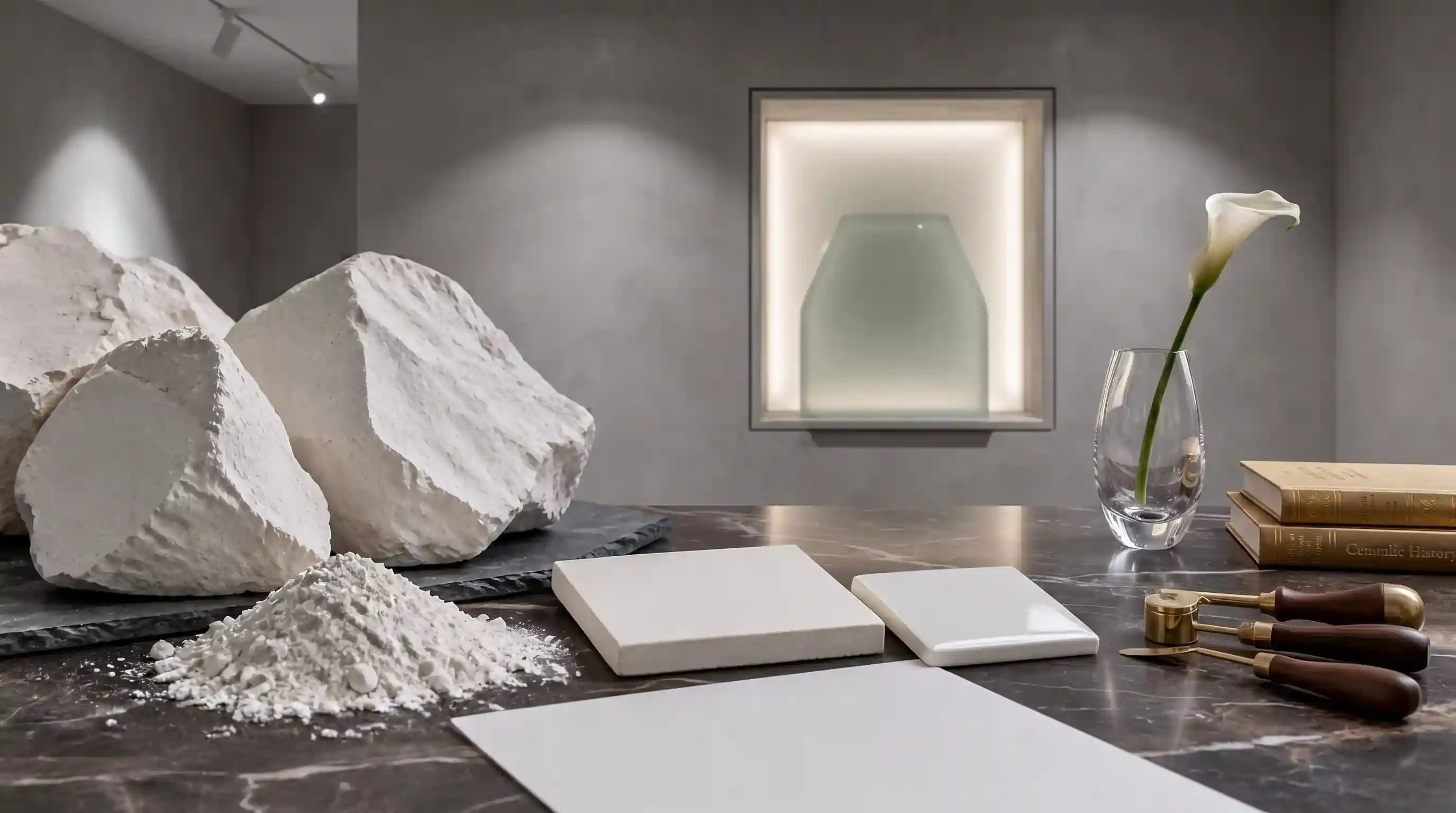
Application of Kaolin in the Tile and Ceramic Industry
The tile and ceramic industry is one of the largest and most important consumers of kaolin in the world. As a main material in the composition of ceramic body and tile, kaolin plays a very vital role in determining the quality, strength, and appearance of the final product. In this section, we closely examine the role of kaolin in this industry.
In the ceramic body composition, kaolin acts as the main backbone. A significant amount of the tile and ceramic body composition consists of kaolin, which supplies the aluminum oxide (Al2O3) needed to form the mullite structure during firing. Mullite is a highly heat-resistant mineral phase that guarantees the strength and durability of the ceramic product.
One of the most important features of kaolin in the ceramic industry is its plasticity. This property allows the ceramic composition to be easily molded, pressed, and shaped. Without kaolin, shaping the ceramic body becomes very difficult, and the final product will be brittle and fragile. Kaolin's water-retention capability also prevents the body from cracking during drying.
During the firing process, kaolin undergoes multiple changes. At around 500°C, the structural water of kaolin evaporates and metakaolinite is formed. At higher temperatures (around 980°C), metakaolinite transforms into mullite and silica. These new phases significantly increase the thermal and mechanical strength of the product.
High-quality kaolin improves several important features in tile and ceramic: increased flexural and compressive strength, reduced inappropriate swelling and shrinkage during drying, improved surface uniformity, increased glaze adhesion to the body, and improved general ceramic properties.
The quality of kaolin used in the tile industry directly affects the final product quality. Impurities present in kaolin, such as iron oxide, can cause body discoloration and create unwanted spots. Therefore, choosing kaolin with sufficient purity and appropriate whiteness degree is a fundamental priority for tile and ceramic manufacturers.
Besides the ceramic body, kaolin is also widely used in the production of other ceramic products such as chinaware, sanitaryware, electrical insulators, and technical ceramics. The wide variety of these applications demonstrates the extraordinary importance of kaolin in the ceramic industry. For manufacturers seeking consistent quality, supplying kaolin with constant specifications and high purity is a major challenge.
Role of Kaolin in Glaze Production
Glaze is one of the most important parts of ceramic and tile products that significantly improves their appearance, strength, and durability. As one of the main materials in glaze composition, kaolin plays multiple roles in its formulation and performance. In this section, we examine the role of kaolin in glaze production.
In glaze composition, kaolin acts as a source of alumina (Al2O3). Alumina is an essential component of any glaze, increasing its scratch resistance, chemical resistance, and thermal stability. Without sufficient alumina, the glaze layer becomes soft and vulnerable, performing poorly against chemicals and abrasion.
One of the most important roles of kaolin in glaze is its suspension and particle-retention property. Due to its layered structure and high specific surface area, kaolin can create a stable suspension and prevent other glaze particles from settling in the slurry. This feature is very vital for maintaining the uniformity of the glaze composition during application.
Kaolin also acts as a binder in glaze. Before firing, the glaze is applied as a thin layer on the surface of the ceramic body. Kaolin makes this layer stick well to the surface and prevents it from detaching during handling and drying. This adhesive capability is one of the main advantages of kaolin in the glaze-making industry.
During the firing process, kaolin combines with other glaze components such as silica, feldspar, and fluxes to form a transparent and resistant glass. The firing temperature of the glaze and its viscosity are affected by the chemical composition of the kaolin used. Choosing kaolin with an appropriate chemical composition is essential to achieve the desired final properties of the glaze.
The quality of kaolin used in glaze production directly affects the final product quality. High-quality kaolin with a high whiteness degree creates a transparent, uniform, and flawless glaze. Conversely, the presence of impurities in kaolin can cause bubbles, colored spots, opacity, and other defects in the glaze layer.
The particle size of kaolin is also important in glaze application. Higher-mesh (finer) kaolin creates a smoother and more uniform surface in the glaze layer. For this reason, high-mesh grade kaolin is used to produce high-quality and delicate glazes such as glaze for wall tiles, sanitaryware, and chinaware. Supplying kaolin with consistent quality and appropriate technical specifications is a major challenge for glaze manufacturers.

Application of Kaolin in Paper and Paint Industries
Kaolin is one of the most important minerals used in the papermaking and paint industries. In these two major industries, kaolin acts as a filler, coating agent, and extender pigment, having a significant impact on the quality of final products. In this section, we examine the role of kaolin in these industries.
In the papermaking industry, kaolin is used in two main stages: filling and coating. In the filling stage, kaolin is mixed with paper pulp and fills the spaces between cellulose fibers. This increases paper density, improves the paper surface for printing, increases whiteness and brightness degrees, and reduces production costs, as kaolin replaces some of the paper pulp.
In the coating stage, a thin layer of kaolin along with adhesives and additives is applied to the paper surface. This layer prepares the paper surface for high-quality printing and significantly improves features such as ink absorption, surface smoothness, and print gloss. For this application, higher-mesh (finer) kaolin is used to create a very smooth and uniform surface.
In the paint industry, kaolin acts as a filler and extender pigment. Kaolin increases the paint's covering power, improves color and gloss, increases abrasion resistance, and reduces production costs. Also, kaolin improves paint dispersion, prevents particle settling, and increases paint stability during storage.
The quality of kaolin used in these industries is very important. The whiteness and brightness degree of kaolin directly affect the whiteness and brightness of paper and paint. Also, its particle size distribution and uniformity are fundamentally important for achieving a high-quality surface in paper and a uniform coating in paint. For this reason, paper and paint manufacturers choose kaolin with high purity and appropriate whiteness degree.
In recent years, the demand for high-quality industrial minerals such as kaolin and talc in various industries has been on an upward trend. The growth of construction industries, paper and packaging production, and the paint industry has increased the consumption of these minerals. To better understand this trend, you can read the article Review of the Rising Demand Trend for High-Quality Industrial Talc. This growth further highlights the importance of supplying high-quality and stable minerals.
Guide to Choosing and Buying High-Quality Kaolin
Choosing the right kaolin for any industrial application requires attention to several key factors. In this section, we examine important points in selecting and buying high-quality kaolin and introduce the main criteria for evaluating the quality of this mineral.
The first and most important factor in choosing kaolin is determining the final application. Each industry requires specific kaolin specifications. For example, the tile and ceramic industry needs kaolin with high plasticity and appropriate chemical purity, while the papermaking industry requires kaolin with a very high whiteness and brightness degree. Accurately determining the industrial need is the first step in selecting the right product.
The second factor is the chemical composition of kaolin. The percentages of SiO2, Al2O3, Fe2O3, and other oxides must match the application's requirements. Especially the iron oxide level, which directly affects the whiteness degree, must be carefully controlled. For color-sensitive applications like paper and paint, the iron oxide level must be kept to a minimum.
The third factor is the mesh grade and particle size. As we reviewed, kaolin is produced in various mesh ranges from 450 to 1500 mesh. For applications requiring a smooth and delicate surface, such as paper coating and high-quality glaze, higher-mesh kaolin is more suitable. For more general applications like ceramic body, medium or lower-mesh kaolin can also be used.
The fourth factor is the whiteness and brightness degree. This feature is especially important for the paper, paint, and glaze industries. High-quality kaolin must have a high and uniform whiteness degree. Precise colorimetry tests determine this feature numerically.
The fifth factor is quality uniformity and stability. One of the main challenges for industrial consumers is the quality difference across different shipments. A supplier that can provide kaolin with consistent quality and stable technical specifications is of great value to manufacturers.
To lea how the price of this mineral is determined, you can read the article Review of Kaolin Price Trend Changes in the Mining Market. Awareness of the factors affecting price helps buyers make better decisions in the mineral market.
If you are looking for high-quality kaolin for the tile, ceramic, glaze, paper, and paint industries, you can check the Kaolin available at Amiran Stone Mineral Project. This group supplies the needs of various industries by offering high-quality mineral products. Choosing a reputable and specialized supplier ensures consistent product quality.
| Question | Answer |
|---|---|
| What is kaolin and what is it composed of? | Kaolin, or China clay, is a hydrous aluminum silicate with the formula Al2Si2O5(OH)4, primarily composed of kaolinite. |
| What is the chemical formula of kaolin? | The chemical formula of kaolin is Al2Si2O5(OH)4, which includes SiO2, Al2O3, and water. |
| In which industries is kaolin used? | Kaolin is widely used in the tile, ceramic, glaze, papermaking, and paint industries. |
| What does the mesh grade mean in kaolin? | The mesh number indicates particle size; the higher the mesh, the finer the particles. Kaolin is usually offered in the 450 to 1500 mesh range. |
| What is the difference between high-quality and ordinary kaolin? | High-quality kaolin has higher chemical purity, greater whiteness, fewer impurities (especially iron oxide), and a more uniform particle size distribution. |
| What role does kaolin play in the tile and ceramic industry? | Kaolin forms the backbone of the ceramic body, supplies the alumina needed to create mullite, and provides the plasticity needed for shaping. |
| Why is kaolin used in the papermaking industry? | Kaolin is used as a filler and paper surface coating agent, increasing the paper's whiteness, surface smoothness, and print quality. |
| What is the role of kaolin in the paint industry? | As a filler and extender pigment, kaolin increases the paint's covering power, gloss, and abrasion resistance. |
| How is kaolin formed in nature? | Kaolin is mainly formed through the chemical weathering of feldspar-containing rocks (the kaolinization process) over long geological periods. |
| Which mesh of kaolin is suitable for glaze? | For high-quality glazes, high-mesh kaolin (finer particles, e.g., 1500 mesh) is usually used to create a smoother and more uniform surface. |
Amiran Stone Mineral Project — Mineral Production: https://ksamiran.ir/products/kaolin/
برچسب: Kaolin,Comprehensive Review of Chemical and Mineral Properties of High,Quality Kaolin,
نویسنده: رساوب آفرین