
درباره سایت
آخرین مطالب
- Why is choosing Limonite Oxide (Gole Mash) important for industries?
- چگونه بهترین فرمولاسیون با اکسید لیمونیت (گل ماش) بسازیم؟
- لماذا يعد اختيار أكسيد الليمونيت (أوكر أصفر/كلماش) مهماً للصناعات؟
- دور أكسيد الليمونيت (الجول ماش) في إنتاج الطوب والفخار
- Examining the Effect of Limonite Oxide (Gol Mash) on Color Stability
- مراجعة مزايا الشراء بالجملة لأكسيد الليمونيت (غل ماش)
- دور أكسيد الليمونيت (الغل ماش) في الصناعات الدوائية ومستحضرات التجميل
- بررسی میزان سختی و سایش اکسید لیمونیت (گل ماش)
- Application of Limonite Oxide (Gole Mash) in Anti-Rust Industries
- نقش اکسید لیمونیت (گل ماش) در تولید پوششهای محافظ
امکانات وب
Introduction to the Importance of White Talc in Industry
Mineral white talc powder is one of the most widely used and vital materials in various industries, holding a special place due to its unique physical and chemical properties. Kani Sang Amiran project covers the needs of various industries by producing this high-quality material. In today's mode industries, understanding the properties of this material and how it affects the quality of final products is of high importance. To better understand the quality standards of this material, you can read the article Reviewing National and Inteational Standards in White Talc Production.
This material is recognized as an efficient mineral filler that results in improved mechanical and appearance properties. Due to the diversity of applications, choosing the appropriate granulation plays a decisive role in final efficiency. The processing procedure of this mineral material requires precision and advanced technology to maintain the desired purity and whiteness.
Large industrial manufacturers are always seeking to source raw materials with precise technical specifications. Featuring a layered structural behavior, this mineral powder performs well in various industrial formulations and greatly helps improve the thermal and dimensional stability of products.
The Role of Meshing in Determining the Quality and Efficiency of White Talc
Meshing refers to the particle size of the mineral powder, which is considered one of the key factors in determining the quality of white talc. The mesh range of this product lies between 450 and 2500 mesh, indicating diversity in particle dimensions from medium to very fine (micronized) sizes. Finer particles usually create a larger contact surface and play a more prominent role in improving the final properties of the product.
Accurately determining the meshing directly affects particle dispersion in polymer matrices, paints, and other compounds. The more uniform and finer the particles are, the higher the appearance quality and homogeneity of the final product will be. For example, in the production of masterbatch and compound, particle size prevents accumulation and agglomeration.
Mode milling and particle classification equipment at Kani Sang Amiran has made it possible to produce this powder within the mentioned mesh range with high precision. This allows industrialists to choose the most appropriate granulation based on their formulation needs.
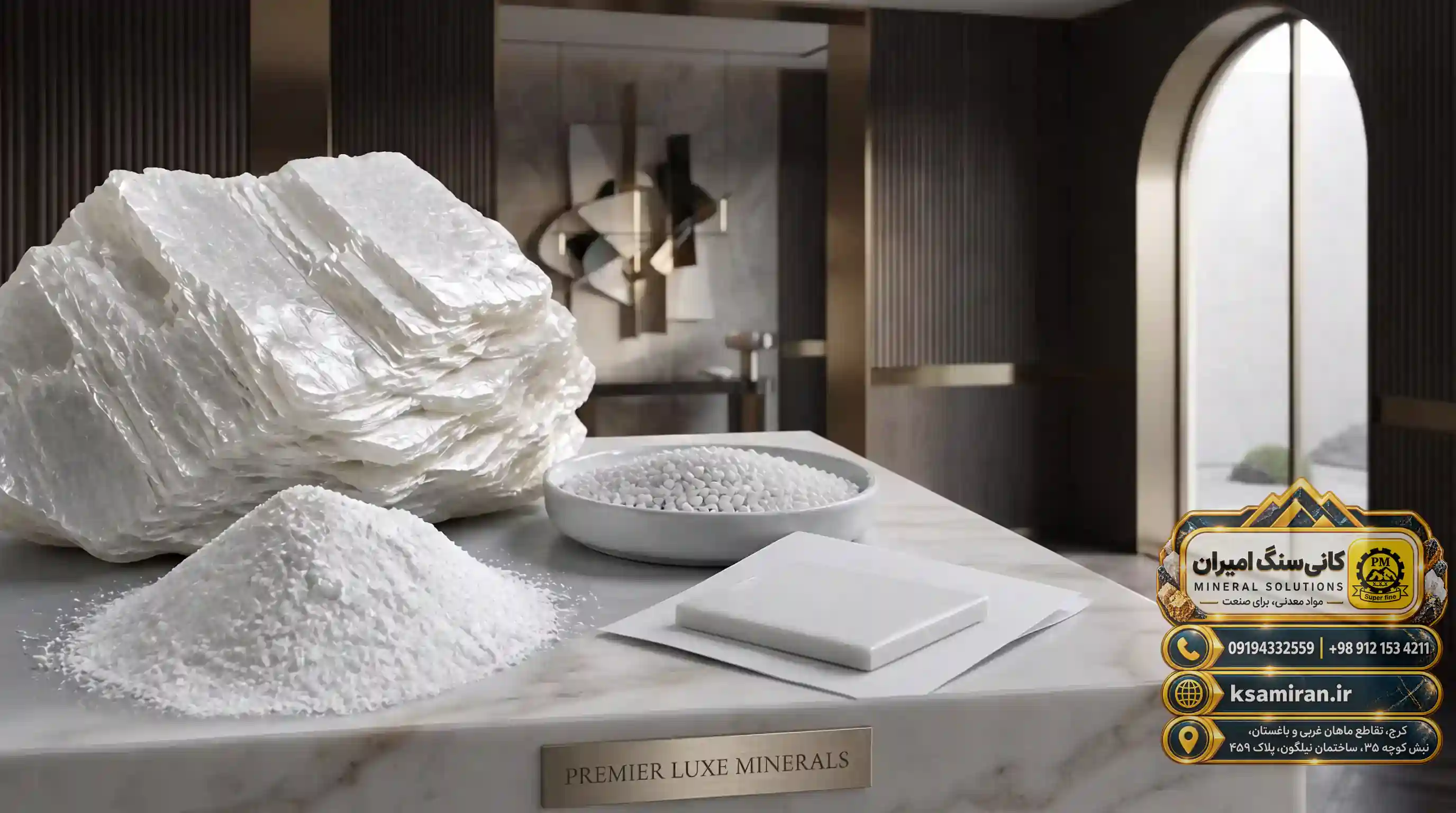
The Impact of Meshing on the Finished and Economic Price of White Talc
One of the important economic topics in the mineral market is the direct relationship between meshing and the price of white talc. The micronization process and bringing particles to high ranges such as 1500 or 2500 mesh require higher energy consumption, longer time, and higher equipment depreciation. For this reason, the price of products with higher mesh is usually higher than products with lower mesh (such as 450 mesh).
Despite the higher cost for finer meshes, the added value created in the final product usually justifies this cost. Industrial consumers must strike a precise balance between the technical needs of their process and the allocated budget when purchasing. Using an inappropriate mesh can either lead to a drop in quality or create uecessary costs.
Procurement experts and materials engineers are always looking to optimize this ratio. To get more familiar with the specialized applications of this material, you can visit the White Talc introduction page to obtain complete information about its technical specifications.
Application of White Talc in the Masterbatch and Compound Industry
Polymer industries, especially masterbatch and compound producers, are among the largest consumers of this mineral powder. The use of white talc in these industries helps improve hardness, tensile strength, dimensional stability, and reduces the shrinkage of plastic parts. For further reading on the impact of this material on the appearance of polymeric products, it is suggested to review the article The Role of White Talc in Improving the Appearance Quality of Polymeric Products.
In the production of compounds, homogeneous distribution of powder particles is of vital importance. The mesh range of 450 to 2500 mesh makes it possible to choose the optimal particle size depending on the type of base polymer (such as polypropylene or polyethylene) and the mechanical requirements of the final part. Micronized particles disperse well within the polymer matrix.
In addition to improving mechanical properties, using this mineral filler has no negative effect on the base color of the masterbatch due to its desirable whiteness, and can even help reduce titanium dioxide consumption, which is economically cost-effective for manufacturers.

Application in the Paint, Paper, and Ceramic Industries
In addition to polymers, white talc has widespread applications in paint manufacturing, paper production, and ceramic products. In the paint industry, this material acts as a filler and improver of opacifying properties, flowability, and peeling resistance. High meshing in paints helps create a smoother and more uniform surface.
In the paper-making industry, this material is used as a filler and surface coating agent, which increases whiteness, improves printability, and reduces ink penetration. Choosing the appropriate mesh in this industry prevents problems in printing and paper-making machinery.
In ceramic products, the presence of this mineral powder also helps lower the firing temperature, improve thermal shock resistance, and increase the mechanical strength of the ceramic body. The chemical stability of this material against environmental factors significantly increases the durability of ceramic products.
Comparison of White Talc with Other Mineral Filler Powders
In the mineral market, other materials such as calcium carbonate and dolomite powders are also used as fillers. To better understand the quality and appearance differences between these materials, reading the article Reviewing the Appearance Characteristics and Quality of White Dolomite Powder will not be amiss and will give you a comprehensive perspective.
The prominent feature of white talc is its flaky structure and softness, which gives it a lubricant-like behavior. Compared to other fillers, this feature reduces the wear of extruder equipment and industrial machinery. Also, its lower coefficient of friction is considered an important advantage in specific formulations.
Chemically, this material is neutral and has low reactivity, making it resistant to acids and weak bases. This exact chemical stability justifies choosing this material for sensitive applications such as the paint industry and industrial coatings.
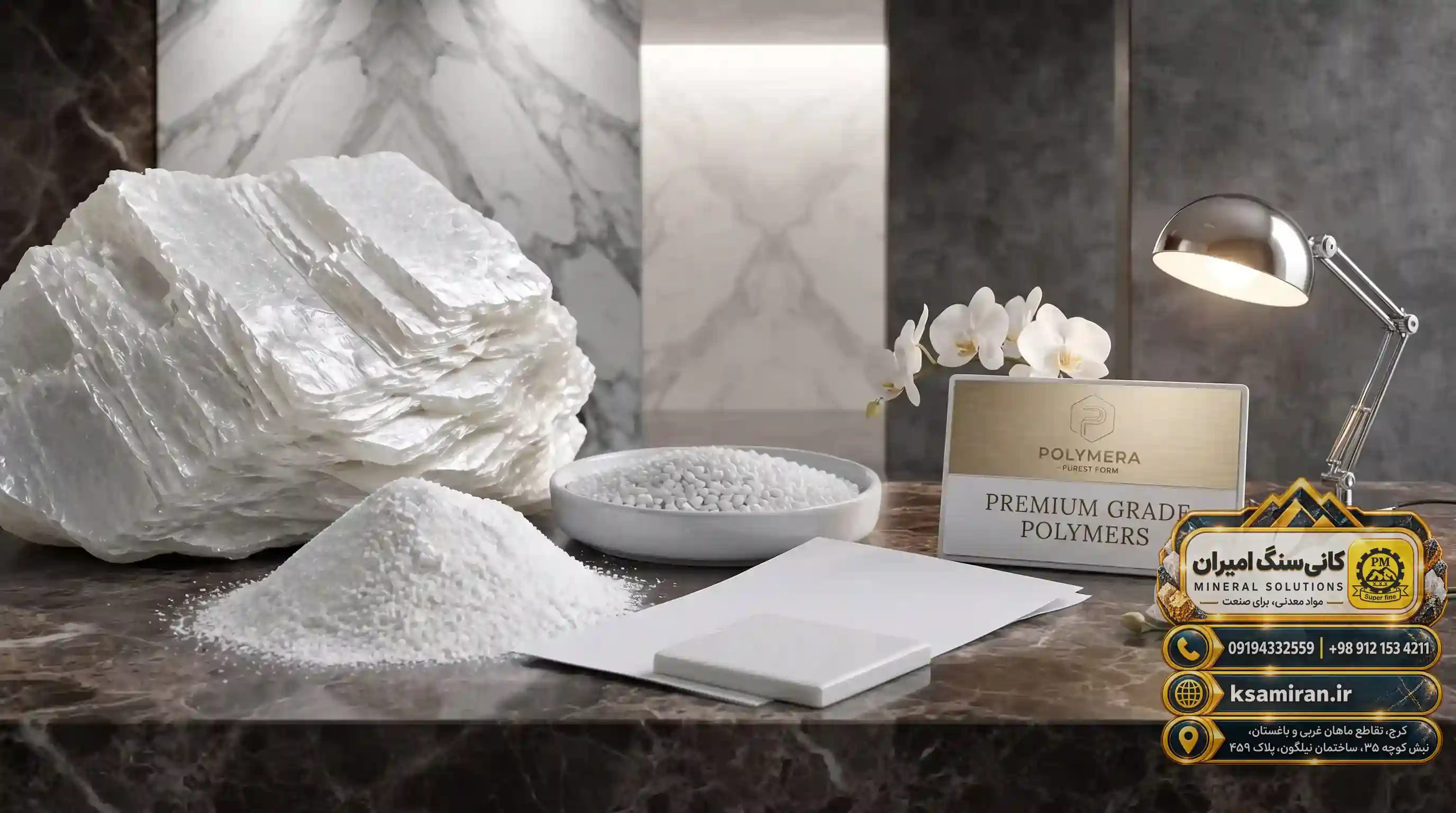
Key Points in Choosing and Purchasing Quality White Talc
When purchasing white talc for industrial uses, paying attention to a few key parameters is very important. Whiteness level, purity percentage, moisture content, and most importantly, particle size distribution (meshing) are items that must be checked in the product's Technical Data Sheet (TDS). Matching these parameters with the production line's needs will guarantee the quality of the final product.
By providing accurate and transparent information about its products, Kani Sang Amiran project has made it possible for industries to make an informed choice. Buyers should receive laboratory samples and perform compatibility tests on their formulation before placing bulk orders.
Also, stability in raw material supply is another conce for manufacturers. Cooperating with reputable manufacturers who have sustainable production capacity within the 450 to 2500 mesh range protects industrial production lines from risks caused by changes in raw material quality.
Prospects of Production and Market of White Talc in Iran
The mineral market and micronized products in Iran are moving towards modeization and quality enhancement at a suitable pace. As a strategic material in the plastics, paint, paper, and ceramic industries, white talc plays a fundamental role in self-sufficiency and reducing dependence on imported materials. Investment in mode milling and particle separation technologies has helped upgrade quality standards.
Utilizing rich mines and advanced production lines, Kani Sang Amiran strives to supply products compliant with mode industrial standards. Developing export markets and responding to the precise needs of domestic industries are key goals of this collection in the mineral supply chain.
Ultimately, industrialists' awareness of the direct relationship between meshing and price and quality will help improve the overall productivity of the country's industry. With the continuation of this trend, we will witness an even greater upgrade in the quality of final Iranian products in domestic and inteational markets.
| Question | Answer |
|---|---|
| What is white talc and what are its applications? | It is a mineral filler powder used in masterbatch, compound, paint, paper, and ceramic product industries. |
| What is the meshing range of Amiran white talc? | This product is produced and supplied in a mesh range of 450 to 2500. |
| Why does meshing affect the price of white talc? | Producing finer particles (micronized) requires more energy, time, and advanced equipment, which increases the final price. |
| Does meshing affect the quality of polymeric products? | Yes, finer and more uniform particles improve mechanical properties, better dispersion, and the appearance quality of polymeric parts. |
| What are the most important physical features of this material? | Flaky structure, softness, low coefficient of friction, desirable whiteness, and chemical neutrality are its main features. |
| How can the most appropriate mesh be chosen for the production line? | Based on formulation requirements, matrix type (polymeric or non-polymeric), and performing laboratory tests on samples. |
| What is the impact of this powder on the paint-making industry? | It acts as a filler, opacifying improver, and creates a smooth, uniform surface in paints. |
| Is this material a substitute for calcium carbonate? | In some formulations yes, but due to its flaky structure and softness, it offers different properties such as reduced equipment wear. |
| How is the order and price inquiry process of the product handled? | You can visit the dedicated white talc page on the Kani Sang Amiran website. |
| What is the role of this material in the paper-making industry? | Increasing whiteness, improving printability, and reducing ink penetration are advantages of using it in paper. |
Specialized reference for mineral and industrial materials information Kani Sang Amiran

برچسب: White Talc,The Impact of Meshing on Determining the Price and Quality of White Talc,
نویسنده: رساوب آفرین