
درباره سایت
آخرین مطالب
- انتخاب اکسید آهن قرمز (اخرا) برای بهبود کیفیت پیگمنت و پوششهای رنگی
- تامین کربنات کلسیم با دانهبندی دقیق جهت استفاده در مستربچ
- تأمین تخصصی سیلیس برای مصالح ساختمانی، شیشه و صنایع سرامیک
- ویژگیهای فنی بنتونیت کانی سنگ امیران برای کاربردهای خاص
- فلدسپات کانی سنگ امیران برای شیشه کاشی و سرامیک
- کاربرد تالک سفید درجه یک در فرمولاسیون پیشرفته رنگ و محصولات کاغذی
- اکسید آهن قرمز (اخرا) کاربردی جهت تولید محصولات سرامیکی و پوشش
- مشخصات فنی اکسید آهن قرمز (اخرا) مناسب برای پوشش و تولید پیگمنت
- مشاوره تخصصی خرید کربنات کلسیم بر اساس نیاز دقیق صنعت شما
- انتخاب تالک سفید صنعتی مناسب برای تولیدات کاغذ و مستربچ
امکانات وب
What is White Talc and Why is it Important in Industries?
White talc is one of the most important and widely used non-metallic industrial minerals, utilized in a wide range of industries from plastics and paint production to paper and ceramics. Known scientifically as hydrated magnesium silicate, this mineral has secured a special place in transformation industries due to its layered structure and unique physical and chemical properties. Its white to milky-white color, exceptional softness, natural brightness, and easy pulverizability are among the characteristics that make it an ideal filler and functional filler.
In nature, talc typically occurs as rocky masses within metamorphic deposits and appears alongside minerals such as chlorite, dolomite, and quartz. The purity and whiteness of this mineral play a decisive role in its pricing and end-use application. The lower the impurity content—such as iron oxide—the whiter the final product and the more suitable it becomes for sensitive industries. For this reason, the processing and beneficiation of mineral talc is as important as the extraction itself.
Mineral white talc is used in dozens of industries due to its unique properties: natural greasiness, chemical neutrality, acid and alkali resistance, and thermal and electrical insulating properties. In the plastics industry it serves as a filler and functional filler, in paint manufacturing as a base pigment, and in papermaking as a coating and filling agent. Moreover, in the ceramics, sanitary ware, and tiling industries, this mineral plays a key role in reducing firing temperature and improving mechanical properties.
For a deeper understanding of this mineral's properties, you can read the article Review of the Physical and Chemical Properties of High-Quality White Talc. In this article, we intend to examine the complete process from extraction to processing of this valuable mineral step by step, and show how raw mineral stone is transformed into a uniform, high-quality powder ready for use in various industries. In the following, we will also address the main applications of this product in masterbatch, compound, paint, paper, and ceramics.
Stages of Exploration and Extraction of White Talc from Mines
The first step in producing white talc is the exploration and identification of its mineral deposits. This stage involves geological studies, aerial mapping, sampling, and exploratory drilling conducted by specialized geology teams. The goal is to determine the reserve volume, quality, and depth of the talc deposit. The data obtained at this stage determine whether extraction is economical and which extraction method should be used.
After the economic viability of the deposit is confirmed, the extraction stage begins. In most talc mines in Iran and around the world, the open-pit or quarrying method is employed. In this method, the overlying soil layers and waste rock are removed in stages to approach the talc-bearing layer. Then, using heavy machinery such as excavators, loaders, and trucks, the talc-bearing rocks are extracted and transported to the processing plant.
In some deeper deposits, underground mining is also used. In this method, numerous tuels and shafts are excavated to access the deposit. Underground mining is more expensive but can provide access to higher-quality deposits. The choice of extraction method depends on factors such as deposit depth, talc quality, topographical conditions, and environmental considerations.
One of the key points during extraction is separating talc-bearing rocks from waste and impurities. The extracted rocks typically consist of a mixture of talc, chlorite, quartz, dolomite, and other associated minerals. These rocks should be hand-sorted as much as possible at this initial stage so that the feed entering the processing plant has higher purity. Initial hand-sorting drastically reduces processing costs.
Finally, the extracted rocks are transported to the processing plant as large blocks. There, the crushing, grinding, and pulverizing stages are carried out, which will be examined in detail in the following sections. It is worth noting that the final product quality is directly affected by the quality of the extracted raw stone. Therefore, mines with richer and higher-purity deposits offer a higher-quality final product.

Primary Processing and Beneficiation of White Talc
After extraction, the rocks containing white talc enter the processing plant to be transformed from raw stone into a uniform, high-quality powder. Primary processing includes crushing, screening, separation, and in some cases special treatments. The main objectives of this stage are the removal of impurities, increasing the whiteness, and achieving the desired particle size distribution.
The first stage in processing is primary crushing. The large incoming rocks are crushed by jaw crushers and then reduced to smaller particles by cone or impact crushers. This stage is typically performed dry and produces a granulation of a few millimeters. After crushing, the material passes over multi-deck screens to be classified by size. Oversized particles are retued to the crushing circuit.
The next stage is beneficiation or concentration, in which impurities such as quartz, chlorite, iron oxide, and associated minerals are removed. One common method is magnetic separation. In this method, magnetic impurities such as hematite and magnetite are separated from the talc using powerful magnets. This stage plays an important role in increasing the product's whiteness, since the presence of iron oxide even in small amounts can make the product's color dull and yellowish.
Another concentration method is flotation processing. In flotation, the raw powder is suspended in water and, by adding specific chemicals, talc particles rise to the surface while impurities settle at the bottom of the tank. This method can produce a very pure product, but it is more costly and is not always economical for standard production. For sensitive applications such as paper and paint that require very high whiteness, the use of floated products is essential.
At the end of primary processing, the product is stored as powder with a specified granulation and then enters the final grinding stage. The quality of this stage directly affects the product's performance in end-use applications. For example, in the plastics industry, the presence of coarse particles and non-uniform powder can degrade the quality of the final product. Therefore, strict quality control at all these stages is essential.
Grinding and Pulverizing White Talc in the 450 to 2500 Mesh Range
One of the most important stages in producing white talc is grinding and pulverizing it to the desired particle size. In industry, the particle size of mineral powder is measured in "mesh" units, indicating the number of openings per square inch of screen. The higher the mesh number, the finer the particles. This product is produced and offered in the 450 to 2500 mesh range, and this wide range covers the different needs of various industries.
In primary mills, the powder is typically produced in the 450 to 800 mesh range. This range is suitable for applications such as masterbatch and compound, construction paints, and standard paper. In these mills, equipment such as hammer mills, ball mills, and roller mills are used. Particles in this range offer a good balance between price and performance, and therefore account for the largest volume of market consumption.
For more advanced applications such as high-quality paints, paper coatings, and specialty ceramics, much finer powder is required. In these cases, more advanced mills such as jet mills or fluidized-bed mills are used, which can produce powder in the 1250 to 2500 mesh range. The jet mill uses high-pressure air streams to break particles apart and can produce very fine and uniform particles. These machines consume more energy, but the final product has much higher quality.
One of the key points in the grinding stage is controlling the Particle Size Distribution. A uniform particle distribution delivers better performance in end-use applications. For this purpose, air classifiers and precision screens are used. Also, in some cases, anti-caking agents or advanced drying methods are used to prevent fine particles from sticking together.
After grinding, the produced powder undergoes quality control. Whiteness, particle size distribution, moisture, and chemical purity are measured. The final product is then packaged in bags or various packaging types and offered to customers. Correct selection of the mesh range, based on the target industry's needs, has a direct impact on the final product quality and total cost.

Application of White Talc in Masterbatch and Compound
One of the most important applications of white talc is in the plastics industry. This mineral is used as a filler and functional filler in the production of masterbatch and compound. Masterbatch is a concentrated mixture of pigments or additives in a polymeric carrier, used for coloring or modifying plastic properties. Due to its high white color and chemical neutrality, talc is an ideal base material for white masterbatch.
In masterbatch production, talc powder is mixed with the carrier polymer (such as polyethylene, polypropylene, or polystyrene), melted and homogenized in an extruder, and then cut into small granules. These granules are used in the production of final plastic products. The presence of talc in this composition reduces production cost, increases whiteness, and improves the mechanical properties of the product. Also, talc can serve as a white pigment, reducing the amount of expensive titanium dioxide pigment required.
In compound production, talc is used as a functional filler. Talc-filled compounds have better mechanical properties such as increased strength, hardness, and impact resistance. Additionally, talc reduces shrinkage, improves thermal stability, and increases production rate. These characteristics make talc-filled compounds suitable for producing automotive parts, household appliances, pipes, and plastic films.
The exact amount of talc used in masterbatch and compound depends on the polymer type, end-use application, and desired properties. In some cases, talc constitutes up to 50% of the formulation by weight. The quality of the talc used has a direct impact on the final product quality. For this reason, masterbatch and compound manufacturers typically choose powders with high whiteness and uniform particle size distribution.
The suitable mesh range for this application is typically 450 to 1250 mesh. Coarser particles can degrade the surface quality of the final product, while very fine particles increase production cost. The product offered by Kani Sang Amiran Project, with appropriate technical specifications, can meet the diverse needs of these industries.
Application of White Talc in the Paint and Paper Industries
The paint and paper industries are other major consumers of white talc. In paint production, this mineral is used as a white pigment and filler. Due to its natural brightness, chemical neutrality, and affordable price, talc is considered a suitable replacement for expensive pigments such as titanium dioxide. In construction paints, industrial paints, and various coatings, talc increases coverage, improves color, and reduces production cost.
In paint production, talc powder must have high whiteness and a uniform particle size distribution. Finer particles provide better coverage and result in a smoother painted surface. For this reason, in high-quality paints, powders in the 1250 to 2500 mesh range are used. Also, talc's greasy property allows the paint to spread easily on surfaces and improves paint moisture acceptance.
In the papermaking industry, talc is used as a filler and coating agent. In printing paper, writing paper, and highlighter paper, talc plays an important role. This mineral is a suitable alteative to kaolin and, in some cases, offers advantages. The presence of talc in paper increases whiteness, improves paper surface, enhances printability, and reduces production cost. Also, talc's greasy property improves ink performance during printing.
In papermaking, talc must have very high chemical purity. The presence of impurities such as iron oxide, quartz, and calcium carbonate can severely degrade paper quality. For this reason, high-purity floated products are typically used for this application. The suitable mesh range for this application is 800 to 2500 mesh.
In addition, talc is used in the production of roofing felt, asphalt, and in oil refining. In the roofing felt industry, talc is used as an anti-caking and insulating material. In oil refining, edible talc is used to refine oils. This breadth of applications demonstrates the importance of this mineral in various industries. The demand trend for this product has also been upward in recent years, which is examined in detail in the article Review of the Upward Trend in Demand for High-Quality Industrial Talc.
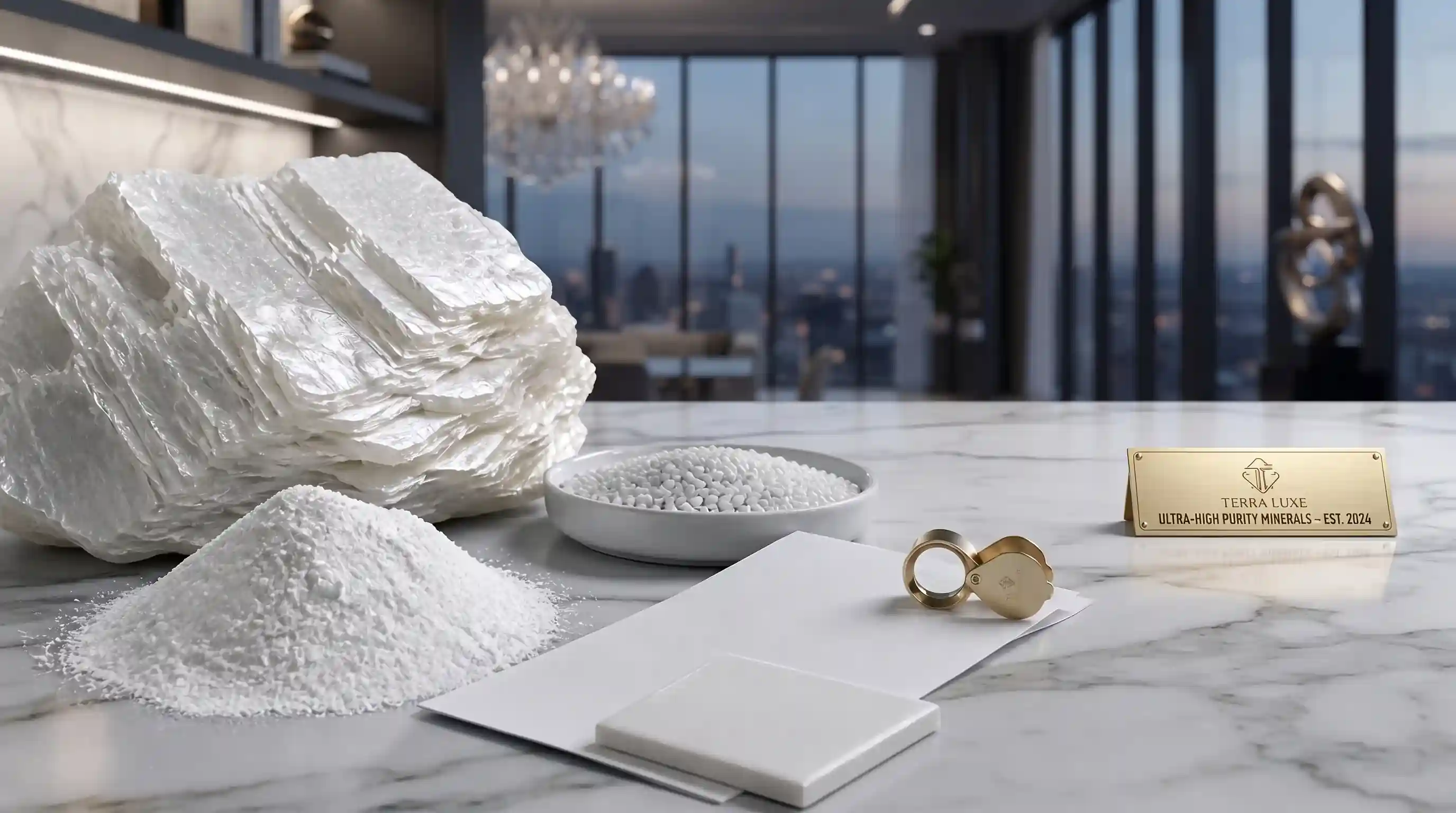
Application of White Talc in the Ceramic Industry
The ceramics industry is one of the oldest consumers of white talc. This mineral is used in the production of tiles, fine ceramics, sanitary ware, electrical insulators, and technical ceramics. In the ceramic body, talc serves as a primary raw material and functional mineral. The presence of talc in the ceramic body reduces the firing temperature, improves mechanical properties, and increases heat resistance.
In tile and ceramic production, talc is typically mixed with other minerals such as kaolin, quartz, and feldspar. This mixture, after shaping, is fired in high-temperature kilns. The presence of talc in this mixture lowers the firing temperature, which means significant savings in energy consumption. In addition, talc improves strength, reduces porosity, and increases the whiteness of the ceramic body.
In the production of fine ceramics and sanitary ware, talc plays a more critical role. Steatite ceramic, a type of talc-based ceramic, is used in the production of electrical insulators, spark plugs, and electronic components due to its electrical insulating properties and high heat resistance. Also, in the production of technical ceramics with advanced applications, high-purity talc powder is used.
In this application, the quality of talc is extremely important. The presence of metallic impurities can cause discoloration of the ceramic body, staining, and degradation of the final product quality. For this reason, for high-quality ceramics, talc with high whiteness and appropriate chemical purity is used. The mesh range required for this application is typically 450 to 1250 mesh, although finer powders are also used for more advanced applications.
Beyond the ceramics industry, talc is used in the production of carpets, tiles, and industrial powders. Also, in the agricultural industry, talc is used as an anti-caking agent in fertilizers. This breadth of applications has made this mineral one of the most important industrial mineral materials. The final quality of the ceramic product is directly affected by the quality of the talc used; therefore, choosing the right supplier is of high importance.
Quality Control and Standards for White Talc
Quality control is one of the most important stages in producing white talc. This stage ensures that the final product meets the technical specifications required by various industries. The main parameters measured in quality control include whiteness, particle size distribution, chemical purity, moisture, and pH. Each of these parameters is important for a specific application and must fall within the permissible range.
Whiteness is one of the most important parameters. This parameter is measured using spectrophotometer devices and indicates the amount of light reflected from the powder surface. Whiteness above 90% is suitable for sensitive applications such as paper and paint. The presence of iron oxide, even in small amounts, can severely reduce whiteness. For this reason, removing iron-bearing impurities during processing is of great importance.
Particle size distribution is another parameter measured in quality control. This parameter is determined using laser analysis devices or by screening. Uniformity of particle distribution has a direct impact on the product's performance in end-use applications. Chemical purity is also measured using methods such as XRF and ICP. With these methods, the percentage of main elements such as SiO2 and MgO, as well as impurity elements, is determined.
In addition, the powder's moisture must also be controlled. High moisture can cause particles to stick together, form clumps, and degrade quality in end-use applications. For this reason, during the drying stage, the product's moisture is minimized. The powder's pH is also important for applications involving sensitive chemical reactions. Pure talc has a neutral pH close to 7.
To ensure product quality, various national and inteational standards have been established. These standards define the technical specifications, test methods, and quality requirements of the product. To become familiar with these standards, you can read the article Review of National and Inteational Standards in White Talc Production. Compliance with these standards eas customer confidence and guarantees product quality.
Finally, it should be emphasized that the production process of this mineral—from extraction to processing—is a continuous chain, and the quality of each stage affects the subsequent stages. Choosing a reputable supplier that carries out all these stages with precise quality control is of great importance to consumer industries.

| Question | Answer |
|---|---|
| What is white talc? | White talc is a non-metallic industrial mineral with the formula hydrated magnesium silicate, used in numerous industries due to its softness, whiteness, and chemical neutrality. |
| What is the mesh range of white talc? | This product is produced and offered in the 450 to 2500 mesh range to cover the diverse needs of various industries. |
| What are the main applications of white talc? | Main applications include masterbatch, compound, paint, paper, and ceramic products. |
| What method is used to extract mineral talc? | In most mines, the open-pit extraction method is used; in deeper deposits, underground mining is also employed. |
| What is talc beneficiation or concentration? | It is the process of removing impurities such as quartz, chlorite, and iron oxide from raw ore using methods such as magnetic separation and flotation. |
| Why is talc whiteness important? | High whiteness is essential for sensitive applications such as paper and paint, and the presence of iron oxide reduces it. |
| What role does talc play in masterbatch? | It acts as a base material and white pigment, improves the whiteness and mechanical properties of the product, and reduces production cost. |
| What is talc's application in the ceramic industry? | It reduces the firing temperature, increases the strength and whiteness of the ceramic body, and is used in the production of electrical insulators. |
| What are the main quality control parameters for talc? | Whiteness, particle size distribution, chemical purity, moisture, and pH are the most important quality control parameters. |
| What role does talc play in the papermaking industry? | As a filler and coating agent, it improves the whiteness, printability, and surface quality of paper. |
Kani Sang Amiran Project — Mineral Materials Production (https://ksamiran.ir/products/white-talc/)
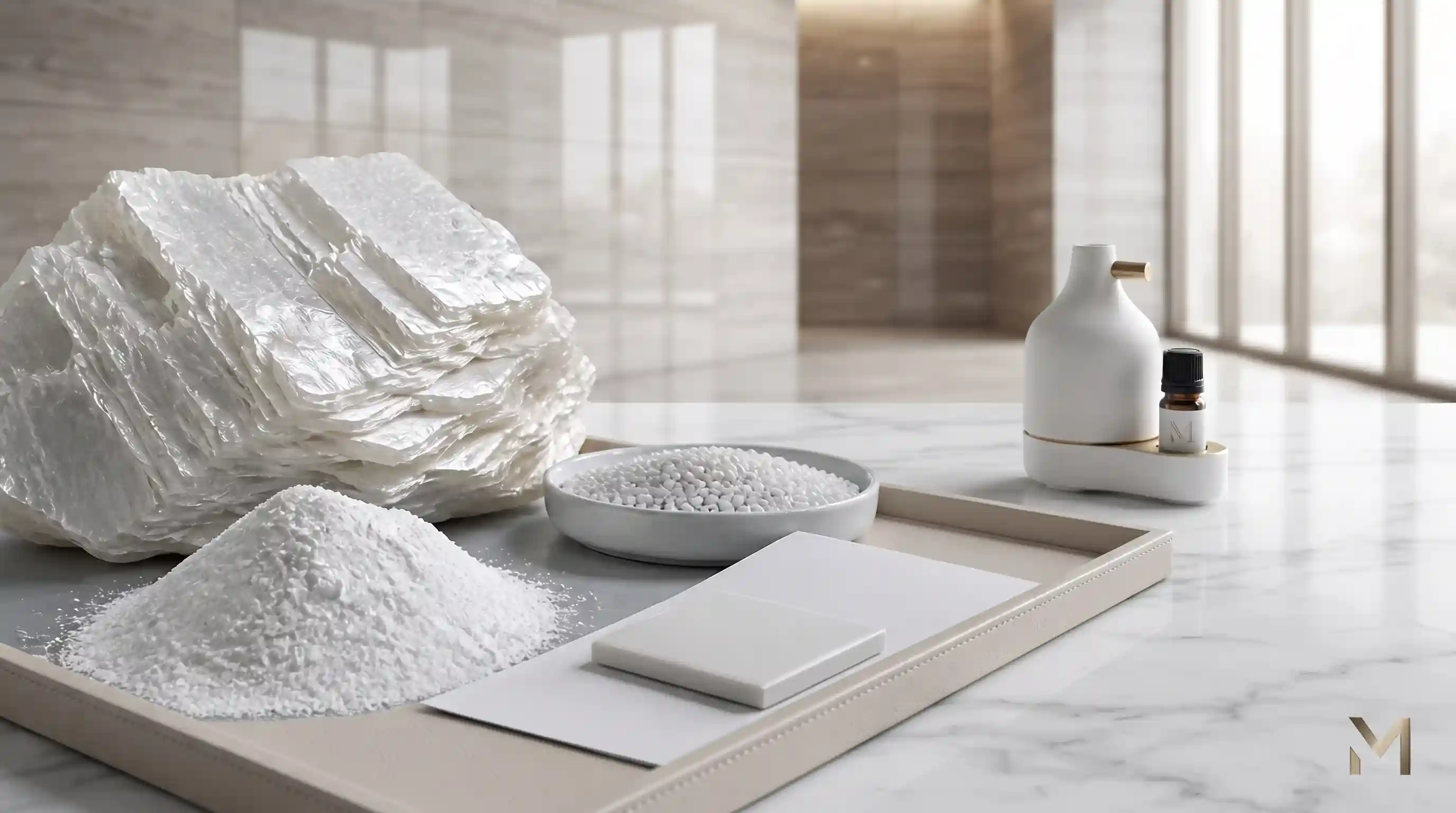
برچسب: White Talc,Reviewing the Process from Extraction to Processing of Mineral White Talc,
نویسنده: رساوب آفرین