
درباره سایت
آخرین مطالب
- اکسید لیمونیت (گل ماش) استاندارد جدید در صنایع پوشش صنعتی
- کائولن باکیفیت کانی سنگ برای کاغذسازی مش 450 تا 1500
- سیلیس باکیفیت کانی سنگ امیران برای صنایع سرامیک با مش ۱۰ تا ۴۵۰
- تالک صنعتی با دانه بندی استاندارد برای کاربردهای صنعتی
- کائولن مرغوب کانی سنگ امیران برای رنگ و لعاب با مش 450 تا 1500
- کائولن درجه یک کانی سنگ امیران برای کاشی و لعاب مش 450 تا 1500
- خرید کائولن اصیل کانی سنگ برای کاشی و کاغذ دانه بندی 450 تا 1500
- دریافت کاتالوگ و آنالیز فنی کربنات کلسیم ۸۰۰ مش
- سیلیس صنعتی کانی سنگ امیران برای صنایع شیشه در مش ۱۰ تا ۴۵۰
- خرید فلدسپات به عنوان مواد اولیه صنایع شیشه و سرامیک
امکانات وب
Introduction to Limonite Oxide (Gol Mash) and Its Position in the Adhesive Production Industry
The adhesive production industry has undergone extensive transformations in recent decades; transformations that are the product of the market's ever-increasing demand for adhesives with competitive color, durability, and economics. In this path, minerals play a key role, since a large part of the cost and performance of an adhesive formula depends on additives and fillers. Limonite Oxide (Gol Mash) is one of these materials, produced as a natural mineral pigment in the Amiran Stone Mineral Project and introduced for applications such as mineral pigments, coatings, and construction products.
Limonite is basically a natural iron oxide-hydroxide whose distinct yellow to brown color has been used as a pigment for centuries. Today, with precise processing and pulverizing of this material, products with different meshes are obtained, each having a specific application in industries. The mesh range of 450 to 1500 mesh for Limonite Oxide (Gol Mash) provides the possibility of choosing a gradation suitable for the type of adhesive-making process; from coarse-grained industrial adhesives to fine and uniform adhesives.
In adhesive production, Limonite Oxide (Gol Mash) is not just a simple pigment; this material can play multiple roles in the formula. On one hand, its warm and earthy color gives products a natural and pleasant appearance, and on the other hand, its particles can act as a filler to increase the volume of the adhesive and reduce the formula cost. This very duality has caused many manufacturers to move towards this mineral pigment instead of expensive synthetic pigments.
Another reason for the importance of Limonite Oxide (Gol Mash) in the adhesive industry is its inherent color variety. Depending on the source and processing, this product can offer a spectrum from amber yellow to dark brown; a color that is in high demand in wood adhesives, construction adhesives, and industrial adhesives. This light-stable color is considered a significant advantage for products exposed to sunlight.
Economically, the use of indigenous mineral pigments like Limonite Oxide (Gol Mash) helps reduce dependence on imported materials. The Amiran Stone Mineral Project, by producing this material in the 450 to 1500 mesh range, has provided the possibility of local and stable supply for domestic industries.
In the rest of this article, we will examine the structure and properties of Limonite Oxide (Gol Mash), its role as a pigment and filler in adhesive formulation, its effect on mechanical properties, its application in construction adhesives, and its chemical and process considerations. The goal is to present a clear picture of how this mineral creates value in the adhesive production line.
Structure and Properties of Limonite Oxide (Gol Mash) Related to Adhesive Production
To better understand the role of Limonite Oxide (Gol Mash) in adhesive production, familiarity with the structure and properties of this material is essential. In inorganic chemistry, limonite refers to a group of hydrated iron oxide-hydroxides (like goethite) found in nature in yellow to brown forms. This natural structure is the origin of the warm and stable color of this pigment and distinguishes it from synthetic pigments.
One of the most important properties of Limonite Oxide (Gol Mash) for the adhesive industry is its particle size distribution. The product offered in the 450 to 1500 mesh range makes access to very fine particles possible. Finer particles disperse better in the adhesive matrix, create higher color uniformity, and in some formulas help improve adhesion and filling. This issue is especially important in adhesives with low film thickness.
The yellow-brown color of Limonite Oxide (Gol Mash) results from the presence of iron in its structure, and this color shows good stability in adhesive production processes. Color stability against UV light and temperature is a key advantage for adhesives used in outdoor environments or with high process temperatures. As a result, the manufacturer can use this pigment in their formula without worrying about the final product changing color.
In terms of density and physical behavior, Limonite Oxide (Gol Mash), as a mineral pigment, is heavier than most organic resins; therefore, in adhesive formulation, attention must be paid to sedimentation and suspension stability. Using appropriate mixers, dispersing additives, and selecting the right mesh are known solutions for managing this challenge. The wide mesh range of this product allows the manufacturer to find the desired balance between dispersion and cost.
The hardness and mineral nature of Limonite Oxide (Gol Mash) particles can also affect the mechanical properties of the dried adhesive film. Mineral particles play a reinforcing role in the polymer matrix and in some formulas increase the abrasive resistance and durability of the adhesive. This property is attractive for industrial and construction adhesives exposed to wear and stress.
Finally, the difference in quality between various products must be mentioned. Limonite Oxide (Gol Mash) offered by the Amiran Stone Mineral Project, with gradation control in the 450 to 1500 mesh range, is customized for applications of mineral pigments, coatings, and construction products, and this is a reliable starting point for adhesive formulators.
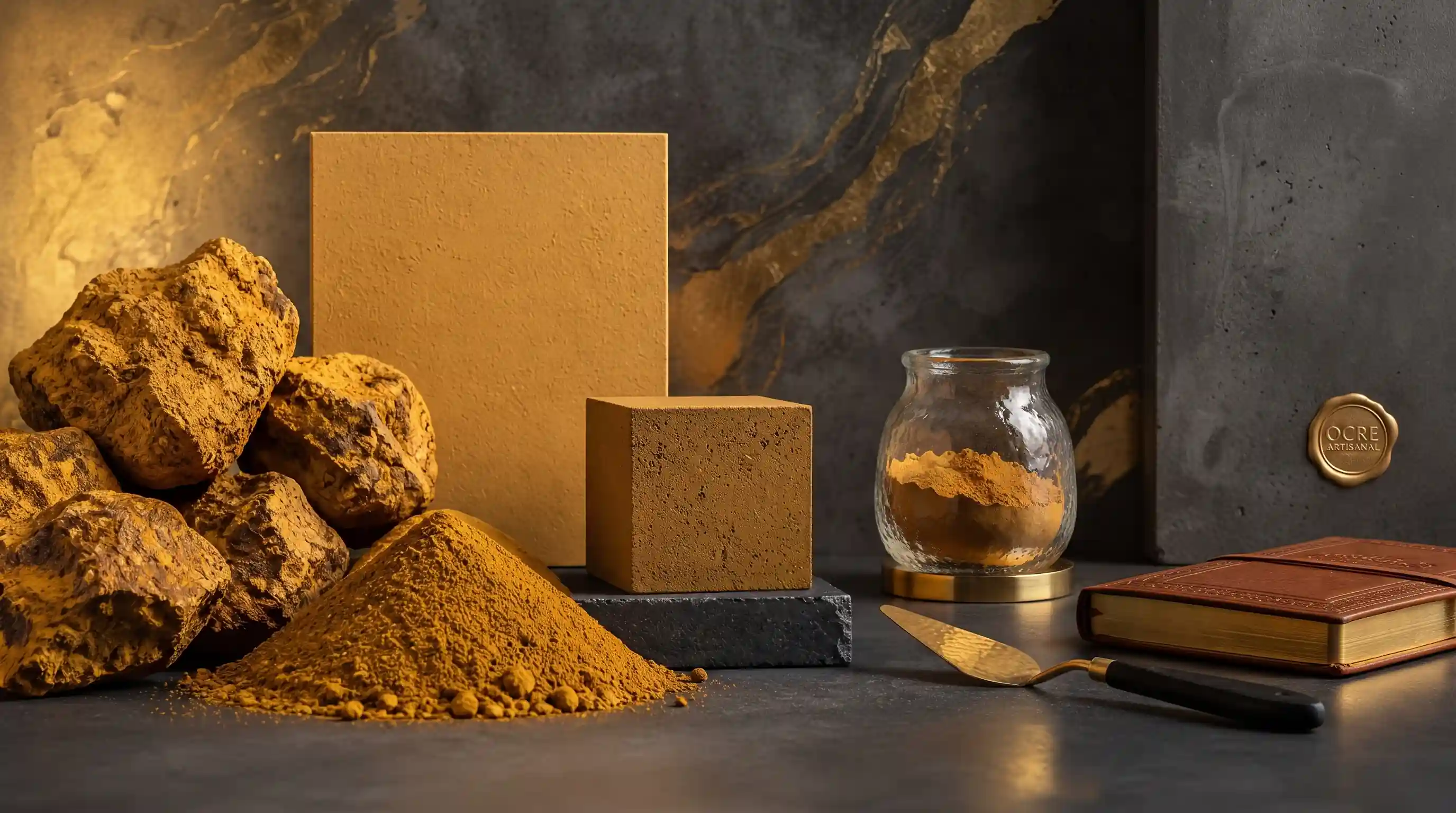
The Role of Limonite Oxide (Gol Mash) as a Pigment and Filler in Adhesive Formulation
In adhesive formulation, additives are usually divided into two groups: pigments and fillers. Limonite Oxide (Gol Mash) is one of the few minerals that can play both roles simultaneously, and this multifunctional feature has made it attractive to manufacturers.
As a pigment, Limonite Oxide (Gol Mash) gives the adhesive a warm yellow-brown color. This color is in high demand in final products such as wood adhesives, paper adhesives, and industrial adhesives, because it creates a natural and pleasant appearance. Unlike synthetic pigments that sometimes have an uatural color, this mineral pigment offers a familiar and soothing color tone.
As a filler, Limonite Oxide (Gol Mash) particles fill part of the adhesive volume, and as a result, the consumption of resin and other expensive organic materials decreases. This cost reduction without a severe drop in quality is one of the most important goals of adhesive formulators. Mineral particles with a suitable mesh can strengthen the structure of the adhesive matrix and in some cases increase its resistance to wear and stress.
One of the key points in using Limonite Oxide (Gol Mash) as a filler is the correct selection of particle size. Coarser mesh (around 450 mesh) is suitable for adhesives that have a higher film thickness and need more volume filling; whereas finer mesh (up to 1500 mesh) works better for adhesives that require a smooth, uniform, and fine surface. Precise knowledge of the final product will guide the mesh selection.
It should also be noted that the filler loading level in the adhesive formula must be carefully optimized. Excessive addition of Limonite Oxide (Gol Mash) can increase the viscosity of the adhesive and reduce bonding strength. Usually, formulators determine the optimal percentage of this filler for each product through workshop and laboratory tests.
Finally, due to its natural nature and mineral processing, Limonite Oxide (Gol Mash) is a sustainable option for manufacturers looking to reduce the environmental impacts of their formula. Using indigenous mineral pigments both helps the local economy and reduces dependence on imported synthetic pigments.
Coloring and Color Stability of Adhesive with Limonite Oxide (Gol Mash)
Color is one of the most important visual features of an adhesive from the customer's perspective. In many applications, the adhesive must not only perform well but also have a color coordinated with the final product. With its natural yellow-brown color, Limonite Oxide (Gol Mash) is an ideal option for producing adhesives with a warm and classic appearance.
In the wood adhesive industry, Limonite Oxide (Gol Mash) plays a special role. Most woods have a yellow to brown color, and an adhesive colored with this pigment shows the joint lines less and gives the final product a more integrated appearance. This advantage is very valuable for fuiture, doors and windows, and the wood industry.
Besides wood adhesive, this pigment is also used in construction adhesives, paper adhesives, and packaging adhesives. The earthy color of Limonite Oxide (Gol Mash) in these products creates a natural and traditional feel that is highly popular in certain markets. Also, this base color provides the ability to adjust the final color tone by adding other pigments.
Color stability against light and moisture is another advantage of Limonite Oxide (Gol Mash). Iron-containing mineral pigments generally have good resistance to ultraviolet rays, and as a result, adhesives colored with this material retain their color over time. This feature is vital for adhesives used in outdoor environments or exposed to sunlight.
The experience of using mineral pigments in industrial coatings is also not unrelated to the adhesive industry; many manufacturers working with colored powders use Limonite Oxide (Gol Mash) as the main pigment. To become more familiar with this topic, you can read the article Application of Limonite Oxide (Gol Mash) in Powder Coatings.
Finally, to achieve color uniformity in mass production, controlling the gradation of Limonite Oxide (Gol Mash) is very important. Particles that are precisely controlled in the 450 to 1500 mesh range create equal dispersion in the adhesive and prevent color differences between different batches of the product.
The Effect of Limonite Oxide (Gol Mash) on Adhesion and Mechanical Properties of Adhesive
One of the main conces of adhesive manufacturers is maintaining the balance between cost and performance. Adding mineral filler to the adhesive can reduce the cost, but the question is what effect it has on adhesion and mechanical properties. Experience shows that Limonite Oxide (Gol Mash), with proper mesh selection and loading, offers acceptable performance in this regard.
Mineral particles play a physical reinforcing role in the polymer matrix. When Limonite Oxide (Gol Mash) is uniformly dispersed in the adhesive, it can increase the resistance of the dried film to abrasion, pressure, and mechanical stresses. This property is important for industrial adhesives, construction adhesives, and adhesives exposed to dynamic loads.
On the other hand, Limonite Oxide (Gol Mash) particles have their own specific surface area and roughness, which can improve the mechanical interlocking of the adhesive to the surface. This type of physical bond complements the chemical adhesion of the resin and shows a greater effect on porous surfaces like wood, concrete, and pottery.
However, overloading the filler can have negative effects. Increasing the concentration of mineral particles raises the viscosity of the adhesive and reduces its ability to wet the surface. As a result, adhesion may drop. For this reason, formulators usually determine the optimal percentage of Limonite Oxide (Gol Mash) for each application by combining tensile, shear, and peel tests.
Mesh selection also affects mechanical properties. Finer particles (1500 mesh) create a smoother and more uniform surface and are suitable for thin-film adhesives; whereas coarser particles (450 mesh) are more suitable for bulky adhesives and filling large joints. Knowing the type of product and the application surface is the guide for the right choice.
To ensure the performance of the final formula, manufacturers usually conduct a series of tests: measuring viscosity, drying time, bonding strength on various surfaces, and abrasion tests. Comparing the results of the formula containing Limonite Oxide (Gol Mash) with the base formula shows the formulator what value this mineral pigment has added to the product.
The conclusion of this section is that Limonite Oxide (Gol Mash) is not an inert filler, but rather a material that, with proper management, can simultaneously reduce costs and maintain or improve the mechanical properties of the adhesive.
Application of Limonite Oxide (Gol Mash) in Construction Adhesives
The construction industry is one of the largest consumers of adhesives; from tile and ceramic adhesives and stone adhesives to wood adhesives and insulations. In this field, Limonite Oxide (Gol Mash), which is also introduced for construction products, plays a prominent role.
Construction adhesives usually must tolerate a large volume of minerals, because the cost per unit of product must be kept low. Limonite Oxide (Gol Mash), with its simultaneous role as a filler and pigment, helps reduce costs and increase volume, while its natural yellow-brown color is in good harmony with the built environment.
In tile, stone, and mosaic adhesives, this mineral pigment can be used as a mineral filler and pigment. Its particles disperse in the cementitious or polymer matrix and in some cases improve physical adhesion. Also, the earthy color of this material is suitable for adhesives where part of their surface remains visible after installation.
Attention must also be paid to the relationship of this material with construction mineral systems. Limonite Oxide (Gol Mash) is also used in cement-based building materials, and understanding its behavior in these systems can be useful for construction adhesive manufacturers; for further reading, you can read the article Specialized Application of Limonite Oxide (Gol Mash) in Concrete.
In construction wood adhesives such as door and window adhesives, Limonite Oxide (Gol Mash) creates a color coordinated with wood and reduces the need for painting after joining. This feature is also valuable in the fuiture and facade industries.
Construction adhesives are usually exposed to moisture, temperature changes, and sunlight. The color stability of Limonite Oxide (Gol Mash) against these factors makes it suitable for outdoor and indoor applications. Of course, the formulator must also use the correct combination of resin and water-repellent additives for moisture resistance.
Finally, the availability of this material locally and with controlled quality in the Amiran Stone Mineral Project is a supply advantage for construction adhesive manufacturers; since one of the challenges of this industry is the fluctuation in the quality of imported minerals.
Chemical and Process Considerations in Using Limonite Oxide (Gol Mash)
To successfully exploit Limonite Oxide (Gol Mash) in adhesive production, attention to chemical and process considerations is essential. This material is an iron oxide-hydroxide and therefore must be cautiously evaluated in systems with strongly acidic or alkaline pH. It is suggested that formulators perform compatibility tests with their resins and additives before extensive use.
In the production process, the dispersion stage is critical. Mineral pigment particles tend to agglomerate, and if dispersion is not appropriate, color spots and a drop in quality appear in the final product. Using high-speed mixers, appropriate dispersants, and organizing the order of adding materials are standard methods for managing this challenge.
The sedimentation of heavy mineral particles during adhesive storage is another common conce. Limonite Oxide (Gol Mash), with its mineral density, can settle in packages over time. To reduce this effect, adjusting the base viscosity, using anti-settling agents, and selecting a finer mesh are known solutions.
In processes where the adhesive is dried with heat, the thermal stability of the pigment must be considered. Limonite Oxide (Gol Mash), as an iron-containing pigment, usually has good thermal stability at the typical temperatures of the adhesive industry, but at very high temperatures, a color change may occur. Testing at the actual process temperature is recommended.
In terms of safety, this material is a mineral pigment with common dust hazards. Using a mask, proper ventilation, and observing industrial hygiene when handling the powder are essential. Also, storage in a dry and covered environment prevents moisture absorption and product agglomeration.
To become more familiar with the chemical behavior of this material in various industries, reading the article The Role of Limonite Oxide (Gol Mash) in the Chemical Industries is recommended. These resources can expand formulators' perspectives on the applications of this mineral pigment.
Finally, the consistency of raw material quality is the key to success in mass production. Purchasing Limonite Oxide (Gol Mash) from a supplier with continuous quality control assures adhesive manufacturers that they will receive a product with the same color, particle distribution, and process behavior every time.
Criteria for Selecting Limonite Oxide (Gol Mash) for Adhesive Production and Conclusion
Selecting Limonite Oxide (Gol Mash) for an adhesive formula requires knowledge of the final product and its requirements. The first criterion is particle size: for fine adhesives with a thin layer, finer meshes (e.g., close to 1500 mesh) and for bulky and gap-filling adhesives, coarser meshes (close to 450 mesh) are more suitable. This wide range provides the possibility of flexible selection.
The second criterion is color. The yellow to brown tone of Limonite Oxide (Gol Mash) must be coordinated with the desired appearance of the final product. If needed, the desired color tone can be created by combining this pigment with other pigments.
The third criterion is chemical compatibility with the formula's resins and additives. Laboratory tests prior to mass production reduce costs arising from incompatibility. The fourth criterion is supply and quality consistency; because fluctuations in color or particle distribution can affect the uniformity of the final product.
Given the topics presented, Limonite Oxide (Gol Mash) is a multifunctional material in adhesive production: it acts as a warm and stable color pigment, as a cost-reducing filler, and in some cases as a reinforcer of mechanical properties. This multiple role makes this mineral pigment a smart choice for manufacturers looking to optimize their formula.
If you are also looking to use this mineral pigment in your adhesive production line, you can examine the product details on the Limonite Oxide (Gol Mash) page of the Amiran Stone Mineral Project. This product is introduced with a mesh range of 450 to 1500 mesh and for applications of mineral pigments, coatings, and construction products.
The growing trend of industries towards natural and sustainable minerals shows that the role of pigments like Limonite Oxide (Gol Mash) will become more prominent in the coming years. Manufacturers who try this path sooner will consolidate their competitive advantage in the market.
Ultimately, success in using Limonite Oxide (Gol Mash) depends on combining formulation knowledge, precise testing, and the selection of high-quality raw materials; a combination that can produce adhesives with beautiful color, desirable performance, and competitive economics.
| Question | Answer |
|---|---|
| What is Limonite Oxide (Gol Mash) and what role does it play in adhesive production? | It is a natural mineral pigment with a yellow to brown color used in adhesives as a pigment and filler. |
| What is the color of Limonite Oxide (Gol Mash) in adhesive? | This product imparts a natural, warm yellow-brown color suitable for wood and construction adhesives. |
| What is the mesh range of this product? | The mesh range of Limonite Oxide (Gol Mash) is 450 to 1500 mesh, which allows selection based on the type of adhesive. |
| Which mesh is more suitable for adhesive? | Finer meshes are more suitable for thin and delicate layers, while coarser meshes are better for bulky and gap-filling adhesives. |
| Does Limonite Oxide (Gol Mash) retain its color against light? | Iron-containing mineral pigments generally have good light stability, but testing under real conditions is recommended. |
| How is the sedimentation of this pigment in adhesive managed? | It can be controlled by adjusting the base viscosity, using anti-settling additives, and selecting a finer mesh. |
| Is this material compatible with water-based and solvent-based resins? | Compatibility depends on the resins and additives, and a compatibility test is essential before mass production. |
| What is the consumption level of this filler in the adhesive formula? | The optimal loading level must be determined separately for each product through adhesion and viscosity tests. |
| What is the application of Limonite Oxide (Gol Mash) in construction adhesives? | It is used as a filler and pigment in tile, stone, and construction wood adhesives. |
| Where is this product supplied from? | Limonite Oxide (Gol Mash) is produced by the Amiran Stone Mineral Project. |
Reference: Product data for Limonite Oxide (Gol Mash) from Amiran Stone Mineral Project (ksamiran.ir).
برچسب: Limonite Oxide (Gol Mash),The Role of Limonite Oxide (Gol Mash) in Adhesive Production,
نویسنده: رساوب آفرین