
درباره سایت
آخرین مطالب
- استخدام أكسيد الليمونيت (الماغش) في صناعات الزجاج
- کاربرد اکسید لیمونیت (گل ماش) در صنایع شیشهسازی
- A Review of Daily Prices for Limonite Oxide (Ocher) in the Market
- چگونه خالص بودن اکسید لیمونیت (گل ماش) را تشخیص دهیم؟
- بررسی قیمت روز اکسید لیمونیت (گل ماش) در بازار
- Application of Limonite Oxide (Gole Mash) in Glassmaking Industries
- كيف تتعرف على نقاء أكسيد الليمونيت (جول ماش)؟
- How to Determine the Purity of Limonite Oxide (Gol Mash)?
- بررسی استانداردهای ایمنی کار با اکسید لیمونیت (گل ماش)
- Comprehensive Guide to Technical Analysis of Limonite Oxide (Gol Mash)
امکانات وب
Introduction to Calcium Carbonate and the Importance of Understanding the Production Process
Calcium carbonate, with the chemical formula CaCO₃, is one of the most abundant and widely used mineral compounds in the Earth's crust. This material is known as a mineral filler that, due to its affordable price, availability, and balanced physical and chemical properties, is used in a wide range of industries from polymer and paint production to papermaking and engineered products. In fact, many of the products we use daily contain amounts of this mineral, and their final quality is directly related to the quality of the calcium carbonate used in them.
However, supplying a quality product is not limited to just extracting the ore. The true value of this mineral lies in its production and processing; a process in which raw stones are transformed into very fine and uniform particles with specific mesh sizes. In fact, calcium carbonate as a functional mineral is produced in various grades and mesh sizes based on the needs of different industries, and each application has its own specific requirements. For this reason, understanding the production stages of this material helps buyers and consumers to correctly choose the product suited to their needs.
At the Kani Sang Amiran project, mineral production is carried out with a focus on quality and particle uniformity, and the final products are selected for polymer, paint, paper, and engineered product applications. Becoming familiar with calcium carbonate and its specifications is the first step toward making the right purchasing decision.
In this article, we intend to provide a comprehensive review of the production and processing of calcium carbonate; from ore extraction and primary crushing to fine grinding, coating, quality control, and ultimately product packaging and delivery. We will also reference at the end how to select the appropriate grade for each industrial application. If you are active in the plastics, paint, paper, or engineered stone industries, this guide can serve as a good starting point for better understanding this mineral.
From an industrial perspective, two main types of this product are recognized: ground (Ground Calcium Carbonate or GCC) and precipitated (Precipitated Calcium Carbonate or PCC). The ground type is obtained through mechanical crushing of ore and, due to its lower production cost, has captured a large share of the market. In contrast, the precipitated type is produced through chemical processes and offers particles with controlled shape and size distribution. In this article, the main focus is on the production process of the ground type, as this type has broader applications in the polymer, paint, and paper industries, and the products used in the aforementioned applications are mainly produced through this route.
Ore and Primary Extraction Stages
The production process of calcium carbonate begins with ore extraction. This material is found in nature in various forms, the most important of which include limestone, marble, and chalk. Limestone is considered the largest source for producing this mineral, as it has large and uniform deposits and offers a high degree of purity. Choosing the right mine is the first and most important decision in the production line, as the quality of the input stone directly affects the color, brightness, and purity of the final product.
After identifying deposits, extraction is carried out using open-pit mining methods. In this method, after removing surface soil and rocks, drilling and controlled blasting are performed to separate large pieces of stone. The extracted pieces are then transported to the factory with heavy machinery. One of the key points at this stage is careful examination of the chemical composition of the stones; stones with a high percentage of calcium carbonate and low impurities such as iron oxide and silica are selected for producing high-quality grades, as metallic impurities can change the product's color and cause problems in paint and polymer applications.
In the next stage, the extracted stones are sorted manually or using separators based on quality and size. This sorting ensures that the input to the crushing line is uniform and prevents resource waste. Also, in many mines, periodic tests are conducted on samples to ensure that the chemical composition of the input remains constant. This continuous monitoring is especially important for factories that produce products in high mesh sizes.
Another important point in extraction is storing the raw stone in a dry and controlled environment. High humidity can cause efficiency losses in later stages, especially in grinding and classification systems. For this reason, in advanced factories, stones are kept in an enclosed space with a proper drainage system before entering the crushing line. Overall, it can be said that proper extraction is the foundation for the entire production chain, and any error at this stage will be reflected in the quality of the final product.
It should also be noted that ore extraction is not limited to the ground calcium carbonate route; the same stones are used as raw material for producing precipitated calcium carbonate, but the production routes diverge at a specific point. In the ground route, the stone enters grinding directly after crushing, while in the precipitated route, the stone is first calcined in special kilns to produce quicklime (CaO), and then through a recarbonation process, calcium carbonate precipitates are obtained. Understanding these two routes helps in better comprehending the price and application differences of various grades.

Crushing and Primary Processing of Ore
After extraction and transport of the stone to the factory, primary processing begins. At this stage, the goal is to reduce the size of large stone pieces into smaller particles that can be fed into fine mills. The input stones are typically about one square meter in size and must be converted into millimeter-sized particles in several stages. This is usually done using jaw, cone, and hammer crushers, each of which has a specific role in the crushing chain.
The jaw crusher is the first station and breaks large pieces into medium dimensions. Then, the cone or hammer crusher further reduces the particle size. At each station, the particles passing through the screens are monitored to keep their dimensions within the desired range. One of the important points in this section is controlling the amount of dust and collecting it through covering and filtration systems. This action both protects the health of workers and prevents loss of the mineral material.
After primary crushing, the particles enter intermediate processing, which includes conveyor transport, storage in intermediate silos, and in some lines, stone washing. Washing helps remove surface impurities and mud, and is especially important for maintaining the brightness and whiteness of the final product. In production lines that use lower-purity ore, washing is an essential step. After that, the particles enter the final mill with controlled moisture.
At this stage, the selection of equipment is based on stone hardness, production capacity, and the target mesh. Harder stones require more powerful machines with more resistant wearing parts. It should also be noted that over-crushing at this stage can cause an increase in fines and reduce classification efficiency in later stages. For this reason, standard lines are always under the control of automated systems and continuous monitoring so that machine settings can be adjusted if deviations occur.
The final point regarding primary processing is the difference between the precipitated and ground calcium carbonate production routes at this very stage. In the precipitated type production, the crushed particles enter the calcination kiln, and through a chemical process, a product with spherical particle shape and a very uniform size distribution is obtained. In contrast, in the ground type production, the particles directly enter mechanical grinding, and the shape of the final particles depends on the type of mill and classification conditions.
Fine Grinding and Particle Classification
Grinding is the most important stage in calcium carbonate production, as it is at this stage that the mesh of the final product is determined. In industrial production lines, various mills are used, such as ball mills, hammer mills, and high-pressure air classified mills. The choice of mill type depends on the target mesh, the desired particle size distribution, and the type of final application. For low mesh sizes such as 100 to 400, conventional mills provide suitable performance, while for higher mesh sizes, specialized equipment and multi-stage classification systems are required.
In a ball mill, stone particles are placed inside a rotating cylinder along with steel or ceramic balls, and are gradually crushed by impact and abrasion. As the residence time in the mill increases, the particles become finer. In classified mills, high-pressure air divides the particles into groups based on size, and particles that have not reached the desired size retu to the inside of the mill. This retu cycle makes the particle size distribution in the final product very uniform.
The mesh range in the final products varies between 100 and 3500 mesh. The higher the mesh, the finer the particles and the greater the specific surface area. This is of great importance for applications that require good dispersion in a polymer or paint matrix. For example, in the production of masterbatch and artificial leather, finer particles provide transparency, surface smoothness, and uniform distribution, while in PVC profiles and engineered stone, medium mesh sizes are preferred to maintain strength and reduce costs.
Particle classification is performed using centrifugal separators and cyclones. These devices separate particles from each other based on settling velocity and size. In many mode production lines, the automated control system continuously measures the passing particles and, in the event of deviation from the permitted range, adjusts the separator settings. This precision in control ensures that the final product has identical specifications throughout the entire production run, which is a critical matter for industrial customers.
At the end of this stage, the product is dried and prepared for subsequent processing. In high-mesh grades, the product enters coating units after grinding to improve the surface properties of the particles. Also, throughout this process, the moisture level, mill temperature, and energy consumption are monitored, as these factors directly affect production efficiency and product quality. Energy management at this stage also helps reduce the final cost of the finished product.
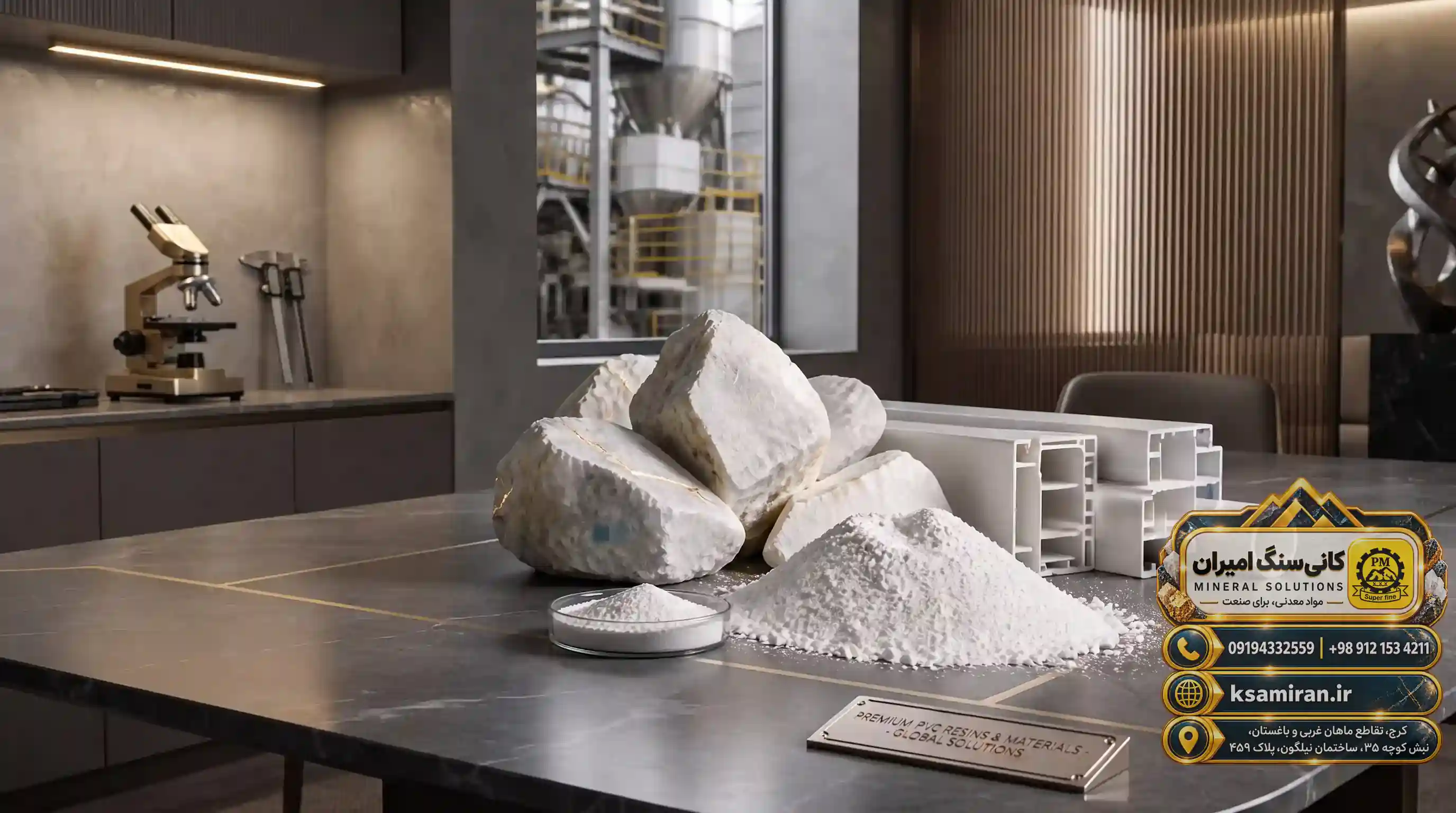
Calcium Carbonate Coating Process
The coating process is one of the complementary stages in the production of high-quality calcium carbonate. At this stage, the particle surface is covered with a thin layer of organic material such as stearic acid. The purpose of this is to convert the particle surface from a hydrophilic state to a hydrophobic state. This change in surface characteristic allows the particles to disperse better in polymer and organic matrices, and by reducing particle agglomeration, the mechanical properties of the final product are improved.
The coating process is usually carried out in the same mill or in a dedicated unit called a coating mixer. Stearic acid is added to the particles at a controlled temperature, and through precise mixing, a uniform layer is formed on the surface. The amount of coating material is typically between one and several percent by weight, and its formulation is adjusted depending on the type of application. In more sensitive applications such as artificial leather and cable, high-quality coating is of great importance.
One of the most important results of coating is the reduction of oil and moisture absorption in the particles. This characteristic allows coated calcium carbonate to be processed in polymer systems with lower viscosity, increasing production speed. Proper coating also prevents secondary reactions between the particles and polymer additives, resulting in better color stability and surface quality of the final product. For more information about the applications of this product in the plastics industry, you can read the article Introduction to the Applications of Coated Calcium Carbonate in the Plastics Industry.
Coating quality is tested through experiments such as measuring oil absorption, wetting time, and examining stability in organic solvents. If the particles are incompletely coated, they will agglomerate in the polymer matrix and create weak points in the final product. For this reason, quality control in this section is performed with very high precision, and if a problem occurs, the process is corrected so that a uniform product reaching the customer in accordance with the declared specifications.
It should be noted that not all applications require coated calcium carbonate. In some industries, such as water-based paint, adhesive manufacturing, and papermaking, uncoated grades have more suitable performance, as the particles must be dispersed in an aqueous environment. In contrast, for polymer and resin-based applications, the coated product is the better choice. Therefore, recognizing the needs of the final application is one of the important responsibilities of technical experts in the production and sales line.
Quality Control in the Production Line
Quality control is one of the main pillars in calcium carbonate production, as this mineral, as an industrial raw material, must have consistent specifications across all shipments. The quality control process begins at the ore intake stage and continues through to the packaging of the final product. At each production station, periodic sampling is conducted and various parameters are measured to ensure the product conforms to the declared specifications.
One of the most important quality control parameters is particle size distribution (Particle Size Distribution). This parameter is measured using laser analysis instruments and, in some cases, with the traditional sieving method. The result of this test shows what percentage of the particles fall within the target mesh range. For products produced at high mesh sizes, the accuracy of this measurement is more important, as residual coarse particles can severely affect the surface quality of the final product.
Another parameter is the color and brightness of the product. This characteristic is measured with colorimetry instruments and indicates the degree of whiteness and color uniformity. The presence of metallic impurities such as iron oxide causes a reduction in brightness and is not acceptable for paint and artificial leather applications. In addition, moisture content, oil absorption (Oil Absorption), and pH are among the parameters that are controlled in various applications. To become more familiar with these parameters, you can read the article Introduction to the Physical Properties of Industrial Calcium Carbonate.
Alongside laboratory tests, quality control also includes process monitoring. This includes checking the mill temperature, separator speed, amount of coating material, and energy consumption. All of these data are recorded and analyzed so that if a problem occurs, its root cause is quickly identified. Also, many manufacturers provide the product analysis results with each shipment so that industrial customers can review the test results and use the product in their lines with full confidence.
Ultimately, effective quality control means that the customer receives a product with consistent behavior in every shipment. This consistency is very critical for production lines that operate with fixed settings. A sudden change in calcium carbonate specifications can cause line stoppage or a drop in the quality of the final product. For this reason, professional manufacturers base their management systems on continuous monitoring and industrial standards.

Product Packaging, Storage, and Transportation
After the production stages are completed and quality is confirmed in the quality control unit, the product enters the packaging stage. Proper packaging plays an important role in maintaining the quality of calcium carbonate, as this mineral has a high tendency to absorb moisture and can stick together or agglomerate if exposed to air. For this reason, moisture-proof, sealed, and leak-proof bags are used.
Common types of packaging include 25-kilogram bags for bulk use, jumbo bags (Jumbo Bag) with a capacity of one ton for large consumers, and in some cases, bulk packaging in mobile silos. The choice of packaging type depends on the customer's needs, the transportation method, and the volume of consumption. In all cases, the bags must be stored in a dry and enclosed environment, and prolonged exposure to direct sunlight or ground moisture must be prevented.
In standard production lines, the bag filling process is performed automatically, and at each stage, the product weight is precisely controlled. The labels on the bags include information such as the product name, mesh, coating type, weight, production number, and production date. This information helps track the product throughout the supply chain and, if needed, provides the ability to review production records. This transparency of information is of great importance to industrial buyers.
In storage, the products are kept separated by type and mesh to prevent the mixing of different grades. Warehouses must have a proper ventilation system and moisture-proof flooring. Also, observing arrangement principles such as using pallets and maintaining distance from walls helps preserve product quality during storage. For bulk shipments, sealed and covered trailers are used to prevent the entry of moisture and contamination.
One of the important points in this section is inventory management and production scheduling. Since industrial customers typically produce with precise plaing, on-time product delivery is of great importance. For this reason, manufacturers, by maintaining regular inventory and coordinating with the transport fleet, try to guarantee uninterrupted supply. Overall, it can be said that proper packaging and storage is the complementary part of the production process and demonstrates the factory's quality at the time of product delivery to the customer.
Industrial Applications and Criteria for Selecting the Right Grade
Due to the variety of grades and mesh sizes, calcium carbonate is used in a wide range of industries. The most important applications of this product include PVC/UPVC profiles and pipes, masterbatch, cable, artificial leather, paint, paper, adhesive, and engineered stone. In each of these applications, the role of the product is different; sometimes it acts as a volume filler to reduce costs, and sometimes as a stabilizing agent or property modifier.
In PVC/UPVC profiles and pipes, this mineral helps increase strength, reduce shrinkage, and improve processability. In masterbatch production, fine and uniform particles provide better color distribution and increased transparency. In the cable industry, coated calcium carbonate is used due to its suitable electrical resistance and good dispersion in the polymer matrix. In artificial leather as well, high-mesh particles create a soft and uniform surface that offers high visual and tactile quality.
In the paint industry, this product is used both as a filler and as a material for adjusting gloss and coverage. In papermaking, calcium carbonate acts as a filler and pigment, helping to increase the brightness and printability of paper. In adhesive manufacturing, the product helps control viscosity and reduce costs. Finally, in engineered stone, calcium carbonate particles together with polymer resins produce high-quality stone products that visually resemble natural stone.
When selecting the appropriate grade, attention should be paid to parameters such as mesh, coating level, brightness, particle size distribution, and moisture content. Choosing the wrong grade can lead to problems in the production line; from deteriorating surface quality to reduced production speed. If you are facing problems in the production line such as particle agglomeration, loss of strength, or color change, the article Guide to Troubleshooting Production Problems with Coated Calcium Carbonate can be a useful guide.
Ultimately, success in using this mineral depends on a precise understanding of the production process and choosing a supplier that provides high-quality and uniform products. The Kani Sang Amiran project, with expertise in mineral production, produces products in the 100 to 3500 mesh range for diverse industrial applications. Understanding the production process helps you make decisions with a broader perspective and choose a product suited to the needs of your production line. Also, consulting with technical experts before purchasing can prevent operational problems in your production line.

| Question | Answer |
|---|---|
| From which stone is calcium carbonate produced? | It is extracted mainly from limestone, marble, and chalk, with limestone having the largest share in production. |
| What stages does the calcium carbonate production process include? | Ore extraction, primary crushing, fine grinding, particle classification, coating (for coated grades), quality control, and packaging. |
| What is product mesh and what effect does it have? | Mesh indicates the fineness of the particles; a higher mesh means finer particles, which is more suitable for applications such as masterbatch and artificial leather. |
| What is the difference between ground and precipitated calcium carbonate? | The ground type is obtained through mechanical crushing of stone, while the precipitated type is produced through a chemical process and recarbonation. |
| When is coating necessary for this product? | For polymer and resin-based applications such as PVC profiles, cable, and artificial leather, coating provides better particle dispersion. |
| Why is quality control important in the production of this product? | Because industrial customers need a product with consistent specifications so their production lines operate without quality loss or stoppage. |
| In which applications is calcium carbonate used? | PVC/UPVC profiles and pipes, masterbatch, cable, artificial leather, paint, paper, adhesive, and engineered stone. |
| What is the proper way to store this product? | It should be stored in a dry and enclosed environment, on pallets, and away from ground moisture and direct sunlight. |
| How should we choose the right grade for our application? | Based on mesh, coating level, brightness, particle size distribution, and the needs of the final application; consulting with technical experts is the solution. |
| Do all applications require a coated product? | No; in applications such as water-based paint, adhesive, and paper, uncoated grades have more suitable performance. |
This article has been written relying on the technical information of the Kani Sang Amiran project (mineral production) and general scientific sources in the field of mineral processing.
برچسب: Calcium Carbonate,Introduction to the Production and Processing of Calcium Carbonate,
نویسنده: رساوب آفرین