
درباره سایت
آخرین مطالب
- بررسی تاثیر اکسید لیمونیت (گل ماش) بر پایداری رنگ
- استخدام أكسيد الليمونيت (الماغش) في صناعات الزجاج
- کاربرد اکسید لیمونیت (گل ماش) در صنایع شیشهسازی
- A Review of Daily Prices for Limonite Oxide (Ocher) in the Market
- چگونه خالص بودن اکسید لیمونیت (گل ماش) را تشخیص دهیم؟
- بررسی قیمت روز اکسید لیمونیت (گل ماش) در بازار
- Application of Limonite Oxide (Gole Mash) in Glassmaking Industries
- كيف تتعرف على نقاء أكسيد الليمونيت (جول ماش)؟
- How to Determine the Purity of Limonite Oxide (Gol Mash)?
- بررسی استانداردهای ایمنی کار با اکسید لیمونیت (گل ماش)
امکانات وب
Introduction to White Talc and Its Crystal Structure
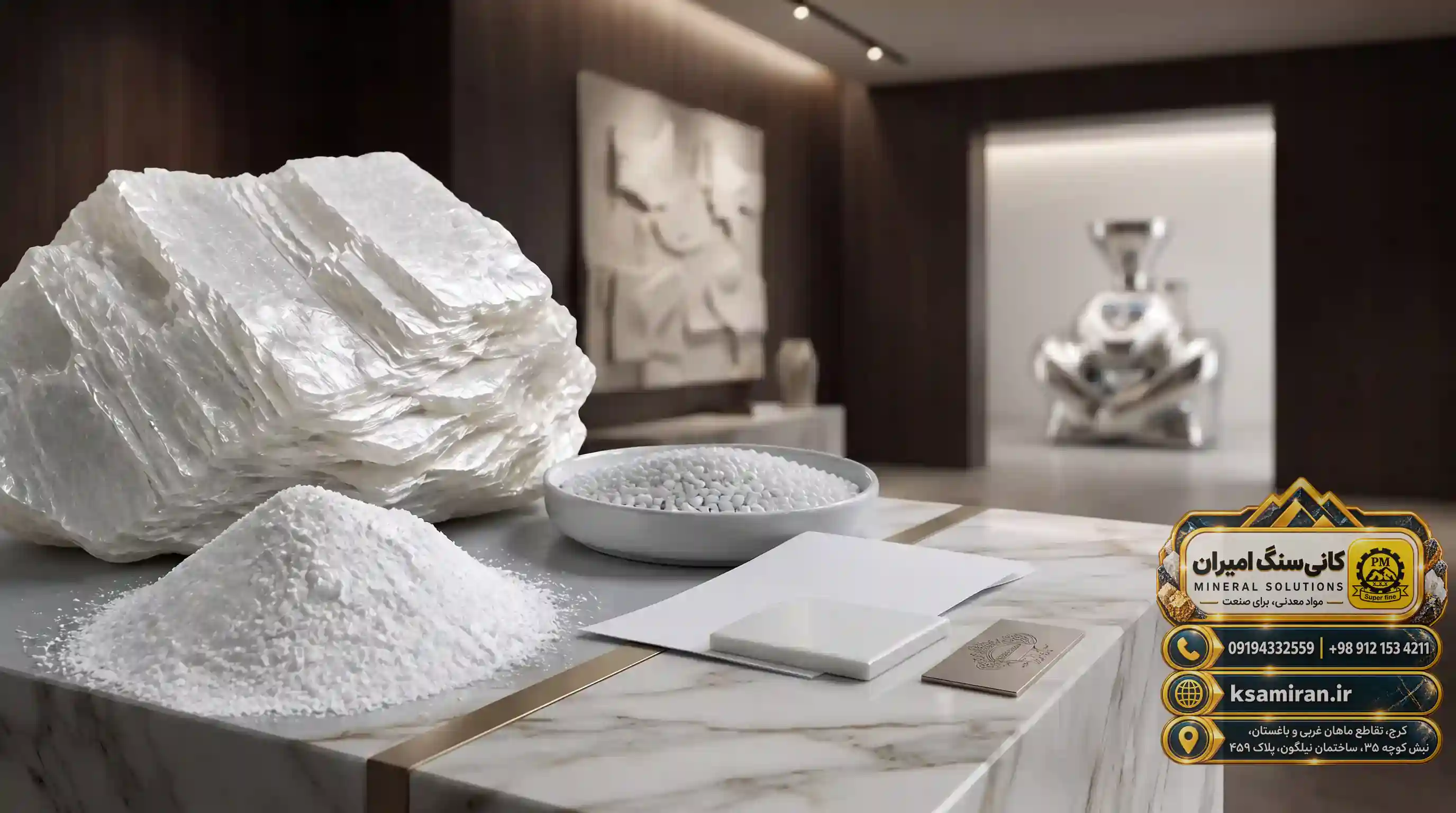
White talc is one of the most widely known and commonly used industrial minerals in the world, classified among hydrated magnesium silicates. Its chemical formula is expressed as Mg₃Si₄O₁₀(OH)₂, and in nature it forms mainly through metamorphic and hydrothermal processes acting on carbonate rocks such as dolomite and limestone. Its light color, high whiteness, exceptional softness, and natural slipperiness are among its most important visual characteristics, making it an outstanding material for applications where surface quality and the appearance of the final product are of paramount importance.
The crystal structure of talc consists of alteating silicate layers and magnesium layers resting on one another through weak van der Waals forces. This layered structure is the main reason for the mineral's softness, slipperiness, and "grease-like" behavior. When a force is applied, the layers slide easily over one another, and this property makes talc an ideal material for modifying surfaces in contact, reducing wear, and improving surface properties in polymeric products.
Other key characteristics of white talc include chemical neutrality, thermal stability, electrical insulation, natural hydrophobicity, and oleophilicity. These properties give the mineral stable and predictable performance in polymer processing, paint manufacturing, paper production, and ceramics. Talc's natural hydrophobicity makes it easier to mix with organic and polymeric systems, which is one of the main reasons for its widespread use in masterbatches and compounds.
In the production process, after extraction from mines, talc undergoes crushing, grinding, and classification operations to achieve different particle size grades. These particle sizes are indicated by the "mesh" unit, and the 450 to 2500 mesh range constitutes the most important processed grades of this mineral for fine industries. The higher the mesh number, the finer and more uniform the particles, and the higher the surface quality achieved from its use in polymeric products.
Amiran Stone Minerals Project, as a producer of mineral materials, supplies white talc focused on key industrial applications including masterbatch, compound, paint, paper, and ceramic products. In the rest of this article, we will examine in detail the role of this mineral in improving the surface properties of polymeric materials and other industries, and demonstrate why choosing a high-quality talc directly affects the added value of your final product.
The Role of White Talc in Improving the Surface Properties of Polymeric Materials: An Overview
The surface properties of polymeric materials encompass a set of physical and chemical characteristics manifested in the outer layer of the product: surface roughness or smoothness, gloss and brilliance, printability and paint receptivity, wettability, scratch and abrasion resistance behavior, adhesion, and even antiblock behavior in films. These characteristics often precede mechanical properties as the first criterion by which a customer judges the quality of a product. A plastic part with a dull, irregular appearance and flow lines will not survive in a competitive market, even if it is mechanically robust.
Adding mineral particles to polymers is one of the oldest and most effective methods for modifying these properties. Among various mineral fillers, white talc holds a special position due to its platy structure, high whiteness, and chemical neutrality. During polymer processing, talc particles tend to align themselves in the direction of melt flow, and this behavior creates a layer of smooth, orderly particles near the product's surface, directly leading to improved smoothness, uniformity, and surface gloss.
One of the most important effects of talc on polymer surfaces is its nucleating role in semi-crystalline polymers such as polypropylene. Talc particles act as crystallization nucleation sites and increase the crystallization rate. The result of this process is the formation of smaller and more uniform spherulites, leading to reduced warpage, improved dimensional stability, and ultimately a smoother and defect-free surface in the final product. This property is vital for injection-molded parts with tight dimensional tolerances.
In addition, white talc, due to its inherent hydrophobicity, has good compatibility with the polymer matrix and enables higher loading levels without sacrificing surface quality. Reduced shrinkage coefficient, improved heat resistance, decreased creep, and increased stiffness are among the other benefits of using this mineral in polymer formulations, which indirectly preserve the surface quality of the product over time and under various working conditions.
Ultimately, it should be noted that the extent to which these advantages can be leveraged depends heavily on the quality of the talc, its particle size distribution, purity, and dispersion method in the polymer matrix. Talc with an appropriate and uniform mesh grade has a remarkable effect on improving surface properties, while talc with poor dispersion can become the weak point of your product. In the following chapters, we will examine the exact mechanism of these improvements and the role of different mesh grades.

Technical Mechanisms of Surface Improvement by Platy Talc Particles
To precisely understand the role of white talc in improving the surface properties of polymeric materials, we must consider its particle structure. Unlike roughly spherical particles such as calcium carbonate, which have limited contact points with the matrix, talc particles have a platy structure with a high aspect ratio. This unique geometry creates several physical behaviors that collectively enhance the surface quality of the polymeric product.
The first mechanism is "particle alignment" during melt flow. During extrusion or injection molding, the shear stresses present in the polymer melt flow guide the platy talc particles into a horizontal orientation parallel to the product's surface. This orderly arrangement creates a layer of smooth particles adjacent to the surface, significantly improving the uniformity, gloss, and smoothness of the surface. This phenomenon is highly valuable for injection-molded parts in household appliances and automotive interior components.
The second mechanism is crystallization nucleation. Talc particles have active surfaces upon which the crystal structures of semi-crystalline polymers form. This raises the crystallization rate, reduces the spherulite size, and leads to a more uniform structure. The reduction in spherulite size is directly related to reduced surface roughness and increased optical uniformity. Also, reducing the time required for cooling in the mold means higher productivity on production lines.
The third mechanism is the antiblock effect and prevention of adhesion. In the production of polymeric films, film layers tend to stick together due to electrostatic forces and the softness of the polymer. Platy talc particles create microscopic protrusions on the film surface that prevent full contact between the layers and improve the opening and handling of the film. This is an excellent example of how surface properties directly affect product performance.
The fourth mechanism is the role of talc as a carrier and modifier in color systems and masterbatches. Talc particles, when properly dispersed in the matrix, help distribute pigments uniformly and prevent their accumulation at the surface. This results in a more consistent product color, greater color depth, and the absence of undesirable colored spots on the surface. The combination of these four mechanisms has made white talc a versatile tool for controlling surface quality in the polymer industry.
The Importance of Particle Size and the 450 to 2500 Mesh Range in White Talc
One of the most important factors affecting the performance of white talc in improving the surface properties of polymeric materials is its particle size. In the minerals industry, particle size is usually expressed in "mesh" units, indicating the number of openings per inch of the sieve. The higher the mesh number, the finer the particles passing through the sieve. The 450 to 2500 mesh range covers a wide spectrum of particles with entirely different applications across various industries.
Lower mesh grade talc (around 450 mesh) has coarser particles and is more suitable for applications where filler volume matters more than surface precision, such as certain structural compounds, thick polymeric parts, and ceramic bodies. These particles provide strength, stiffness, and dimensional stability at high loading levels and reduce formulation costs. However, for products requiring an extremely smooth and glossy surface, this grade is not the best option.
In contrast, higher mesh grade talc (1250 to 2500 mesh) has very fine and uniform particles designed for delicate applications. In masterbatches, finer particles improve pigment dispersion and make the surface of the colored product more consistent. In paints, fine particles provide greater coverage and matting. In coated papers, fine particles create a smooth and printable surface. In ceramic products, fine particles contribute to a denser structure and more uniform glazes.
However, particle size alone is not the only important factor; Particle Size Distribution (PSD) is also critical. A high-quality talc should have a narrow distribution, meaning that most particles fall within a specific range. Very fine particles may tend to agglomerate due to their high surface energy and distribute as clumps in the polymer matrix, creating spots and surface defects. Therefore, selecting talc with a uniform distribution is a key step in guaranteeing the surface quality of the final product.
To select the appropriate mesh grade, one must consider the product type, the processing method (extrusion, injection, film blowing, paper coating), the part thickness, and the final surface requirements. Consulting with a supplier that offers a wide range of grades helps you strike the right balance between cost, processability, and surface quality.
Application of White Talc in Masterbatches and Compounds
Masterbatches and compounds are two of the most important consumption areas for white talc in the polymer industry. A masterbatch is a concentration of additives or pigments in a polymeric carrier used for precise dosing and better dispersion in the final process. A compound is a ready-to-use blend of polymer with fillers and additives that goes directly into the product manufacturing machine. In both cases, white talc plays multiple roles.
In masterbatches, talc acts as an antiblock agent, a pigment dispersion aid, and in some cases a carrier. Its platy particles prevent polymeric film layers from sticking together and make the film easier to handle. Also, the white and neutral structure of talc helps pigments distribute uniformly throughout the matrix without side reactions. This directly affects the visual and surface quality of the colored product: deeper, more consistent colors, free of streaks or surface defects.
In compounds, white talc is a versatile mineral filler. In polypropylene, it acts as a nucleating agent and provides an optimal combination of strength, hardness, and dimensional stability. In automotive parts, household appliances, and toys, talc helps improve surface smoothness, reduce post-molding warpage, and increase heat resistance. In engineering compounds, combining talc with other fillers such as barite can simultaneously enhance mechanical and surface properties; for more information on this topic, you can read the article Examining the Role of White Barite in Improving the Mechanical Properties of Composites.
One of the key points in using talc in masterbatches and compounds is its proper dispersion. For this purpose, some manufacturers use surface coatings such as stearic acid or silane compounds to increase the compatibility of the mineral particles with the organic matrix. This treatment reduces agglomeration and significantly improves the surface quality of the final product. Additionally, the moisture content of talc must be controlled so that it does not cause bubbles and surface defects during the extrusion process.
Finally, selecting the appropriate mesh grade for each application is important: for high-quality masterbatches and delicate colors, finer grades (1250 to 2500 mesh) and for structural compounds, coarser grades (450 to 1250 mesh) are usually more suitable. Combining formulation know-how with a high-quality and uniform talc is the key to achieving a flawless surface in polymeric products.
The Role of White Talc in the Paint and Paper Industries
The paint industry is one of the largest consumers of white talc. In paint formulations, talc acts as an extender pigment; that is, it extends the primary pigments and reduces formulation costs. But talc is not merely a cheap filler: its platy particles act as a matting agent, regulate the surface gloss of the paint, and increase coverage and whiteness. The layered structure of talc also helps paint durability against abrasion and moisture, because these layers lengthen the penetration path of water and destructive agents.
In architectural, industrial, and powder coatings, white talc improves surface properties such as smoothness, uniformity, absence of bumps, and scratch resistance. Fine particles (grades above 1250 mesh) are ideal for paints requiring high surface quality, as they create a smooth, soft, and defect-free paint layer. In industrial paints and primers, talc contributes to adhesion and surface filling and provides a suitable substrate for the final coat.
In the papermaking industry, white talc plays a vital role in both filling and coating. As a filler, talc replaces part of the cellulose fibers and increases the whiteness, smoothness, and printability of the paper. Talc's hydrophobic property also helps with pitch control in the paper production process; talc particles absorb the sticky substances present in wood pulp and prevent their deposition on the paper machine and the resulting decline in product quality.
In the paper coating sector, talc, with its fine and uniform particles, creates a very smooth and dense surface on the paper that absorbs ink better and produces higher-quality images. This property is vital for high-quality printing papers, magazines, and luxury packaging. Talc also increases the brightness and whiteness of the paper, which has a direct impact on the commercial value of the product. To lea more about the role of this mineral in the quality of manufactured products, read the article The Key Role of Industrial Talc in Improving the Quality of Manufactured Products.
In both the paint and paper industries, the uniformity and purity of white talc are of great importance. The presence of colored impurities, coarse particles, or high moisture can directly reduce the surface quality of the final product. Therefore, choosing a supplier with precise quality control over whiteness, particle size distribution, and purity is an essential requirement for these industries.
Application of White Talc in Ceramic Products
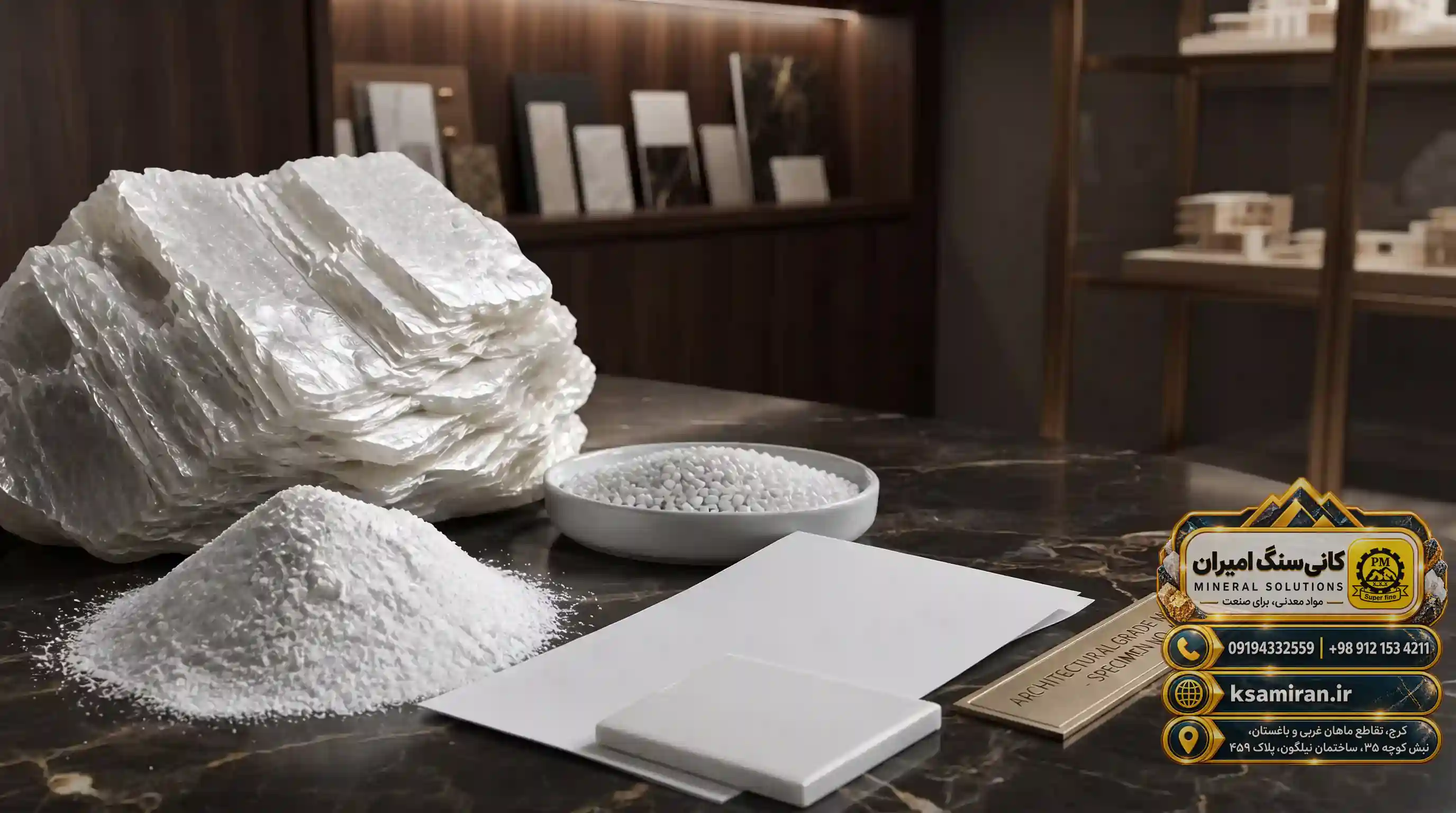
Ceramics is one of the oldest yet most mode markets for white talc consumption. This mineral plays a principal role in the production of steatite and talc-based ceramic bodies. Steatite is a ceramic produced from high-purity talc along with other minerals, and due to its electrical resistance, thermal stability, and machinability, it is widely used in electrical insulator parts, spark plugs, and technical bodies.
In ceramic bodies, white talc, with its layered structure, contributes to toughness, thermal shock resistance, and a reduced coefficient of thermal expansion. These properties are vital for cookware, kiln fuiture, and technical ceramics. Talc also helps lower the firing temperature, resulting in lower energy consumption and reduced production costs. Talc's natural whiteness makes the ceramic body appear lighter and enables the production of white and uniform ceramics.
In the realm of glaze and engobe, white talc acts as a versatile mineral. In engobes, talc serves as a whitening and covering base that coats the underlying surface and provides a suitable substrate for decorations. In glazes, talc helps regulate the coefficient of thermal expansion, increase heat resistance, and improve adhesion to the body. The presence of talc in these systems creates a uniform, glossy, and defect-free surface that raises the commercial value of the ceramic product.
The quality of the talc used in ceramics has a direct impact on the final product. Chemical purity, whiteness, particle size distribution, and thermal behavior are the most important variables. Fine and uniform particles help create a denser structure during firing, reduce porosity, and produce a smoother surface. Iron or alumina impurities can cause discoloration, staining, or even cracking during firing, inflicting major losses on the producer.
The 450 to 2500 mesh range provides a suitable spectrum for various ceramic needs: from coarser grades for technical and structural bodies to very fine grades for delicate glazes and engobes. Choosing the appropriate grade depends on the product type, the forming method (pressing, casting, extrusion), and the firing temperature. Collaborating with a supplier that offers a complete range of grades with consistent quality is a competitive advantage for ceramic manufacturers.
Conclusion and Guide to Choosing the Right White Talc
Throughout this article, we have examined the multifaceted role of white talc in improving the surface properties of polymeric materials and other industries. From this mineral's unique layered structure to the mechanisms of particle alignment, crystal nucleation, antiblock effects, and matting regulation, each of these characteristics directly contributes to a smoother, more uniform, and higher-quality surface in the final product. We also saw that the applications of this mineral go beyond polymers, and it plays a vital role in masterbatches, compounds, paint, paper, and ceramic products.
When selecting white talc for your application, you should pay attention to several key criteria. First, the whiteness and purity of the mineral; colored impurities can rapidly diminish the visual quality of your product. Second, the particle size distribution; a uniform distribution guarantees good dispersion and a defect-free surface. Third, the mesh grade suited to the application; grades from 450 to 2500 mesh meet diverse needs, from structural compounds to masterbatches and delicate paints. Fourth, compatibility with your matrix, which sometimes requires surface coating or moisture control.
Beyond technical specifications, quality consistency across shipments is the most critical factor in a long-term supply relationship. Changes in talc specifications between shipments can cause fluctuations in the surface quality of your products and make reformulation necessary. An expert supplier not only delivers a quality product but also provides the technical know-how needed to select the right grade and help optimize your formulation. For more information on the effect of this mineral on the visual quality of products, you can read the article The Role of White Talc in Improving the Appearance Quality of Polymeric Products.
Amiran Stone Minerals Project, as a producer of mineral materials, supplies white talc focused on masterbatch, compound, paint, paper, and ceramic product applications in the 450 to 2500 mesh range. To view product specifications and obtain more information, you can visit the White Talc product page. Our goal is to provide a product that acts as a value-creating element in your formulations, not merely a simple raw material.
Finally, remember that improving the surface properties of your product is an investment in brand value and customer satisfaction. Choosing a high-quality white talc with appropriate specifications can make the difference between a product that sits on the store shelf and one that captures the consumer's attention. We recommend discussing your precise requirements with technical experts before making a final decision, so that the best grade and specifications for your production line are selected.
| Question | Answer |
|---|---|
| What is white talc and what structure does it have? | White talc is a hydrated magnesium silicate with a layered structure, white color, high softness, and chemical neutrality, widely used in the polymer, paint, paper, and ceramics industries. |
| What effect does white talc have on the surface properties of polymers? | Platy talc particles align during processing, creating a smoother and more uniform surface, and through crystal nucleation, they reduce warpage and improve surface quality. |
| What is meant by the 450 to 2500 mesh range? | The mesh number indicates particle size; the higher the mesh, the finer the particles. This range covers a spectrum of particles from general applications (450 mesh) to delicate applications such as masterbatches and paints (up to 2500 mesh). |
| What is the application of white talc in masterbatches? | In masterbatches, talc acts as an antiblock agent, pigment dispersion aid, and sometimes a carrier, helping to achieve a more consistent color and a defect-free surface in the final product. |
| Why is white talc used in paint? | As an extender pigment, talc reduces cost, raises matting and coverage, and its platy particles increase the paint's durability against abrasion and moisture. |
| What is the role of white talc in the paper industry? | As a filler and in paper coating, talc improves whiteness, smoothness, and printability, and by absorbing sticky substances from wood pulp, it prevents their deposition on the paper machine. |
| What are the applications of white talc in ceramic products? | In the production of steatite and ceramic bodies, talc increases thermal shock resistance and toughness, lowers the firing temperature, and contributes to surface uniformity in glazes and engobes. |
| Which polymers is white talc most suitable for? | This mineral is especially effective in semi-crystalline polymers such as polypropylene, as well as in polyethylene and in masterbatch and compound systems. |
| Is white talc easily dispersed in a polymer matrix? | Due to its inherent hydrophobicity, it has good compatibility with organic matrices; however, to reduce agglomeration of very fine particles, surface coating and moisture control are sometimes used. |
| How do I choose the right white talc for my needs? | Based on the product type, processing method, and final surface requirements, select the appropriate mesh grade (450 to 2500) and source it from a supplier with consistent quality in whiteness, purity, and particle size distribution. |
This article has been compiled relying on the technical information of the white talc product supplied by Amiran Stone Minerals Project (producer of mineral materials).
برچسب: White Talc,The Role of White Talc in Improving the Surface Properties of Polymeric Materials,
نویسنده: رساوب آفرین