
درباره سایت
آخرین مطالب
- Why is choosing Limonite Oxide (Gole Mash) important for industries?
- چگونه بهترین فرمولاسیون با اکسید لیمونیت (گل ماش) بسازیم؟
- لماذا يعد اختيار أكسيد الليمونيت (أوكر أصفر/كلماش) مهماً للصناعات؟
- دور أكسيد الليمونيت (الجول ماش) في إنتاج الطوب والفخار
- Examining the Effect of Limonite Oxide (Gol Mash) on Color Stability
- مراجعة مزايا الشراء بالجملة لأكسيد الليمونيت (غل ماش)
- دور أكسيد الليمونيت (الغل ماش) في الصناعات الدوائية ومستحضرات التجميل
- بررسی میزان سختی و سایش اکسید لیمونیت (گل ماش)
- Application of Limonite Oxide (Gole Mash) in Anti-Rust Industries
- نقش اکسید لیمونیت (گل ماش) در تولید پوششهای محافظ
امکانات وب
Introduction to Industrial Barite and Its Strategic Importance in Mode Industries
Industrial barite, scientifically known as barium sulfate (BaSO4), is one of the most widely used industrial minerals in today's world. This mineral, extracted mainly from underground and open-pit mines, has attracted attention in a wide range of industries due to its high specific gravity, light color, chemical inertness, and heat resistance. In industries such as oil and gas well drilling, welding electrode production, and the manufacture of rubber and plastic products, industrial barite plays a vital and irreplaceable role.
The word “barite” is derived from the Greek word “baros,” meaning “heavy,” and this naming well reflects the prominent characteristic of this mineral. The specific gravity of pure barite is around 4.3 to 4.5 grams per cubic centimeter, making it one of the heaviest non-metallic minerals. Kani Sang Amiran Project, as a mineral producer, manufactures and supplies industrial barite in the 200 to 450 mesh range to meet the diverse needs of domestic industries.
The strategic importance of industrial barite boils down to a few key aspects: first, its role in drilling fluids as a weighting agent, which guarantees the safety and efficiency of oil and gas well drilling operations; second, its application in welding electrode production as a coating and protective slag former; third, its use in the rubber and plastic industries as a filler, density enhancer, and improver of mechanical properties. This wide variety of applications has made quality control and precise analysis of this mineral a necessary specialization in the industry.
The global barite market is growing, and with the development of the oil and gas industries and the expansion of manufacturing industries, demand for premium industrial barite is expected to rise. In such a market, understanding quality standards, analysis methods, and product selection criteria helps buyers make better decisions. The quality of barite depends on factors such as barium sulfate purity, particle size distribution, impurity levels, and moisture, which are examined in detail in subsequent chapters.
This guide attempts to provide a comprehensive picture of industrial barite, from chemical composition and quality analysis to applications and testing methods, so that engineers, buyers, and quality managers can identify the product suited to their needs with a broader perspective. Finally, if you intend to supply industrial barite with precise technical specifications, you can contact the experts at Kani Sang Amiran Project via the industrial barite product page.
Chemical Composition and Quality Analysis of Industrial Barite
Chemical composition is the most important determinant of industrial barite quality. Pure barite consists of 58.8% barium and 41.2% sulfate group, but in nature, it is always found with impurities such as silica (SiO2), iron oxide (Fe2O3), alumina (Al2O3), calcium carbonate, and heavy metal compounds. The amount of these impurities directly affects the final product's performance, which is why chemical analysis has become one of the main steps in quality control.
In sensitive industries like drilling, the presence of acidic or basic impurities can react with other fluid chemicals and cause serious problems. For example, the presence of calcium carbonate in barite used for drilling fluids may lead to precipitation and reduced fluid stability. Also, free iron in barite can react with saltwater to produce hydrogen sulfide gas, which poses safety risks to persoel. Therefore, reputable suppliers are obliged to provide the buyer with a Certificate of Analysis (COA).
Various methods exist for determining the chemical composition of barite, including gravimetric titration of sulfate, atomic absorption spectroscopy (AAS), inductively coupled plasma spectroscopy (ICP), and X-ray diffraction (XRD). The XRD method is very efficient for identifying crystalline phases and detecting associated minerals like quartz, calcite, and iron oxides, and is widely used in quality control laboratories.
One of the key indicators in barite analysis is the barium sulfate purity, usually reported as weight percent. Barite used in drilling fluids must have high purity so the fluid's specific gravity is correctly adjusted. In rubber and plastic applications, high purity improves mechanical properties and reduces the negative effects of impurities on the curing or melting process. In the electrode industry, the chemical composition of barite directly affects slag quality and electric arc stability.
Moisture is another important parameter in quality analysis. High moisture can cause powder caking, reduced weighing accuracy, and disruption in pneumatic conveying systems. The standard method for measuring moisture involves drying the sample at a specified temperature and calculating the weight loss. Additionally, the color and brightness of barite are important in some applications, like plastic products, and are evaluated using colorimeters.
Ultimately, it should be noted that chemical analysis is only valid if sampling is done correctly. Samples must represent the entire shipment and be tested under identical conditions. Kani Sang Amiran Project guarantees the uniformity of the chemical composition of industrial barite in the 200 to 450 mesh range by conducting periodic tests on its production and provides analysis reports to customers.

Mesh Standards and the Importance of the 200 to 450 Mesh Range
The term “mesh” is one of the most common terms in the mineral powder industry, referring to the particle size of a material relative to a standard screen. In fact, the mesh number indicates how many openings exist in one square inch of the screen; the higher the mesh number, the finer the particles. In the ASTM and Tyler standard systems, particle size is determined based on the amount of sample passing through consecutive sieves.
Industrial barite is produced in the 200 to 450 mesh range, meaning product particles pass through the 200 mesh sieve and are ground down to a maximum size equivalent to the 450 mesh. More simply, barite particles in this range have dimensions in the micron range, suitable for sensitive industrial applications. This chosen range results from balancing the need for a fine structure for uniform dispersion with the cost of the milling and classification process.
Why does particle size matter so much? In drilling fluids, barite particles must be fine enough not to settle and to remain suspended in the fluid. Coarse particles can cause equipment wear, pipe blockage, and reduced fluid stability. On the other hand, in welding electrode production, particle size distribution affects the quality of the electrode coating and slag formation. In rubber and plastic products, finer particles create better dispersion and improve the mechanical properties of the final product.
In addition to particle size, “Particle Size Distribution” (PSD) is also very important. A uniform distribution means most particles fall within a specific range, leading to predictable product behavior in industrial processes. To accurately measure PSD, methods such as standard sieve analysis, laser diffraction, and centrifugation are used, each with its own specific precision and application.
Particle size quality control is typically performed in several stages: sampling from the production line, testing with standard sieves, recording data, and finally adjusting mill and classifier parameters. If there is a deviation from the desired range, the production process is corrected. This continuous control yields a product with high uniformity and stable performance.
The industrial barite market has diverse needs, and each industry may request a different mesh range. For example, one buyer might need barite close to 200 mesh, while another requests a product closer to 450 mesh. A supplier capable of producing a wide range with consistent quality gains a significant competitive advantage. By producing industrial barite in the 200 to 450 mesh range, Kani Sang Amiran Project has the ability to meet these diverse needs.
Application of Industrial Barite in Drilling Fluids
Drilling fluids are one of the most important and widely used application areas for industrial barite. In oil and gas well drilling operations, drilling fluid has several responsibilities: transporting cuttings to the surface, cooling and lubricating the drill bit, creating hydrostatic pressure to prevent oil and gas blowouts, and maintaining wellbore stability. To perform these tasks, the fluid must have a specific gravity, and industrial barite is exactly the material that provides this weight.
The high density of barite means that adding a relatively small amount significantly increases the fluid's specific gravity. This feature, along with chemical inertness and a suitable price compared to similar materials, makes barite an ideal choice for drilling fluids. In fact, the largest share of industrial barite consumption in the world belongs to this industry, and without it, drilling deep and high-pressure wells would be virtually impossible.
Drilling fluids are divided into three general categories: water-based, oil-based, and synthetic. Industrial barite is used in all these systems. In water-based fluids, barite is added to a slurry of water and other additives to adjust the fluid weight. In oil-based fluids, barite is used as a weighting agent and must be compatible with the oil phase. In both cases, the purity and particle size of barite are very important.
One of the main challenges in using barite for drilling fluids is controlling impurities. The presence of calcium carbonate can react with fluid chemicals and form scale. Free iron, in contact with saltwater, can produce toxic hydrogen sulfide gas. Soluble sulfides can also cause corrosion of pipes and equipment. For this reason, buyers typically set strict specifications for the maximum level of these impurities.
In addition to specific gravity, other properties such as fluid viscosity, gelling, and filtration are also affected by barite. Very fine particles can drastically increase fluid viscosity, causing difficulties in pumping and fluid circulation. Therefore, choosing barite with a suitable particle size distribution (like the 200 to 450 mesh range) is of high technical importance.
In deep drilling and high-pressure wells, fluids with very high specific gravity are needed, making the purity of the barite used even more important. Barite with a low specific gravity caot bring the fluid weight to the desired level, compromising operational safety. Kani Sang Amiran Project covers the needs of the domestic drilling industry by supplying industrial barite with appropriate purity and uniformity in the 200 to 450 mesh range. Selecting a product with technical specifications matching project needs not only guarantees drilling safety but also prevents resource waste and increased costs due to impurities.

Application of Industrial Barite in the Production of Welding Electrodes
Welding electrodes are another important product whose production uses industrial barite. A coated electrode consists of a metal core and a coating, which has several responsibilities: creating a protective gas shield against atmospheric oxygen, forming a protective slag over the weld, stabilizing the electric arc, and controlling the chemical composition of the weld metal. Barite, in this context, is used as one of the primary coating materials.
The presence of barite in the electrode coating releases shielding gases during welding and forms a slag with appropriate viscosity that protects molten metal droplets and controls the cooling rate of the weld. Barite also acts as an oxygen source and a refining agent in the slag, separating impurities such as phosphorus and sulfur from the weld metal. This improves the mechanical properties and durability of the welded joint.
The quality of barite used in the electrode industry is crucial. Barium sulfate purity must be at a desirable level for stable electric arc performance. Impurities like silica and alumina are acceptable in controlled amounts, but the presence of heavy metals or unwanted compounds can cause arc instability, improper slag freezing, and reduced weld quality. For this reason, electrode manufacturers typically request a specific range of chemical composition from barite suppliers.
Barite particle size is also very important in this application. The electrode coating is applied to the metal core through an extrusion process, and for this coating to be uniform and crack-free, barite particles must be sufficiently fine with a uniform distribution. The 200 to 450 mesh range meets this need well, as particles in this range have good mixability with the binders and other organic materials in the coating.
Besides coated electrodes, barite is used in the production of certain special electrodes, such as submerged arc welding electrodes and consumable electrodes in induction melting processes. In each of these applications, the chemical composition and particle size of barite must match that product's specific formulation. Electrode manufacturers typically perform baking and welding tests on samples to ensure the supplied barite is compatible with their production process needs.
An important note conces raw material storage. Moisture absorption can reduce the quality of barite powder over time and negatively affect electrode coating quality. Therefore, proper storage of minerals in warehouses is a quality control requirement. To familiarize yourself with proper storage principles, you can read the Comprehensive Guide to Warehousing and Storage of Industrial White Barite Powder.
Application of Industrial Barite in the Rubber and Plastic Industries
The rubber and plastic industries are significant consumers of industrial barite. In these industries, barite is used as a mineral filler that simultaneously handles several tasks: increasing density, improving mechanical properties, reducing production costs, and in some cases, improving the chemical properties of the final product. Choosing barite as a filler relates to characteristics like chemical inertness, thermal stability, light color, and dispersibility in the polymer matrix.
In the rubber industry, barite is used in producing a variety of products such as tires, conveyor belts, gaskets, and technical rubber parts. Adding barite to the rubber compound increases abrasion resistance, improves thermal stability, and raises the product's specific gravity. Also, in rubbers used in chemical environments, barite's inertness helps resist acid and base attacks.
In the plastics industry, barite is used as a filler in producing films, sheets, pipes, injection-molded parts, and compounds. One interesting application of barite in plastics is producing parts with high specific gravity, such as components requiring a sense of weight and higher quality. Additionally, barite is used in producing engineering compounds requiring specific thermal and mechanical properties.
The quality of barite in these industries directly affects the final product. An improper particle size distribution can create stress concentration points and reduce mechanical properties. Chemical impurities can also react with polymeric additives or alter the rubber curing process. For this reason, rubber and plastic manufacturers typically set precise technical specifications for purchased barite and conduct incoming inspections on every shipment.
An important aspect of the production process is the uniform dispersion of barite in the polymer matrix. Particles of suitable size (in the 200 to 450 mesh range) with high brightness create better dispersion and have less negative impact on product color and clarity. Also, barite moisture must be controlled, as high moisture can cause bubbles and porosity in the product during plastic extrusion or injection molding.
Proper storage of mineral fillers in these industries is also very important. Improper storage can cause caking, moisture absorption, and contamination of barite, jeopardizing the quality of final products. Storage principles for mineral fillers share many similarities; for instance, the Comprehensive Guide to Storage and Warehousing of Industrial Coated Calcium Carbonate offers useful practical tips in this regard that also apply to barite.
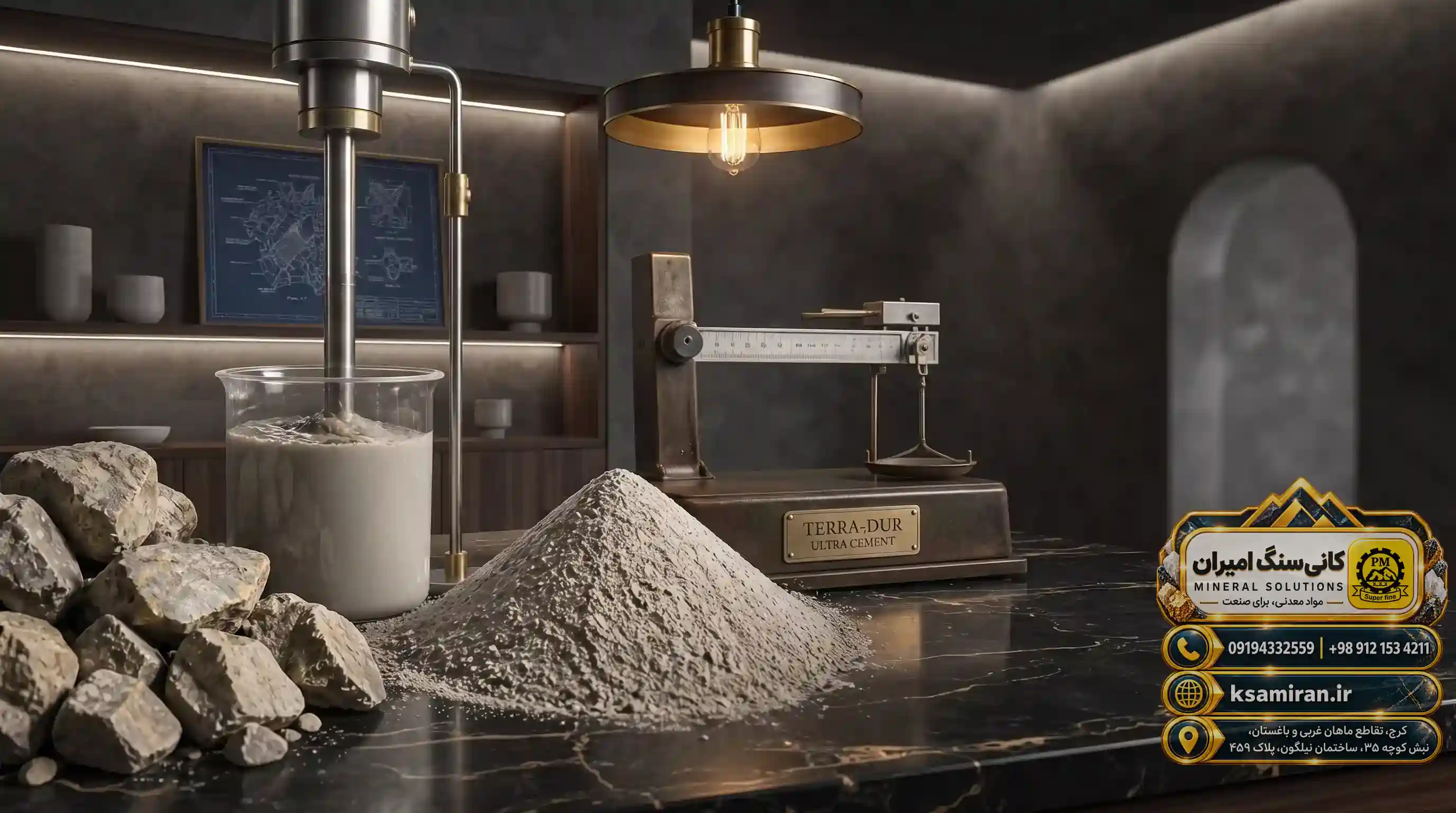
Testing Methods and Quality Control of Industrial Barite
Quality control of industrial barite is a multi-step process that begins with sampling and continues with laboratory testing and the issuance of quality certificates. The goal of this process is to ensure the product matches the requested technical specifications and maintains quality uniformity across shipments. Below, the most common tests in barite quality control are introduced.
The first step is correct sampling. Samples must represent the entire shipment, taken from various points according to sampling standards and mixed. Without correct sampling, even the most accurate tests will not yield reliable results. After sample preparation, the following tests are performed in order:
1. Specific Gravity Measurement: The specific gravity of barite is measured using densitometry devices like a pycnometer. This parameter is an indicator of barite purity, as lighter impurities reduce specific gravity. For barite used in drilling fluids, the specific gravity must be within a specified range to guarantee optimal performance.
2. Particle Size Distribution Measurement: This test is performed using standard sieves or the laser diffraction method. The output of this test is a cumulative percentage chart of particles at different sizes, indicating the mesh range of the product. For barite in the 200 to 450 mesh range, the majority of particles must be smaller than the 200 mesh size.
3. Chemical Analysis: Using classical titration methods and instrumental techniques like XRF, AAS, and ICP, the percentage of barium sulfate and main impurities is determined. Results are provided to the buyer as a Certificate of Analysis (COA).
4. Moisture Measurement: By drying the sample at a specified temperature and calculating the percentage of weight loss, the product's moisture is determined. This parameter is very important for industries transporting the powder in bulk or bags.
5. Color and Brightness Assessment: Using colorimeters, the whiteness and color of the product are measured. This parameter is vital for applications where the final product's appearance matters.
6. Application Tests: In some cases, buyers request that the barite sample be tested in their actual process. For example, in the electrode industry, the sample is used in the coating formulation, and the resulting welding quality is evaluated. These tests are the most common final validation method for sensitive applications.
Implementing a successful quality control system requires detailed documentation, laboratory persoel training, periodic device calibration, and production process inspection. Kani Sang Amiran Project guarantees uniform quality for industrial barite in the 200 to 450 mesh range by establishing these requirements in its production line.
Tips for Buying, Storing, and Selecting a Reliable Industrial Barite Supplier
Purchasing industrial barite is a decision directly affecting product quality and industrial operations. For this reason, knowing the key points in product and supplier selection helps buyers make decisions with greater confidence. This chapter covers the most important criteria and practical tips.
The first step is understanding the project's needs. The buyer must determine for what application they need barite and which specifications take priority: is high specific gravity important for drilling fluid? Does brightness matter for a plastic product? What mesh range is needed? Answering these questions helps the buyer choose the product suited to their needs. For instance, barite used in drilling fluids generally requires higher specific gravity and purity than barite used in some plastic fillers.
The second step is evaluating the supplier. A reputable supplier must provide product technical data, an analysis certificate, and a sample to the buyer. Also, production capacity for the required volume, quality uniformity across shipments, and adherence to packaging and transport standards are other traits of a reliable supplier. Industry track record and references from previous projects can also be useful evaluation indicators.
The third step is reviewing independent reports and tests. Professional buyers usually test received samples at independent laboratories to confirm the supplier's analysis certificate accuracy. This is considered a necessity, especially for high-volume purchases and sensitive projects.
Proper storage and warehousing also play a key role in maintaining barite quality. Storing in a dry environment away from moisture and pollution, and observing warehouse arrangement principles, prevents caking and quality degradation. Additionally, familiarizing yourself with general principles of buying industrial minerals helps you make better decisions; reading the Industrial Talc Buying Guide with Best Quality and Reasonable Price provides a complete perspective on industrial mineral purchasing criteria.
Finally, maintaining continuous communication with the supplier and providing feedback on product quality contributes to continuous production process improvement. Kani Sang Amiran Project, by producing industrial barite in the 200 to 450 mesh range and supplying it to the drilling fluid, electrode, rubber, and plastic industries, is ready to provide technical consultation and send samples for review. For more information and direct contact with experts, visit the industrial barite product page.

| Question | Answer |
|---|---|
| What is industrial barite and what are its applications? | Industrial barite is equivalent to barium sulfate (BaSO4) and, due to its high density and chemical inertness, is used in drilling fluids, welding electrode production, and rubber and plastic products. |
| What does the 200 to 450 mesh range mean? | This range indicates that barite particles have passed through the 200 mesh sieve and been ground to a maximum size equivalent to the 450 mesh; i.e., a fine powder product with a particle size distribution suitable for sensitive industrial applications. |
| Why is barite used in drilling fluids? | Barite's high density increases the drilling fluid's specific gravity, providing the hydrostatic pressure needed to prevent well blowouts and maintain wellbore stability. |
| What is the role of barite in welding electrode production? | Barite in the electrode coating produces shielding gas, forms a slag with appropriate viscosity, stabilizes the electric arc, and separates impurities like phosphorus and sulfur from the weld metal. |
| What are the benefits of industrial barite in rubber and plastic products? | Increased density, improved mechanical and wear properties, chemical and thermal resistance, and reduced production costs are the main benefits of using barite as a mineral filler. |
| What are the most important quality parameters of industrial barite? | Barium sulfate purity, specific gravity, particle size distribution (mesh range), impurity levels, moisture, and brightness are the most important quality parameters. |
| How do barite impurities affect its quality? | Calcium carbonate can cause precipitation in drilling fluid, and free iron in contact with saltwater can produce toxic hydrogen sulfide gas; heavy metals also disrupt arc stability in welding. |
| How is barite particle size distribution measured? | Measurement is done with standard sieves (ASTM or Tyler) and instrumental methods like laser diffraction and centrifugation, with the output reported as a cumulative particle percentage chart. |
| Why is barite moisture important and how is it controlled? | High moisture causes powder caking, pneumatic conveying disruptions, and bubbles in polymeric products; this parameter is controlled by drying the sample at a specified temperature and calculating weight loss. |
| How do we choose a reliable industrial barite supplier? | A supplier is reputable if they provide an analysis certificate and samples, maintain uniform quality across shipments, supply production in the required mesh range (200 to 450 mesh), and follow proper packaging and storage principles. |
This guide has been compiled based on the technical product information of Kani Sang Amiran Project (mineral producer).

برچسب: Industrial Barite,Comprehensive Guide to Analysis and Quality Standards of Premium Industrial Barite,
نویسنده: رساوب آفرین