
درباره سایت
آخرین مطالب
- استخدام أكسيد الليمونيت (الماغش) في صناعات الزجاج
- کاربرد اکسید لیمونیت (گل ماش) در صنایع شیشهسازی
- A Review of Daily Prices for Limonite Oxide (Ocher) in the Market
- چگونه خالص بودن اکسید لیمونیت (گل ماش) را تشخیص دهیم؟
- بررسی قیمت روز اکسید لیمونیت (گل ماش) در بازار
- Application of Limonite Oxide (Gole Mash) in Glassmaking Industries
- كيف تتعرف على نقاء أكسيد الليمونيت (جول ماش)؟
- How to Determine the Purity of Limonite Oxide (Gol Mash)?
- بررسی استانداردهای ایمنی کار با اکسید لیمونیت (گل ماش)
- Comprehensive Guide to Technical Analysis of Limonite Oxide (Gol Mash)
امکانات وب
Why is choosing the right industrial talc important?
Industrial talc is one of the most widely used minerals in mode industries, used in the production of polymeric products, rubber, paint, and various industrial products. With its unique layered structure, this material imparts properties such as softness, natural greasiness, high heat resistance, and excellent filling capability to final products. However, choosing the wrong industrial talc can lead to reduced product quality, increased production costs, and even production line stoppages.
The importance of industrial talc's compatibility with your needs lies in the fact that each industrial application requires specific specifications of this mineral. For example, talc suitable for the paint industry is not necessarily the best option for producing polymeric parts. Differences in particle size, purity degree, whiteness, and other physical and chemical characteristics determine whether the talc is compatible with your production process and final product.
In polymer industries, industrial talc acts as an active mineral filler and improves mechanical properties, thermal stability, and dimensional stability of parts. In rubber industries, it plays a reinforcing and processing-aid role, and in paint production, it acts as an extender pigment with high abrasion resistance. Each of these applications requires a precise understanding of talc's technical specifications to achieve optimal performance.
One of the main challenges for buyers and manufacturers is how to ensure that the selected industrial talc is fully compatible with their industrial needs. Answering this question requires examining several factors, which we will discuss in detail in this article:
- Understanding the concept of mesh and the 450 to 1000 mesh range and its effect on product performance
- Recognizing the main applications of industrial talc in polymer, rubber, and paint industries
- Key quality evaluation criteria such as purity, whiteness, and particle size distribution
- Common purchasing mistakes and how to avoid them
- A practical checklist for matching industrial talc to your specific needs
Amir Kani Sang Project, as a mineral materials producer, offers high-quality industrial talc suitable for various industrial applications. In this comprehensive guide, we intend to help you make the best decision for supplying the industrial talc your production line needs with sufficient knowledge and an analytical approach, and to stay safe from the consequences of a wrong choice.
One of the most important technical specifications of industrial talc that directly affects its performance in the production process is its particle size, or in other words, its mesh grade (Mesh). The term “mesh” refers to the particle size measurement unit of minerals, defined based on the number of holes per square inch of the sieve. The higher the mesh number, the finer the particles and the softer the powder.
The industrial talc discussed in this article is offered in the 450 to 1000 mesh range. This range means a significant variety in particle size, allowing selection based on specific industrial needs. Below we examine what each part of this range is used for:
Mesh 450 to 600: Coarser particles
Particles in this range are suitable for applications requiring high filling capability at a more economical price. In rubber industries, this mesh can be used as a general filler. Also in some polymeric products where dimensional accuracy of particles is not critical, this mesh range is a suitable option.
Mesh 600 to 800: Medium particles
This range is most widely used in paint and coating industries. Particles of this size create good dispersion in the paint matrix and lead to improved mechanical and abrasion properties of the final coating. Also in polymer industries where a smooth and glossy surface of the final product is needed, this mesh range is ideal.
Mesh 800 to 1000: Very fine particles
Ultra-fine particles are used for sensitive and specialized applications. In producing high-quality polymeric parts, these particles create significant improvement in mechanical properties, heat resistance, and surface quality. In high-quality paints, these particles contribute to the transparency and uniformity of the coating.
The key point is that choosing the right mesh depends not only on particle size but also on Particle Size Distribution. A high-quality industrial talc should have a uniform distribution of particles to show predictable behavior in the production process.
In addition to mesh, other technical factors affect the compatibility of industrial talc with your needs:
- Chemical purity: Percentage of pure talc versus impurities such as calcium carbonate, iron oxide, and silica
- Whiteness degree: For paint and white plastic industries, talc whiteness is highly important
- Moisture: High moisture can cause problems in mixing and extrusion processes
- Specific surface area: Affects oil absorption and filling capability
- Layered structure: Affects reinforcing properties and talc behavior in the polymer matrix
To better understand technical specifications and choose the right mesh, you can visit the industrial talc product page and examine the exact information for each mesh range.
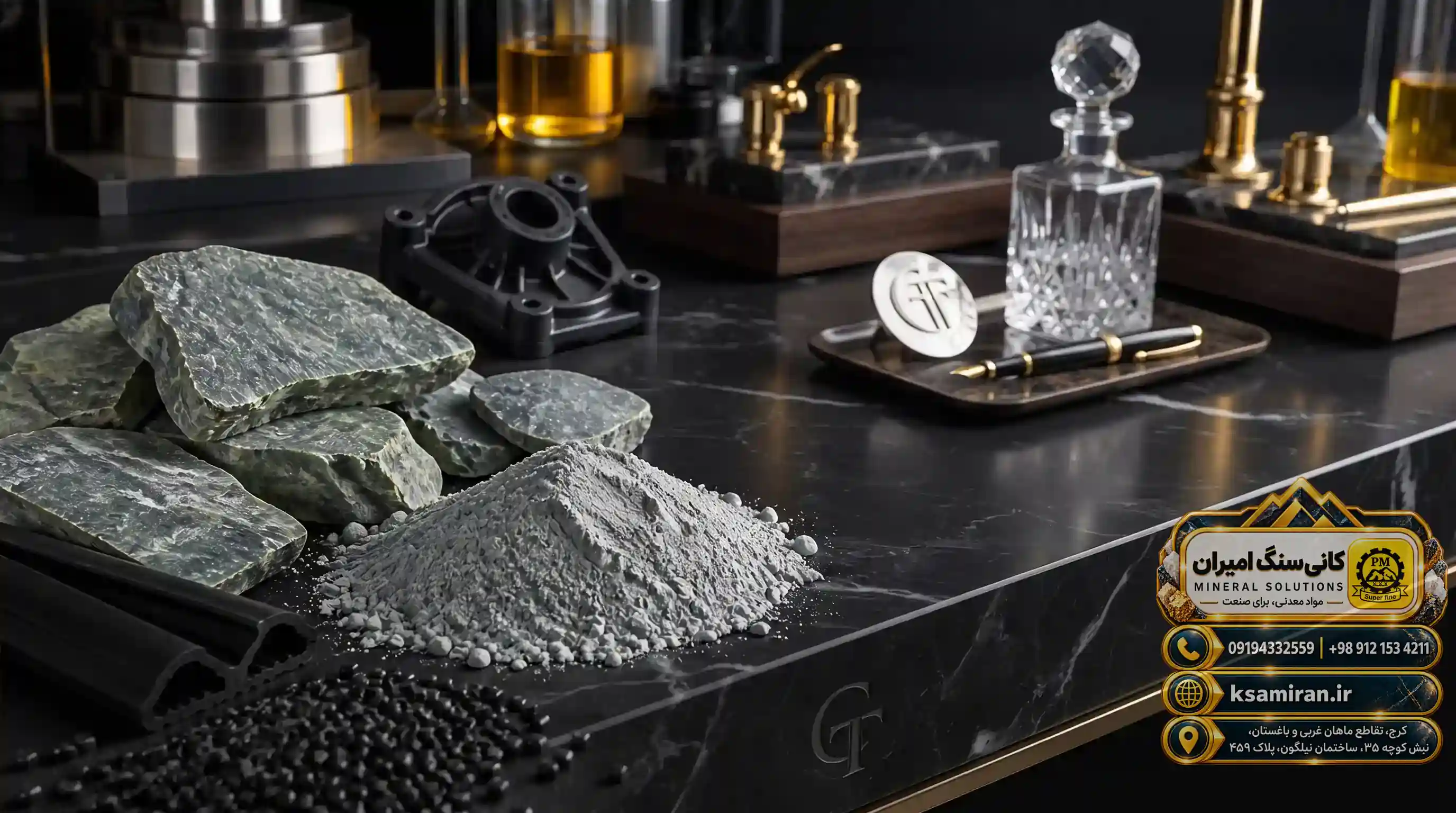
Polymer industries are one of the largest consumers of industrial talc worldwide. Talc acts as an active mineral filler (Active Filler) in the polymer matrix and imparts various properties to the final product. A correct understanding of how talc interacts with polymers is the key to choosing the right product for your production line.
Improvement of mechanical properties
Adding industrial talc to polymers increases the elastic modulus, hardness, and bending resistance of parts. The layered structure of talc allows load distribution in the polymer matrix, resulting in a final part with higher mechanical resistance. This property is especially important in producing automotive parts, household appliances, and technical products.
Thermal and dimensional stability
One of the most important advantages of industrial talc in polymers is the reduction of the thermal expansion coefficient. This means maintaining part dimensions at varying temperatures and is vital for products operating in environments with temperature fluctuations. Talc also increases the polymer's heat resistance and raises the heat deflection temperature (HDT).
Application in engineering plastics
- Polypropylene (PP): Talc is the most common filler in polypropylene and is used in producing automotive parts, dashboards, bumpers, and interior parts.
- Polyethylene (PE): To improve hardness and dimensional stability of pipes, tanks, and polymer films
- PVC: In window profiles, cables, and pipes as filler and processing aid
- Engineering polymers (PA, PBT, ABS): For high-performance parts requiring thermal and mechanical stability
Choosing the right mesh for polymers
For polymer applications, choosing the mesh range depends on the final product's surface and production method. For high-quality parts requiring a smooth and glossy surface, higher mesh (800 to 1000) is recommended. For general and more economical parts, mesh 450 to 600 suffices. Finer particles disperse better in the polymer matrix and create higher surface quality, but cost more.
Processing tips
When using industrial talc in the polymer process, note the following:
- Before mixing, check the talc's moisture; high moisture causes bubbles in the part
- Adjust extrusion speed and temperature according to the talc type
- Talc purity degree directly affects mechanical properties; impurities create weak points in the matrix
- For dark colors, talc whiteness is less important, but for white or colored products, it is highly important
Industrial talc is also used as an anti-blocking agent in polymer films and as a flow aid in the molding process. This wide adaptability has made talc an inseparable component of mode polymer industries.
Rubber industries are another major consumer of industrial talc. In rubber compounds, talc plays various roles from reinforcing filler to processing aid, and choosing it correctly directly affects the quality and lifespan of the final product.
Main functions of talc in rubber
Industrial talc has several simultaneous functions in rubber compounds:
- Mechanical reinforcement: Talc particles act as reinforcement points in the rubber matrix and increase abrasion, tensile, and tear resistance
- Reduced tackiness: Talc's naturally greasy surface prevents rubber from sticking to mold surfaces and rollers
- Improved processability: Talc improves the flow of the rubber compound in calendering and extrusion processes
- Hardness control: The amount of talc added adjusts the hardness of the rubber compound
- Thermal insulation: In insulating rubbers, talc helps reduce heat transfer
Rubber applications of industrial talc
Industrial talc is used in producing various rubber products:
- Automotive tires: As filler and processing aid in tread and sidewall compounds
- Industrial hoses: To improve abrasion resistance and formability
- Power transmission belts: Increased tensile strength and longer lifespan
- Gaskets and seals: Improved sealing property and heat resistance
- Footwear: In soles and uppers of rubber and canvas shoes
- Technical rubber products: Precision parts with low dimensional tolerance
Choosing the right mesh for rubber
In rubber industries, the 450 to 1000 mesh range is used, but choosing the appropriate part of this range depends on the final product:
For general products like shoe soles or non-sensitive parts, lower meshes (450 to 600) are economical and efficient. For tires and technical products requiring high abrasion resistance and quality surface, mesh 600 to 800 is suitable. For specialized products with the highest surface quality and mechanical properties, mesh 800 to 1000 is recommended.
Technical tips for using talc in rubber
- Uniform distribution of talc in the rubber matrix is vital; heterogeneous mixing causes a drop in mechanical properties
- Particle size affects curing speed and must be adjusted with the vulcanization system
- Talc purity affects the final product's color and abrasion properties
- In colored rubbers, talc whiteness must match the final color
- Talc's oil absorption level affects compound lubrication and filling
Industrial talc is also used as a dusting agent to prevent raw rubbers from sticking together during storage and transport. This simple but important application requires talc with appropriate particle size and low moisture.
For more information on selecting and supplying industrial talc for rubber industries, you can refer to the industrial talc buying guide.

The paint and coating industry is one of the most important consumer markets for industrial talc. In paint compounds, talc acts as an extender pigment and functional filler, imparting various properties to the final coating. A correct understanding of talc's role in paint helps you produce a better quality product at optimal cost.
Functions of talc in paint
- Pigment extension: Talc increases paint volume without dropping coating quality
- Abrasion resistance: Talc particles increase the hardness and durability of the paint film
- Gloss control: Talc acts as a matting agent in matte and semi-matte paints
- Suspension stability: Prevents pigments from settling in the paint can
- Chemical resistance: Makes the paint film more resistant to chemicals
- Recoatability: Creates a suitable surface for applying subsequent paints
Talc in paint types
Industrial talc is used in various industrial and architectural paints:
- Architectural paints: In plastic, acrylic, and oil paints as filler and matting agent
- Industrial paints: For coatings resistant to abrasion and corrosion
- Marine paints: Improved resistance to water and salty environments
- Fillers and plasters: In thick coatings and surfacing
- Printing ink: Viscosity and surface property control
Choosing the right mesh for paint
In the paint industry, the 450 to 1000 mesh range is most commonly used:
Meshes 450 to 600 are suitable for architectural paints and general fillers. Meshes 600 to 800 are used for industrial paints and high-quality architectural paints. Meshes 800 to 1000 are used for high-quality paints, printing ink, and specialized coatings.
The key point in choosing mesh for paint is that particles must be fine enough to create a smooth and uniform paint film, but not so fine as to incur uecessary cost. It should also be noted that talc must disperse well in the paint matrix to prevent particle agglomeration.
Important quality factors in paint talc
- Whiteness: Very important for white and light-colored paints; iron impurities make the color yellow
- Chemical purity: Impurities affect color stability and chemical reactions in the compound
- Oil absorption: Affects paint viscosity and solvent consumption
- Particle size distribution: Affects coating uniformity and final gloss
- Moisture: Must be minimal to prevent preservation and stability problems in the paint
In addition to talc, other minerals like white barite are also used in producing high-quality paints. As examined in the article Why Using White Barite is Essential in Paint Production, choosing the right mineral plays a vital role in final paint quality. Combining industrial talc with other fillers can bring the best result for your product.
To ensure industrial talc is compatible with your needs, you must be able to evaluate its quality systematically. In this chapter, we introduce the most important quality criteria and how to check them.
1. Chemical purity
Talc purity refers to the percentage of pure talc (Mg₃Si₄O₁₀(OH)₂) versus impurities. Common impurities include calcium carbonate, iron oxide, free silica, and alumina. The higher the purity, the more uniform and predictable properties the talc shows in the production process. High purity is especially important for sensitive applications in polymer and paint industries.
2. Whiteness degree
Whiteness is one of the most important visual indicators of industrial talc, measured with colorimetric devices. High whiteness is essential for white polymer products, light-colored paints, and colored rubbers. Talc whiteness is influenced by the raw material type and beneficiation process.
3. Particle size distribution
In addition to average particle size (mesh), their distribution also matters. A high-quality talc should have a narrow distribution, meaning most particles are close to the average. A wide distribution means the presence of both very fine and very coarse particles simultaneously, which can cause processing problems.
4. Moisture
Talc moisture directly affects its behavior in production processes. High moisture can cause:
- Bubbles in polymer parts
- Reduced paint stability in the can
- Flow problems in production lines
- Change in actual mass in formulation
5. Oil absorption
This indicator shows how much of a liquid (usually oil or solvent) the talc absorbs. High oil absorption means more liquid is needed to fully wet the particles, which is important in paint making and rubber compounds.
6. Application tests
In addition to laboratory tests, conducting application tests on your production line is very important:
- Mixing test: Checking how talc disperses in your product matrix
- Final product test: Checking final product properties with new talc
- Production line test: Ensuring no processing problems occur
7. Reliable supplier
One of the most important factors in guaranteeing quality is choosing a reliable supplier. Amir Kani Sang Project, as a mineral materials producer, produces industrial talc with continuous quality control for industrial applications. Choosing a committed supplier gives you assurance of quality stability in long-term supply.
Evaluating industrial talc quality is a continuous process. Even after initial approval, you should periodically check the quality of subsequent shipments to ensure quality stability. This is especially vital for manufacturers producing products with consistent quality.
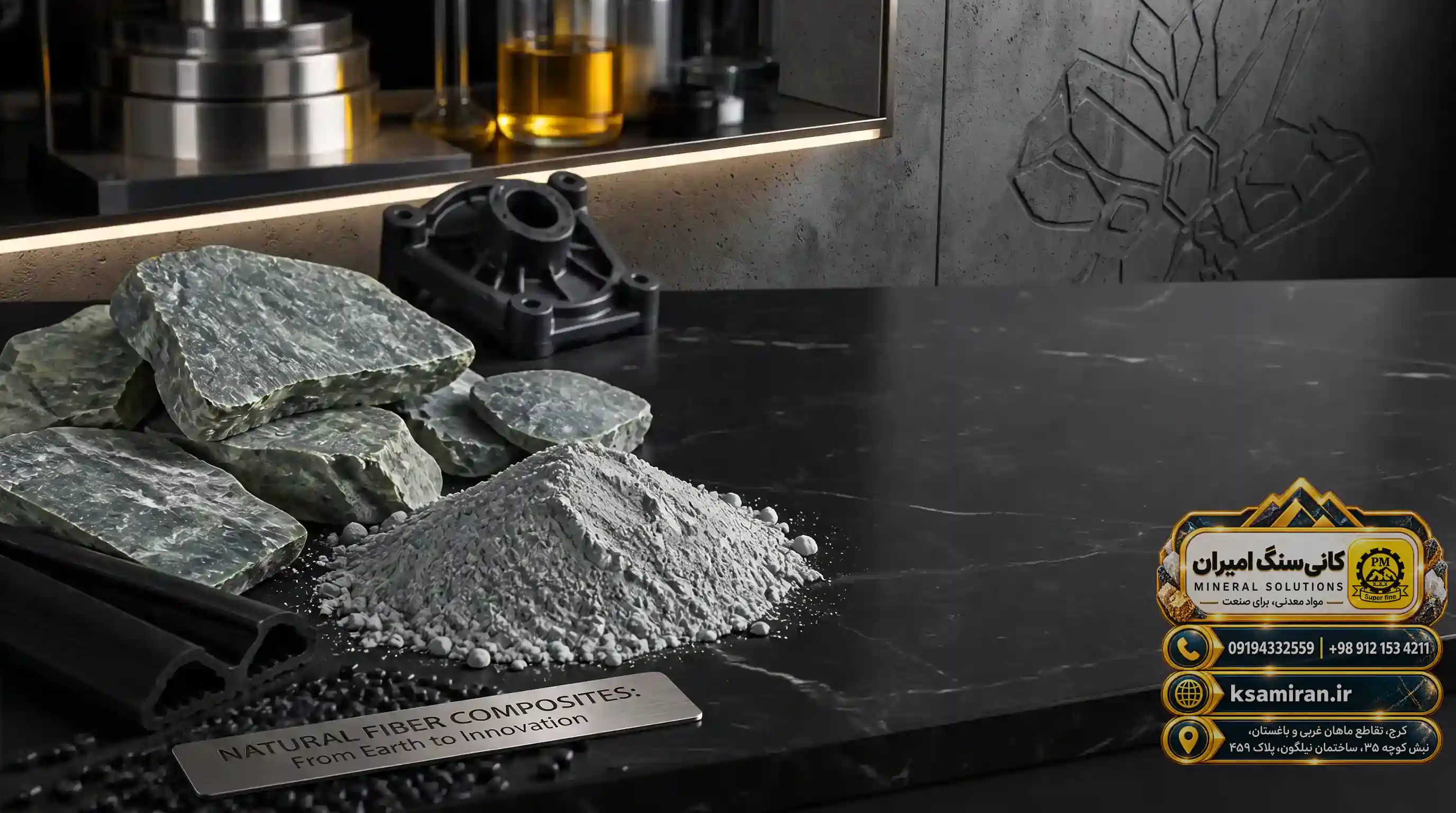
Many buyers of industrial talc make mistakes during the selection and buying process that can be avoided with sufficient awareness. In this chapter, we examine the most common mistakes and their solutions.
1. Focusing only on price
One of the biggest mistakes in buying industrial talc is choosing solely based on the lowest price. Low-priced talc may have lower purity, lower whiteness, or inappropriate particle size distribution. These can cause reduced final product quality, increased waste, and ultimately much higher cost than the initial savings. Price should be examined alongside quality and suitability for your needs.
2. Ignoring the product's actual needs
Many buyers purchase talc without a precise understanding of their product's needs. Does your product need high whiteness? Is heat resistance important to you? What production method do you use? Answering these questions before buying is essential. If you don't know what you want, you will probably buy an inappropriate product.
3. Not paying attention to particle size distribution
Many buyers only pay attention to the average mesh, while particle size distribution is equally important. Talc with the same average mesh but a wide distribution can show completely different behavior in the production process. Be sure to request a particle size distribution chart from the supplier.
4. Buying without samples and testing
Buying industrial talc in bulk without receiving a sample and testing it on the production line is a big mistake. Even if technical specifications are identical, talc's behavior on your production line can be different. Always take a sample, test it on the production line, and then place a bulk order.
5. Ignoring supply stability
Talc quality can vary between shipments. If your supplier lacks continuous quality control, the next shipment may have different quality, and you may be forced to readjust the formulation. Quality stability over time is as important as initial quality.
6. Not documenting specifications
Many buyers do not document their required technical specifications in writing. Without a clear Specification Sheet, you caot check the quality of the received shipment or determine responsibility if a problem occurs.
7. Ignoring storage conditions
Industrial talc must be stored under appropriate conditions so it does not absorb moisture and contamination. Buying in bulk without plaing for proper storage can cause quality loss during storage.
Solutions
To avoid these mistakes, have a systematic purchasing process:
- Carefully determine and document your product's technical needs
- Get samples from several suppliers and compare
- Conduct application tests on your production line
- Prepare a technical specification sheet for each order
- Periodically check the quality of received shipments
- Work with a supplier that has continuous quality control
For specialized guidance in the purchasing process, you can refer to the Specialized Industrial Talc Buying and Supply Guide. This guide helps you supply the industrial talc you need with a broader perspective and a more informed decision.
In this final chapter, we provide a practical checklist to ensure industrial talc compatibility with your industrial needs. By following these steps, you can decide with more confidence and avoid costly mistakes.
Step 1: Determine the product's technical needs
- What is your final product and what function does it have?
- What are the required mechanical properties (hardness, tensile strength, abrasion)?
- Is the product exposed to high temperatures or a chemical environment?
- What should the product's surface quality be (matte, glossy, light color)?
- What is your production method (plastic injection, extrusion, calendering, paint mixing)?
Step 2: Determine the appropriate mesh range
Based on the determined technical needs:
- Mesh 450 to 600: Suitable for general fillers, economical rubber products, architectural paints
- Mesh 600 to 800: Suitable for industrial paints, high-quality polymer parts, technical rubber products
- Mesh 800 to 1000: Suitable for specialized products, high-quality paints, fine polymer parts
Step 3: Determine quality criteria
- Minimum required chemical purity
- Minimum whiteness degree for your product
- Maximum acceptable moisture
- Particle size distribution range
- Required oil absorption level
Step 4: Evaluate the supplier
- Does the supplier have continuous quality control?
- Is it possible to receive samples for testing?
- Does it have stable supply capacity in the long term?
- Does it provide technical documentation for products?
Step 5: Testing and approval
- Test the sample on your production line
- Compare final product properties with the new talc
- Identify and resolve processing problems
- If approved, place a small trial order
- After final approval, conclude a supply contract with explicit technical specifications
Step 6: Continuous monitoring
- Periodically check the quality of received shipments
- Collect and analyze production line feedback
- If quality changes, negotiate with the supplier immediately
By following this checklist, you can systematically evaluate and select the industrial talc you need. Remember that suitable industrial talc is a product that not only has the required technical specifications but is also supplied stably and with high quality over time.
Amir Kani Sang Project, with experience in producing mineral materials, is ready to provide high-quality industrial talc tailored to your industrial needs. By examining the product and consulting with experts, you can make the best choice for your production line.
| Question | Answer |
|---|---|
| What is industrial talc and what are its applications? | Industrial talc is a filler mineral used in the production of polymeric products, rubber, paint, and industrial products. |
| What does the industrial talc mesh range mean? | The 450 to 1000 mesh range indicates talc particle size. The higher the mesh, the finer the particles and the more suitable they are for sensitive applications. |
| Which mesh is suitable for polymer industries? | Mesh 450 to 600 is recommended for general parts and mesh 800 to 1000 for high-quality products. |
| What role does industrial talc play in paint? | Talc in paint acts as an extender pigment, matting agent, and improves abrasion resistance. |
| Is industrial talc beneficial for rubber? | Yes, talc in rubber acts as a reinforcer, reduces tackiness, and improves processability. |
| How do we evaluate the quality of industrial talc? | By checking chemical purity, whiteness, particle size distribution, moisture, and application tests on the production line. |
| What is the most important mistake in buying industrial talc? | Focusing only on price and ignoring the product's actual needs are among the most common mistakes in buying industrial talc. |
| Should we test a sample before buying in bulk? | Yes, always take a sample, test it on your production line, and then place a bulk order. |
| How should industrial talc be stored? | It should be stored in a dry and contamination-free environment, away from moisture, to preserve its quality. |
| How do we order industrial talc suitable for our needs? | By determining the product's technical needs, choosing the appropriate mesh range, receiving samples and testing, you can order the right talc. |
The information in this article is based on the technical data of the industrial talc product of Amir Kani Sang Project (ksamiran.ir).

برچسب: Industrial Talc,How to Ensure Industrial Talc Is Compatible with Our Needs?,
نویسنده: رساوب آفرین