
درباره سایت
آخرین مطالب
- استخدام أكسيد الليمونيت (الماغش) في صناعات الزجاج
- کاربرد اکسید لیمونیت (گل ماش) در صنایع شیشهسازی
- A Review of Daily Prices for Limonite Oxide (Ocher) in the Market
- چگونه خالص بودن اکسید لیمونیت (گل ماش) را تشخیص دهیم؟
- بررسی قیمت روز اکسید لیمونیت (گل ماش) در بازار
- Application of Limonite Oxide (Gole Mash) in Glassmaking Industries
- كيف تتعرف على نقاء أكسيد الليمونيت (جول ماش)؟
- How to Determine the Purity of Limonite Oxide (Gol Mash)?
- بررسی استانداردهای ایمنی کار با اکسید لیمونیت (گل ماش)
- Comprehensive Guide to Technical Analysis of Limonite Oxide (Gol Mash)
امکانات وب
Introduction to Silica Chemical Analysis and Its Importance
Silica, with the chemical formula SiO2, is one of the most abundant mineral compounds in the Earth's crust, found profusely in igneous, sedimentary, and metamorphic rocks. Due to its high thermal stability, adequate chemical resistance against most acids, moderate hardness, and inherent transparency, it has become one of the vital raw materials in the glassmaking, casting, ceramic, and building materials industries. The silica product offered by the Kani Sang Amiran Project, with a mesh range of 10 to 450 mesh and main applications in glass, casting products, ceramic products, and building materials, is a practical example of this mineral whose quality is measured directly by its chemical composition. To view the complete specifications of this product, you can visit the silica page.
Chemical analysis of silica is a process through which the exact amount of silicon dioxide and its accompanying oxides in a mineral sample is determined. This measurement alone can reveal the difference between a valuable raw material and a low-grade one. For instance, a silica powder with high purity is suitable for producing clear and crystalline glass, whereas a sample with a higher percentage of iron oxide and alumina might be more applicable for building materials, coating ceramics, or casting products. Therefore, a careful examination of the chemical analysis before purchasing, processing, or final consumption is a technical and economic necessity.
Chemical analysis is not limited to the final SiO2 number; rather, particle distribution, moisture, grain morphology, and the type of accompanying minerals also affect product quality. A sample with high chemical purity but improper particle distribution might cause foaming or bubbling in the glassmaking process or lead to undesirable mold permeability in casting. Thus, a comprehensive view of silica quality is a combination of chemistry, physics, and processing.
The purpose of writing this article is to provide a structured guide for the careful examination of silica chemical analysis; from understanding the main oxides and laboratory methods to sampling, interpreting results, the role of impurities, quality control, and matching the analysis with industrial applications. In the end, the reader will be able to evaluate a silica chemical analysis report with a critical and practical perspective and make material choices aligned with their production needs.
Chemical Composition of Silica and Major Oxides
The chemical composition of silica is usually reported as the mass percentage of oxides. SiO2 is the main component, and the remaining part consists of impurity or accompanying oxides. Understanding each of these oxides and the role they play in industrial processes is the first step in interpreting any chemical analysis. Laboratory reports typically mention SiO2, Al2O3, Fe2O3, TiO2, CaO, MgO, Na2O, K2O, and the loss on ignition (LOI).
Silicon dioxide (SiO2) is the primary purity indicator. The higher this number, the greater the raw material's value for glassmaking and sensitive applications. In mineral resources, SiO2 is sometimes accompanied by quartz, cristobalite, or tridymite, and is sometimes found in amorphous form (like sedimentary silica). The difference between crystalline and amorphous structures is important in terms of reactivity, solubility, and thermal behavior.
Alumina (Al2O3) is one of the most common accompanying oxides, mostly entering silica from feldspar, mica, and kaolinite. A low amount of alumina is desired in crystalline glassmaking, but in some ceramics and building materials, its moderate presence helps improve mechanical properties and adhesion. Iron oxide (Fe2O3) has a direct effect on color; in clear and white glasses, there is a very strict limit on iron, whereas in building materials, the coloration from iron is not so harmful.
Titania (TiO2) and chromium oxide (Cr2O3) are also colorants and are limited in optical glasses and crystalline ware. Alkaline earth oxides like CaO and MgO usually enter from accompanying carbonates and dolomites and can affect thermal behavior and firing in casting and ceramics. The alkali oxides Na2O and K2O are alkali metals accompanying feldspars, which change the melting point and viscosity of glass.
Loss on ignition (LOI) is the part of the analysis report that shows how much mass is lost upon heating; this amount includes moisture, carbon dioxide from carbonates, and other volatile materials. A high LOI usually indicates the presence of carbonate minerals, high material moisture, or organic matter. Overall, evaluating a silica chemical analysis means looking simultaneously at SiO2, key impurities, and LOI to obtain a true picture of the mineral quality.

Common Methods for Chemical Analysis of Silica
There are several common laboratory methods for determining the chemical composition of silica, each with its own advantages, limitations, and scope of application. Familiarity with these methods helps quality control engineers and buyers better assess the validity of received reports. The most widely used methods include X-ray fluorescence (XRF), inductively coupled plasma (ICP-OES and ICP-MS), atomic absorption spectroscopy (AAS), and wet chemistry methods.
The XRF method is based on measuring secondary X-rays emitted from the sample and can quickly and accurately determine all major oxides. This method requires sample preparation, usually done as a pressed pellet or a fusion bead. The fusion bead provides the highest accuracy in measuring major oxides due to the reduction of matrix and texture effects, and is highly suitable for continuous quality control in factories.
The ICP-OES and ICP-MS methods are very powerful for measuring trace impurities such as iron, titanium, and chromium. In this method, the sample must be converted into a solution; however, dissolving SiO2 completely is difficult, so silica is usually estimated as a total first, and then impurities are measured with high precision. The AAS method is also a cost-effective and accurate option for single-element determinations like iron or calcium.
Wet chemistry methods still retain their value. The classic method of determining SiO2 via precipitation and weighing (gravimetric method) is one of the most accurate reference methods; in this method, silica is converted into silica gel, precipitated, dried, and weighed. Titration and colorimetric methods are also used for elements like iron and alumina. These methods are time-consuming but are still employed in reference laboratories and for validating instrumental methods.
The choice of method depends on factors such as required accuracy, number of samples, available equipment, and budget. In routine quality control, combining XRF for major oxides and ICP for tracing minor impurities is a common patte. The important thing is that the chosen method matches the final application of the silica; for example, for sensitive glassmaking, a method that measures iron and chromium impurities at the ppm level is of strategic importance. In addition, laboratory credibility, instrument calibration, and the use of certified reference materials (CRM) are fundamental requirements in all methods.
Sample Preparation and Common Laboratory Errors
The accuracy of any silica chemical analysis is determined at the sample preparation stage, before the measuring instrument. If sampling, crushing, homogenization, or fusion are not done correctly, even the most advanced instrument will yield incorrect results. The first principle is representative sampling; meaning the sample must reflect the average characteristics of the entire shipment. To achieve this, samples are usually taken from several points, combined, and volume-reduced to obtain a uniform sample.
After sampling, the sample must be dried and crushed. Crushing must be done under conditions that prevent contamination from the crushing tools; for example, using ceramic discs can add extra alumina and silica to the sample, and using metallic tools can increase iron. For high-purity silica, mills with non-metallic or ceramic linings are typically used. After crushing, the powder must be thoroughly homogenized and screened to the desired mesh (within the 10 to 450 mesh range of the product profile).
In the XRF method, sample preparation plays a key role. In the pressed pellet method, the powder is combined with an appropriate amount of binder and pressed; this method is fast but more sensitive to matrix and porosity effects. In the fusion bead method, the sample is melted with a flux, usually lithium metaborate, at high temperature to obtain a clear and homogeneous glass. This method has higher accuracy but requires experience and temperature control. In ICP and AAS methods, the sample must be completely converted into a solution, which usually requires digestion with HF acid along with other acids, followed by the removal or complete destruction of silica.
Common errors at this stage include: non-representative sampling, unbalanced sample moisture, tool-induced contamination, weighing errors during fusion bead preparation, bubbles or porosity in the pressed pellet, and incomplete sample digestion in wet methods. Also, considering the sample's loss on ignition and reporting results on a dry basis is very important, because variable moisture can systematically shift the SiO2 and other oxide numbers.
A key step in reducing errors is using certified reference materials (CRM) with a composition close to silica samples and ruing duplicate samples. Close repeatability is an indicator of reliable preparation and a dependable measurement process. Finally, careful documentation of preparation conditions—including drying temperature, flux type, instrument, and operator—helps trace the source of potential errors and increases the analysis report's validity.

Interpretation of Analysis Results and Reference Values
Receiving a chemical analysis report is not the end of the jouey; rather, it is the begiing of the interpretation stage. A standard report usually includes sample identification, date, test method, mass percentage of each oxide, loss on ignition (LOI), and in some cases, measurement uncertainty. The reader should first check the test method and reporting basis (dry or natural), because comparing two reports with different bases can lead to wrong conclusions.
In qualitative evaluation, SiO2 higher than 98 to 99 percent is usually considered high-purity silica, suitable for clear glassmaking, crystalline ware, crystal, and some specialized ceramics. Lower ranges, depending on the impurity composition, are used in casting, ceramics, colored glass, building materials, and refractory products. These are general reference values, and each industry defines its own acceptance range based on its formulations and inteal standards.
One of the key points in interpretation is paying attention to the suite of impurities. Two samples with identical SiO2 but different impurity compositions can behave completely differently in the fuace. For example, high alumina increases glass viscosity and makes refining difficult, while alkali and alkaline earth oxides change the softening point and thermal behavior. Also, the presence of carbonate minerals, indicated by a high LOI, can cause bubbling and gaseous impurities during the melting process.
Uncertainty and repeatability of the numbers must be taken into account in critical decision-making. In valid reports, the error range of each number is stated, or at least retesting is possible. Making decisions based on differences smaller than the instrument's uncertainty is a common mistake; for instance, a 0.3 percent difference in SiO2 between two samples might fall within the test's error range and show no real superiority.
Ultimately, the interpretation of the analysis should occur in the context of the final application. A material might be perfectly suitable for one application and unacceptable for another. Therefore, it is best to interpret silica analysis reports using a checklist including SiO2 purity, colorant impurities, alumina, alkali oxides, LOI, and particle distribution to fully assess alignment with the production process needs.
The Role of Impurities in Silica Quality and Their Control Methods
Impurities play a decisive role in the final quality of silica and its application in industries. The most important impurities include iron oxide, alumina, titania, calcium, magnesium, and alkali oxides, each entering silica from accompanying minerals, lime deposits, feldspars, or processing contamination. Understanding the source and effect of these impurities is the first step in quality control.
Iron oxide (Fe2O3) is the most well-known impurity in silica. Even very minute amounts of iron can cause a yellow or green tint in glassmaking and severely reduce the transparency of crystalline products. The source of iron can be minerals like hematite, magnetite, limonite, or iron-containing silicates. To control iron, processing methods such as mineral washing, magnetic separation, and particularly high gradient magnetic separation (HGMS) are employed. Alongside this, moisture management and preventing caking of fine mineral powders are very important for process consistency and processing efficiency; for practical solutions in this area, you can refer to the article How to Prevent Red Iron Oxide (Ochre) Caking?.
Alumina (Al2O3) enters silica from feldspar, mica, and kaolinite. Its moderate amount is desired in some building materials and ceramics, but for clear glassmaking, it must be carefully controlled. Alumina control is mainly achieved through mineral washing, hydrocyclones, and flotation. Titania also has a colorizing effect similar to iron and is usually separated along with other impurities during processing.
Alkaline earth oxides (CaO, MgO) and alkali oxides (Na2O, K2O) usually enter glassmaking as clarifiers and fluxes; for this reason, the silica used in glassmaking typically has specific limits on these elements. In casting and ceramics, these oxides can affect the thermal behavior, firing, and density of the final product. Carbonate minerals and lime deposits are the main sources of these impurities, which can be managed through washing and mine control.
A comprehensive impurity control approach consists of three steps: first, understanding the mineralogy of the ore and determining the critical impurities based on the final application; second, selecting appropriate processing whether washing, magnetic separation, flotation, or hydrocyclones; and third, continuous quality control with periodic analyses. The cycle of evaluation, correction, and re-testing ensures that the product maintains its consistency over time and processing deviations are quickly identified. This consistency is the product's most valuable feature for consumers with sensitive formulations.
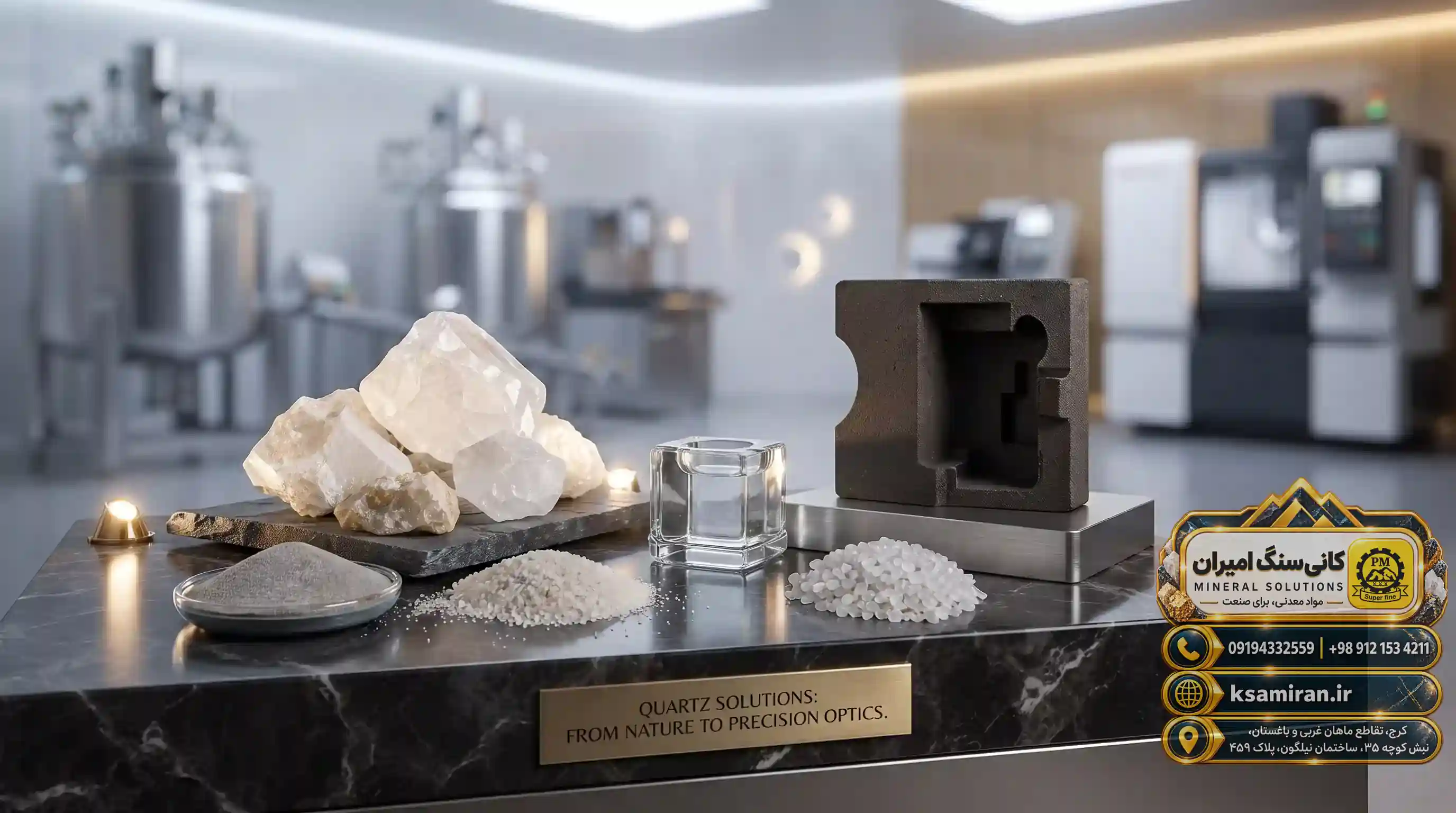
Quality Control and Documentation of Silica Analysis
Continuous quality control is the main pillar of quality stability in supplying industrial silica. An effective quality control system tus chemical analysis into a management tool that not only verifies the quality of the current shipment but also makes the trend of changes trackable over time. The first step in this system is defining key performance indicators (KPIs), including SiO2 percentage, permissible levels of critical impurities like Fe2O3 and Al2O3, particle distribution, and moisture.
To monitor these indicators, periodic tests are performed on samples extracted from the production line or dispatched shipments. Results are recorded in statistical process control (SPC) charts to visualize process trends. Deviation from the control range indicates the need for corrective action; for example, adjusting magnetic separation or changing the mine working face. Long-term data provides the opportunity to understand the inherent characteristics of each part of the mineral deposit and to plan extraction accordingly.
Documentation is an inseparable part of quality control. Every shipment must be recorded with complete specifications, including sampling date, stone characteristics, test method, analysis results, and retest results. These documents are valuable for building transparent relationships with buyers, tracking complaints, and continuously improving the process. Many industrial buyers consider receiving a technical catalog containing valid analysis data as a precondition for starting a collaboration; to become familiar with the content and receive this information, you can refer to the Guide to Receiving the Technical Catalog and Specialized Silica Analysis.
Laboratory validation must also be on the agenda. This includes periodic instrument calibration, using certified reference materials (CRM), round-robin testing between laboratories, and sample replication. An analysis report without knowledge of the test method, uncertainty, and calibration status has little decision-making value. For this reason, the best collaboration approach is providing complete reports including method specifications, date, and uncertainty.
Ultimately, it should be noted that quality control is not merely a laboratory activity, but a chain from the mine to the final product. Training sampling operators, maintaining the cleanliness of crushing tools, and quickly transferring samples to the laboratory all affect the accuracy of the numbers. An integrated system coecting the mine, processing, laboratory, and sales can continuously improve product quality and guarantee stable compliance with the needs of industrial customers.
Industrial Applications of Silica Based on Chemical Analysis and Conclusion
Industrial applications of silica are directly related to its chemical composition. In the glassmaking industry, SiO2 purity and low levels of iron oxide, chromium, and titanium determine the transparency and final quality of the product. Clear glasses, crystalline ware, optical glasses, and borosilicate glasses require the highest purity, while colored glasses and glass fibers can use lower-purity silica. Particle distribution is also vital for accelerating melting and structural uniformity, which is why fine and controlled meshes are typically used in this industry.
In the casting industry, silica is used as the primary molding material and, in some processes, as an expansion-reducing additive. In this application, the consistency of grading and particle distribution is of equal importance to chemical purity, as it affects mold permeability, surface finish of the casting, and minimization of defects. The wide range of 10 to 450 mesh of the silica product allows for selecting particles suited to the mold type and casting method. The levels of iron and alumina impurities in this industry must also be controlled to remain compatible with binder materials and the mold's thermal properties.
In the ceramic industry, silica forms part of the structure of the ceramic body and is usually combined with feldspar, kaolin, and other additives. The selection of appropriate silica in this industry is done considering thermal behavior, firing, and other accompanying materials; for example, the use of micronized feldspar in ceramic bodies and glazes highlights the interaction of feldspar and silica in the formulation. To lea more about this topic, you can read the article How to Use Micronized Feldspar in Industries?.
In building materials, silica is widely used in the production of industrial sands, coatings, precast concretes, and refractory products. In this sector, chemical purity requirements are usually more lenient, and instead, mechanical resistance, particle shape, and grading consistency become important. Silica is also used in chemical processes and the production of industrial additives as a filler and carrier with controlled physical properties. This variety of applications shows that there is no single definition for high-quality silica, and quality is always defined relative to the consumer process's needs.
Conclusion: A careful examination of silica chemical analysis requires a multidimensional view, encompassing an understanding of major oxides, selection of the appropriate test method, precise sample preparation, informed interpretation of results, impurity control, and the establishment of a continuous quality control system. A product that can maintain grading consistency and quality stability over time, alongside desirable chemical purity, can efficiently cover the diverse needs of the glass, casting, ceramic, and building materials industries. The Kani Sang Amiran Project, by offering silica in the 10 to 450 mesh range with main applications in these four industries, strives to make transparency in providing technical information a precondition for its collaborations.

| Question | Answer |
|---|---|
| What is the chemical analysis of silica? | It is a process in which the exact amount of silicon dioxide (SiO2) and its accompanying oxides in a mineral sample is determined to assess its quality and suitability for industrial applications. |
| What are the most important accompanying oxides in silica? | Alumina (Al2O3), iron oxide (Fe2O3), titania (TiO2), calcium (CaO), magnesium (MgO), and the alkali oxides Na2O and K2O, along with loss on ignition (LOI). |
| How does the XRF method for silica analysis work? | This method quickly and accurately determines the main oxides by measuring the secondary X-rays emitted from the sample, and it is usually performed on a pressed pellet or fusion bead. |
| Why is iron oxide important in silica? | Even in small amounts, iron oxide changes the color of glass and crystalline products and reduces transparency; for this reason, it is strictly controlled in glassmaking. |
| What does the 10 to 450 mesh range mean? | This range shows that the product is offered in highly diverse particle sizes, from coarse to very fine, to match the needs of glass, casting, ceramic, and building material products. |
| What is the difference between instrumental and wet chemistry methods? | Instrumental methods such as XRF and ICP are fast and suitable for daily quality control, while wet methods such as gravimetric precipitation are highly accurate and are used as reference methods. |
| Why is sample preparation important in analysis? | Because sampling, crushing, tool contamination, and incomplete digestion errors cause the instrument's results to be wrong even before measurement, and affect industrial decision-making. |
| What should the analysis report include? | Sample identification, date, test method, mass percentage of oxides, LOI, test repetitions, and if possible, measurement uncertainty and reporting basis (dry or natural). |
| How are quality deviations in silica production identified? | Through statistical control charts, periodic tests, comparison with key quality indicators, and tracking the trend of changes over time. |
| What are the main applications of silica? | The glass industry, casting products, ceramic products, and building materials, each of which has its own specific purity and grading requirements. |
The data in this article is compiled based on the technical information of the silica product on the Kani Sang Amiran Project website (https://ksamiran.ir/products/silica/) and general sources on quality control and chemical analysis of minerals.

برچسب: Silica,How to Carefully Examine the Chemical Analysis of Silica?,
نویسنده: رساوب آفرین