
درباره سایت
آخرین مطالب
- Why is choosing Limonite Oxide (Gole Mash) important for industries?
- چگونه بهترین فرمولاسیون با اکسید لیمونیت (گل ماش) بسازیم؟
- لماذا يعد اختيار أكسيد الليمونيت (أوكر أصفر/كلماش) مهماً للصناعات؟
- دور أكسيد الليمونيت (الجول ماش) في إنتاج الطوب والفخار
- Examining the Effect of Limonite Oxide (Gol Mash) on Color Stability
- مراجعة مزايا الشراء بالجملة لأكسيد الليمونيت (غل ماش)
- دور أكسيد الليمونيت (الغل ماش) في الصناعات الدوائية ومستحضرات التجميل
- بررسی میزان سختی و سایش اکسید لیمونیت (گل ماش)
- Application of Limonite Oxide (Gole Mash) in Anti-Rust Industries
- نقش اکسید لیمونیت (گل ماش) در تولید پوششهای محافظ
امکانات وب
Introduction to Micronized Calcium Carbonate Powder
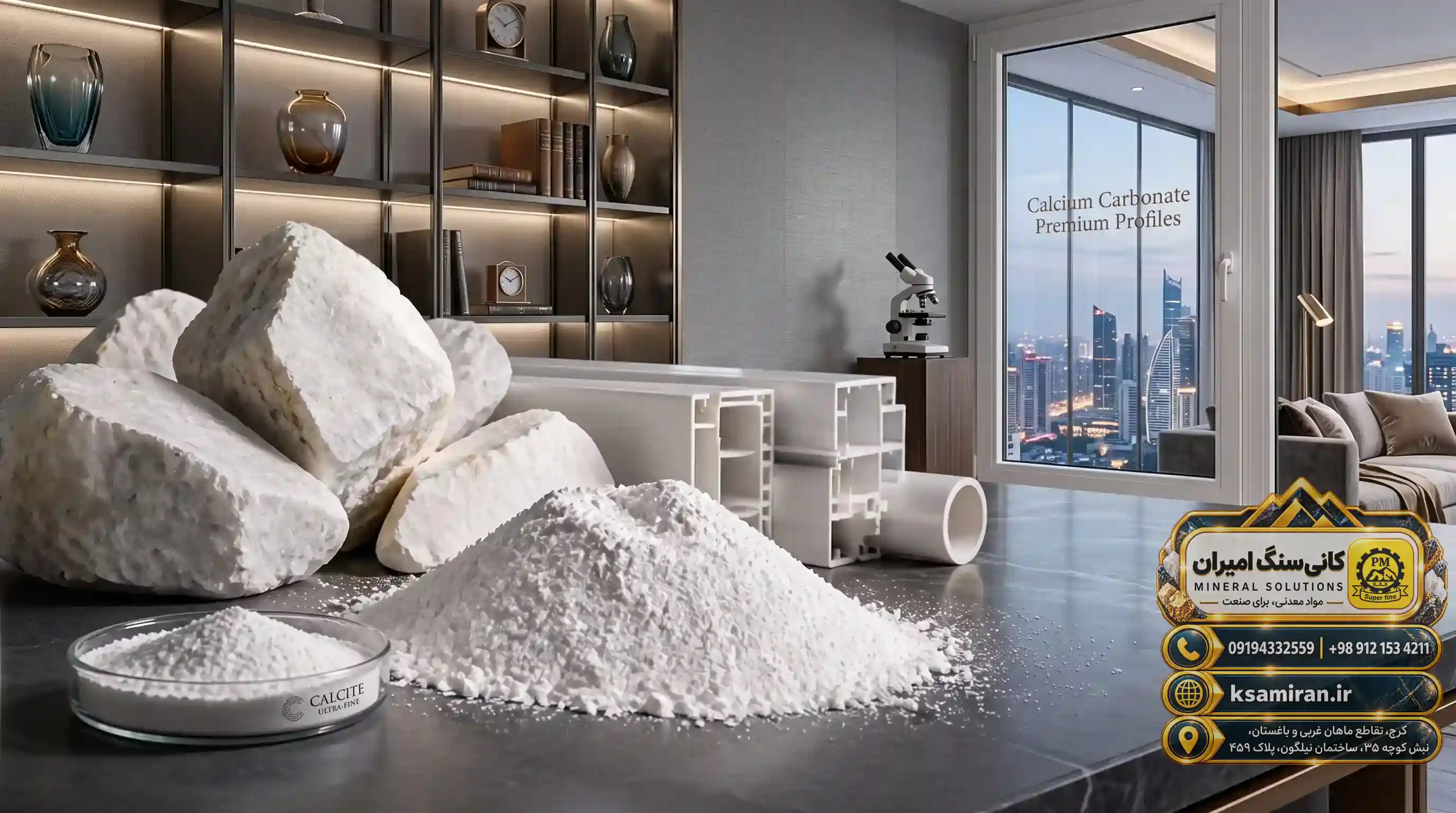
Micronized calcium carbonate powder has become one of the most important raw materials in manufacturing industries today. Extracted from limestone and calcite, this material is processed and ground to very fine dimensions, becoming a valuable mineral filler. The term “micronized” refers to a process in which the particle size of this material is reduced to micrometer dimensions, resulting in increased contact surface with the polymer matrix or other base materials.
Calcium carbonate with the chemical formula CaCO3 is naturally found in limestone, marble, and calcite, and is chosen across a wide range of industries due to its abundance, affordable price, and desirable technical properties. This product is selected for polymer, paint, paper, and engineering applications, and its production range varies from 100 to 3500 mesh. This size variety allows manufacturers to choose the most precise type of product based on their production line needs.
One of the most important features of micronized powder is particle size uniformity. The more micronized the powder, the better it disperses in the polymer matrix, improving the mechanical properties of the final product. Additionally, the white color of this material makes it perform very well in the production of light and colored products. The main applications of this product include PVC/UPVC profiles and pipes, masterbatch, cables, artificial leather, paint, paper, adhesives, and engineered stone.
In the production process, limestone extracted from mines undergoes washing, primary crushing, and then micronization in advanced equipment. Finally, the powder is packaged with a specific mesh size and supplied to the market. Quality control of particle size at this stage plays a decisive role in the final performance of the product. To view the complete specifications of this mineral and the available mesh range, you can visit the Calcium Carbonate product page on the Kani Sang Amiran website.
In this article, we strive to examine the benefits of using micronized calcium carbonate powder in various industries. In the upcoming chapters, we first discuss the general benefits of this material in polymer industries, and then examine its specialized applications in each industry in detail. Finally, we will discuss important points in selecting a supplier and quality control.
Benefits of Micronized Calcium Carbonate in Polymer Industries
The use of micronized calcium carbonate powder in polymer industries offers numerous benefits. As an active mineral filler, this material not only reduces production costs but also improves the physical and mechanical properties of the final product. In polymer compounds, micronized particles, due to their small size and high specific surface area, form a better bond with polymer chains, resulting in more uniform dispersion.
One of the most important benefits of using this material in polymer industries is the increase in the thermal resistance of the product. Calcium carbonate particles act as an insulating agent and help the dimensional stability of polymer products at varying temperatures. This feature is especially valuable in the production of UPVC profiles exposed to sunlight and temperature changes. This material also helps improve product durability against environmental factors and increases the lifespan of the final product.
Furthermore, this mineral increases the stiffness, hardness, and compressive strength of polymer products without significantly increasing the final weight. Manufacturers can significantly reduce the final product cost by replacing a portion of expensive resin with this mineral filler. The share of this material in the formulation of polymer compounds can vary depending on the application and desired properties.
Also, the role of this material in improving processability should be mentioned. By reducing the adhesion of the melt to the extruder screw and improving melt flow, micronized particles help produce products with better surface quality. This reduces energy consumption, increases production speed, and consequently boosts production line efficiency. On the other hand, the white color of this material helps produce light-colored products and reduces the need for additional pigments.
From an economic perspective, using this filler is highly justifiable. As explained in the article Examining the Economic Benefits of Using Coated Calcium Carbonate in Manufacturing, choosing the right type and size of this material can directly impact production line profitability.
Ultimately, it should be noted that selecting the appropriate mesh and controlling filler quality is of high importance. Using uniformly sized particles prevents stress concentration at various points in the product and reduces the risk of cracking and failure. Therefore, sourcing this material from a reputable supplier with strict quality control over particle size is very important.

Application of Calcium Carbonate in PVC/UPVC Profiles and Pipes
The industry producing PVC and UPVC profiles and pipes is one of the largest consumers of micronized calcium carbonate powder. In this industry, this mineral acts as an active and economic filler, reducing production costs while improving the mechanical properties of the product. In the formulation of UPVC profiles, this material is typically used in high percentages and constitutes a major portion of the final product's weight.
One of the most important reasons for using this material in profile and pipe production is the dimensional stability of the product. By creating a uniform structure, micronized particles prevent profile deformation during production and cooling. This is especially important in producing complex profiles with delicate cross-sections like UPVC doors and windows, as any dimensional change can cause assembly and installation problems.
In addition, this mineral filler increases the compressive strength of pipes. PVC pipes used in water supply and sewage systems must withstand inteal pressure and exteal loads. Using calcium carbonate with the appropriate mesh helps distribute stress uniformly in the pipe wall and improves the final strength of the product. This material also increases pipe hardness and reduces thermal expansion.
The surface quality of the final product is also directly affected by this mineral. High-mesh micronized particles (e.g., 1250 mesh and above) create a smooth and even surface in profiles, which is crucial for delicate products. Conversely, using coarser particles may cause surface roughness. Therefore, selecting the right mesh based on product type and desired surface quality is very important.
Another point to consider is the effect of this material on the production process. In extruder machines, using this filler reduces melt adhesion to screws and lowers process temperature. This not only reduces energy consumption but also increases equipment lifespan. Also, in producing large-diameter pipes, this material helps better melt flow and enables production at higher speeds.
Finally, it must be mentioned that quality control of this material in the profile and pipe industry is crucial. Moisture, particle size distribution, and chemical purity are among the factors that must be controlled by the supplier. Impurities or high moisture can cause bubbles in the profile and reduce final product quality. For this reason, reputable manufacturers typically use suppliers who adhere to strict quality standards.
Role of Calcium Carbonate in Masterbatch Production and the Cable Industry
The masterbatch and cable manufacturing industries are also primary consumers of micronized calcium carbonate powder. In these industries, this mineral plays a much more specialized role, and the choice of mesh and its quality directly affects the final product's performance.
In the masterbatch industry, this mineral is used as a carrier for pigments and additives. Masterbatch is essentially a concentration of pigments and additives in a polymer carrier that is combined with the main polymer materials in the final stage. Using micronized calcium carbonate in this formulation allows pigments to disperse better and increases color uniformity in the final product. This is particularly important in producing white and light-colored masterbatches, as this material itself acts as an economic white pigment.
Also, in filler masterbatches, this material acts as the primary filling agent and is used in high percentages. High-mesh micronized particles (such as 1500 to 3500 mesh) are more common in this application, as they create a uniform surface and better appearance in the final product. Meanwhile, using this material reduces the consumption of expensive pigments like titanium dioxide.
In the cable industry, this mineral is used as an insulating filler. Electrical cables require high-quality insulation, and micronized particles, by creating a uniform structure in the polymer insulation, help distribute the electric field uniformly and reduce the risk of insulation breakdown. Additionally, this material increases the thermal resistance of the insulation, which is important in high-power cables that generate a lot of heat.
Another important point is the effect of this material on the mechanical properties of the cable sheath. Micronized particles improve the abrasion and tensile resistance of the sheath, making the cable more resistant to mechanical damage during installation and use. This material also helps manage cable density, resulting in significant weight reduction in long cables.
In both the masterbatch and cable industries, precise control of particle size and distribution is crucial. Inappropriately sized particles can cause weak points in cable insulation or reduced color uniformity in masterbatch. Therefore, suppliers in these industries typically demand a very precise mesh range from their mineral suppliers and take incoming quality control very seriously. Using powders with very high meshes (up to 3500 mesh) is quite common in these industries.
Application of Calcium Carbonate in Paint and Artificial Leather
The paint manufacturing and artificial leather production industries are also important consumers of micronized calcium carbonate powder. In these industries, this mineral acts as a filler and supplementary pigment, reducing production costs and improving final product properties.
In the paint industry, this material is used as an accessible and economic filler. High-mesh micronized particles increase the paint's covering power, improve the final surface, and enhance the paint's abrasion resistance. In conventional paints, this material usually constitutes a major portion of the formulation volume and replaces some of the expensive pigments. For example, replacing a portion of titanium dioxide with this material can significantly reduce production costs.
One of the key benefits of using this material in paint is the ability to adjust the gloss level. By selecting the appropriate mesh, matte, semi-gloss, or glossy paints can be produced. Finer particles create a smoother and glossier surface, while coarser particles create a matte surface. This flexibility allows paint manufacturers to produce a wide range of products. As explained in the Comprehensive Guide to Using Coated Calcium Carbonate in Paint Making, using coated varieties of this material can bring additional benefits to this industry.
In the artificial leather industry, this mineral also has extensive applications. Artificial leather is produced from a fabric substrate with a polymer coating (usually PVC or polyurethane), and calcium carbonate is used as a filler in this coating. This material creates a uniform surface, increases abrasion resistance, and improves the tactile properties of the artificial leather. This filler also reduces the density and final cost of the product.
An important point in both industries is selecting the appropriate mesh. In producing high-quality paints and natural-looking artificial leather, very high meshes (1250 to 3500 mesh) are typically used to achieve a completely smooth and uniform surface. Conversely, for standard industrial paints, lower meshes (such as 400 to 800 mesh) can be used.
Also, the oil and moisture control of this material should be mentioned. In the paint industry, the presence of moisture causes problems in the production process and reduces the paint's shelf life. Therefore, suppliers of this material for the paint industry usually offer products with very low moisture. In artificial leather, uniform particle distribution is also important to prevent spots and uneveess on the product surface.
Application of Calcium Carbonate in Paper and Adhesive Industries
The papermaking and adhesive production industries are also traditional consumers of micronized calcium carbonate powder. In these industries, this mineral acts as a supplementary material and filler that significantly improves the quality of the final product.
In the paper industry, this material is used in two main ways: as a filler during sheet formation and as a coating on the paper surface. In its filling role, micronized particles fill the spaces between cellulose fibers, resulting in paper with a smoother surface and higher density. This improves print quality, increases brightness, and reduces light transmission through the paper. Replacing some of the expensive fibers with this mineral also significantly reduces paper production costs.
In the paper coating process, very high-mesh calcium carbonate is used to create a completely smooth and even surface for high-quality printing. In this application, meshes of 1500 to 3500 are typically used, and uniform particle size distribution is very important. High-quality printing papers usually use this type of coating, and the brightness and whiteness of the paper are strongly influenced by the quality of this mineral.
In the adhesive industry, this material is used as a filler and viscosity regulator. Water-based and solvent-based adhesives typically use this mineral to adjust consistency, increase dry volume, and improve the mechanical properties of the adhesive layer. By creating a uniform structure, micronized particles increase the adhesive layer's resistance to moisture and temperature.
Furthermore, in industrial and wood adhesives, this material reduces the shrinkage of the adhesive layer during drying. This is especially important in structural adhesives, as excessive shrinkage can cause stress and reduce bond strength. This filler also increases the adhesive's drying speed and reduces energy consumption in the production process.
An important point in both industries is the chemical purity and color of this material. In producing high-quality white paper, metallic or colored impurities can reduce the paper's brightness degree. Therefore, the paper industry typically uses calcium carbonate with high whiteness and appropriate chemical purity. Suppliers to this industry usually offer products with strict quality control over color, purity, and particle size distribution. Choosing the appropriate mesh in these industries depends on the final product type, but generally, the higher the desired surface quality, the higher the mesh required.

Application of Calcium Carbonate in Engineered Stone and the Importance of the 100 to 3500 Mesh Range
Engineered stone, or engineered quartz, is one of the most important mode applications of micronized calcium carbonate powder. In producing this type of stone, stone slabs with the appearance and properties of natural stone are made by combining mineral aggregates (such as quartz, calcium carbonate, and ceramics) with polymer resins. In this industry, this mineral is used both as a primary aggregate and as a fine filler.
One of the main benefits of using this material in engineered stone is filling the fine spaces between larger particles. In engineered stone formulations, a combination of different particle sizes is typically used to achieve higher density and a stronger structure. By filling the spaces between coarse particles, micronized particles reduce the stone's porosity and significantly increase its mechanical strength.
Additionally, this mineral reduces resin consumption in the formulation. Resin is the most expensive part of the engineered stone formulation, and replacing some of it with this economic filler drastically reduces production costs. At the same time, micronized particles, by creating more contact surface with the resin, increase the adhesion between particles and thus enhance the structural integrity of the stone.
Regarding the 100 to 3500 mesh range, it should be noted that this wide variety allows the production of diverse products. In engineered stone, a combination of different meshes is typically used: low meshes (100 to 400) as coarse aggregates and high meshes (1250 to 3500) as fine fillers. This combination creates an optimal structure with high density and low porosity.
The importance of choosing the right mesh in this industry is very high. Inappropriately sized particles can cause cavities in the stone, reduce strength, or create problems in the pressing and drying process. For example, excessive use of fine particles may increase the mixture's viscosity and cause pressing issues, while a lack of fine particles increases the stone's porosity.
Besides engineered stone, this material is used in producing other engineering products such as industrial sheets, automotive parts, and FRP products. In all these applications, precise control of particle size distribution and material purity is of high importance. Reputable suppliers usually offer their products in standard, specified meshes and allow selection based on customer needs. This very variety of 100 to 3500 mesh demonstrates the breadth of this material's application in various industries.
Conclusion and Criteria for Choosing a Calcium Carbonate Supplier
In this article, the benefits of using micronized calcium carbonate powder in various industries were examined. From polymer industries and PVC/UPVC profile and pipe production to masterbatch, cables, artificial leather, paint, paper, adhesives, and engineered stone, all these industries benefit from the features of this mineral. The variety of the 100 to 3500 mesh range allows manufacturers to choose the most precise product based on their needs.
Summary of benefits: reduced production costs, improved mechanical properties, increased thermal resistance, improved surface quality, gloss adjustment, increased brightness, and improved processability are among the most important benefits of this material. In each industry, a combination of these benefits is utilized, and the final formulation is adjusted based on product needs.
When choosing a supplier, there are several key criteria. First, product variety: the supplier should be able to offer a wide range of meshes so you can choose based on your production line needs. Second, quality control: uniform particle size distribution, chemical purity, low moisture, and appropriate whiteness are among the factors that must be guaranteed. Third, quality consistency; quality fluctuations can cause serious problems in the production line.
Also, the supplier's technical consulting is very important. A professional supplier not only sells products but can also guide you in choosing the right mesh for your application. In addition to calcium carbonate, some suppliers offer other minerals such as talc. As examined in the article Examining the Technical Benefits of Using Micronized White Talc, in some applications, combining several minerals can yield better results.
A final point is that before purchasing large volumes, be sure to test the sample in your production line. Every production line has unique characteristics, and a mesh suitable for one manufacturer will not necessarily be suitable for another. Testing samples and reviewing the results is the best way to ensure the right choice.
Ultimately, choosing a reputable and experienced supplier like Kani Sang Amiran, which operates in the field of mineral production, can guarantee quality and consistency in product supply. By considering the above criteria and understanding your production line's needs, you can make the best decision for your business.

| Question | Answer |
|---|---|
| What is micronized calcium carbonate powder? | Calcium carbonate (CaCO3) is a mineral that, after grinding to micrometer dimensions, becomes a powder with high specific surface area and better dispersion. |
| What is the mesh range of this product? | This product is produced and offered in the mesh range of 100 to 3500 mesh. |
| What are the main applications of micronized calcium carbonate? | PVC/UPVC profiles and pipes, masterbatch, cables, artificial leather, paint, paper, adhesives, and engineered stone. |
| Why is this material used in polymer industries? | Because it reduces production costs and improves the thermal resistance, stiffness, and surface quality of polymer products. |
| What is the suitable mesh for UPVC profiles? | Typically, meshes of 1250 and above are used for profiles with high surface quality. |
| What effect does this material have on paint quality? | It increases the covering power, abrasion resistance, and gloss of paint, and reduces formulation costs. |
| How much of this material is used in the formulation? | Its share varies depending on the application and desired properties, and is determined by each product's formulation. |
| What is the difference between different meshes? | The higher the mesh number, the finer and more uniform the particles, and the smoother the final product surface becomes. |
| What role does it play in engineered stone? | It fills the spaces between coarse particles, reduces porosity, and increases the mechanical strength of the stone. |
| How do we choose the right supplier? | Pay attention to mesh variety, quality control, product consistency, and the possibility of sample testing before purchasing large volumes. |
This article is based on the calcium carbonate product information on the Kani Sang Amiran website (ksamiran.ir).

برچسب: Calcium Carbonate,Benefits of Using Micronized Calcium Carbonate Powder,
نویسنده: رساوب آفرین