
درباره سایت
آخرین مطالب
- انتخاب اکسید آهن قرمز (اخرا) برای بهبود کیفیت پیگمنت و پوششهای رنگی
- تامین کربنات کلسیم با دانهبندی دقیق جهت استفاده در مستربچ
- تأمین تخصصی سیلیس برای مصالح ساختمانی، شیشه و صنایع سرامیک
- ویژگیهای فنی بنتونیت کانی سنگ امیران برای کاربردهای خاص
- فلدسپات کانی سنگ امیران برای شیشه کاشی و سرامیک
- کاربرد تالک سفید درجه یک در فرمولاسیون پیشرفته رنگ و محصولات کاغذی
- اکسید آهن قرمز (اخرا) کاربردی جهت تولید محصولات سرامیکی و پوشش
- مشخصات فنی اکسید آهن قرمز (اخرا) مناسب برای پوشش و تولید پیگمنت
- مشاوره تخصصی خرید کربنات کلسیم بر اساس نیاز دقیق صنعت شما
- انتخاب تالک سفید صنعتی مناسب برای تولیدات کاغذ و مستربچ
امکانات وب
What is Calcium Carbonate? Complete Introduction and Its Importance in Construction Industries
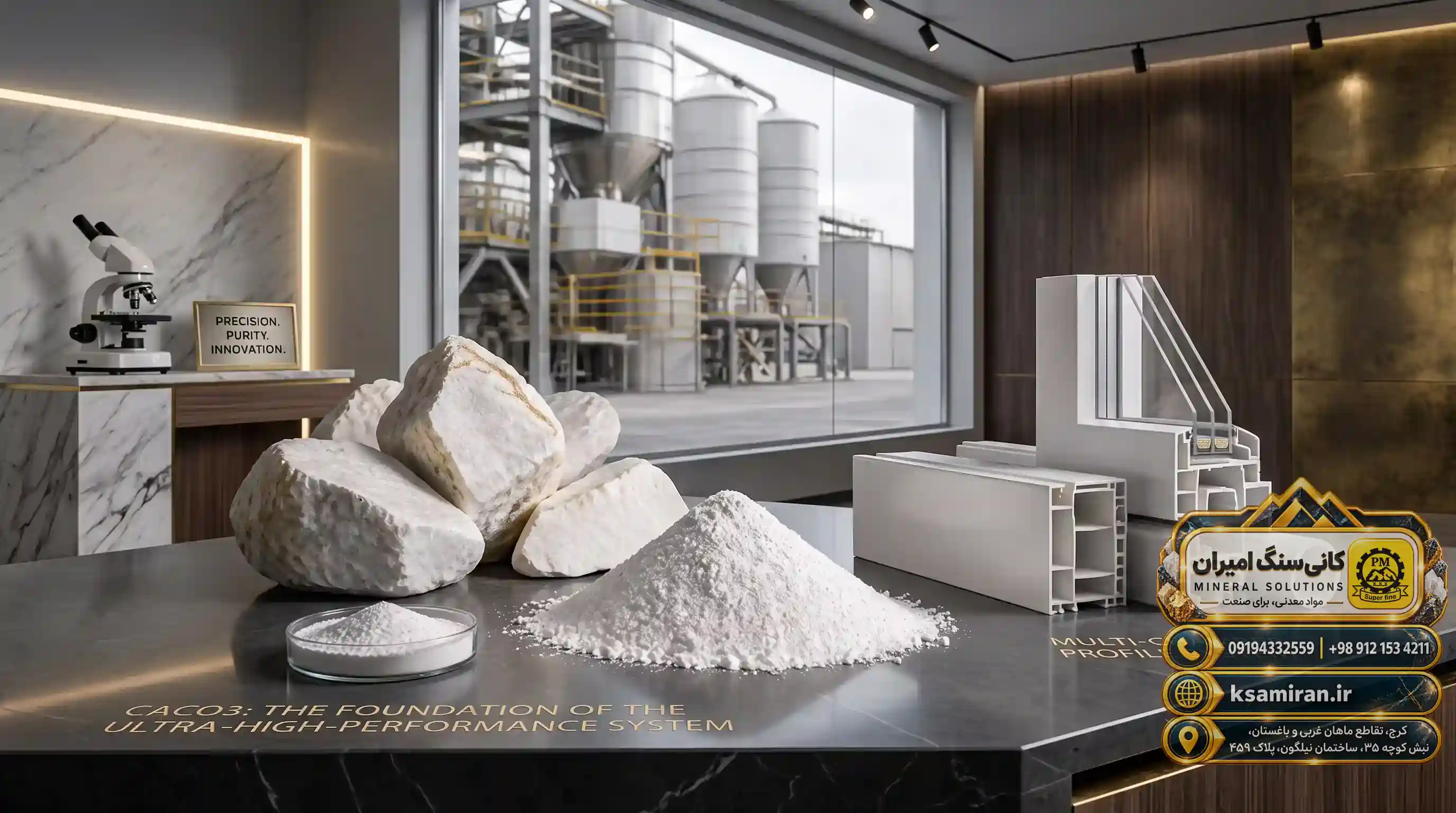
What is calcium carbonate? This question is of great importance to anyone dealing with the construction, polymer, paint, and paper industries, because calcium carbonate with the chemical formula CaCO3 is one of the most abundant mineral compounds on Earth and at the same time the most widely used filler material in the global industry. This white compound is found naturally in limestone, marble, mountain gypsum, and calcite deposits, and humans have long used it as a construction raw material. Today, with the advancement of processing technology, calcium carbonate is no longer a simple raw stone; rather, it is an engineered additive whose particle size, particle size distribution, whiteness, oil absorption, and purity can be adjusted based on the needs of each industry.
In mode construction industries, this material is not just a cheap filler, but a factor that directly affects the strength, dimensions, appearance, and final cost of the product. From UPVC window profiles and water transmission pipes to paint, paper, adhesive, and artificial stone, the presence of calcium carbonate can be seen in the formulation of dozens of everyday products. Alongside this material, other minerals also play a role in the construction industry; to lea more, you can read the article What is the Important Application of Dolomite in Construction and Manufacturing Industries.
The widespread acceptance of calcium carbonate by industries can be summarized in several key factors:
- Abundance of mines and consequently stable and competitive prices compared to other raw materials
- High whiteness, which reduces the need for expensive pigments
- Appropriate chemical and thermal stability in production processes
- Ability to produce in a very wide particle size range from 100 to 3500 mesh
- Reduction of formulation cost without a significant drop in product quality
- Compatibility with polymers, resins, solvents, and aqueous systems
In the rest of this article, we will first examine the structure, types, and production methods of calcium carbonate, then review the technical properties that make this material suitable for engineering applications, and finally explain in detail its main applications in PVC/UPVC profiles and pipes, masterbatch, cable, artificial leather, paint, paper, adhesive, and engineered stone. This comprehensive review will help you make a more informed decision about choosing this mineral in your production lines and understand why leading manufacturers choose calcium carbonate for polymer, paint, paper, and engineered product applications.
Chemical Structure, Types, and Production Methods of Calcium Carbonate
Chemically, calcium carbonate is a salt composed of calcium and carbonate ions, represented by the formula CaCO3. In the crystal structure of this compound, calcium and carbonate ions form a regular network that crystallizes in three main crystalline forms: calcite, aragonite, and vaterite. Among these three forms, calcite is the most stable and common form, and most commercial mines consist of this type. The difference between these structures lies in their atomic arrangement, which affects the density, hardness, and optical behavior of the particles.
In industry, calcium carbonate is divided into two general categories. The first type is Ground Calcium Carbonate (GCC), which is obtained by crushing and grinding limestone and is offered in different meshes after classification. The second type is Precipitated Calcium Carbonate (PCC), which is produced through chemical processes and the reaction of calcium hydroxide with carbon dioxide gas, and its particles have a much more uniform shape, size, and distribution. Each of these two methods creates products with different applications; however, in the construction and polymer industries, GCC has a larger share due to its lower cost and high production volume.
The production stages of ground calcium carbonate usually include the following:
- Extracting limestone from the mine and transporting it to the processing plant
- Primary and secondary crushing to reduce the size of the pieces
- Grinding in ball or vertical mills along with air classification
- Controlling the final particle size and reaching the desired mesh
- Surface coating of particles with fatty acids such as stearic acid for polymer applications
- Packaging and preparation for shipping to various industries
One of the most important production features of this material is the ability to offer it in a very wide mesh range. Calcium carbonate is produced in sizes from 100 to 3500 mesh, and each industry chooses the appropriate mesh based on its needs. For example, in paint and paper making, finer sizes are preferred due to the need for gloss, surface uniformity, and higher opacity, while in some structural applications and general fillers, coarser sizes are used to control viscosity and reduce price. This flexibility in production is the main reason for the penetration of calcium carbonate into various industrial sectors.
Alongside size control, manufacturers also closely monitor the level of impurities such as silica, iron, magnesium, and colored compounds, because these elements can negatively affect the whiteness, wear of machinery, and chemical behavior of the final product. For this reason, processing calcium carbonate is a specialized task requiring an equipped laboratory and continuous quality control so that every shipment reaches the customer with identical specifications.
Technical and Qualitative Properties of Calcium Carbonate in Industrial Applications
To understand why calcium carbonate holds such a prominent place in the construction and manufacturing industries, we must properly understand its technical properties. These properties determine in which application a product performs well and where it should not be used. The most important properties of calcium carbonate are:
- Whiteness and brightness: High-quality calcium carbonate has high whiteness, and this property becomes critically important in paint, paper, and masterbatch, as it reduces the consumption of expensive pigments.
- Particle size and distribution: The 100 to 3500 mesh range allows for precise selection based on application needs. Finer particles give a smoother surface and better dispersion.
- Chemical stability: It is stable against moisture, light, and common chemicals, and performs well in exterior products such as window profiles.
- Thermal stability: It withstands the process temperatures of polymers and papermaking without changing color.
- Relatively low hardness: The hardness of calcite is low on the Mohs scale, causing less wear on production machinery and molds.
- Low oil absorption: Low oil absorption leads to lower consumption of resin, solvent, and adhesive in the formulation.
- Economical price: Compared to pigments and resins, it is very cost-effective and lowers the final cost of the product.
Each of these properties plays a specific role in the formulation. For instance, in paint, the combination of high whiteness and appropriate particle size allows titanium dioxide pigment to spread better on the surface, increasing paint coverage. In UPVC profiles, thermal and chemical stability contribute to the product's durability against weather conditions, and in papermaking, opacity and brightness help the final product achieve high print quality.
It should be noted that these properties are not constant and vary depending on the raw material mine and the production process. For this reason, professional manufacturers control their product through specific tests such as particle size analysis with a standard sieve or laser device, measuring whiteness, determining oil absorption, and chemical analysis. The buyer should also test the sample in their own production line before purchasing in high volume to ensure the product specifications match their formulation. This alignment is the key to successful use of calcium carbonate in any industry.
Application of Calcium Carbonate in PVC/UPVC Profiles and Pipes
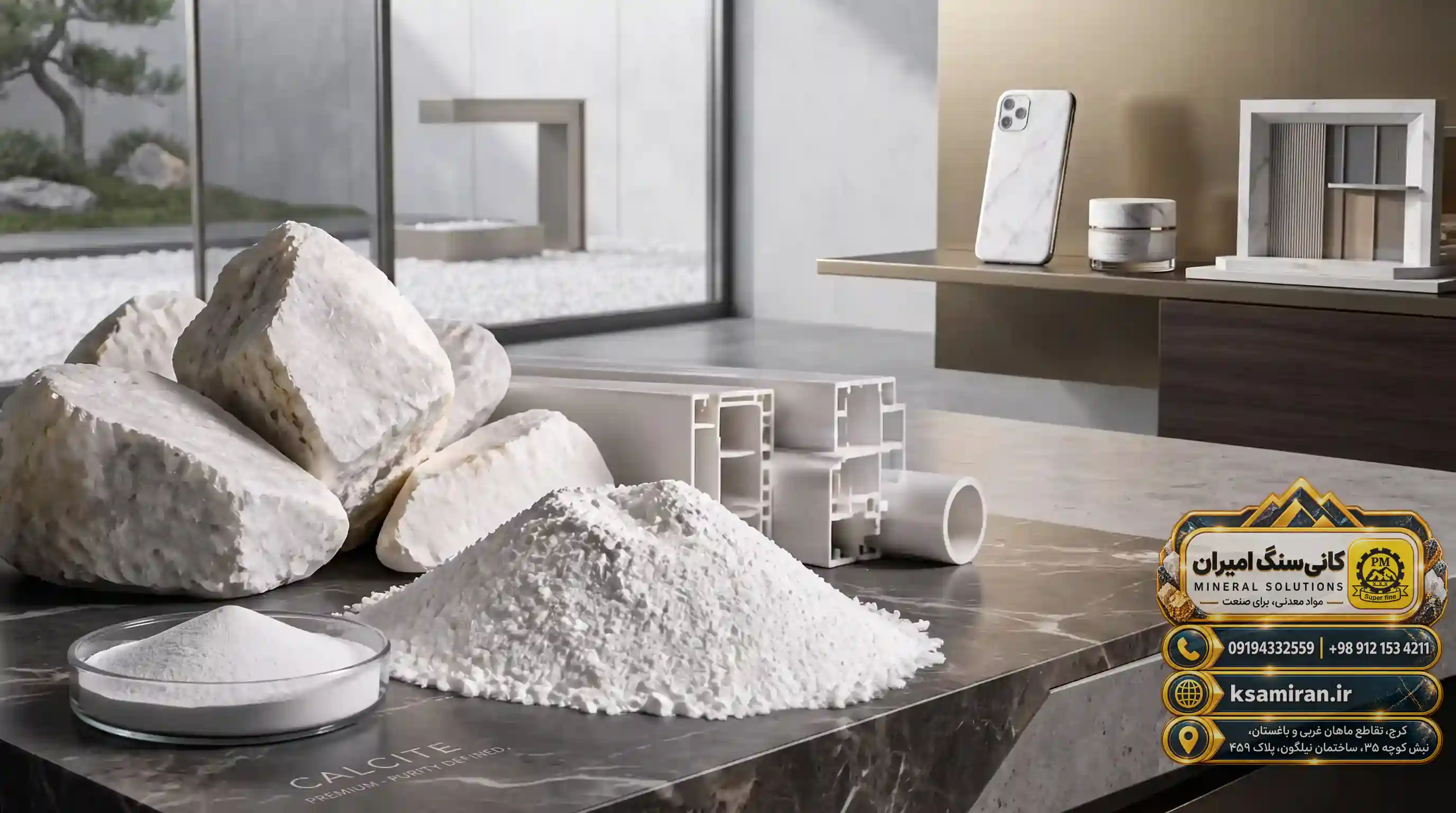
One of the largest consumer markets for calcium carbonate in the world is the PVC and UPVC profile and pipe industry. Window profiles, doors, facades, water and sewer transmission pipes, cable coverings, and polymer fittings all contain significant amounts of this mineral. The reason for this high consumption is a combination of technical and economic advantages that calcium carbonate brings to PVC formulations.
The most important role of calcium carbonate in PVC profiles is acting as a functional filler. By occupying volume in the mixture, this material increases the strength, stiffness, and hardness of the profile while simultaneously significantly reducing the product's weight. This property is very important for UPVC window profiles, which must be produced in large, durable dimensions. In addition, calcium carbonate helps improve dimensional stability during the extrusion process, reduces shrinkage after exiting the mold, and increases resistance to deformation caused by heat.
Economically, calcium carbonate is one of the most effective ways to reduce the final cost of profiles and pipes, as it replaces part of the expensive PVC resin. However, its use requires precision; the particles must be well dispersed in the mixture to minimize the loss of impact resistance. For this reason, for polymer applications, grades coated with fatty acids are typically used, which blend better with the polymer melt and create uniform dispersion.
The following factors are decisive in selecting calcium carbonate for PVC/UPVC profiles and pipes:
- Appropriate particle size for a smooth surface and desirable appearance
- High whiteness for light profiles and light colors
- Low abrasive impurities such as silica to protect machinery and molds
- Uniformity of specifications across different shipments for production line stability
- Type of surface coating compatible with the resin and stabilizer system
In UPVC pipes, calcium carbonate is also used as a structural filler. Water transmission, sewer, and cable-covering pipes utilizing this material have lower production costs while maintaining the necessary strength. The inteal surface quality of the pipe, which is important for smooth fluid flow and preventing sedimentation, depends heavily on the particle size and dispersion of the calcium carbonate. Therefore, choosing a supplier that performs strict quality control is critically important in this industry.
The Role of Calcium Carbonate in Masterbatch, Cables, and Artificial Leather
In addition to profiles and pipes, calcium carbonate plays a key role in several other advanced polymer industries. Masterbatch, cables, and artificial leather are three examples of these applications, each with different technical requirements, yet all benefiting from the properties of this mineral.
Masterbatch: Masterbatch is a method of distributing additives in polymers in which pigments and fillers are mixed concentratedly in a polymer carrier. Calcium carbonate acts as a filler and dispersion aid in masterbatches. By occupying volume, it lowers the final cost of the masterbatch while helping to better disperse pigments so the final color appears more uniform. For this application, a fine and uniform particle size is essential so that pigments open up well and the final product surface looks smooth and clean. In white masterbatches, calcium carbonate with high whiteness proves itself well and meets part of the need for titanium dioxide.
Cable: In the cable industry, calcium carbonate is used in cable insulation and covering compounds. This filler improves the mechanical strength, hardness, and dimensional stability of the insulation and cover, while keeping the cost of the compound low. In the cable production process, which involves high-speed extrusion, the uniformity of the melt flow and the stability of the filler's properties are very important. Calcium carbonate, with appropriate particle size and correct surface coating, creates good flowability in the extruder and contributes to the final surface quality of the cable. Also, the thermal resistance of this material against cable manufacturing process temperatures is a significant advantage.
Artificial leather: Artificial leather is usually made from polymers such as PVC and polyurethane, which are coated onto a base fabric. Calcium carbonate in this application acts as a soft filler, giving the product a more natural texture, pleasant touch, and leather-like appearance. This material helps control the viscosity of the polymer paste during the coating process, improves sealing and layer uniformity, and makes the artificial leather lighter and cheaper. It also contributes to the embossing and patteing capability on the leather surface, which is very important in the final appearance of bags, shoes, and interior coverings.
In all these applications, there is one common point: calcium carbonate should not be seen merely as a cheap material, but rather as a formulation component whose incorrect selection can affect the quality of the final product. This is why leading manufacturers carefully select calcium carbonate for polymer, paint, paper, and engineered product applications.
Application of Calcium Carbonate in Paint, Paper, and Adhesives
Paint: The paint industry is one of the oldest and largest consumers of calcium carbonate. In paint manufacturing, this material is known as an extender pigment; meaning its particles are placed alongside primary pigments like titanium dioxide and improve their dispersion on the surface. The result of this cooperation is increased paint hiding power, improved resistance to washing and abrasion, and a significant reduction in the final cost. In architectural paints, primers, stains, and decorative paints, calcium carbonate accounts for a significant volume of the formulation. For this application, whiteness, particle size, and oil absorption are three critical factors determining the final quality of the paint.
Paper: In papermaking, calcium carbonate is used both as a filler inside the paper pulp and as a surface coating pigment. As a filler, it fills the spaces between cellulose fibers, making the paper smoother, brighter, and more suitable for printing. As a coating pigment, it creates a layer on the paper surface that raises print gloss and image clarity. Using this material also reduces the consumption of wood fibers, which is a major economic and environmental advantage. For papermaking applications, very fine grades with high brightness and opacity are usually required.
Adhesive: In the adhesive and sealant industry, calcium carbonate acts as a structural filler. This material controls the viscosity of the adhesive, gives it thixotropic properties so it doesn't drip on vertical surfaces and ceilings, and fills the product volume in a way that lowers the price while achieving suitable mechanical properties. In construction adhesives, window sealants, wood glues, and carpet making, calcium carbonate is widely used due to its particle uniformity and compatibility with aqueous and solvent systems. The particle size here directly affects the final texture and surface quality of the dried adhesive.
In all three applications above, the following shared factors are important:
- Uniformity of particle size in every shipment for formulation stability
- Whiteness control for light products
- Low colored and metallic impurities
- Adjusting oil absorption to the formulation's needs
- Easy dispersion in aqueous and solvent systems
Therefore, it can be said that paint, paper, and adhesives are three areas where calcium carbonate not only reduces costs but also enhances the quality of the final product. This is why high-quality and uniform calcium carbonate is chosen for these applications.
Calcium Carbonate in Engineered Stone and Engineered Products
Engineered stone, or artificial stone, is one of the most amazing examples of the use of calcium carbonate in mode construction industries. In these products, calcium carbonate is used as the main filler alongside polyester or acrylic resins and constitutes the bulk of the artificial stone's volume. The combination of these two materials creates a product that has the appearance of natural stone and offers engineered advantages such as color uniformity, absence of seams and cracks, moldability, and lighter weight.
In artificial stone, calcium carbonate plays multiple roles. First, it fills the product volume and drastically lowers the final cost, as it replaces a large portion of the expensive resin. Second, it increases compressive strength, hardness, and the abrasion resistance of the surface, which are vital for cabinet, countertop, flooring, and building facade applications. Third, due to its high whiteness, it enables the production of light stones and light colors. Fourth, it improves the processability of the mixture, so that molding and vibro-compaction are performed better.
In addition to artificial stone, calcium carbonate is also used in other engineered products:
- Composite panels and interior building panels
- Injection-molded and extruded engineered parts
- PVC and mineral polypropylene floorings
- Cement and gypsum products to control setting time and texture
- Building insulations and foams
Alongside calcium carbonate, other minerals play a complementary role in building materials; for example, industrial talc, due to its layered structure and lubricating properties, has special applications in the gypsum and building materials industries. To read more on this topic, read the article The Role of Industrial Talc in Gypsum and Building Materials Industries.
In engineered products, choosing the right grade of calcium carbonate depends on the production process and the desired final properties. In injection-molded parts, particles must be fine enough to create a smooth surface and minimize wear on molds and machinery. In artificial stone, particle size distribution is important because the stone's texture must look natural and uniform. In cement and gypsum products, chemical reactivity and particle size affect the setting time and final strength. For this reason, engineered stone manufacturers usually work with suppliers capable of providing different grades and strict quality control.
Guide to Choosing Calcium Carbonate and Conclusion
Choosing the right calcium carbonate for any application is a decision that must be made based on technical data and production line needs. In the market, various products with different meshes and grades are offered, and making the wrong choice can lead to quality loss, increased resin consumption, machinery wear, or visual defects in the final product. In this chapter, we review the key selection criteria.
1. Choosing the right mesh: The mesh must be aligned with the final application. For paint, paper, and masterbatch, finer grades are usually preferred to achieve gloss and surface uniformity. For structural fillers like profiles, pipes, and artificial stone, coarser and mid-range meshes can better manage viscosity control and price. Calcium carbonate is produced in the 100 to 3500 mesh range, and this breadth allows adaptation to various needs.
2. Attention to whiteness and purity: The higher the whiteness, the more suitable it is for light products and light colors. Chemical purity is also important; silica, iron, and magnesium compound impurities can negatively affect the color, abrasion, and chemical behavior of the product. Just like other industrial minerals whose quality is controlled by specific standards; for example, Silica Quality Standards in Mode Manufacturing Industries shows how important quality control is in selecting raw materials.
3. Uniformity and supply stability: One of the most important criteria is product uniformity across different shipments. Changes in particle size or whiteness between shipments can cause fluctuations in the production line. A supplier with an equipped laboratory and continuous quality control guarantees this stability.
4. Appropriate surface coating: For polymer applications such as PVC profiles, masterbatch, and artificial leather, surface coating of particles with fatty acids improves dispersion. You must ensure the selected grade is compatible with your resin and additive systems.
5. Sample testing: Before purchasing high volumes, the sample must be tested in your own formulation. Parameters such as dispersion, effect on melt flow, final surface, and strength should be evaluated.
In conclusion, calcium carbonate is a material that, by combining competitive price, abundance, and suitable technical properties, has secured a place in a broad sector of mode construction industries. From PVC/UPVC profiles and pipes to masterbatch, cable, artificial leather, paint, paper, adhesives, and engineered stone, this mineral is recognized as a formulation component that not only reduces costs but also enhances the quality of the final product. If you are looking for suitable calcium carbonate for polymer, paint, paper, and engineered product applications, you can use the technical consultation and product Calcium Carbonate from Kani Sang Amiran Project.
| Question | Answer |
|---|---|
| What is calcium carbonate? | A mineral compound with the chemical formula CaCO3, found in nature in limestone, marble, and mountain gypsum, widely used as an industrial filler. |
| In which industries is calcium carbonate used? | PVC/UPVC profiles and pipes, masterbatch, cable, artificial leather, paint, paper, adhesives, and engineered stone. |
| What is the mesh range of calcium carbonate? | From 100 mesh to 3500 mesh depending on industry needs and final application. |
| What is the difference between GCC and PCC? | GCC is obtained by grinding limestone, while PCC comes from a chemical precipitation process and has more uniform particles. |
| Why is calcium carbonate used in PVC profiles? | To increase stiffness and strength, improve dimensional stability, reduce shrinkage, and lower the final cost. |
| What role does calcium carbonate play in paint? | It acts as an extender pigment and improves hiding power, wash resistance, and paint surface quality. |
| What is the application of calcium carbonate in papermaking? | As a filler and coating pigment to increase brightness, opacity, surface smoothness, and printability of paper. |
| How is calcium carbonate used in artificial stone? | As the main filler alongside resin to create strength, hardness, natural texture, and reduce product cost. |
| What are the safety considerations when handling calcium carbonate? | This material is generally considered safe, but when working with the powder, a respiratory mask and proper ventilation should be used to prevent inhalation of suspended particles. |
| How to choose the right calcium carbonate? | Based on application needs: appropriate mesh, whiteness, chemical purity, type of surface coating, and quality uniformity across shipments. |
The information in this article was collected from the technical sources of the Kani Sang Amiran Project (ksamiran.ir).
برچسب: Calcium Carbonate,What is Calcium Carbonate? Key Applications in Modern Construction Industries,
نویسنده: رساوب آفرین