
درباره سایت
آخرین مطالب
- Why is choosing Limonite Oxide (Gole Mash) important for industries?
- چگونه بهترین فرمولاسیون با اکسید لیمونیت (گل ماش) بسازیم؟
- لماذا يعد اختيار أكسيد الليمونيت (أوكر أصفر/كلماش) مهماً للصناعات؟
- دور أكسيد الليمونيت (الجول ماش) في إنتاج الطوب والفخار
- Examining the Effect of Limonite Oxide (Gol Mash) on Color Stability
- مراجعة مزايا الشراء بالجملة لأكسيد الليمونيت (غل ماش)
- دور أكسيد الليمونيت (الغل ماش) في الصناعات الدوائية ومستحضرات التجميل
- بررسی میزان سختی و سایش اکسید لیمونیت (گل ماش)
- Application of Limonite Oxide (Gole Mash) in Anti-Rust Industries
- نقش اکسید لیمونیت (گل ماش) در تولید پوششهای محافظ
امکانات وب
Introduction: Why is determining the purity of red iron oxide (ochre) important in the laboratory?
Red iron oxide (ochre) with the chemical formula Fe₂O₃ is one of the world's most important mineral pigments, which has found a special place in industries due to its color stability, light and heat resistance, and reasonable price. This product is introduced in the Kani Sang Amiran production unit for pigment, coating, cement, and ceramic product applications, and its final quality directly depends on the purity of the raw material.
Purity in red iron oxide is not just a number on a test sheet; it is a set of chemical, phase, and physical indicators that determines whether this material works correctly in your formulation or not. Total iron percentage, amount of divalent iron oxide (FeO), presence of impurity phases such as magnetite and goethite, particle size distribution, and the amount of water-soluble salts all form part of the overall picture of purity.
In pigment and coating applications, impurities such as silica, alumina, and calcium cause color dulling, reduced tinting strength, and defective spots on the coating surface. In the cement industry, the excessive presence of soluble ions and sulfates can disrupt setting time and the hydration process. In ceramic products, metallic impurities and volatile materials cause blistering, glaze color changes, and even cracking during firing.
Therefore, the laboratory must be able to measure the purity of this material quantitatively and reliably so that the production line makes decisions based on real data. These decisions include accepting or rejecting a shipment, adjusting the color formulation, selecting a supplier, and controlling kiln temperature changes. Without accurate testing, companies are forced to rely on sellers' claims, which can lead to rework, financial loss, and a decline in final product quality.
The purpose of this article is to provide a practical and comprehensive guide for determining the purity of red iron oxide (ochre) in the laboratory. In the upcoming chapters, we will review classical titration methods, instrumental methods such as XRF and XRD, particle size tests, and practical color indicators in simple language and with practical details so that every laboratory can choose its suitable method.
Understanding the structure and purity indicators of red iron oxide (ochre)
To design a purity test correctly, we must first know what we are measuring. Red iron oxide (ochre) in its pure form is trivalent iron oxide with a hematite crystal structure (hematite, trigonal oxide group). This structure gives the material a red to reddish-brown color, high density, and significant chemical stability. Any other iron phase or accompanying minerals reduces the actual purity of the product.
One of the most important physical characteristics of this product is the mesh range. The red iron oxide produced by Kani Sang Amiran is offered in the 450 to 1500 mesh range; meaning very fine particles, almost in the range of under 30 microns to a few microns. This fineness of particles is essential for pigment and coating applications, as it increases tinting strength and coating uniformity, but at the same time it raises the chemical reactivity of the sample in the lab, which is why precise control of test conditions becomes important.
Impurities commonly found in natural or synthetic red iron oxide include silica (SiO₂), alumina (Al₂O₃), calcium and magnesium (CaO and MgO), manganese, titanium, sulfate and chloride compounds, moisture, and sometimes organic matter. These impurities may enter the product from the parent ore, the production process, or the drying and packaging method. Identifying the origin of each helps in choosing the appropriate test method.
From a color perspective, high purity is usually associated with a brighter and more transparent red color, although color alone is not a definitive criterion. Lightening impurities such as silica and alumina cause the color to become dull and grayish, while the presence of magnetite or goethite phases makes the color dark and brownish or black. For this reason, colorimetric tests must be complemented by chemical analysis.
Purity can be defined at three levels: chemical purity (mass percentage of total Fe₂O₃ versus other oxides), phase purity (share of the hematite phase versus other crystalline phases), and functional purity (product behavior in the final application, such as tinting strength or dispersion in cement). A professional laboratory evaluates all three levels; a product may be chemically acceptable but perform poorly in application due to improper particle size distribution or caking.
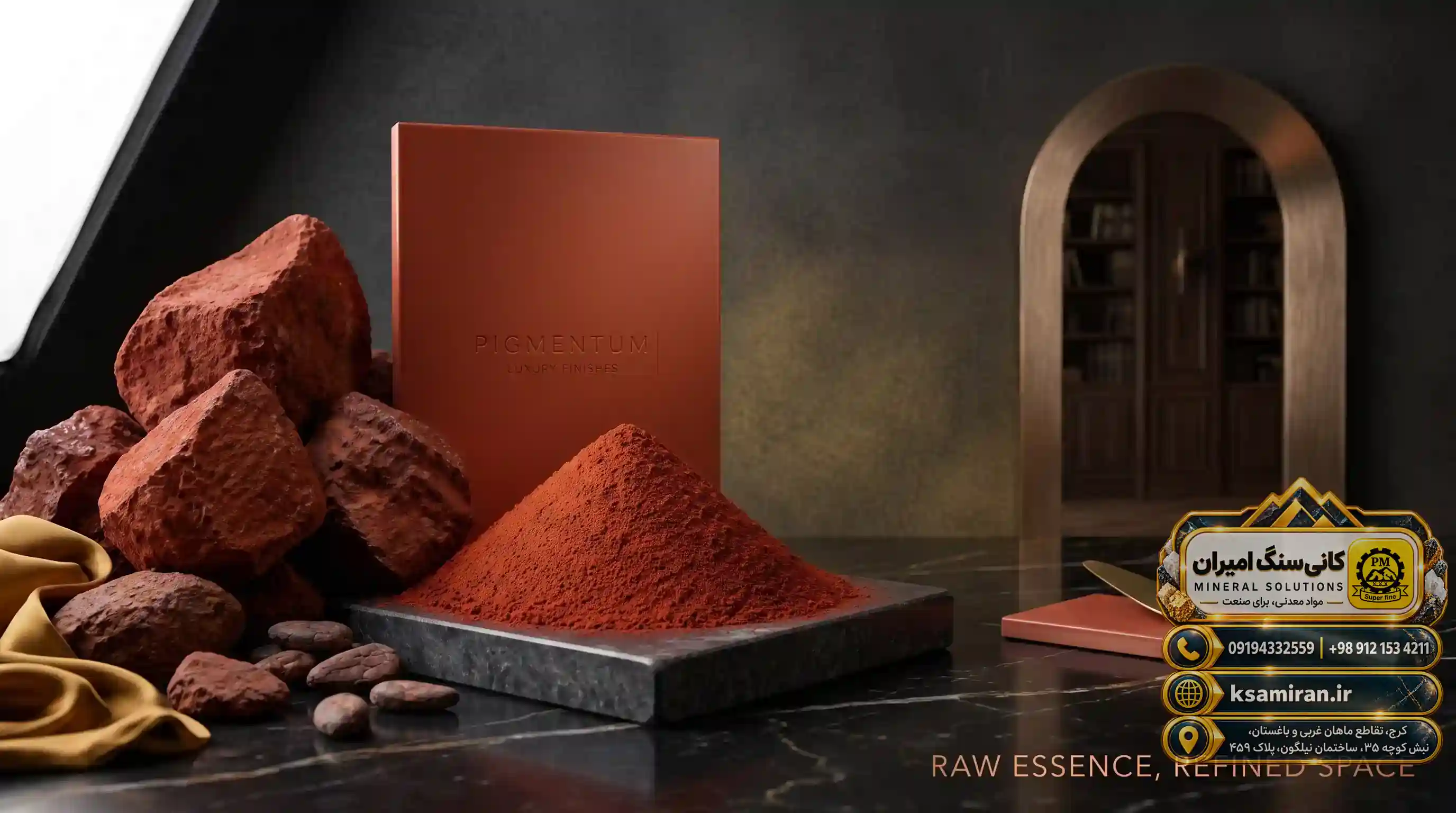
Sampling and sample preparation for purity testing
Even the most accurate test method, if performed on an incorrect sample, gives a misleading result. Sampling of red iron oxide (ochre) must be representative of the entire shipment, as this fine powder in the 450 to 1500 mesh range has a high tendency for stratification and caking. It is recommended to take samples from several different points of the package or silo and then mix and homogenize them.
The common method is multiple sampling and then coning and quartering. In this method, the powder is poured onto a clean surface, mixed, and formed into a cone, then divided into four equal parts with a spatula, and two opposite parts are discarded. This is repeated until the sample volume reaches the amount required for the test. Using a sample splitter increases accuracy.
If the sample has caked, it should be gently crushed. For this, use a non-metallic mortar such as porcelain or agate so that metallic particles do not enter the sample; iron contamination from a steel mortar can falsely show a high iron percentage. Then pass the sample through an appropriate sieve to separate caked particles and foreign materials. For more information on preventing this phenomenon, read the article Preventing caking of red iron oxide (ochre).
Moisture is one of the common errors in purity measurement, as water replaces the dry material and lowers the iron percentage. To determine moisture, weigh about 2 to 5 grams of the sample in a container of known weight and dry it at 105°C for two to three hours, then cool it in a desiccator and weigh it again. The weight difference is the sample's moisture, and chemical results should be reported based on dry weight.
Keep the prepared sample in airtight, moisture-proof containers and label it with the ID, sampling date, package number, and supplier name. Recording this information makes it easy to track results and compare different shipments. It is also better to always keep a reference sample of previously accepted shipments so that you have a quick comparison in case of conflicting results.
Method 1: Determination of total iron by dichromate titration
The most classic and accessible method for determining the purity of red iron oxide (ochre) is potassium dichromate titration to determine total iron. The principle of this method is simple: all the iron in the sample is first reduced to the divalent state (Fe²⁺), then oxidized with a standard potassium dichromate solution (K₂Cr₂O₇), and the consumed volume is equivalent to the amount of iron.
The procedure is as follows: accurately weigh about 0.5 grams of the dry sample and dissolve it in concentrated hydrochloric acid with gentle heating. Since hematite dissolves slowly in acid, adding some dilute hydrochloric acid and heating on a sand bath accelerates dissolution. If white insoluble particles remain, it indicates silica and silicate impurities, which should be separated by filtration and weighed as acid-insoluble residue.
After dissolution, dilute the solution and reduce it dropwise with staous chloride (SnCl₂) until the pale yellow color of Fe³⁺ disappears. To remove the excess drop of tin, a mercury indicator (HgCl₂) is added, which gives a white precipitate of mercury oxide. Then add phosphoric and sulfuric acids and titrate with standard dichromate, in the presence of sodium diphenylamine sulfonate indicator, until a stable purple color change. Based on stoichiometry, one mole of dichromate is equivalent to six moles of iron, and the percentage of Fe₂O₃ is calculated from the mass formula.
In newer methods, due to environmental conces regarding mercury, mercury-free reducing agents such as titanium trichloride (TiCl₃) or electrochemical reduction are used. Also, instead of dichromate, EDTA can be used in the complexometric titration method, which is easier to control. The choice of method depends on the laboratory's equipment and inteal standards.
The main sources of error in this method are: aerial oxidation of divalent iron before titration (the best practice is rapid titration or working in an inert atmosphere), incomplete reduction of trivalent iron, spilling of the excess tin solution which causes excessive dichromate consumption, and error in standardizing the chromium solution. Repeating each test at least twice and reporting the average increases confidence in the result. Chromium- and mercury-containing waste must be collected in special containers and never discharged into the public sewer.

Method 2: Determination of FeO, acid-insoluble residue, and specific impurities
In pure red iron oxide (ochre), the iron should be almost entirely trivalent. The significant presence of divalent iron (FeO) indicates that the product has either been contaminated with other iron phases such as magnetite (Fe₃O₄) and wüstite, or has been over-reduced during the production/drying process. For this reason, measuring FeO is a complementary and very important indicator for phase purity.
The classical method for determining FeO is to dissolve the sample in a neutral atmosphere (CO₂ or N₂ gas flow) in hydrochloric acid so that the divalent iron is not oxidized, then immediately titrate the solution with a standard potassium dichromate or potassium permanganate solution. Working under an inert gas flow is mandatory, otherwise atmospheric oxygen will oxidize Fe²⁺ and falsely lower the result.
The acid-insoluble residue test also provides useful information. After dissolving the sample in hydrochloric acid, the insoluble materials (mostly silica, quartz, and silicates) are collected on an ashless filter, washed with hot water, ignited in a fuace, and weighed. The percentage of insoluble residue gives a preliminary estimate of the total silicate impurities and can be confirmed by instrumental methods.
For specific impurities, rapid tests also exist. Sulfate with a barium chloride solution in an acidic medium gives a white precipitate of barium sulfate. Chloride with silver nitrate gives a white precipitate of silver chloride. Calcium and magnesium, after separating the iron, are titrated with EDTA. These rapid tests are suitable for the daily control of incoming factory shipments, and if an anomaly is observed, the sample is sent for more accurate instrumental analysis.
The interpretation of these results is combined: a high-quality red iron oxide should have a high total Fe₂O₃ percentage, a very low FeO percentage, low acid-insoluble residue, and minimal sulfate and chloride. This information package, along with particle size, allows the buyer and producer to judge the shipment's quality logically and defensibly, and if needed, adjust formulation settings accordingly.
Method 3: Instrumental analysis XRF, ICP, XRD, and particle size
Instrumental methods are nowadays the backbone of red iron oxide (ochre) quality control, as they are fast, multi-element, and relatively independent of the operator's skill. One of the most widely used is X-ray fluorescence (XRF). In this method, the powder sample, after homogenization, is prepared as a pressed powder or fused bead and placed in the instrument. Stimulated X-rays give a specific spectrum of elements, and the intensity of the spectral lines is equivalent to the concentration of each element.
The main advantage of XRF is its speed: a full analysis is done in a few minutes and simultaneously covers Fe, Si, Al, Ca, Mg, Mn, Ti, and S. This method is very suitable for daily shipment control and production process monitoring. Its limitation is its dependence on the matrix and the need for calibration with reference materials; therefore, the laboratory must have standard samples with known composition on hand and periodically review the calibration curve.
For higher accuracy in trace elements, ICP-OES or atomic absorption spectroscopy (AAS) is used. In these methods, the sample must be completely dissolved in acid and usually diluted. The accuracy of these methods at the ppm level is very good for impurities such as heavy metals, sulfates, and chlorides, and is used to confirm XRF results and resolve disputes between supplier and buyer.
X-ray diffraction (XRD) is the only method that directly identifies crystalline phases. This method determines what percentage of the sample is actually hematite and how much consists of other phases such as magnetite, goethite, siderite, or quartz. For phase purity evaluation, XRD is complementary to chemical titration; because the total iron percentage may be good, but part of it may be in an impurity phase that behaves differently in application.
Finally, particle size analysis is part of physical purity control. The product is offered in the 450 to 1500 mesh range, which includes very fine particles. The wet sieve method (washing the sample over a standard sieve and weighing the residue) is traditional and reliable, while laser diffraction is faster and provides more complete information on particle distribution. The measurement must be done by preventing particle caking (using appropriate dispersing agents), as due to the high specific surface area, the particles tend to stick together.
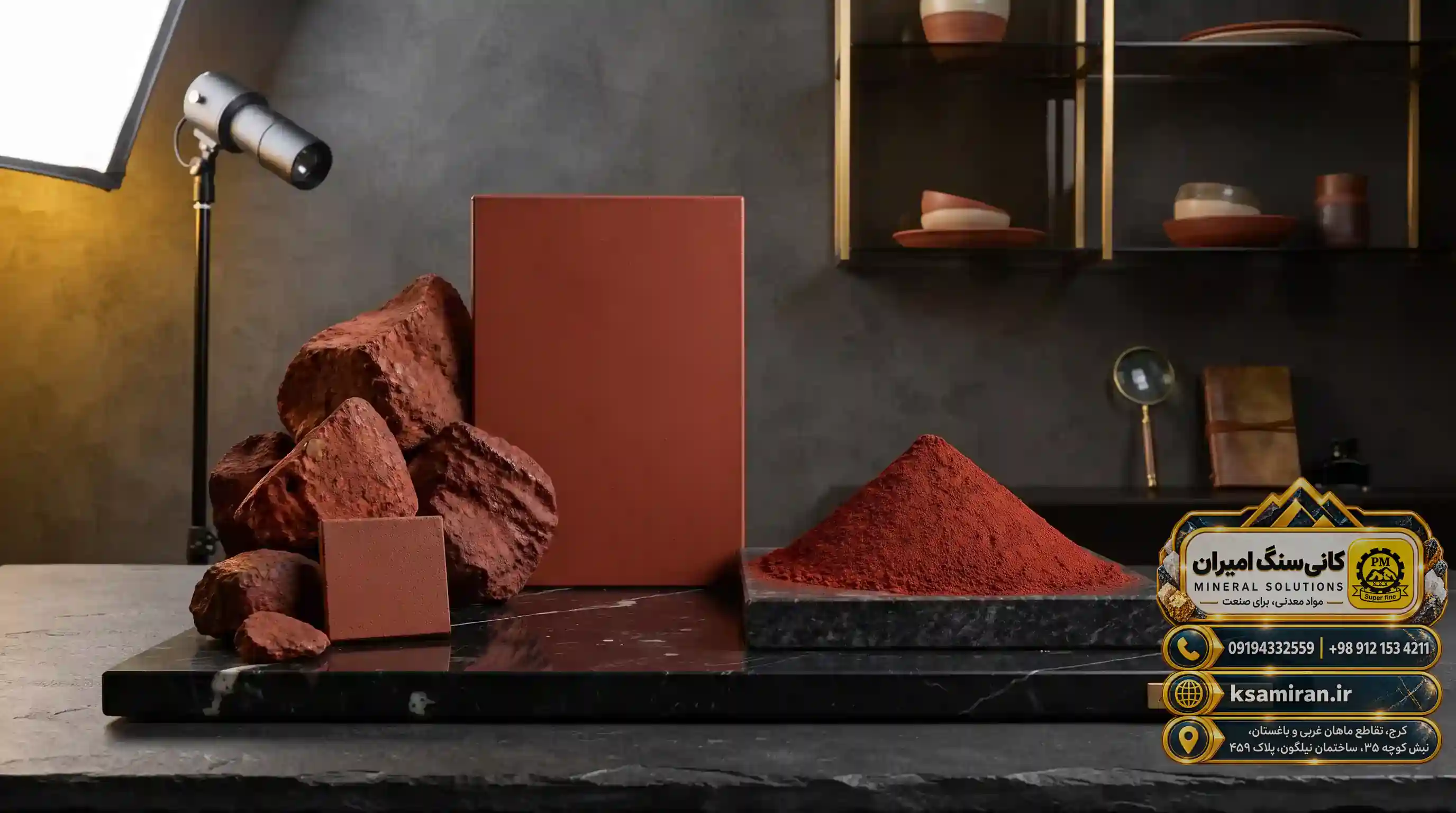
Functional purity indicators: color, oil absorption, and behavior in cement and ceramics
In addition to chemical indicators, the purity of red iron oxide (ochre) must also be evaluated functionally. The most important functional indicator is color, which is measured with a colorimeter in the CIE L*a*b* system. In this system, a* indicates red color intensity, b* yellow color intensity, and L* lightness. A pure product usually has a high a* and a medium L*. The measurement must be performed on a paste or compressed powder with the same thickness and conditions and compared against a reference sample.
Tinting strength is another indicator that shows how much color this pigment imparts to a system. The test method involves mixing a specific amount of the pigment with a white base color and comparing the final color with the standard sample. A product with lower tinting strength, even if its iron percentage is good, has more impurities or shows poor dispersion, resulting in the need for a larger amount of product.
Oil absorption is important for coating and pigment applications and shows how much oil 100 grams of the pigment absorbs to reach a uniform paste. This number is directly related to purity, particle shape, and specific surface area. A high oil absorption number can mean porous particles, absorbent impurities, or residual moisture, and raises formulation costs.
In cement applications, functional tests include measuring setting time and comparing the color of the dry mortar with a reference sample. The presence of sulfates and soluble salts can disrupt setting time. In ceramic products, the sample is added to a clear glaze or test body, and after firing, the color, uniformity, presence of blisters, and black spots are examined. Any irregularity in these observations is usually due to phase impurity or heavy metals.
To get acquainted with another important application, read the article Application of red iron oxide (ochre) in brick production. In brick production, too, pigment purity directly affects the uniformity of the brick's final color. The set of these functional indicators, alongside chemical analysis, provides a true picture of product quality and allows the producer to accept or reject shipments scientifically.
Interpreting results, test reports, and purchasing criteria
After performing the tests, the data must be converted into a coherent report. A professional test sheet for red iron oxide (ochre) includes these sections: sample information (ID, date, supplier), moisture and dry weight percentage, total Fe₂O₃ percentage by titration or XRF, FeO percentage, acid-insoluble residue, main impurities (Si, Al, Ca, S, Cl), particle size distribution (mesh or d50), and color indicators (L*a*b* and tinting strength).
In interpreting the results, attention should be paid to the correlation between the data. For instance, if the Fe₂O₃ percentage is high but the acid-insoluble residue is also high, iron-bearing silicates may be present. If FeO is high, the product has likely been over-reduced or contaminated with magnetite. If a* is low and L* is high, lightening impurities or excessively fine particles are involved. This cross-analysis helps in better decision-making.
It is recommended that every laboratory define its inteal threshold limits based on the needs of its applications. For pigment and coating applications, color and dispersion indicators are more important; for cement, setting behavior and soluble salts; and for ceramics, phase purity and post-firing uniformity. This hierarchy helps you make decisions based on the most important application if one of the indicators drops.
When selecting a supplier, pay attention to the details of the purchasing guide. A guide to buying high-quality, high-purity red iron oxide (ochre) can provide a roadmap for continuously evaluating suppliers. Also, to view product specifications and the 450 to 1500 mesh range, you can check the Red Iron Oxide (Ochre) page on the Kani Sang Amiran website.
Ultimately, purity is a stable process, not a one-time test. Establishing a periodic quality control system, keeping test records, comparing with reference samples, and continuously communicating with the producer ensures that shipment quality remains stable over time and your production line operates with minimal errors and maximum efficiency.

| Question | Short Answer |
|---|---|
| What is the most accurate method for determining the purity of red iron oxide? | Combining dichromate titration for total iron with XRD for phase purity gives the most complete result. |
| Can purity be determined by color alone? | Color alone is not sufficient; it must be complemented by chemical analysis, but a color change can be a sign of impurity. |
| What is the difference between 450 and 1500 mesh? | Higher mesh means finer particles; 1500 mesh is the finest state, which is more suitable for delicate pigments. |
| Why should FeO be low? | High FeO indicates contamination with other iron phases or over-reduction during production. |
| Is XRF sufficient for daily control? | Yes, with proper calibration and standard samples, XRF is a fast and reliable method. |
| What does acid-insoluble residue indicate? | Mostly silica and silicates that are not soluble in acid, and it is one of the indicators of the product's mineral impurity. |
| How to prevent sample caking? | Storing in moisture-proof packaging and keeping the sample dry is the primary measure. |
| Why is purity important for cement? | Soluble impurities and sulfates can change the setting time and color quality of the cement. |
| How does moisture affect the result? | Water replaces the dry material and falsely lowers the iron percentage; results must be based on dry weight. |
| How to choose a good supplier? | By continuously reviewing laboratory results, phase purity, color indicators, and mesh range according to the application. |
The methods in this article are based on standard principles of iron chemical analysis (dichromate titration, XRF, and XRD) and technical information about the red iron oxide (ochre) product on the Kani Sang Amiran project website (ksamiran.ir).
برچسب: Red Iron Oxide (Ochre),How to determine the purity of red iron oxide (ochre) in the laboratory?,
نویسنده: رساوب آفرین