
درباره سایت
آخرین مطالب
- انتخاب اکسید آهن قرمز (اخرا) برای بهبود کیفیت پیگمنت و پوششهای رنگی
- تامین کربنات کلسیم با دانهبندی دقیق جهت استفاده در مستربچ
- تأمین تخصصی سیلیس برای مصالح ساختمانی، شیشه و صنایع سرامیک
- ویژگیهای فنی بنتونیت کانی سنگ امیران برای کاربردهای خاص
- فلدسپات کانی سنگ امیران برای شیشه کاشی و سرامیک
- کاربرد تالک سفید درجه یک در فرمولاسیون پیشرفته رنگ و محصولات کاغذی
- اکسید آهن قرمز (اخرا) کاربردی جهت تولید محصولات سرامیکی و پوشش
- مشخصات فنی اکسید آهن قرمز (اخرا) مناسب برای پوشش و تولید پیگمنت
- مشاوره تخصصی خرید کربنات کلسیم بر اساس نیاز دقیق صنعت شما
- انتخاب تالک سفید صنعتی مناسب برای تولیدات کاغذ و مستربچ
امکانات وب
What Is Industrial Talc and Why Does a Specialized Catalogue Matter?
Industrial talc is a natural mineral with a layered structure that, thanks to its high softness, light color, relatively low density and neutral chemical behavior, has become a strategic material in many industries. It is typically processed into a very fine powder and is used as a mineral filler, reinforcing agent and property modifier in the formulation of polymeric products, rubber, paint and other industrial products. Because of the wide variety in particle size distribution and purity, industrial talc must always be chosen according to the precise needs of each industry, and this is exactly where the importance of a specialized catalogue reveals itself.
A specialized industrial talc catalogue is a document in which the product's technical specifications are presented in a transparent, precise and reliable maer — from particle size distribution and mesh range to color, moisture, bulk density and packaging conditions. When a manufacturer puts this information at the customer's disposal, it effectively shifts the purchasing decision-making process from guesswork to data-driven analysis. By reviewing the catalogue, the buyer can assess how well the talc fits their production line, machinery and final product formulation.
Absence of a specialized catalogue carries serious risks. For example, a talc whose particle size distribution does not match the process requirement can cause a drop in final product quality, higher additive consumption, reduced production line speed and even damage to machinery. That is why professional buyers never register an order before receiving and reviewing the product's technical catalogue; they first match the technical information against their own requirements.
The Kani Sang Amiran Project, as an enterprise active in the production of mineral materials, supplies industrial talc in the 450 to 1000 mesh range for main applications including polymeric products, rubber products, paint and industrial products, and makes the specialized catalogue of this product available to interested buyers. Obtaining this catalogue is the first logical step toward understanding the product and matching it to your needs.
In the remainder of this article, we will fully examine the structure of a specialized industrial talc catalogue, the step-by-step way to obtain it, the information that should be checked inside it, and the key points for choosing the right talc for each industry, so that the path from “catalogue request” to “reliable mineral supply” becomes clear for you.
Technical Specifications of Industrial Talc and the 450 1000 Mesh Range
One of the most important parts of any specialized catalogue is the product's technical specifications. For industrial talc, the particle size distribution, or “mesh,” plays a decisive role in product selection. The mesh number indicates how fine the powder particles are; the higher the number, the finer the talc particles and the larger their total surface area. The industrial talc offered by the Kani Sang Amiran Project is produced in the 450 to 1000 mesh range — a range that covers the needs of a broad spectrum of industries.
In the polymeric and rubber industries, higher-mesh talc generally creates better dispersion in the polymer matrix and can help improve mechanical properties, reduce shrinkage and increase the dimensional stability of products. In the paint industry, finer talc acts as a filler that influences covering power, surface smoothness and coating durability. In general industrial products, choosing the right mesh depends on the formulation and the desired final output of the product.
In a specialized industrial talc catalogue, besides the mesh range, information such as the product's color and brightness, moisture content, bulk density and processing method is usually included. Bright talc color is vital for applications where the final appearance of the product matters — for instance, in the production of light-colored polymeric parts or light-based paints. Low moisture is also important to prevent the powder from caking and to maintain stability during the mixing process.
The bulk density of talc powder directly affects volumetric measurement, transfer systems and material dosing on the production line. For this reason, manufacturers of parts and mineral compounds usually factor bulk density into packaging, silo and weighing-equipment calculations. Obtaining a specialized catalogue helps you check these parameters before making a supply decision.
An important point is that industrial talc of different meshes is not necessarily “better” or “worse”; rather, it is engineered for different applications. The right choice means matching the product's specifications to the needs of your process, and this is impossible without studying a specialized catalogue. That is why requesting a catalogue is considered the first serious step in any industrial talc purchase inquiry.
Main Applications of Industrial Talc in the Polymer, Rubber, Paint and Other Industries
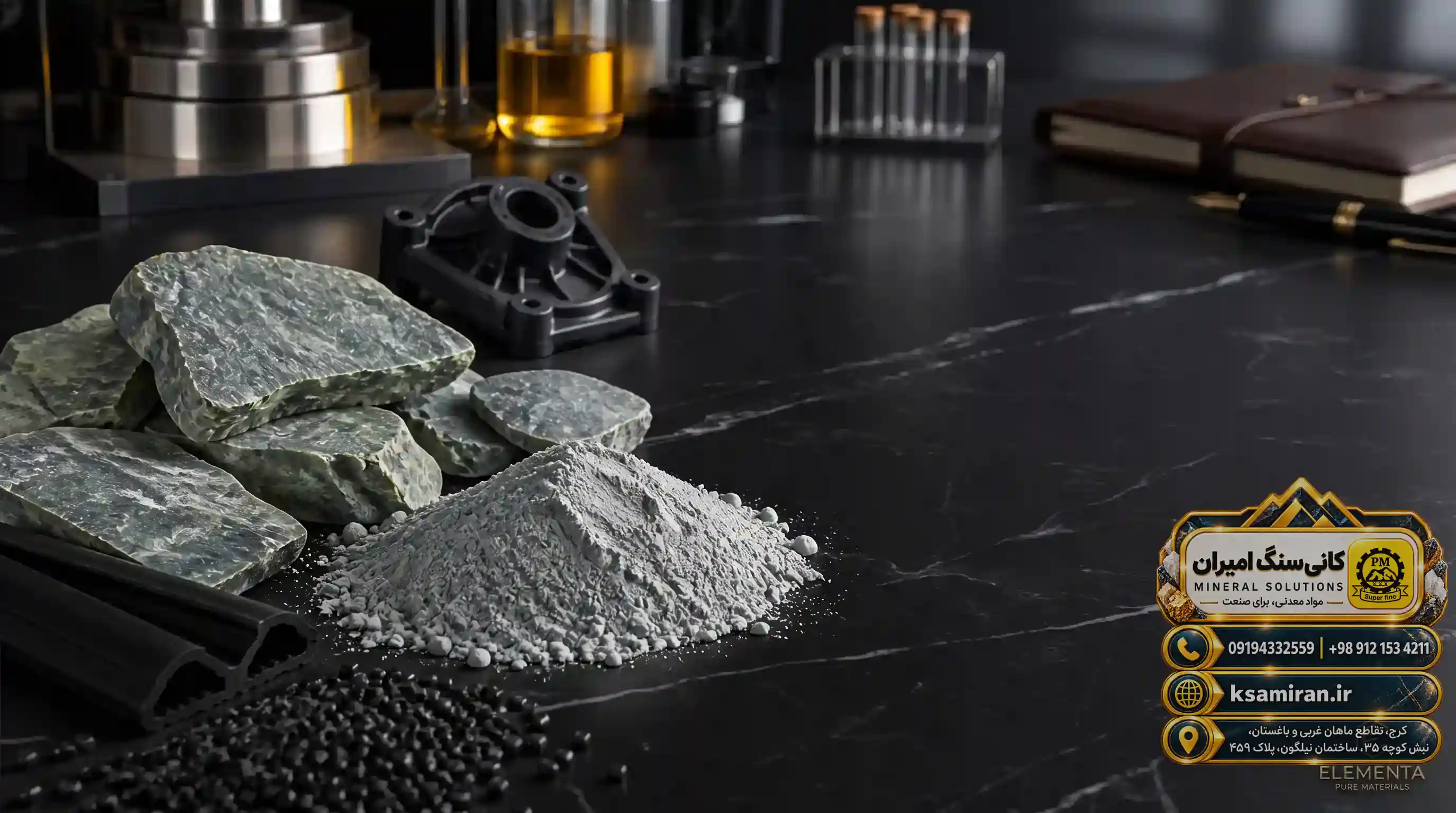
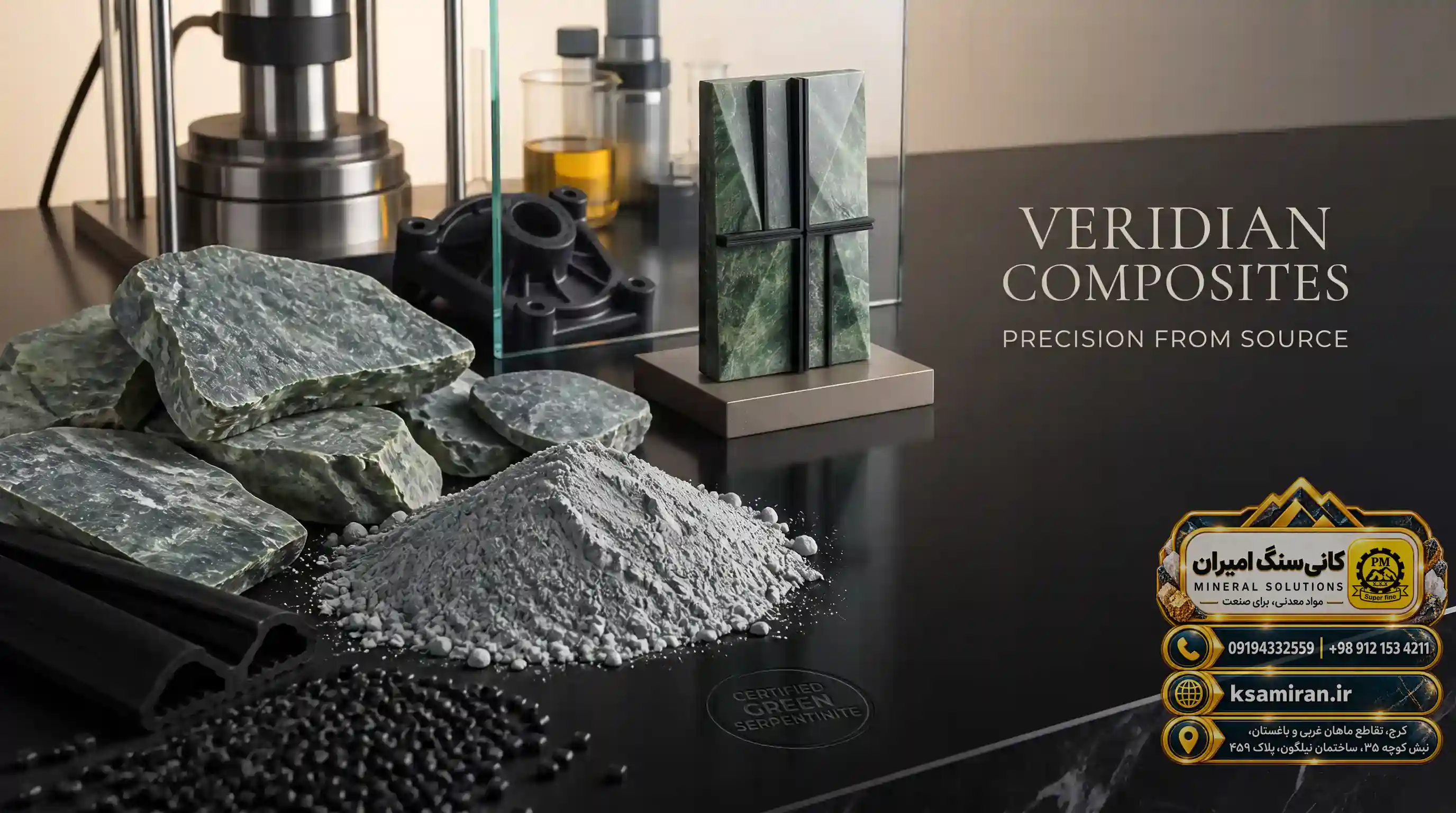
Thanks to its unique characteristics, industrial talc falls into four main application categories: polymeric products, rubber products, paint and industrial products. In the polymer industry, talc is widely used as a mineral filler and is typically employed to improve mechanical properties, increase hardness, reduce the coefficient of thermal expansion and improve the dimensional stability of polymeric parts. Talc can also help lower formulation costs while the base properties of the product are preserved.
In the rubber industry, talc is known as a filler and processing aid. The layered structure of this mineral acts as a lubricant and helps reduce tack, improve compound flow and increase the speed of the shaping process. In the production of technical rubber parts, talc can help improve abrasion resistance and extend product durability.
In the paint industry, industrial talc is used as a functional filler. Because of their platy shape, talc particles form a layered arrangement in coatings that can improve covering power, increase moisture resistance and enhance the final surface quality of the coating. Talc is also used in the production of architectural paints, industrial coatings and surface fillers.
In the industrial products category, talc is used in a wide range of other applications including ceramics, abrasives, papermaking, agriculture and the chemical industry. In each of these industries, the expected specifications for talc differ, which is why obtaining a specialized catalogue before selecting a product is an accepted principle in mineral materials marketing.
To view the full specifications of this mineral material and to receive the specialized catalogue, you can visit the Kani Sang Amiran Project industrial talc product page. On that page, the product's basic information — including the 450 to 1000 mesh range and its main applications — is presented, and the path to receiving the specialized catalogue is also available through contact with the company's technical team.
Why Is Obtaining a Specialized Catalogue Essential Before Buying Industrial Talc?
The mineral materials market is full of different options, and without precise technical information it is virtually impossible to tell products apart by price alone. Obtaining a specialized industrial talc catalogue lets you evaluate the target product based on technical data rather than mere sales claims. This approach significantly reduces the risk of buying an unsuitable product.
One of the most important reasons to obtain a catalogue is matching the product's specifications to the needs of your production line. Every industry has its own specific parameters; for example, a manufacturer of polymeric parts may need high-mesh talc with a particular brightness, while a paint manufacturer may prioritize particle size distribution and behavior in solution. A specialized catalogue puts these parameters in writing at your disposal.
The next reason is transparency in valuation. When technical specifications are clearly stated, comparing different products and evaluating the quality-to-price ratio becomes easier. This is of strategic importance especially for buyers who make periodic, high-volume purchases, because consistency in the quality of raw materials is one of the key factors in production stability.
Besides this, a specialized catalogue also serves as a document for inteal benchmarking. Quality-control teams can use the specifications given in the catalogue as an initial reference for evaluating incoming shipments and take the necessary actions if any deviation is observed. In this way, the catalogue is not merely a marketing tool; it becomes part of your quality-control chain.
Ultimately, providing a catalogue is a sign of the manufacturer's professionalism. A company that transparently presents the technical specifications of its products is confident in its product quality and runs an organized production process. The Kani Sang Amiran Project offers this transparency to applicants by providing a specialized industrial talc catalogue, so that purchases are made with full awareness.
Step-by-Step Process for Obtaining a Specialized Industrial Talc Catalogue
Obtaining a specialized industrial talc catalogue is a simple process, but observing a few key points can increase the speed and accuracy of the work. Below we review the main steps.
Step one: visit the product page. The first step is to go to the official product page and study its basic information. On the industrial talc product page, information such as the 450 to 1000 mesh range and the main applications — polymeric products, rubber products, paint and industrial products — is provided. This information gives you an overall view and helps shape the initial framework for your technical questions.
Step two: define your needs. Before requesting a catalogue, identify your needs: which industry you operate in, what your final product is, what mesh range you require and what volume of mineral material you need. The more precise this information is, the more relevant a catalogue and technical recommendation the manufacturer's technical team can offer you.
Step three: get in touch with the technical team. Through the contact chaels available on the website, submit your request for a specialized catalogue. In your request, mention your industry and the mesh range you need so that the relevant catalogue is sent to you. In many cases, supplementary information such as a product selection guide is provided alongside the catalogue.
Step four: study and analyze the catalogue. After receiving the catalogue, read it carefully and match the specifications against the needs of your production line. If you have questions about certain parameters such as particle size distribution, moisture or bulk density, prepare a list of technical questions. For guidance at this stage, you can also read the guide to receiving a technical catalogue and specialist analysis to better understand the structure of a technical catalogue and how to interpret its information.
Step five: request a sample or a price quote. After the specifications are initially confirmed, the final step is to request a laboratory sample or an official quotation. This stage assures you that the final product truly matches the catalogue's specifications. Following this process prevents risky trial purchases.
What Information Should Be Checked in a Specialized Industrial Talc Catalogue?
A specialized industrial talc catalogue is essentially the product's technical identity card. When reviewing the catalogue, you should pay special attention to a few groups of key information. Below we introduce the most important of these.
1. Particle size distribution and mesh range: The most important characteristic of industrial talc is its particle size distribution. The offered talc falls within the 450 to 1000 mesh range, and the catalogue should specify where in this range the supplied product sits, or whether the entire range can be offered. Matching this parameter to your formulation's needs is critical.
2. Color and brightness: Talc brightness is key for applications where the final appearance of the product matters. In the production of light-colored polymeric parts or light-colored paints, low-brightness talc can negatively affect the final product quality.
3. Moisture: The moisture content of talc powder affects its behavior during mixing, its flowability and its storage stability. High moisture can cause the powder to cake and disrupt dosing systems.
4. Bulk density: This parameter is important for volumetric calculations, silo design and transfer systems, and it should be stated in the catalogue.
5. Suggested applications: The catalogue should specify which industries the product is recommended for — for instance, polymeric products, rubber products, paint and other industrial products.
For supplementary information on evaluating talc quality and purity, you can read the article How to Recognize the Purity and Quality of Industrial Talc. This article offers practical tips for evaluating the quality of the received product and complements the catalogue review process.
Finally, keep in mind that the catalogue is the starting point, not the finish line. Combining the catalogue's information with an evaluation of a laboratory sample is the best approach for a confident selection of industrial talc.

Selecting Industrial Talc and the Importance of Pre-Purchase Technical Consultation
After receiving and reviewing the specialized catalogue, the product selection stage begins. At this stage, technical consultation plays a very important role. Even if you have carefully studied every specification in the catalogue, tuing that information into a sound purchasing decision requires a deep understanding of how talc interacts with the other materials in your formulation and with the conditions of your production line.
One of the main benefits of technical consultation is avoiding the selection of an unsuitable product. For example, based on the catalogue, two products with different meshes may both seem suitable for your application, yet only one of them is better matched to your machinery's conditions. An experienced technical consultant can guide you toward the right choice by asking a few key questions about your production line, final product and processing method.
Technical consultation also helps you avoid buying more or less than you need. Determining the appropriate volume and mesh range not only optimizes supply costs but also prevents unsuitable material from piling up in your warehouse. This is especially important for manufacturers with limited storage space.
On the other hand, technical consultation lays the groundwork for a stable supply relationship. When you are engaged with the manufacturer's technical team, you can quickly get guidance if your needs change or technical issues arise. This support is one of the key advantages of buying from a specialized mineral materials producer such as the Kani Sang Amiran Project.
For a more complete roadmap, we recommend reading the specialized guide to consultation on buying and supplying industrial talc. This guide covers practical tips for purchasing and supplying this mineral material and, together with the specialized catalogue, gives you a complete toolkit for making the right decision.
Conclusion: The Right Path to Obtaining a Catalogue and Supplying Industrial Talc
In this article we fully examined the importance of obtaining a specialized industrial talc catalogue and the steps involved. From introducing this mineral and its technical specifications to its applications, the steps for receiving a catalogue, the points to check and the importance of technical consultation — each part showed that successful purchasing of mineral materials requires a systematic, data-driven approach.
Industrial talc, with its 450 to 1000 mesh range and main applications in polymeric products, rubber products, paint and industrial products, is a versatile mineral material. But being versatile does not mean it is suitable for every application without review. Precisely matching the product's specifications to your needs is possible only by studying the specialized catalogue and consulting with the manufacturer's technical team.
The key steps we covered were: visiting the product page, defining your needs, requesting a catalogue from the technical team, analyzing the catalogue's information and finally requesting a sample or a price quote. Each of these steps is a logical link in the purchasing decision chain, and overlooking any of them can increase purchasing risk.
The Kani Sang Amiran Project, as a mineral materials producer, stands beside you on this path by offering a specialized catalogue and technical support. If your industry needs industrial talc with precise technical specifications, we suggest you start the catalogue reception process today; a small step at the outset can prevent major mistakes in purchasing and production.
Finally, remember that choosing the right industrial talc is not just a matter of price; it is a combination of technical fit, consistent quality and reliable technical support. Obtaining a specialized catalogue is the first and most important step on this path.
| Question | Answer |
|---|---|
| What is a specialized industrial talc catalogue? | It is a document that presents the technical specifications of talc — such as mesh range, color, moisture and applications — in a transparent and precise maer. |
| What is the mesh range of the Kani Sang Amiran Project's industrial talc? | This product is offered in the 450 to 1000 mesh range. |
| What are the main applications of industrial talc? | Polymeric products, rubber products, paint and other industrial products. |
| How can I obtain a specialized industrial talc catalogue? | By visiting the product page and requesting it from the Kani Sang Amiran Project's technical team. |
| Is obtaining a catalogue necessary before purchase? | Yes; obtaining a catalogue makes it possible to match the specifications to your production line's needs and reduces the risk of an unsuitable purchase. |
| Which technical information should be checked in a talc catalogue? | Particle size distribution and mesh range, color and brightness, moisture, bulk density and the product's suggested applications. |
| What role does industrial talc play in the polymer industry? | It is used as a mineral filler to improve mechanical properties, dimensional stability and to reduce shrinkage. |
| What is the difference between talc of different meshes? | A higher mesh means finer particles, which produce different dispersion and final properties in a formulation; the choice depends on the industry's needs. |
| Is industrial talc suitable for the paint industry? | Yes; talc is used as a filler in coatings and affects covering power and surface quality. |
| Where should I start for consultation on buying industrial talc? | First receive the specialized catalogue, then define your needs and consult with the manufacturer's technical team. |
Industrial talc specifications (450 1000 mesh range and polymer, rubber, paint and industrial applications) from the Kani Sang Amiran Project product page: https://ksamiran.ir/products/industrial-talc/
برچسب: Industrial Talc,How to Obtain a Specialized Industrial Talc Catalogue,
نویسنده: رساوب آفرین