
درباره سایت
آخرین مطالب
- انتخاب اکسید آهن قرمز (اخرا) برای بهبود کیفیت پیگمنت و پوششهای رنگی
- تامین کربنات کلسیم با دانهبندی دقیق جهت استفاده در مستربچ
- تأمین تخصصی سیلیس برای مصالح ساختمانی، شیشه و صنایع سرامیک
- ویژگیهای فنی بنتونیت کانی سنگ امیران برای کاربردهای خاص
- فلدسپات کانی سنگ امیران برای شیشه کاشی و سرامیک
- کاربرد تالک سفید درجه یک در فرمولاسیون پیشرفته رنگ و محصولات کاغذی
- اکسید آهن قرمز (اخرا) کاربردی جهت تولید محصولات سرامیکی و پوشش
- مشخصات فنی اکسید آهن قرمز (اخرا) مناسب برای پوشش و تولید پیگمنت
- مشاوره تخصصی خرید کربنات کلسیم بر اساس نیاز دقیق صنعت شما
- انتخاب تالک سفید صنعتی مناسب برای تولیدات کاغذ و مستربچ
امکانات وب
What is Coated Calcium Carbonate and Why is it Important in Industrial Formulation?
Coated calcium carbonate is one of the most widely used minerals in the polymer industry, which, due to its modified surface structure, has found a special place in the formulation of industrial compounds. This material is actually natural calcium carbonate with the chemical formula CaCO₃, the surface of whose particles is covered with an organic layer to increase its compatibility with polymeric matrices. As a result, this product shows much better behavior when mixed with resins and has become one of the main components in the production of compounds, granules, and polymeric parts.
The main difference between coated calcium carbonate and the uncoated type lies in the surface behavior of the particles. In ordinary calcium carbonate, the particle surface tends to absorb moisture and stick together, which makes its dispersion in a polymeric matrix difficult. But in the coated product, the organic layer makes the particle surface hydrophobic and reduces friction between particles. This small change has a huge impact on the final quality of the part and the efficiency of the production line.
In industrial formulations, every material must play two simultaneous roles: first, to optimize costs, and second, to maintain or improve the properties of the final product. Coated calcium carbonate can well fulfill both roles; on one hand, it replaces a portion of the volume of expensive resin, and on the other hand, it improves properties such as stiffness, dimensional stability, and surface quality of the part.
The product presented on the Coated Calcium Carbonate product page of the Kani Sang Amiran Project is selected with a suitable mesh for compounds, granules, and polymeric parts, and its mesh range is 450 to 3500 mesh. This wide range allows precise selection based on the type of part, wall thickness, and production line speed, introducing a flexible product for diverse polymeric applications.
Various industries, from profile and cable manufacturers to flooring and PVC part producers, pay special attention to this material, because in addition to technical advantages, it is an accessible and stable mineral. In recent years, the tendency to use surface-modified mineral fillers has increased more than ever due to cost pressure and the need for consistent quality.
In the rest of this article, we will fully examine the coating structure, the importance of the mesh range, the role of this material in compounds and granules, its applications in profiles, cables, flooring, and PVC parts, its technical and economic benefits, and finally, the criteria for its selection and storage.
Coating Structure and Mechanism of Action of Coated Calcium Carbonate
To understand the benefits of coated calcium carbonate, we must first know what coating or surface modification means. Calcium carbonate particles naturally have a polar and hydrophilic surface, which causes them to stick together and agglomerate in aqueous or moisture-absorbing matrices. This behavior is one of the biggest obstacles to using ordinary calcium carbonate in polymeric formulations.
In the coating process, the particle surface is covered with a thin layer of an organic compound, usually a fatty acid such as stearic acid. This layer, by forming a bond on the particle surface, imparts hydrophobic and organophilic properties to it. The result is that the calcium carbonate particle becomes chemically more similar to the polymeric matrix, and the surface energy between the filler and the resin is drastically reduced.
Reduced surface energy means better wetting of the particles by the resin. When the polymeric resin wets the filler particles well, the particle distribution becomes more uniform, and the formation of clumps or agglomerated particles is prevented. This issue is especially important in thin and delicate-walled parts where a small defect in dispersion is clearly visible.
Another important effect of coating is the reduction of moisture absorption. Since the particle surface has become hydrophobic, it absorbs less ambient moisture, and this property is very valuable in processes such as extrusion where the presence of water vapor causes porosity in the part. The final part, as a result, will have a smoother surface and a cavity-free structure.
Increased speed and quality of mixing are among the other achievements of this structure. In mixers and extruders, coated particles spread faster and more uniformly in the mixture due to low friction, reducing machine torque and mixing time. This not only raises the quality of the compound but also helps reduce energy consumption.
In summary, coating is not a simple finishing operation, but a fundamental change in the material's behavior. Coated calcium carbonate, thanks to its organic layer, transforms from a neutral filler into an active and compatible component in the formulation that can directly interact with the resin and improve the performance of the entire mixture.
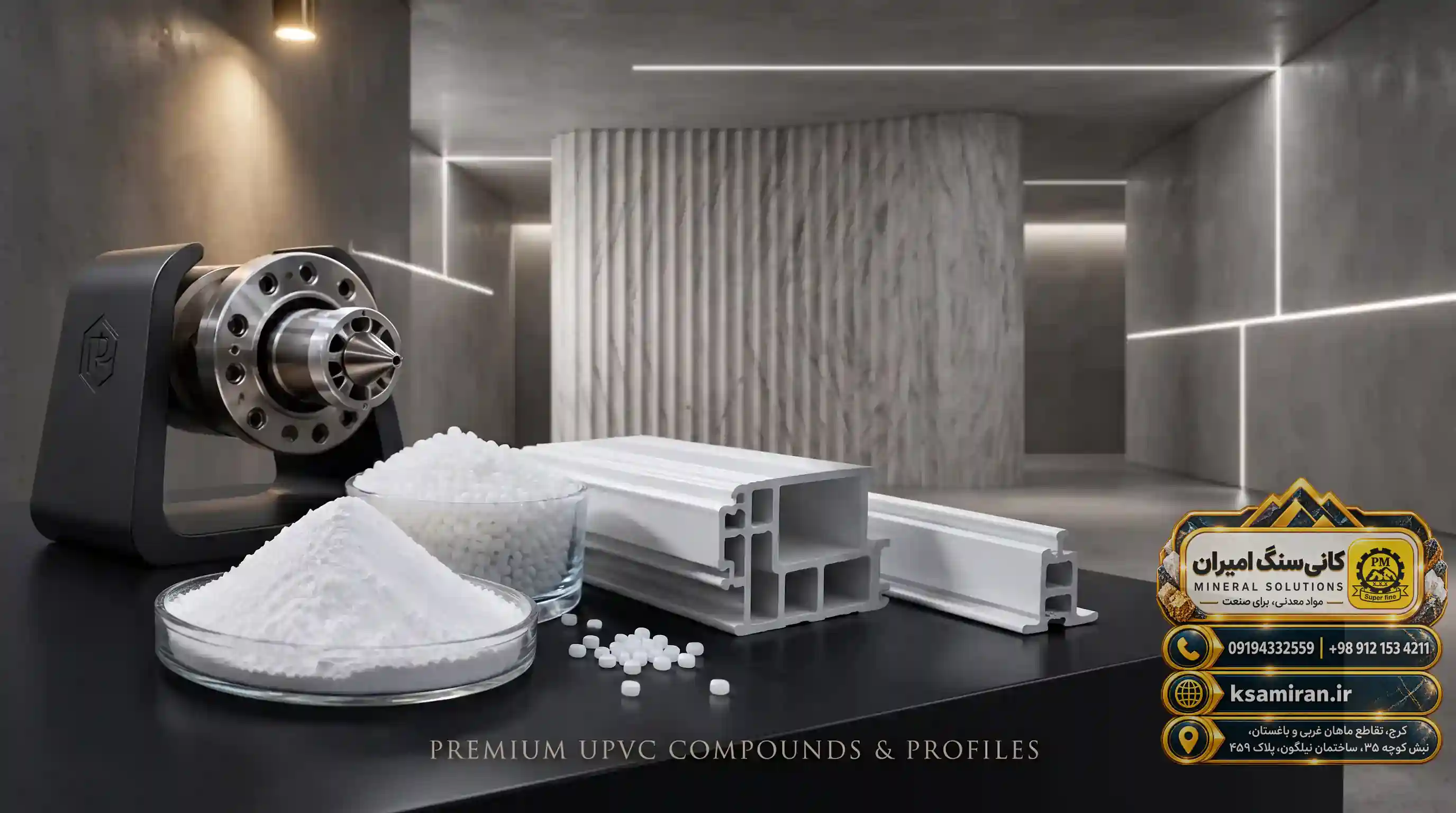
Mesh Range 450 to 3500: Why and How is the Right Mesh Selected?
One of the most important characteristics of coated calcium carbonate in polymeric applications is its particle size, expressed in mesh units. The higher the mesh number, the finer the particles. The product offered in the Kani Sang Amiran Project includes a mesh range of 450 to 3500, which is a very broad spectrum to cover various industrial needs.
At lower meshes, the particles are coarser and are more suitable for thick parts, heavy profiles, and applications that require a large volume of fill. These particles have a higher setting speed and perform well in formulations where ultra-high surface precision is not required.
In contrast, at higher meshes such as 2000 to 3500, the particles are very fine and have a high specific surface area. These particles are considered a better choice for parts with thin wall thickness, cables with thin insulation, flooring, and PVC parts where surface quality and uniformity are critical. The fineness of the particles ensures the final part has a smooth surface free of surface defects caused by coarse particles.
Choosing the wrong mesh can have serious consequences. Very coarse particles for a thin part cause a drop in surface quality, reduced impact resistance, and even weakness at the weld point in welding PVC parts. On the other hand, using a very fine mesh in a formulation whose machine lacks the ability to distribute ultra-fine particles can lead to increased torque, excessive heating of the mixture, and reduced line efficiency.
It should also be noted that the finer the particles, the more power is needed for uniform distribution and complete wetting by the resin. In such cases, the advantage of coating clearly shows itself, as the organic surface layer facilitates the wetting of particles, and good dispersion is achieved even at high meshes.
Ultimately, choosing the right mesh is a technical decision that must be made based on the type of part, thickness, line speed, resin type, and desired mechanical properties. That is why this product is offered with a range of 450 to 3500 mesh so that every manufacturer can find the most precise option for their production line.
The Role of Coated Calcium Carbonate in the Production of Polymeric Compounds and Granules
Polymeric compounds and granules are the beating heart of the plastics industry; where resin, fillers, additives, and stabilizers are combined to prepare a uniform feed for subsequent production stages. Coated calcium carbonate, among these, is one of the most important fillers that simultaneously affects the quality and economics of the process.
In compound production, the first challenge is the uniform distribution of filler particles in the resin. If this distribution is not uniform, the final part will have weak points. Due to the modified surface, coated calcium carbonate particles easily disperse in the resin and reduce the need for high mixing energy, resulting in a compound with consistent and predictable quality.
In the granulation stage, the flowability of the material is very important. Uncoated particles tend to stick together and cause bridging in the hopper and machine. But coated particles, due to reduced friction and low moisture, have better flowability and provide a more stable feed to the extruder, which helps stabilize granule weight and reduce waste.
Another important role of this product in compounds is the reduction of oil and liquid additive absorption. In PVC formulations, the presence of a large amount of lubricant and liquid stabilizer is common. Ordinary calcium carbonate absorbs some of these liquids and alters the formulation, but the coated product limits this absorption and maintains formulation stability.
Also, by reducing torque and process temperature, this material helps increase production speed. For a deeper understanding of this topic, read the article Technical Benefits of Coated Calcium Carbonate in Extrusion, which examines the technical details of this material in the extrusion process.
Finally, it should be noted that coated calcium carbonate is not merely a cheap filler, but a material that, with the right mesh selection, can become a strategic element in the quality of compounds and granules. Manufacturers seeking consistent quality, reduced waste, and increased efficiency usually choose this product as a main component of their formulation.

Applications of Coated Calcium Carbonate in Profiles, Cables, Flooring, and PVC Parts
The variety of applications for coated calcium carbonate in the polymer industry is very broad. Due to its compatibility with resins and availability in various meshes, this product has secured its place in the main branches of the plastics industry.
In the production of profiles, especially UPVC door and window profiles, this material plays a very important role. These profiles require a smooth surface, impact resistance, and dimensional stability. Using coated calcium carbonate with a suitable mesh helps achieve these characteristics while controlling formulation costs. High surface quality and the absence of defects are particularly important in thin-wall profiles.
In the cable industry, this product is used as a filler in cable sheathing and insulation. In this application, insulation uniformity, suitable electrical properties, and surface quality matter. Fine and coated particles guarantee uniform distribution in the insulation and prevent weak points in the sheath. Also, reduced moisture absorption in cables used in humid environments is a major advantage.
In flooring, coated calcium carbonate is used as the primary filler. This material gives the flooring proper weight and stiffness and prepares the final surface for printing or lamination. Using a higher mesh in thin flooring and a lower mesh in thick flooring is an example of the importance of mesh variety in this product.
In PVC parts, whether injection-molded, extruded, or vacuum-formed, this product is used as a versatile filler. From hard parts like plumbing fittings to technical and electrical parts, all can benefit from the advantages of this material. The combination of coating and the right mesh allows for a high filler percentage without a loss of critical properties.
In all these applications, there is a common principle: the quality of the final part depends heavily on the choice of mesh and the surface behavior of the filler. For this reason, coated calcium carbonate with a suitable mesh is an ideal option to meet the diverse needs of these industries.
Technical Benefits of Coated Calcium Carbonate in the Production Process and Part Quality
Using coated calcium carbonate in polymeric formulations brings numerous technical benefits, each directly affecting the final part quality and production line efficiency. Understanding these benefits helps formulation engineers use this material optimally.
One of the most important benefits is the excellent dispersion of particles in the resin. As mentioned, the organic coating makes the particle surface compatible with the polymeric matrix and prevents clumping. The result is a part with a homogeneous structure, without weak points, and with consistent mechanical properties.
The second benefit is reduced moisture absorption. Moisture is public enemy number one for quality in polymeric processes; it causes porosity, rough surfaces, and even a loss of electrical properties in cables. The hydrophobic surface of coated particles minimizes moisture absorption and helps maintain quality in humid environments.
Third, reduced absorption of oil and liquid additives. In formulations containing lubricants, stabilizers, and liquid processing aids, this property ensures the formulation remains stable and additives serve the process and final part rather than being absorbed by the filler.
Fourth, improved mechanical properties. Using a filler with good distribution increases the stiffness and tensile modulus of the part and reduces post-process shrinkage. This means more precise dimensions and parts that better conform to technical tolerances.
Fifth, better surface quality. In extruded and injection-molded parts, the part surface represents the quality of the entire process. Fine, well-distributed particles create a smooth and glossy surface that enhances the value of the final product. Also, reduced process temperature and torque reduce wear on drills and screws, extending machine life.
Sixth, increased production line speed. Improved feeding, reduced torque, and keeping the mixture cool all help increase extrusion speed or reduce injection cycle times. Together, these benefits make coated calcium carbonate a superior choice over ordinary calcium carbonate.
Economic Benefits of Using Coated Calcium Carbonate in Production
In addition to technical benefits, there are many economic reasons to use coated calcium carbonate in the polymer industry. In today's competitive market, controlling production costs without sacrificing quality is key to survival for any manufacturer, and this material can play an important role in this regard.
The first and most obvious economic benefit is replacing a portion of the expensive resin. Polymers make up the bulk of a formulation's cost, and any amount replaced with a reliable mineral filler brings direct savings. Using coated calcium carbonate, a high percentage of filler can be incorporated into the formulation without a loss in part quality.
Second, reduced production waste. Surface quality defects, defective parts, and line stoppages all carry large hidden costs. Improved dispersion and reduced porosity mean fewer defective parts and a higher percentage of sellable product. This saving is often more significant than savings on raw material costs.
Third, reduced energy consumption. Reduced torque in the extruder, shorter mixing times, and lower process temperatures all mean lower electricity consumption per kilogram of product. In high-toage production lines, this reduction becomes a substantial figure.
Fourth, increased production line capacity. Increasing line speed due to improved flowability and reduced torque means producing more in the same amount of time with the same machines. This postpones investment in new equipment.
Fifth, extended machine and mold life. Modified particles with a softer surface and reduced friction cause less wear on screws, molds, and injection machines. Repair and maintenance costs and downtime decrease, which is a major saving in the long run.
For a closer look at this topic, read the article Economic Benefits of Using Coated Calcium Carbonate in Manufacturing. That article provides a more precise analysis of this material's impact on final costs.
Overall, the combination of technical and economic benefits makes coated calcium carbonate one of the most valuable materials in the formulation of industrial compounds. Choosing the right mesh guarantees maximum utilization of these benefits.
Selection Criteria, Storage, and Conclusion
Choosing the right coated calcium carbonate requires attention to several key criteria. First, the type of part and final application: thin parts need a higher mesh, and thicker parts need a lower mesh. Second, the production process: extrusion, injection, and vacuum forming each behave differently with the filler. Third, the base resin: PVC, polyethylene, polypropylene, and other polymers interact differently with the coating layer.
The fourth criterion is the desired filler percentage. If you intend to introduce a high percentage of filler into the formulation, the importance of mesh and coating quality becomes much greater. Fifth, production line speed: high-speed lines require particles with better flowability and dispersion to avoid a drop in quality.
After selection, it's time for proper storage. Although the surface of coated particles is hydrophobic, improper storage can affect product quality. The warehouse must be dry, cool, and properly ventilated, and the product should be stored on pallets, away from floor moisture and direct sunlight. Also, storing it near chemicals that might react with the organic layer should be avoided.
To fully familiarize yourself with this topic, read the article Comprehensive Guide to the Storage and Warehousing of Industrial Coated Calcium Carbonate. This guide covers all aspects of storing this product in full.
In conclusion, coated calcium carbonate with a mesh range of 450 to 3500 is a product that meets the diverse needs of the compound, polymeric granule, profile, cable, flooring, and PVC part industries. Its technical benefits—such as good dispersion, reduced moisture and oil absorption, high surface quality, and dimensional stability—alongside economic benefits like lower resin costs, reduced waste, and faster line speeds, make it an ideal choice.
Success in using this product depends on two factors: choosing the right mesh based on the part and process, and sourcing from a reliable supplier. The Kani Sang Amiran Project, by offering this product for compounds, granules, and polymeric parts with a suitable mesh, strives to meet the technical needs of manufacturers. Consulting with technical experts before making a final decision is always a smart move.
We hope this article has helped you better understand the benefits and selection criteria for coated calcium carbonate. If you need more information, you can contact our experts.

| Question | Answer |
|---|---|
| What is coated calcium carbonate? | It is natural calcium carbonate whose particle surface is coated with an organic layer to increase its compatibility with polymeric resins. |
| What is the difference between it and ordinary calcium carbonate? | In the coated product, the particle surface is made hydrophobic, moisture and oil absorption are reduced, and dispersion in the resin is much better. |
| What is the mesh range of this product? | This product is offered in a mesh range of 450 to 3500 mesh so the appropriate mesh can be selected for each part and process. |
| In which applications is this product used? | The production of compounds, polymeric granules, profiles, cables, flooring, and PVC parts are the main applications of this product. |
| Why does the right mesh matter? | Mesh selection depends on the part thickness, process type, and desired surface quality, and an unsuitable mesh causes a drop in surface quality and mechanical properties. |
| Is this product suitable for thin parts? | Yes, by choosing higher (finer) meshes, the surface quality and uniformity of thin parts can be ensured. |
| What advantages does this product offer for extrusion? | Reduced torque and temperature, improved dispersion, reduced porosity, and increased line speed are among its benefits in extrusion. |
| Is replacing resin with this product economical? | Yes, replacing a portion of the resin with this filler reduces costs, cuts waste, and increases production line capacity. |
| How should this product be stored? | It should be stored in a dry, cool, ventilated warehouse, on pallets, and away from moisture and reactive chemicals. |
| How do we choose the right mesh? | Based on the part type, wall thickness, production process, base resin, and line speed, with consultation from technical experts. |
The information in this article is based on the Coated Calcium Carbonate product page on the Kani Sang Amiran Project website.

برچسب: Coated Calcium Carbonate,Main Benefits of Coated Calcium Carbonate in Industrial Formulation and Compounds,
نویسنده: رساوب آفرین