
درباره سایت
آخرین مطالب
- استخدام أكسيد الليمونيت (الماغش) في صناعات الزجاج
- کاربرد اکسید لیمونیت (گل ماش) در صنایع شیشهسازی
- A Review of Daily Prices for Limonite Oxide (Ocher) in the Market
- چگونه خالص بودن اکسید لیمونیت (گل ماش) را تشخیص دهیم؟
- بررسی قیمت روز اکسید لیمونیت (گل ماش) در بازار
- Application of Limonite Oxide (Gole Mash) in Glassmaking Industries
- كيف تتعرف على نقاء أكسيد الليمونيت (جول ماش)؟
- How to Determine the Purity of Limonite Oxide (Gol Mash)?
- بررسی استانداردهای ایمنی کار با اکسید لیمونیت (گل ماش)
- Comprehensive Guide to Technical Analysis of Limonite Oxide (Gol Mash)
امکانات وب
Introduction to the Importance of Coated Calcium Carbonate Compared to Bentonite and Talc
In the polymer industry, choosing the right mineral filler has a direct impact on the final cost, process stability, surface quality, mechanical strength, and overall performance of the product. Coated calcium carbonate is one of the most widely used fillers, selected with an appropriate mesh for compounds, polymer granules, profiles, cables, flooring, and PVC parts. In fact, selecting the right material can improve the balance between cost reduction and maintaining technical properties.
Bentonite and talc are also important minerals, but their structure and performance are completely different from calcium carbonate. Bentonite is mostly known for its thixotropy, moisture absorption, and suspension capability, while talc has a platy structure and is used to increase stiffness, thermal resistance, and dimensional stability. Coated calcium carbonate, however, due to its modified surface, provides greater ease in dispersion and wetting within polymer systems.
In comparing coated calcium carbonate with bentonite and talc, factors such as particle size, size distribution, specific surface area, moisture content, coating type, density, processing method, and final mechanical properties must be considered. A filler may be suitable for one extrusion process, yet perform poorly in the production of thin parts or sensitive cables. For this reason, the comparison must be done practically and based on product requirements.
Products such as compounds and polymer granules usually require a filler that is stable against heat and shear stress and is compatible with machine speed. Coated calcium carbonate, by reducing torque and improving melt flow, can help increase production rates and reduce energy consumption. This feature is very important in the continuous production processes of profiles and flooring.
Ultimately, coated calcium carbonate should not be considered merely as a cheaper alteative; rather, it should be evaluated as a functional material whose mesh selection and quality stability can optimize formulation design. In the following chapters, we will fully compare the structure, characteristics, and applications of these three minerals to enable a more precise selection.
Structure of Coated Calcium Carbonate and Its Difference with Bentonite and Talc
Coated calcium carbonate is produced from natural or precipitated calcium carbonate, and its particle surface is modified with organic materials, typically fatty acids. This surface treatment transforms the mineral particles from a highly polar state into a surface more compatible with polymers. The result of this process is reduced particle agglomeration, improved dispersion, reduced lubricant absorption, and in many cases, an improved surface quality of the final product.
Bentonite is an aluminum silicate clay with exchangeable cations. Its layered structure absorbs water and other molecules between its layers, a characteristic that causes swelling and creates high suspension capability. This structure is useful in applications requiring delayed reactions, absorption, lubrication, and adhesion, but in polymer processes where moisture and dimensional stability are critical, it requires very precise control.
Talc is a layered magnesium silicate that, due to its platy shape, can align with the flow direction. This structure increases stiffness, reduces shrinkage, improves dimensional stability, and enhances thermal resistance. Talc holds a stronger position in parts that require high service temperatures and dimensional stability, but it can reduce impact resistance and increase sensitivity to weld lines.
The main difference between these three materials is that coated calcium carbonate acts as isotropic particles with a modified surface, whereas bentonite and talc have layered structures and anisotropic behavior. For the production of granules and compounds, this difference can directly affect dispersion, viscosity, delamination, surface roughness, and the deformation rate of the part.
The choice between these materials should be based on product requirements. If the goal is surface quality, excellent dispersion, and large-scale economy, coated calcium carbonate is usually the more balanced option. If the main priority is moisture absorption or suspension capability, bentonite is chosen; and if stiffness and thermal stability are the priorities, talc is considered.
In many formulations, these materials can complement each other; however, combining them requires precise testing, as each of these particles has a different structure and may interact with the behavior of the resin, other fillers, and additives.
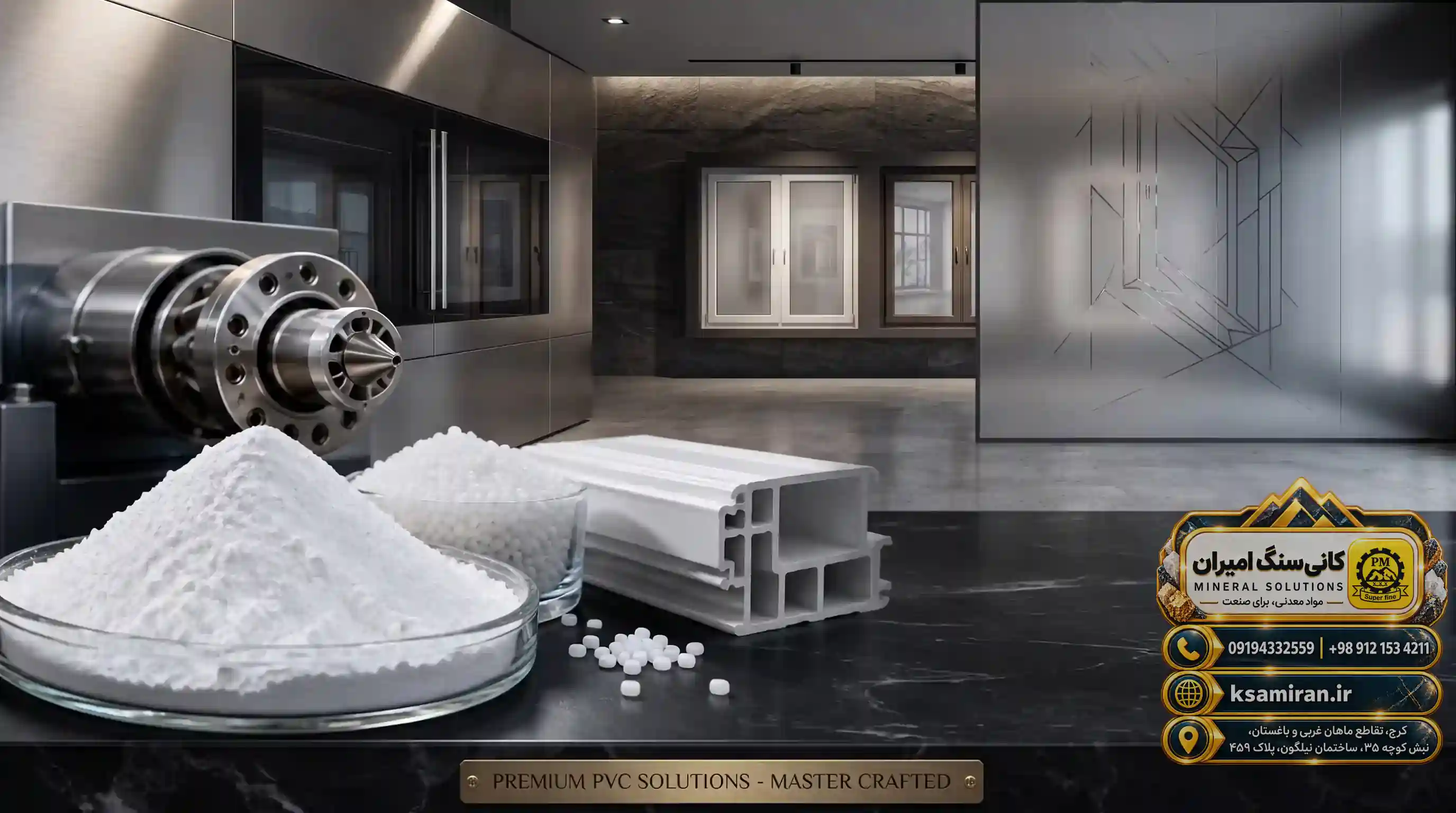
Comparison of Coated Calcium Carbonate and Bentonite in the Polymer Industry
Both coated calcium carbonate and bentonite are used in the mineral and polymer industries, but they perform differently in most polymer applications. Due to its organically modified surface, coated calcium carbonate offers better compatibility with resins such as PVC, polyethylene, and polypropylene, and helps reduce agglomeration and improve dispersion in extrusion and plastic injection processes.
Unlike calcium carbonate, bentonite has higher moisture absorption and can swell upon contact with water. This property is highly beneficial in industries such as drilling, ceramic slip, tiles, adhesives, and purification, but in cable insulation and sensitive polymer parts, it can lead to moisture migration, porosity, and reduced electrical stability. Therefore, in these products, coated calcium carbonate usually provides easier process control.
In the production of compounds and polymer granules, filler dispersion and density are crucial. Coated calcium carbonate can increase production speed by reducing melt torque and improving particle wetting. Bentonite, due to its high specific surface area and tendency to absorb liquids, may alter viscosity and require precise formulation adjustments.
In terms of mechanical properties, coated calcium carbonate can increase hardness, stiffness, and dimensional stability in polymer parts, while its effect on impact resistance can be controlled through proper mesh and coating selection. Bentonite serves a different functional role in some polymer systems and is mostly used for specific applications like viscosity control, adhesion, and reaction inhibition.
In the production of profiles and flooring, surface quality and dimensional stability are of high importance. Coated calcium carbonate can help increase customer satisfaction by reducing flow lines and improving surface smoothness. Using bentonite in these applications, however, requires strict moisture control and a robust mixing system.
Ultimately, if the goal is absorption, swelling, suspension, or fluidity control, bentonite is the stronger option; but for the mass production of compounds, granules, profiles, and PVC parts—where process stability, dispersion, and overall cost are paramount—coated calcium carbonate is generally the more logical choice.
Comparison of Coated Calcium Carbonate with Talc in Various Industries
Both coated calcium carbonate and talc are used as mineral fillers in the plastics industry, but their end results differ. Coated calcium carbonate is primarily used to strike a balance between price, dispersion, surface quality, and processability, whereas talc is mainly used to increase stiffness, thermal stability, and resistance to dimensional changes.
Due to its platy structure, talc can increase stiffness and softening temperature in polymer parts, particularly in polypropylene. This characteristic is important in the automotive, home appliance, and technical parts industries. However, platy talc particles can cause anisotropy in properties, increase sensitivity to weld lines, and in some cases, reduce impact resistance.
Thanks to its particle shape and modified surface, coated calcium carbonate achieves better dispersion within the polymer matrix and can be used at higher loading levels without a severe decline in mechanical properties. In compound and polymer granule production, this means better viscosity control and reduced resin consumption.
In PVC profile, cable, and flooring production, coated calcium carbonate contributes to better surface quality, reduced machinery wear, and stability in continuous processes. Talc is also used in some of these applications to reduce shrinkage and increase thermal resistance, but its proper distribution must be controlled to prevent a drop in impact resistance and weakness along weld lines.
In terms of color and filling capability, coated calcium carbonate generally provides higher color opacity and can reduce the need for pigments. Talc also offers good opacity, but its structural differences can affect transparency, roughness, and surface texture.
In industries where components are subjected to thermal and mechanical stress, talc may perform better; however, in applications where mass production capability, surface quality, and cost control are important, coated calcium carbonate is the more efficient choice. In many cases, the final selection is determined by laboratory data and production line results.

Applications of Coated Calcium Carbonate in Compounds, Granules, and Polymer Parts
Coated calcium carbonate plays the role of a filler and processing aid in compound production. During the compounding process, it helps reduce torque, improve dispersion, and increase machinery efficiency. Because of its modified surface, its particles agglomerate less, resulting in a smoother and more uniform surface quality for the final granules.
In polymer granule production, selecting the right mesh is very important. Finer particles can enhance the surface quality and uniformity of the part, but they raise melt viscosity and require more energy. Coarser particles may cause surface roughness and a loss of mechanical properties. For this reason, coated calcium carbonate must be selected based on the resin type, product thickness, and line speed.
In PVC profile production, coated calcium carbonate helps reduce shrinkage, increase stiffness, and improve dimensional stability. Additionally, in construction profiles, surface quality and resistance to flow lines are highly important, and choosing the right filler can reduce the need for secondary processing.
In the cable industry, one of the most critical factors is controlling moisture and filler dispersion. Coated calcium carbonate with a coated surface can provide improved wetting and dispersion within the polymer matrix, helping to reduce porosity and enhance insulation quality. To understand the application of this material in the plastics industry, the article An Introduction to the Applications of Coated Calcium Carbonate in the Plastics Industry serves as a useful reference.
In flooring and PVC parts, coated calcium carbonate is used for its high hardness, color stability, and high filling capacity. This material can reduce resin consumption while maintaining essential mechanical properties. Also, in injection-molded parts, it can help minimize deformation and improve the production cycle.
Ultimately, the successful application of this material depends on mesh selection, machinery setup, and quality control. Using a single fixed mesh for all products is not practical; rather, meshes for compounds, granules, and polymer parts should be chosen based on the specific needs of each application to provide the best balance between dispersion, mechanical properties, and price.
Principles for Selecting the Mesh of Coated Calcium Carbonate for Extrusion and Injection Processes
Selecting the mesh size of coated calcium carbonate is one of the most important decisions in polymer formulation. Finer particles generally provide better surface quality and uniformity, but they increase viscosity and demand higher power. Coarser particles may agglomerate prematurely and degrade surface quality. Therefore, the mesh choice must be based on the resin type, product thickness, line speed, and required mechanical properties.
In profile extrusion, using coated calcium carbonate with the appropriate mesh helps reduce melt pressure, improve flow, and increase line speed. Extremely fine particles may increase torque and sacrifice mechanical properties, while coarse particles can create surface lines and reduce strength at critical points.
In granule and compound production, the particle size distribution must be uniform to keep the final product properties stable. If particles are heterogeneous, it may result in strength loss, color variation, or surface roughness in later production stages. To lea about the technical aspects of this process, read the article Examining the Technical Benefits of Coated Calcium Carbonate in Extrusion.
In plastic injection, filler particles must be selected so that the mold fills properly and weld lines are minimized. Coated calcium carbonate with a modified surface can help reduce inteal stresses and improve dispersion, but choosing the wrong mesh can lead to poor dispersion and increased scrap.
One key point is that mesh refers not just to particle size; size distribution, particle shape, and coating quality also affect the final performance. For this reason, industrial trials and strict quality control are necessary to evaluate the material's actual behavior on the production line.
Ultimately, the selection of coated calcium carbonate mesh should be comprehensive and driven by product requirements. For every application, the effect of mesh on dispersion, mechanical properties, surface quality, and total cost must be evaluated to achieve the best outcome. This systematic approach prevents material waste and quality degradation.

Quality Control and Testing Tips for Coated Calcium Carbonate on the Production Line
Quality control of coated calcium carbonate is crucial from the moment the raw material is received until the final product is manufactured. Upon receipt, moisture content, particle size distribution, color, purity, and coating quality must be inspected. These parameters directly affect dispersion, melt viscosity, and the mechanical properties of the product.
One of the most important tests is evaluating particle dispersion within the polymer matrix. If particles are not adequately dispersed, weak points, rough surfaces, and reduced impact resistance may appear in the final product. Microscopic tests, agglomerate particle measurement, and surface inspection of the part can be used for this purpose.
On the production line, monitoring parameters such as torque, melt pressure, temperature, and line speed is essential. Any sudden change in these parameters may indicate a variation in the filler or formulation. Coated calcium carbonate must exhibit stable behavior across these parameters at specified loading levels.
In cable and polymer insulation production, controlling moisture and porosity is vital. Increased filler moisture can cause bubbles, insulation failure, and reduced stability at high voltages. For this reason, the raw material must be stored in a dry, controlled environment and tested for moisture before use.
For PVC parts and flooring, tensile strength, hardness, impact resistance, and color stability tests should be conducted continuously. These tests help identify early issues such as a decline in mechanical properties, color changes, or reduced abrasion resistance.
Finally, quality control must be backed by a documented system. Test results, formulation changes, and machinery settings should be recorded to enable quick root-cause analysis in the event of a problem. This reduces scrap, increases production stability, and improves decision-making for filler purchases.
Conclusion and Final Selection Criteria Between Coated Calcium Carbonate, Bentonite, and Talc
Comparing coated calcium carbonate with bentonite and talc shows that no single material is universally the best. Coated calcium carbonate is the optimal choice for producing compounds, granules, profiles, cables, flooring, and PVC parts because it offers an excellent balance of dispersion, surface quality, process stability, and cost. Bentonite is more suitable for applications requiring absorption, suspension, and swelling, while talc is preferred for parts needing stiffness and thermal stability.
In the final selection, attention must be paid to the resin type, processing method, product thickness, environmental conditions, and mechanical properties. Furthermore, pilot-scale and production-line testing is far more valuable than comparisons based solely on technical datasheets. The actual behavior of minerals when combined with additives and under specific process conditions can differ significantly from laboratory results.
Surface coating quality, particle size distribution, and moisture control are among the most critical success factors when using coated calcium carbonate. These factors directly impact the product's dispersion, viscosity, surface quality, and mechanical strength. Therefore, a supplier with stringent quality control and consistent production is a major advantage.
For more information on market criteria and comparisons between different types of this product, you can read the Specialized Guide to Comparing Types of Coated Calcium Carbonate Available on the Market. Additionally, if you are looking for a product suited for compounds, granules, and polymer parts, Coated Calcium Carbonate from the Kani Sang Amiran project is an option worth considering.
Finally, before purchasing in high volumes, it is recommended to test samples in the laboratory and on the production line, comparing the results against product data. This ensures your choice is based on the reality of your own process rather than just a generic product label. This approach maintains quality while reducing production risk.

| Question | Answer |
|---|---|
| What is coated calcium carbonate? | It is calcium carbonate with a modified surface that improves its dispersion, wetting, and compatibility in polymer matrices. |
| What is the difference between coated calcium carbonate and regular calcium carbonate? | The coated type features a surface treatment that reduces particle agglomeration and improves dispersion in polymers. |
| Why is coated calcium carbonate compared with bentonite? | Because both are minerals, but bentonite has higher moisture absorption and swelling, whereas coated calcium carbonate is more stable in polymer processes. |
| When is talc better than coated calcium carbonate? | When the part requires high stiffness, thermal stability, and resistance to dimensional changes. |
| How is the mesh size of coated calcium carbonate selected? | It is selected based on the resin type, product thickness, line speed, and required mechanical properties. |
| What is the main application of this product in the cable industry? | Moisture control, improved dispersion, and enhanced insulation quality in polymer formulations. |
| Is this product suitable for PVC flooring? | Yes, it is used in PVC parts due to its hardness, stability, and suitable dispersion. |
| Why is dispersion important in compounds? | Poor dispersion causes surface roughness, a drop in mechanical properties, and increased waste. |
| What tests are necessary for quality control? | Particle size, moisture, color, dispersion, melt torque, and the mechanical properties of the final product. |
| What are the storage conditions for this material? | A dry environment, intact packaging, and protection from moisture and other contaminants. |
This article is written based on general knowledge of the polymer industry and an introduction to the product from the Kani Sang Amiran project.

برچسب: Coated Calcium Carbonate,Comparison of Coated Calcium Carbonate with Bentonite and Talc in Various Industries,
نویسنده: رساوب آفرین