
درباره سایت
آخرین مطالب
- تاثیر اندازه ذرات کربنات کلسیم در صنایع
- ما هو الفرق بين الفلسبار والكوارتز؟ مقارنة شاملة بين أكثر مادتيْن معدنيتيْن استخدماً
- دليل شراء أكسيد الليمونيت عالي الجودة (الجول ماش)
- What is the Difference Between Kaolin, Bentonite, and Talc in Industry? A Complete Application Comparison
- کربنات کلسیم یا دولومیت؟ بررسی تفاوتها و کاربردهای کلیدی
- مراجعة معايير التصدير لأكسيد الليمونيت (جول ماش)
- راهنمای نگهداری و انبارداری اکسید لیمونیت (گل ماش)
- National Quality Standards of Limonite Oxide (Gol Mash)
- Guide to Receiving the Catalog and Specifications of Limonite Oxide (Gol Mash)
- کاربرد اکسید لیمونیت (گل ماش) در صنایع چرم و پارچه
امکانات وب
What is White Talc and Why is a Buying Guide Important?
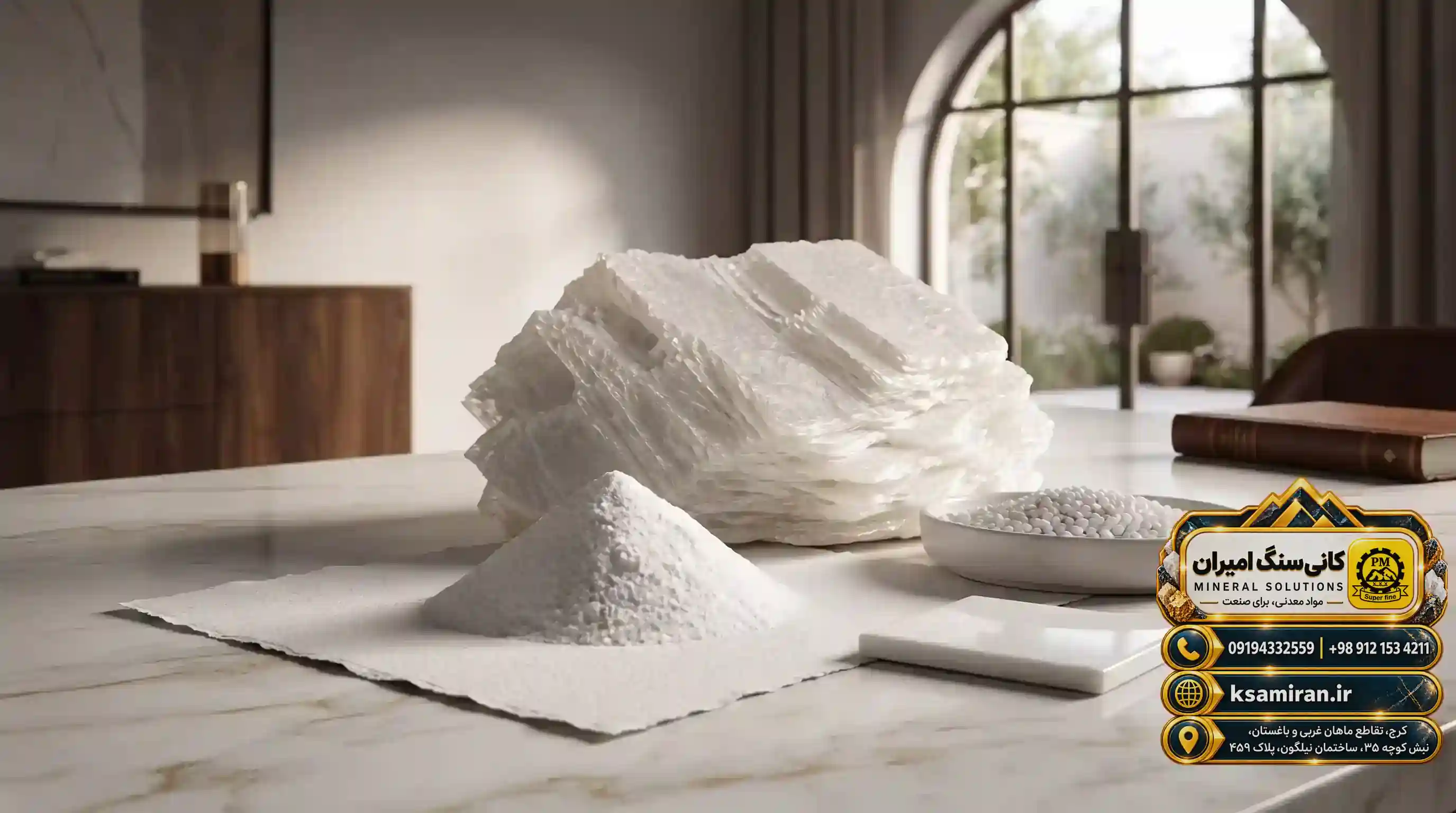
Talc is one of the world's best-known industrial minerals, chemically a magnesium silicate hydroxide, and its special layered structure gives it properties such as very high softness, a greasy surface, and hydrophobicity. On the Mohs hardness scale, talc is known as one of the softest natural minerals, and this feature makes it possible to grind it into fine particles with relatively low energy consumption. White talc is a category of this mineral with a high degree of whiteness and brightness, and its colored impurities are controlled; for this reason, it is the first choice of many factories in products where final appearance and color matter.
In the current market, this product is mainly introduced for masterbatch, compound, paint, paper, and ceramic products, and its mesh range varies from 450 to 2500 mesh. This breadth means the buyer can choose from relatively coarse to very fine particles, but by the same token, the risk of choosing an unsuitable grade for the production line also increases. Buying right here is a technical decision, not just a price comparison: its grade, particle size distribution, whiteness level, load uniformity, packaging type, and shipping method all affect the quality of the final product.
Kani Sang Amiran Project, as a producer of mineral materials, processes and supplies this product for various industries, and you can read its full details on the White Talc product page. The purpose of this article is to examine seven key points together before placing an order: understanding production line needs, choosing the mesh grade, checking whiteness and purity, specialized applications in masterbatch and compound, the material's role in paint, paper, and ceramics, evaluating the supplier and packaging, and finally the steps for price inquiry and ordering.
If you have no experience buying this mineral, this guide will help you ask the right questions from the supplier. If you are an old buyer, reviewing these seven points creates a new criterion for evaluating your current supplier. In either case, the expected outcome is a high-quality, uniform purchase tailored to your production line's needs.
One point you should pay attention to from the very begiing is that talc is not a completely standard and uniform product; its properties depend on the mine source, processing method, grinding intensity, and its grade. Two shipments with the same mesh grade can be completely different in terms of whiteness, oil absorption, and process behavior. Therefore, the buying guide you read below, instead of relying on a fixed number, teaches you an approach based on asking the supplier questions and requesting technical documents so that you can have a transparent technical conversation with any seller.
First Point: Know Your Production Line's Exact Needs Before Buying
The first and most important step before placing an order is understanding your own production line's needs. The most common reason for buyer dissatisfaction is not price; it's a grade that wasn't compatible with their process. Talc is a multipurpose mineral, and its behavior in each production line depends on that line's variables, so your buying criteria must be defined based on your own needs, not on what the supplier has in stock.
To start, raise these questions with your technical team: what exactly is your final product, and what role does talc play in it? Is it used merely as a filler and cost reducer, or are you pursuing goals like improving mechanical properties, controlling viscosity, preventing adhesion, or modifying the final surface? What is the process temperature and shear stress of your machinery, and what additives (oil, sulfur, coupling agents, flame retardants) are present in the formulation? The answers to these questions directly determine the choice of its grade and mesh grade.
A common mistake is for the buyer to copy their buying specifications from a competitor's product. What is suitable for one company's production line won't necessarily work for your line with different machines and formulations. Also, filtering suppliers based solely on price will result in nothing but buying material with unpredictable performance. Instead, first put your needs on paper and then look for a supplier who can meet those needs.
A practical tool for this stage is preparing a technical purchase request sheet that includes: the type of final product, the desired mesh grade or acceptable range, the minimum expected whiteness degree, packaging type and shipping unit, packaging standards for your line (e.g., printable bags with inteal ID), and storage conditions. This sheet gives you the ability to send your request transparently to multiple suppliers and evaluate their responses comparatively.
Finally, before ordering a high volume, request a test sample and trial it in your production line. Even if the technical specs are the same on paper, the actual behavior of the material in your machine is determined only by a small production trial. This is especially vital in industries where color change and rapid dispersion loss show themselves (like masterbatch and paint) and prevents a costly wrong purchase.
Second Point: Choose the Mesh Grade and Particle Size Distribution Correctly
The word "mesh" is actually a unit of measurement that refers to the number of holes per inch of screen; the higher the mesh number, the finer the particles. In the market, white talc is offered in the 450 to 2500 mesh range; i.e., from particles with dimensions of a few tens of microns to very fine particles. This wide range allows you to choose exactly the grade your process needs, but the responsibility of choosing correctly rests on the buyer's shoulders.
In practice, the mesh number alone is not a complete description of the particles. What determines the dispersion quality and final behavior of the material is the particle size distribution; i.e., the volume percentage of particles in each size range. Two powders with the same mesh number can have completely different distributions: one concentrated and uniform, and the other containing scattered coarse particles that create weak points in your process. For this reason, ask the supplier to send you the particle size analysis chart (usually by laser diffraction method) instead of just a number, and to specify values like D50 and D97.
The question arises whether finer is always better? The answer is no. In masterbatch and colored products, finer particles create better dispersion in the polymer matrix and increase final gloss; but in some paper and ceramic applications, or when excessive fineness causes lumping and increased viscosity, coarser grades might perform better. Moreover, being finer usually means more processing costs; so choosing particles much finer than your need just imposes extra costs.
Another related factor is the amount of fine powder or extra very small particles, which can affect flow behavior, bulk density, and oil absorption. These parameters have different criteria in various industries; so when inquiring, ask what distribution the proposed grade has and whether it's optimized for your application. An experienced supplier should be able to explain these parameters in technical language to you.
Finally, definitely request that the reported values in the test include the measurement method and device. The results of particle size analysis depend on the device, wet or dry method, and sample preparation. Without this information, comparing grades from two suppliers with each other might be misleading, and you might mistakenly evaluate a shipment as better or worse than reality.
Third Point: Check Whiteness, Brightness, and Chemical Purity
One of the most important factors of price and quality in white talc is its whiteness and brightness level. This mineral is known as white due to this very feature and is the first choice in products where final color matters. But whiteness is not a qualitative concept; it has two main indicators: Brightness, which is usually measured based on ISO or TAPPI standards and shows the percentage of light reflection at a specific wavelength, and Whiteness, which is a parameter based on the CIE Lab color space and describes the absolute whiteness of the sample.
The higher the amount of colored impurities, especially iron oxide and manganese compounds, the more the material's color shifts towards yellow, cream, or gray. This color change directly affects the final quality in products like white masterbatch, light colors, and white paper, and even a small amount of iron impurity can intensify the product's yellowness over time due to reactions in polymer processes. So if your final product is light, specify your minimum expected whiteness degree and mention it as a technical condition in the order.
Chemical purity is not limited to color. The presence of chlorides, sulfates, carbonates, and other materials can cause serious problems in some applications like industrial paints or ceramic products; for example, creating gas bubbles in the ceramic body or instability in the paint formulation. In polymer applications, the material's moisture and water absorption are also important, because moisture above the permissible limit causes hydrolytic degradation, bubbles, and granule quality loss in extruder processes.
The practical action at this stage is to ask the supplier to provide chemical analysis (XRF) results and whiteness and brightness measurements of the sample. Request these documents for subsequent shipments too, because whiteness and purity can vary from one shipment to another. If the supplier doesn't provide this information or only relies on verbal statements, you should exercise more caution.
In critical cases, you can refer the sample to an independent laboratory and then place the main order. The cost of this test is negligible compared to the risk of producing a low-quality shipment. Also keep in mind that higher whiteness doesn't always mean more suitability; if your application requires a matte color or a product with a natural look, paying extra for the highest whiteness grade might not make sense and just reduces your profit margin.
Fourth Point: Application in Masterbatch and Compound; What to Expect
Masterbatch and compound are among the most important consumer markets for white talc. In these industries, talc enters the formulation as a mineral filler and can have various roles: reducing formulation cost, improving mechanical properties, controlling shrinkage rate, increasing thermal resistance, and improving processability. But which of these roles matters in your product depends on the base polymer type, loading percentage, and other additives.
In masterbatch, good dispersion of talc in the polymer matrix is vital. If the particles don't disperse well, they show themselves as white spots, lines, or color loss in the final product. For this reason, choosing a grade with a suitable particle size distribution is one of the main factors of masterbatch quality. In addition, the lipophilic behavior of the talc surface and its oil and polymer absorption affect the melt viscosity and consequently the machine output and granule quality. If oil absorption is too high, viscosity rises and dispersion becomes harder; if it's low, the material might migrate in the machine and uniformity decreases.
A common comparison in this industry is choosing between talc and calcium carbonate. Both minerals are used as fillers, but talc, due to its layered structure and hydrophobic nature, creates better dispersion in polymers and performs differently in applications where mechanical properties and dimensional stability are important. Calcium carbonate usually has a lower price and is more suitable for high-volume applications. For further reading in this regard, you can study the Calcium Carbonate Order and Purchase Guide.
In masterbatch production, the bulk density of the powder and its flow behavior are also important. A powder with a very low density causes the feeding machine to be unable to introduce a constant amount of material into the extruder, resulting in loading percentage fluctuations. These fluctuations show themselves as color and property changes in the final product. Therefore, request that the supplier provide you with information regarding the bulk density and angle of repose of the proposed grade.
The final action at this stage is conducting a small production trial: produce a sample batch with your actual loading percentage, evaluate the dispersion, color, viscosity, and mechanical properties of the final product, and then place the main order. If you do this for every new supplier, you prevent buying shipments that look similar but perform differently.
Fifth Point: The Role of White Talc in Paint, Paper, and Ceramic Products
Besides the plastics industry, white talc has broad applications in three other important industries: paint, paper, and ceramics. Each of these industries has different expectations from this mineral, and these differences must be specified before buying. An excellent grade for paint is not necessarily a suitable grade for ceramics and vice versa.
In the paint industry, talc is used as an extender pigment; i.e., a material that fills the formulation volume while improving properties like coverage, mattness, and abrasion resistance. Due to its platy shape and surface greasiness, talc helps improve paint spraying on surfaces, prevent pigment settling, and increase the durability of the paint film. In architectural and industrial paints, the mesh grade and whiteness degree of talc directly affect the gloss and covering power of the final product.
In the papermaking industry, talc has multiple roles. It is used as a filler in paper mass and brings improved printability, brightness, and surface smoothness. Also, due to its property of absorbing organic materials, it is used in pitch control and preventing the accumulation of sticky materials on machines. In some processes, talc is also used in paper coating. High brightness and suitable particle size distribution are among the parameters the paper industry is extremely sensitive to.
In the ceramic industry, talc is used as one of the raw materials for the ceramic body and also in the production of specific types of technical ceramics. The presence of talc in the body can change the firing behavior, thermal resistance, and mechanical characteristics of the final product. In this application, the chemical composition and purity of the material are very critical, because impurities can cause color changes in the body, bubble formation, or even cracking at firing temperature.
The common point of these three industries is that each has its own standards and no single grade can be recommended for all of them. If you are a paint manufacturer, you should focus on mattness and dispersion; if you are in the paper industry, brightness and particle size distribution are your priorities; and if you produce ceramics, chemical composition and firing behavior are the most important factors. So when ordering, definitely state your industry to the supplier and ask them to choose the proposed grade based on that, not based on a general recommendation.
Sixth Point: Evaluate the Supplier, Packaging, and Transportation
After determining your required technical specifications, it's time to evaluate the supplier. In buying minerals, shipment consistency is often more important than price. A good supplier is one who can deliver a product with the same mesh grade, same whiteness, and same particle size distribution over several consecutive shipments. To investigate this, get information from previous buyers or samples of past shipments, and request that the quality control test results for each shipment be sent along with the load.
One of the key factors in evaluating a supplier is having a quality control line. Does the supplier have a laboratory for measuring particle size, whiteness, and moisture? Do they issue an analysis sheet for each shipment? Answering these questions distinguishes a long-term business partner from a one-time seller. Kani Sang Amiran Project, as a producer of mineral materials, is one of the options you can contact during evaluation and request technical product documents.
Packaging has a direct role in shipment quality. Talc powder must be packaged in bags that protect against moisture and contamination. The most common options are: polypropylene bags with an ier plastic liner (usually 25 kg), big bags or jumbo bags for bulk purchases, and standard pallets for easy transport. If your line requires a specific type of packaging (e.g., printable bags with inteal ID, or delivery without pallets), raise this before signing the contract, because changing packaging mid-contract is usually costly.
Storage and warehousing are also important: the powder must be kept in a dry, covered environment, and avoid placing pallets directly on damp ground. Also note that if you are a large factory buying multiple minerals, managing several minerals simultaneously requires careful plaing; for example, if buying white barite is on your agenda alongside talc, you can read the White Barite Bulk Order Guide for Large Factories for better order management.
Finally, write transportation and delivery transparently: shipping method, delivery time, and the supplier's responsibility in case of delay or damage to the load. Many commercial disputes arise not from the material's quality but from ambiguity in these items, and a clear contract is the simplest way to prevent them.
Seventh Point: Price Inquiry and Ordering; Final Steps
Now that you have specified your technical needs, evaluated the supplier, and clarified packaging and transport terms, it's time for price inquiry. A good inquiry is one that contains all the necessary technical information so the supplier can offer a real and accurate price. An inquiry that only includes the sentence "How much is talc?" will receive contradictory answers, because the price depends on the mesh grade, whiteness degree, packaging type, order volume, and delivery destination.
A complete inquiry should include: your product type and application, desired mesh grade (or acceptable range), minimum expected whiteness degree, packaging type (bag or jumbo), estimated volume per order, purchase frequency per month or year, delivery destination, and transport terms (ex-works or door-to-door). The more accurate this information, the more real and comparable the received price.
When placing the order, confirm these in writing: agreed technical specifications, sample test results (if done), packaging type, delivery time, shipping method, and payment terms. If you're looking for a standard method to track an order, you can read the White Talc Order and Purchase Price Inquiry Guide to follow the exact and optimized steps and use the correct communication chaels.
One important tip: if you are a new buyer, start with a sample order or a relatively small volume. After confirming quality and uniformity in two or three shipments, increase the purchase volume. This minimizes your risk and simultaneously gives the supplier the opportunity to better understand your needs. Buying high volumes without prior testing is a big risk that rarely pays off in the minerals market.
The summary of the seven key points of this guide is as follows: one, know your production line's needs precisely; two, choose mesh grade and particle size distribution based on need; three, check and document whiteness and chemical purity; four, clarify your expectations for masterbatch and compound application; five, match the grade with your industry (paint, paper, or ceramics); six, evaluate the supplier, packaging, and transport; and seven, do the price inquiry with complete information and start with a sample order. If you follow these seven steps, your purchase will no longer be an accident, but a data-driven decision based on the real needs of your business.
| Question | Answer |
|---|---|
| What is white talc? | Talc is a magnesium silicate hydroxide with a layered structure, used in various industries due to its high softness, greasy surface, and high whiteness degree. |
| What is the mesh range of this product? | This product is offered in the 450 to 2500 mesh range. |
| Which mesh grade is suitable for my application? | It depends on the application; in masterbatch and paint, finer meshes are usually more suitable, while some paper and ceramic applications may need coarser meshes. Discuss this with the supplier. |
| What are the main applications of white talc? | Masterbatch, compound, paint, paper, and ceramic products. |
| Why is talc whiteness important? | Because it directly affects the final color of the product; impurities like iron oxide cause product yellowness. |
| What is the difference between talc and calcium carbonate? | Talc has a layered and hydrophobic structure and creates better dispersion in polymers; calcium carbonate is usually more economical for high-volume applications. |
| What is the standard packaging for this product? | 25 kg bags with an ier liner and jumbo bags (Big Bag) are the most common options. |
| How do I inquire about the price? | By sending technical specifications including mesh grade, whiteness, packaging type, volume, and delivery destination to the supplier. |
| Are product samples provided? | Discuss this and the conditions for receiving a test sample directly with your desired supplier. |
| How should this material be stored? | Stored in a dry, covered environment, on pallets, and away from direct moisture. |
The technical specifications and applications of this product have been published on the product sheet of the Kani Sang Amiran Project (Kani Talc).
برچسب: White Talc,White Talc Buying Guide, Seven Key Points Before Placing an Order,
نویسنده: رساوب آفرین