
درباره سایت
آخرین مطالب
- Review of the Application of Limonite Oxide (Gol Mash) in Various Industries
- دراسة تطبيق أكسيد الليمونيت (غول ماش) في مختلف الصناعات
- بررسی کاربرد اکسید لیمونیت (گل ماش) در صنایع مختلف
- کائولن باکیفیت کانی سنگ امیران برای کاغذ و رنگ مش 450 تا 1500
- استعلام قیمت فلدسپات صنایع لعابسازی از وبسایت کانی سنگ
- تالک صنعتی و کاتالوگ فنی برای صنایع رنگ و لاستیک
- کربنات کلسیم ۲۰۰۰ مش با ذرات کنترلشده برای پروفیل UPVC
- فلدسپات مناسب کانی سنگ با دانهبندی یکنواخت کاشی درجه
- کربنات کلسیم ۱۲۵۰ مش با ترکیب شفاف برای کابل صنعتی
- تالک صنعتی مناسب صنایع پلیمر با دانه بندی دقیق و کنترل شده
امکانات وب
What is coated calcium carbonate?
Coated calcium carbonate (Coated Calcium Carbonate) is one of the most widely used minerals in the construction industry, playing the role of a modified mineral filler in polymer systems. This material is actually ground calcium carbonate (GCC) whose particles are covered during a stage of the production process with a thin layer of organic materials, usually fatty acids such as stearic acid. This coating converts the particle surface from its natural hydrophilic state to a hydrophobic state, and as a result, significantly improves their compatibility with non-polar polymer matrices.
Calcium carbonate, with the chemical formula CaCO3, is one of the most abundant mineral compounds in the Earth's crust and is processed in two general ways: ground calcium carbonate (GCC), which is obtained by crushing and grinding limestone, and precipitated calcium carbonate (PCC), which is produced through chemical processes. In compounds, granules, and polymer parts that are widely used in the construction industry, the ground type is mainly used; because its lower production cost, high whiteness, and availability of resources have made it an economical option.
But why do we need coated calcium carbonate? Calcium carbonate particles in their natural state have polar and hydrophilic surfaces that show a strong tendency to absorb moisture and agglomerate. This characteristic in polymer processes, which involve high temperature and shear stress, leads to problems such as poor dispersion, increased melt viscosity, and a drop in mechanical properties. By applying an organic coating, these problems are largely eliminated and the particles disperse much better in the polymer matrix.
In fact, it can be said that coated calcium carbonate is a bridge between the mineral world and the polymer world; a bridge without which the use of high amounts of filler in industrial formulations would be almost impossible. This very feature has made this product an inseparable part of the supply chain of factories producing compound, granule, profile, cable, flooring, and PVC parts.
In the Kani Sang Amiran project, coated calcium carbonate for compound, granules, and polymer parts is selected with a suitable mesh, and its mesh range covers 450 to 3500 mesh. In the rest of the article, we will fully examine the technical fundamentals, production process, mesh selection criteria, and applications of this material so that you have a clear perspective for decision-making in your construction projects.
What is the production process of coated calcium carbonate?
The production of coated calcium carbonate involves several continuous stages, starting from the extraction of limestone and ending with milling, classification, and finally the coating operation. Understanding these stages helps buyers and formulators to better distinguish the quality differences between various products and make the right choice.
The first stage is the selection and extraction of limestone with high purity and desirable whiteness. The extracted stones, after initial crushing, enter successive mills to be reduced to particles of the desired size. In mode systems, ball mills and air classifiers are used to achieve a uniform size distribution. Controlling the particle size distribution at this stage is very critical, because particle uniformity directly affects dispersion in the polymer and, consequently, the final properties of the part.
After reaching the desired size, it is time for the key stage, i.e., coating. At this stage, calcium carbonate particles are mixed with fatty acids or their metal salts under controlled temperature and conditions. The reaction between the carboxyl groups of the fatty acid and the surface of the mineral particles forms a layer of calcium stearate on each particle. The thickness and uniformity of this layer are considered an important indicator of the coating process quality.
The mechanism of effectiveness of this coating is simple but ingenious: the polar head of the fatty acid molecule attaches to the mineral particle surface, and its long hydrocarbon chain faces outward. This arrangement makes the particle surface hydrophobic and compatible with non-polar polymer matrices such as PVC, polyethylene, and polypropylene. The practical result of this is reduced adhesion of particles to each other, better powder flow, reduced moisture absorption, and more uniform dispersion in the polymer melt.
The quality of coating can be evaluated with indicators such as the degree of coverage, layer uniformity, final product moisture, and dispersion tests in the polymer. A high-quality coating, while maintaining mechanical properties, allows the use of high percentages of filler in the formulation, and this means reducing the final product cost without a drop in quality.
Finally, the coated product is packaged after quality control and prepared for storage. The quality of the coating process plays an important role in the price and final performance, and choosing a manufacturer with a controlled process will guarantee quality consistency across different shipments.

Mesh range 450 to 3500 and the importance of particle size selection
One of the most important technical parameters in choosing coated calcium carbonate is its particle size, which is expressed in the industry with the "Mesh" unit. The mesh number refers to the number of openings in each inch of the screen; the higher the mesh number, the finer the particles. The coated calcium carbonate offered in the Kani Sang Amiran project covers a mesh range of 450 to 3500 to meet the diverse needs of different industries.
But why is particle size so important? The filler particle size directly affects several key characteristics: dispersion in the polymer matrix, final surface quality of the part, mechanical strength, oil and resin absorption rate, and melt flow behavior. In general, coarser particles (lower meshes) are more suitable for applications that require high volumetric filling and only moderate surface aesthetics, while finer particles (higher meshes) are used for products with a glossy surface, thin walls, and high physical strength.
For a better understanding, we divide this range into three general categories:
- Intermediate meshes (around 450 to 800 mesh): Relatively coarser particles, suitable for thick parts, pipes, UPVC profiles, and applications where surface aesthetics is not the first priority.
- Fine meshes (around 1000 to 1500 mesh): Suitable for general compounds, polymer granules, floorings, and parts that require a relatively good surface.
- Very fine meshes (1800 to 3500 mesh): Suitable for delicate parts, thin-walled cables, and products that require a very glossy surface and high strength.
An important point is that mesh selection must be done based on the final product's needs; using an inappropriate mesh can lead to a drop in properties, process problems, or uecessary cost increases. It should also be noted that in the production process, finer is not always better; very fine particles have a greater tendency to clump and require more energy for dispersion. Here, the importance of the organic coating is doubled, because proper coating creates acceptable dispersion even with very fine particles.
Therefore, when ordering, be sure to consult with a technical expert about the final product, production method (extrusion, injection, calendar), and formulation so that the most suitable mesh is selected. Choosing the right mesh means finding the balance point between price, surface quality, and mechanical properties of your construction product.
Application of coated calcium carbonate in polymer compound and granules
Polymer compounds are the beating heart of the plastics industry, and coated calcium carbonate is one of the most important components of their formulation. In the compound production process, the filler is mixed with the polymer, stabilizers, lubricants, and other additives in twin-screw extruders to obtain a homogeneous granule. The produced granule is then converted into final parts in various factories.
The main role of coated calcium carbonate in the compound is to reduce the final cost alongside maintaining and even improving product properties. This material can account for a significant share of the formulation weight, thereby reducing the consumption of expensive polymer. But this is not the only benefit:
- Melt viscosity control: The organic coating allows particles to slide better in the polymer melt and keeps the melt viscosity within the desired range.
- Improved dispersion: Uniformity of the filler in the matrix prevents the creation of concentrated stress points and a drop in impact strength.
- Increased production line speed: Reduced adhesion and improved flow facilitate the exit of the product from the mold and increase line speed.
- Reduced moisture absorption: Coated particles absorb less moisture, which is critical for the process stability of sensitive compounds.
In the production of polymer granules, the uniformity of the dimensions and weight of the granules is very important so that a uniform feed flow is maintained in downstream machines. Coated calcium carbonate helps this uniformity by improving powder flow properties and reducing clumping, and as a result, granules with a uniform shape and size are produced.
In addition, this filler can improve the physical properties of the granule and the final part: increased hardness, compressive strength, dimensional stability, and reduced shrinkage are among the results obtained by using this material. As a result, parts made from these granules in the construction industry, such as profiles and floorings, will have a longer lifespan.
To study this field in more depth, read the article Familiarity with the application of coated calcium carbonate in the plastics industry.
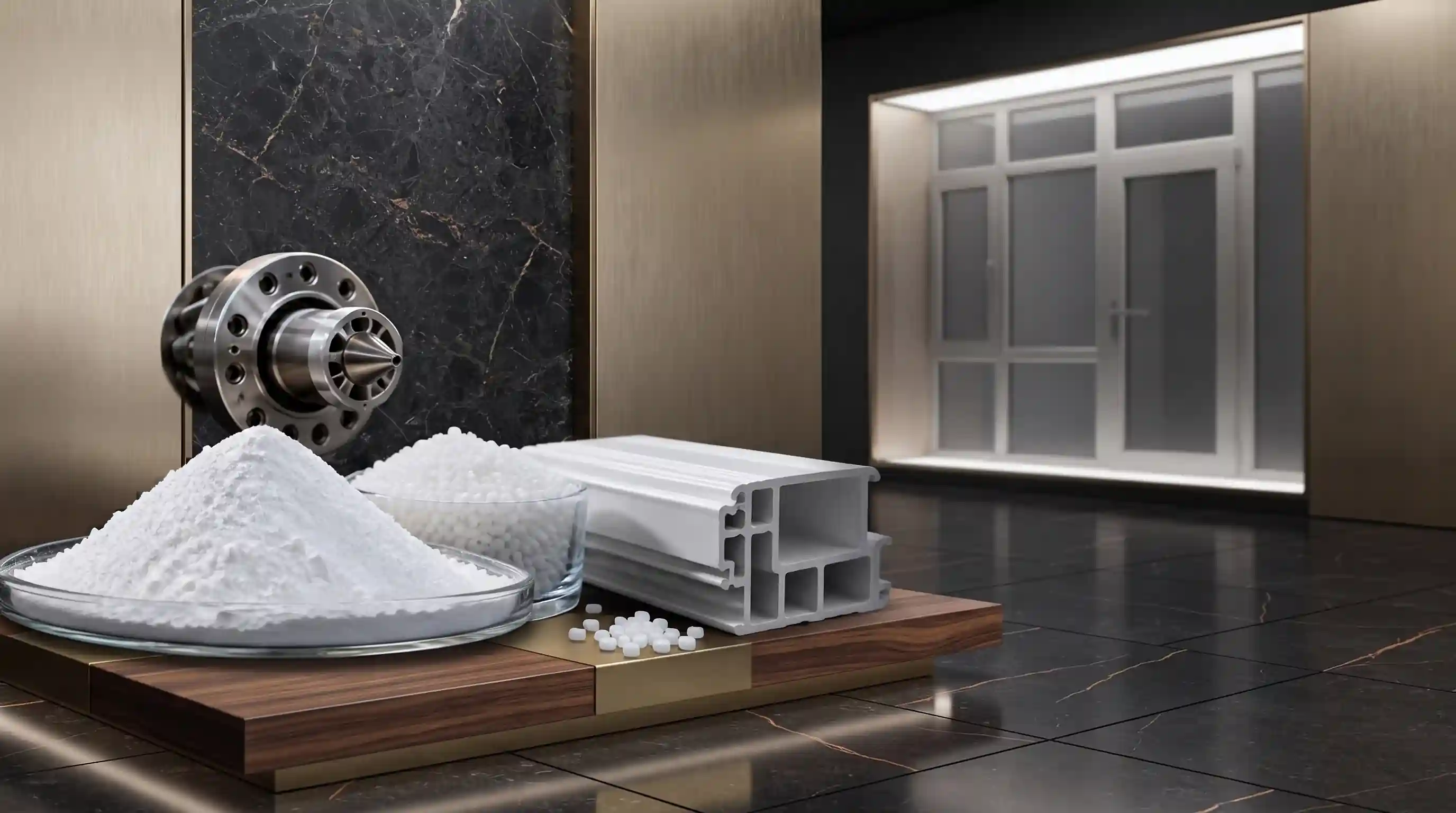
Application of coated calcium carbonate in profiles, cables, flooring, and PVC parts
The construction industry is the main consumer of many products made with coated calcium carbonate. In this chapter, we examine four main applications of this material that play a key role in construction projects.
1. UPVC profiles
UPVC profiles such as window frames and sashes, doors, facades, and separation systems are major consumers of coated calcium carbonate. In this product, the filler must be able to account for a high share of the formulation weight without dropping vital mechanical properties. The organic coating of the particles allows the filler to disperse well in the PVC matrix, and the profile surface to be smooth and flawless at the end of the work. Also, the thermal resistance and dimensional stability of the profile are improved, which is vital for windows exposed to daily temperature changes.
2. Cables
In the cable industry, coated calcium carbonate is used in cable insulation and sheathing compounds. Cable insulation must have a uniform surface, appropriate flexibility, and stable properties. Coated particles, with uniform dispersion, help maintain these properties while reducing the cost of the compound. For thin-walled cables, higher meshes are usually used so that the ier and outer surfaces of the insulation remain smooth and uniform.
3. Floorings
Polymer floorings and floor tiles are products where both aesthetics and wear resistance are important. Coated calcium carbonate in these products acts as a filler that, while reducing costs, increases hardness and resistance to pressure and wear. Choosing the right mesh is very important in flooring, because coarse particles can cause a drop in surface quality and reduce the commercial value of the product.
4. PVC parts
Various PVC parts such as fittings, cable chaels, socket boxes, and decorative parts are all produced using coated calcium carbonate. In these parts, which are usually produced by extrusion or injection methods, the filler must be compatible with the production line speed and the final surface must be glossy. Proper coating facilitates the exit of the part from the mold and reduces the need for exteal lubricants.
In all these applications, there is one common theme: coated calcium carbonate plays the role of a "multi-purpose material" that both reduces costs and improves product performance. This very duality is the main reason for the popularity of this material in the construction industry and its high consumption volume worldwide.
Economic and technical advantages of coated calcium carbonate in the construction industry
The use of coated calcium carbonate in the construction industry brings numerous advantages, which can be examined in two general categories: technical and economic. Understanding these advantages helps factory managers and formulation designers make better decisions.
Economic advantages
- Reduced raw material cost: Polymers are the most expensive component of the formulation, and replacing a part of them with coated calcium carbonate leads to a significant cost reduction.
- Increased production speed: Improved melt flow and reduced adhesion increase the production line speed, which means higher efficiency and lower hourly line cost.
- Reduced energy consumption: In some processes, improved heat transfer due to the presence of mineral filler reduces the time required for heating and cooling.
Technical advantages
- Improved mechanical properties: Hardness, compressive strength, and dimensional stability of the part increase with the presence of mineral filler.
- Reduced shrinkage and warping: Parts made with filler shrink less upon cooling and have more precise dimensions.
- Glossy surface: High-quality coated particles give the product a smooth and uniform final surface, which is very important for building decorative parts.
- Better thermal and chemical resistance: The presence of mineral filler improves the part's behavior against heat and common chemicals in construction.
In addition to direct applications in polymer parts, coated calcium carbonate is also used in the production of paints and building coatings. If you are interested in this field, read the comprehensive guide on using coated calcium carbonate in paint making.
From a sustainability perspective as well, using mineral filler instead of polymer can reduce the environmental impacts associated with polymer production. Products filled with good dispersion have high recyclability and will remain valuable in the secondary production cycle. This issue is aligned with the growing trend of green building and mode environmental standards.
Ultimately, the true value of coated calcium carbonate lies in its "balance": a product that not only reduces costs but also guarantees the quality of the final product by maintaining key properties. This balance is the basis for designing many successful industrial formulations in the construction industry.

Storage, warehousing, and quality control of coated calcium carbonate
Even the highest-quality coated calcium carbonate can lose some of its performance if not stored properly. Despite the hydrophobic coating, this product is still vulnerable to relentless moisture and environmental contaminants. In this chapter, we review the key points of storage and warehousing.
The general principles of storage are as follows: the product must be kept in a dry, covered place with proper ventilation, the bags placed on pallets and at a distance from the ground, direct sunlight and proximity to heat sources must be avoided, and if the packaging is opened, it must be consumed or completely re-closed in the shortest possible time. Observing the "First In, First Out" (FIFO) principle also prevents old product from remaining in the warehouse.
Alongside physical conditions, preventing contamination is also important: coated calcium carbonate should not be stored near reactive chemicals, acids, or colored materials that could affect its whiteness and purity. Also, contact with dirty tools or low-quality wood can degrade the shipment's quality.
Upon receiving each shipment, initial quality control is recommended: checking the match of the ordered mesh range with the received product, checking for the absence of hard clumps, whiteness uniformity, moisture check, and if possible, a dispersion test in the laboratory on a small sample of your formulation. These simple measures can prevent production line stoppages and heavy losses.
From a safety perspective as well, this product is considered an inert mineral material; however, like any other fine powder, long-term inhalation of its dust must be avoided. The use of an appropriate mask, safety glasses, and local ventilation when opening bags and pouring the product into the hopper is recommended.
For supplementary information in this regard, read the comprehensive guide to the storage and warehousing of industrial coated calcium carbonate.
Guide to choosing the right coated calcium carbonate and conclusion
Choosing the right coated calcium carbonate is a decision that must be made based on the exact needs of the final product and the production process. In this chapter, we review the most important criteria you should consider.
- Type of final product: Is your product a UPVC profile, cable, flooring, injection part, or general granule? Each of these products requires a different mesh and filler percentage.
- Processing method: Extrusion, plastic injection, or calendar; each method has different shear stress and residence time, and this affects the choice of mesh and coating quality.
- Desired surface quality: The glossier the surface required, the higher the mesh that must be used.
- Loading percentage: If you intend to use a high percentage of filler, the importance of coating quality is doubled.
- Supplier quality consistency: Uniformity between shipments is critical to prevent frequent adjustment of formulation and machine parameters.
It is recommended that before buying in high volume, you definitely take a sample and perform dispersion and mechanical property tests in your laboratory. This minimizes project risk. To examine the specifications of this product and choose the mesh suitable for your compounds, granules, and polymer parts, you can visit the coated calcium carbonate page.
In conclusion, coated calcium carbonate is a material that, by combining the characteristics of an abundant mineral and an ingenious organic coating, has become one of the main pillars of the construction industry. By reducing costs, improving mechanical properties, facilitating the production process, and increasing surface quality, it adds significant value to producers of compound, granule, profile, cable, flooring, and PVC parts. Understanding concepts such as the coating mechanism, choosing the right mesh, and storage principles helps you to get the most out of this material and to offer products with better quality and price in the competitive market of the construction industry.
We hope this guide has helped you to better understand this material and make the right decisions in your construction projects. For technical consultation and choosing the mesh suitable for your needs, stay in touch with the experts of the Kani Sang Amiran project.

| Question | Answer |
|---|---|
| What is coated calcium carbonate? | It is ground calcium carbonate whose particles are covered with a layer of fatty acids (such as stearic acid) to make its surface hydrophobic and more compatible with polymer matrices. |
| What is the difference between coated and uncoated calcium carbonate? | The uncoated type has a hydrophilic surface that absorbs moisture and disperses less in the polymer; the organic coating in the coated type solves these problems. |
| What is the mesh range of coated calcium carbonate? | The mesh range of this product is 450 to 3500 mesh to cover the diverse needs of compounds, granules, and polymer parts. |
| What are the main applications of this product? | Compound, polymer granules, profiles, cables, flooring, and PVC parts are among its main applications in the construction industry. |
| Why is mesh selection important? | Particle size directly affects dispersion, surface quality, melt viscosity, and mechanical properties; the higher the mesh, the finer the particles. |
| What advantage does coated calcium carbonate have in compounds? | Cost reduction, improved dispersion, melt viscosity control, reduced moisture absorption, and increased production line speed are among its main advantages. |
| Which mesh is suitable for UPVC profiles? | For UPVC profiles, intermediate meshes (around 450 to 800 mesh) are usually used; the final selection should be made in consultation with a technical expert. |
| How is this product stored? | It is stored in a dry and covered place, on pallets, away from direct sunlight and reactive chemicals, observing the FIFO principle. |
| Does coated calcium carbonate absorb moisture? | The organic coating greatly reduces moisture absorption, but prolonged contact with moisture and water should still be avoided. |
| How do I choose the right mesh for my product? | Based on the type of final product, processing method, and desired surface quality, choose the most suitable mesh by consulting the supplier's technical expert. |
Source: Technical specifications and product applications presented by the Kani Sang Amiran Project (ksamiran.ir).

برچسب: Coated Calcium Carbonate,What is Coated Calcium Carbonate? A Guide to Its Application in the Construction Industry,
نویسنده: رساوب آفرین