
درباره سایت
آخرین مطالب
- استخدام أكسيد الليمونيت (الماغش) في صناعات الزجاج
- کاربرد اکسید لیمونیت (گل ماش) در صنایع شیشهسازی
- A Review of Daily Prices for Limonite Oxide (Ocher) in the Market
- چگونه خالص بودن اکسید لیمونیت (گل ماش) را تشخیص دهیم؟
- بررسی قیمت روز اکسید لیمونیت (گل ماش) در بازار
- Application of Limonite Oxide (Gole Mash) in Glassmaking Industries
- كيف تتعرف على نقاء أكسيد الليمونيت (جول ماش)؟
- How to Determine the Purity of Limonite Oxide (Gol Mash)?
- بررسی استانداردهای ایمنی کار با اکسید لیمونیت (گل ماش)
- Comprehensive Guide to Technical Analysis of Limonite Oxide (Gol Mash)
امکانات وب
Introduction to the Importance of Coated Calcium Carbonate in the Door and Window Profile Industry
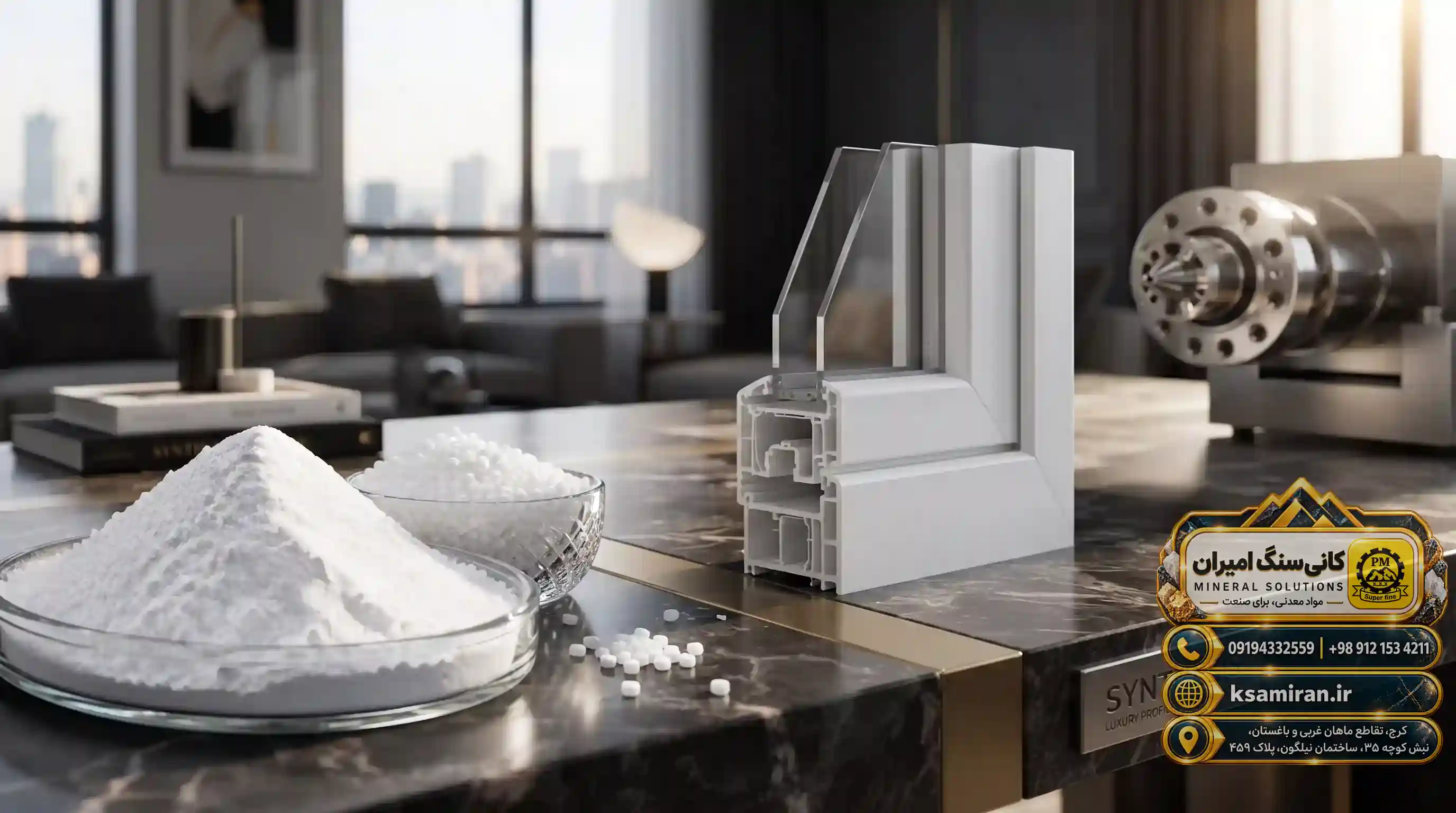
The door and window profile production industry is one of the advanced and strategic fields in the polymer and construction industries, requiring high precision in formulation and selection of raw materials. Meanwhile, the use of high-quality mineral fillers plays a key role in improving the mechanical, dimensional, and economic properties of final products. The key mineral material that has recently attracted the attention of many engineers and manufacturers is coated calcium carbonate, which with its surface coating has created a significant transformation in this industry.
Kani Sang Amiran Project, understanding the precise needs of polymer industries, has offered this mineral material with standard technical specifications. When it comes to the production of UPVC profiles and rigid polymer parts, the compatibility between the polymer matrix and mineral filler becomes doubly important. Precise selection of raw materials can guarantee the long-term durability of profiles against harsh weather conditions.
To become more familiar with the performance and specifications of this product, you can visit the dedicated page of coated calcium carbonate to obtain complete information about its mesh range and applications. The physical and chemical properties of this material are such that it easily fits into complex formulations of engineering polymers.
Door and window profile manufacturers are always looking for solutions to reduce production costs without compromising quality. The use of this processed mineral material not only helps optimize costs but also significantly enhances the appearance and impact resistance of profiles.
The Role and Importance of Coated Calcium Carbonate in Profile Polymer Compounds
The compounding process is the beating heart of building profile production. At this stage, various raw materials including PVC resin, stabilizers, lubricants, and fillers are combined to form a homogeneous granule ready for extrusion. The presence of coated calcium carbonate in these formulations acts as an agent for improving melt flow and uniform distribution.
To better understand the role of this material in related industries, it is recommended to read the specialized article Getting to Know the Application of Coated Calcium Carbonate in the Plastics Industry. The fatty acid coating on the particles of this filler reduces the inteal friction force between polymer chains and mineral particles.
This unique feature causes the granules obtained from the compound to have better rheological properties during the extrusion process. As a result, the profiles exiting the machine die will have a smooth, shiny surface, free of any irregularities or particle accumulation.
Kani Sang Amiran Project prepares this product in such a way that it has the greatest compatibility with various compound and polymer granule formulations, which in tu maximizes the efficiency of production lines.
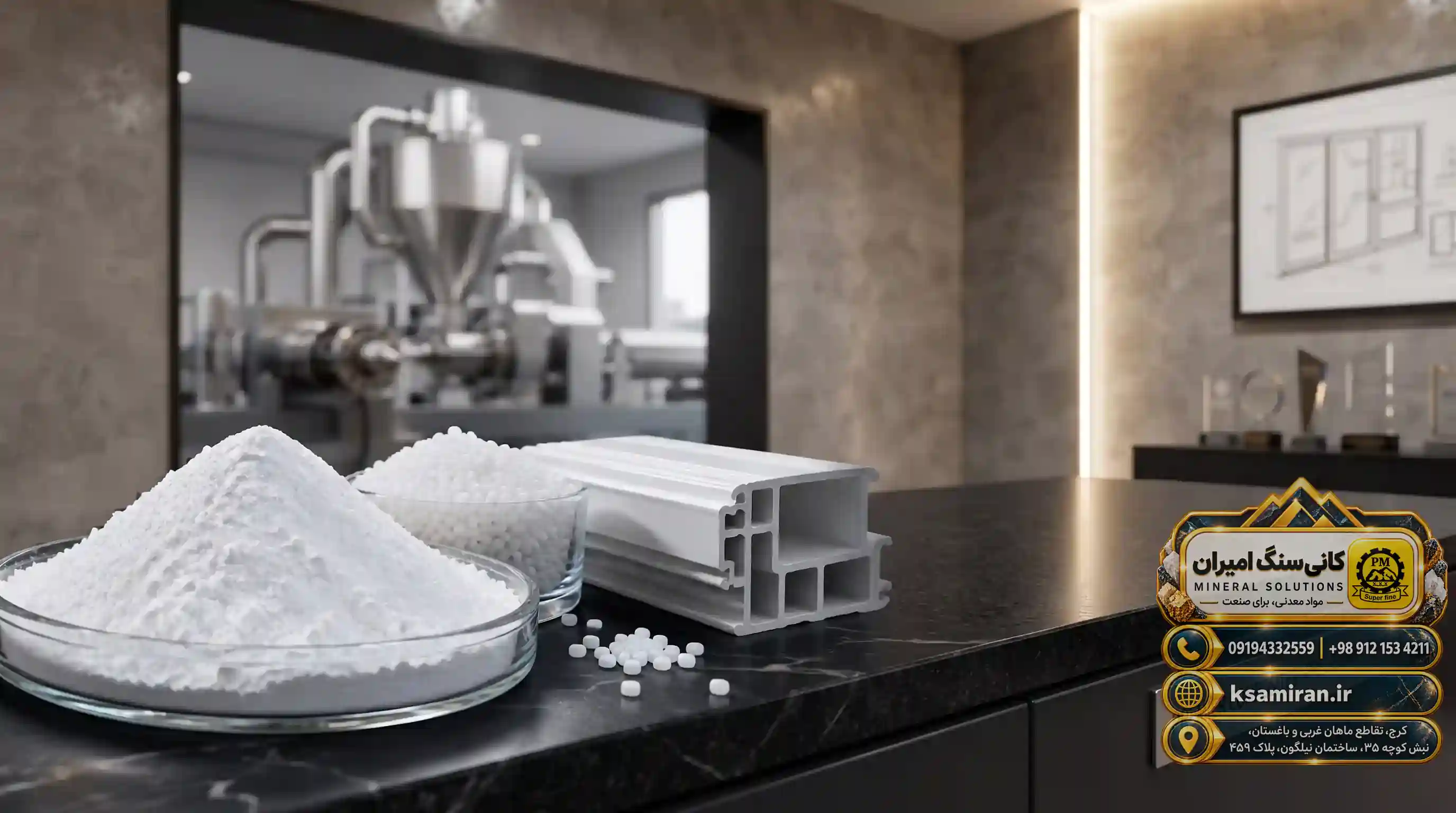
Examining the Mesh Range and Its Impact on the Quality of Door and Window Profiles
One of the most important technical parameters in selecting mineral materials is the particle size or mesh grading. The mesh range of 450 to 3500 is known as the standard range for various polymer applications. Choosing the right mesh depends directly on the type of part and the wall thickness of the door and window profile.
For a more accurate analysis of this issue and making the right choice, reading the article Examining the Standard of Mesh Grading in Types of Coated Calcium Carbonate provides valuable information to industry practitioners. Finer particles with higher meshes create more contact surface with the polymer matrix, thereby improving mechanical properties.
In the production of door and window profiles that require high mechanical resistance and dimensional stability against temperature fluctuations, the use of appropriate meshes is of vital importance. The particle size distribution should be such that it prevents particle accumulation and creates a uniform dispersion throughout the entire polymer volume.
Production engineers, using the products offered by Kani Sang Amiran Project, can ensure that the mesh grading used is selected exactly in accordance with the stringent standards of the profile-making industry.
Technical and Economic Comparison of Various Fillers in the Plastics Industry
In the polymer industries, the choice between regular (uncoated) calcium carbonate and processed versions has always been one of the challenging topics. The coated type, due to having a layer of fatty acid (usually stearic acid) on the particle surface, exhibits completely different behavior compared to the regular type, and this difference is very evident in the profile production process.
To obtain specialized information and a comprehensive comparison, it is suggested to refer to the article Specialized Guide to Comparing Types of Coated Calcium Carbonate Available in the Market. This comparison helps manufacturers make the best decision based on their technical needs.
Processed particles, due to their hydrophobic property, do not tend to agglomerate inside the polymer matrix. This feature causes the oil absorption rate to decrease, and as a result, the possibility of increasing the filler loading percentage without degrading the impact properties of the profile is provided.
From an economic perspective as well, Kani Sang Amiran Project, by providing high-quality products, makes it possible for door and window profile factories to reduce finished production costs, without the structural quality of final products being affected.
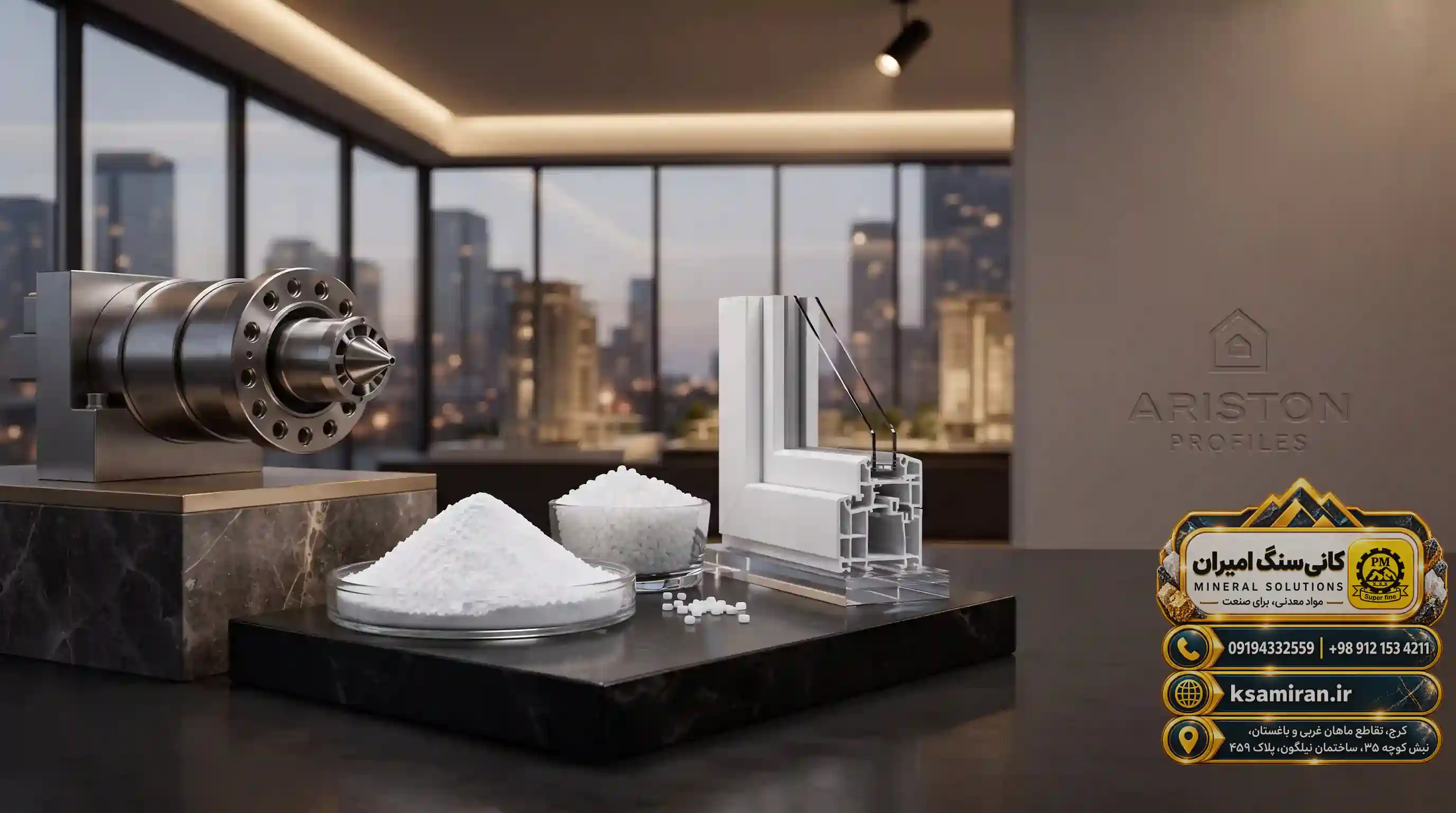
The Impact of Coated Calcium Carbonate on the Mechanical and Dimensional Resistance of Profiles
Door and window profiles must show high resistance against mechanical pressures caused by installation, wind blowing, and severe temperature changes. Adding coated calcium carbonate to the polymer formulation increases the elastic modulus and significantly improves the dimensional stability of the profile.
The surface coating present on the particles creates stronger bonds between the filler and PVC resin. This helps better stress transfer from the soft polymer matrix to the rigid mineral particles, and as a result, increases resistance to impact and bending.
In addition, the linear shrinkage of parts during cooling after the extrusion process is reduced, which prevents warping or deformation of the produced profiles over time.
Kani Sang Amiran Project, by supplying premium raw materials, gives manufacturers the opportunity to supply profiles with high quality standards and very precise dimensional tolerances to the consumer market.
Optimizing the Extrusion Process and Reducing Machinery Wear
The door and window profile extrusion process requires continuous and uninterrupted operation of machinery. One of the common problems when using unprocessed mineral fillers is increased melt viscosity and wear of the inteal parts of the extruder and die, which increases repair and maintenance costs.
By using coated calcium carbonate, due to the surface lubricating property caused by the fatty acid coating, the friction of the melt with the cylinder walls and screw is reduced. This feature causes the material movement to become smoother and reduces the back pressure of the die.
Reducing the extrusion pressure and temperature not only increases the lifespan of equipment and dies but also significantly optimizes the energy consumption of the production line.
Relying on the products of Kani Sang Amiran Project, manufacturers can take a big step towards increasing the productivity of production lines, reducing unwanted stoppages, and improving the final quality of door and window profiles.
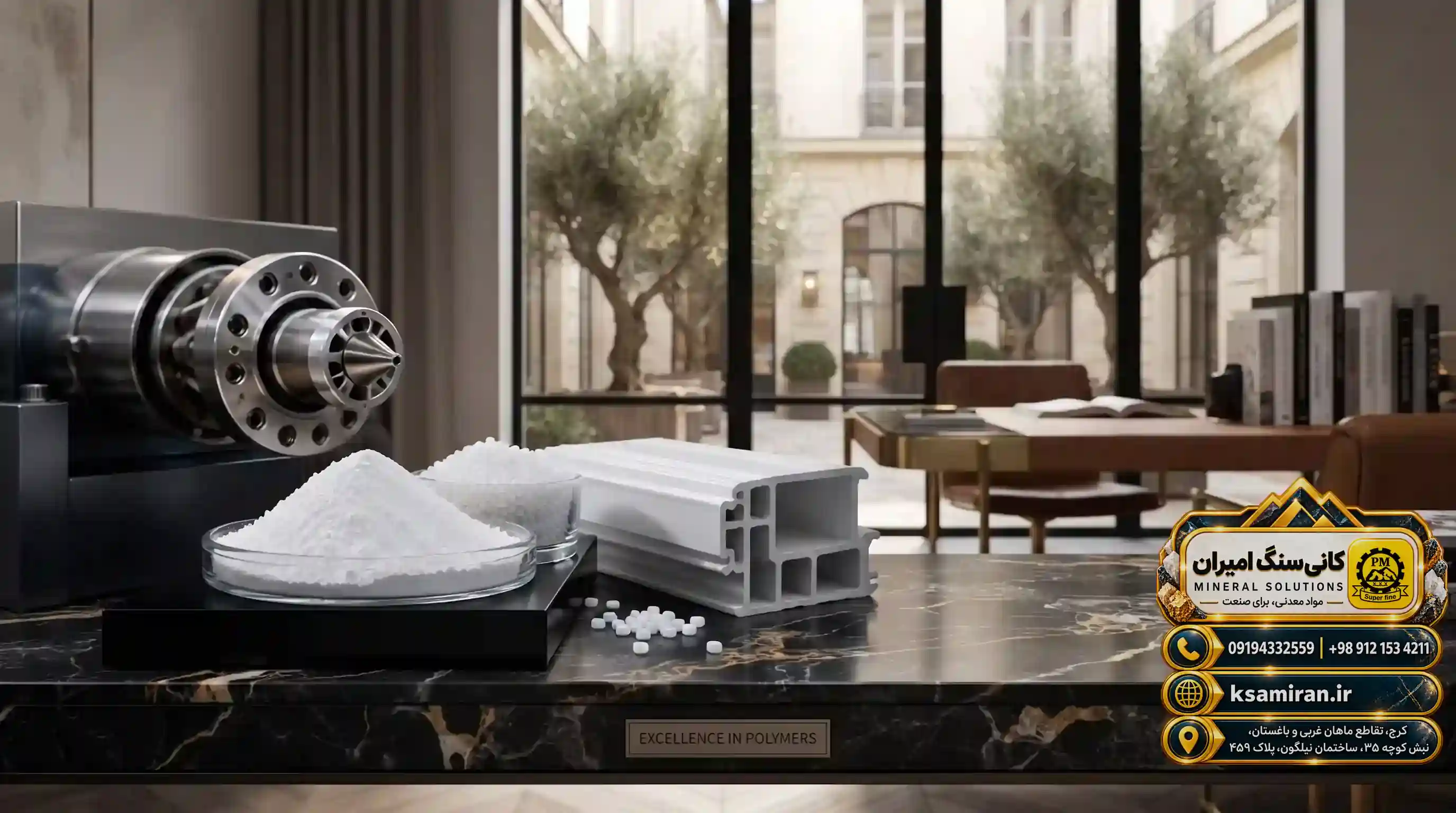
The Role of Coated Calcium Carbonate in Improving Appearance Quality and Final Durability
The appearance of the door and window profile is the first feature evaluated by customers and construction inspectors. Any surface defect, scratch, peeling, or dull color can severely reduce the commercial value of the product. The presence of coated calcium carbonate, due to uniform distribution and lack of agglomeration, creates a completely even and polished surface.
The surface coating of this material prevents unwanted reactions and improves the color stability of the profile against the ultraviolet (UV) radiation of the sun. This prevents yellowing or structural degradation of the profile in hot or suy regions.
Focusing on grading quality and the precise coating process, Kani Sang Amiran Project offers a product to the market that has excellent application in the production of building facade parts and sensitive profiles.
Long-term durability against various weather conditions, moisture resistance, and maintaining visual beauty over years of use are among the competitive advantages of using this processed mineral material.
Conclusion and Future Outlook for the Consumption of Coated Calcium Carbonate in the Construction Industry
The door and window profile production industry, in line with the advancement of construction technologies, requires the use of raw materials that simultaneously meet quality needs, environmental standards, and economic justification. Technical reviews show that coated calcium carbonate, as an efficient solution, has consolidated its position as an inseparable component in polymer formulations.
Precise selection of the appropriate mesh range (from 450 to 3500) and the use of high-quality processed raw materials is the main key to success for manufacturers in today's competitive markets. This material has been able to elevate profile production standards by improving mechanical properties, easier processability, and enhancing appearance quality.
Kani Sang Amiran Project, by continuing to supply and offer premium mineral products, plays an active role in supporting the polymer, compound, flooring, and profile industries of the country.
Given the growing demand for high-quality and durable products in the construction industry, the use of this advanced filler is becoming more widespread day by day, painting a bright outlook for improving the quality of domestic products.
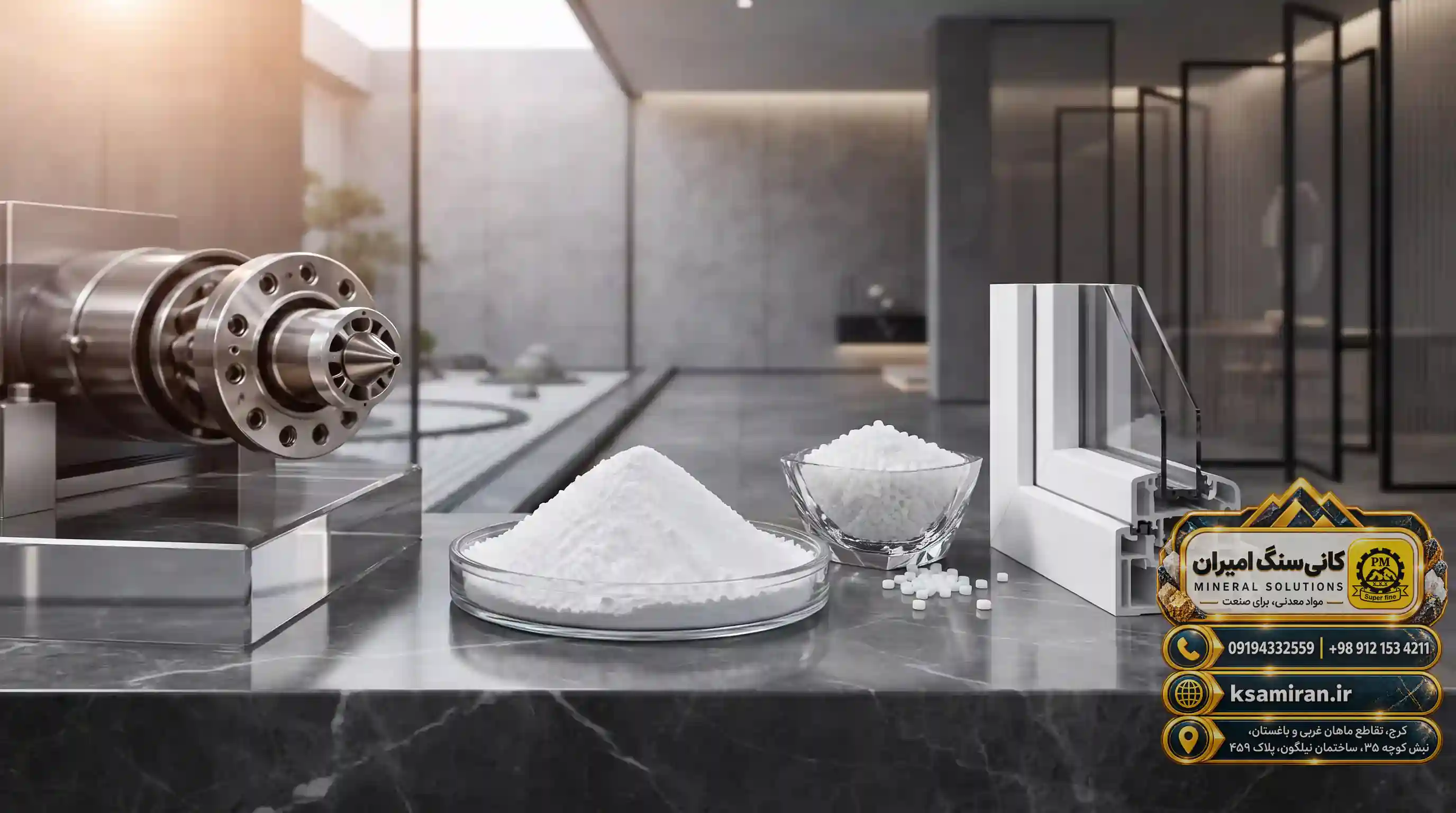
| Question | Answer |
|---|---|
| What is coated calcium carbonate? | It is a type of natural calcium carbonate whose particle surface is coated with a layer of fatty acid to find better compatibility with polymers. |
| What is the mesh grading range of this product? | This product is offered in the mesh range of 450 to 3500, suited to the needs of the polymer industries. |
| What are the main applications of this material? | Compound, polymer granules, door and window profiles, cables, flooring, and PVC parts. |
| Why is the coated type more suitable for profiles? | Due to reduced inteal friction, improved melt flow, and increased resistance to impact and moisture. |
| Does using this filler reduce production costs? | Yes, by allowing an increase in the filler loading percentage without quality loss, it helps optimize costs. |
| What is the role of the fatty acid coating? | Creating hydrophobicity and preventing particle agglomeration in the polymer matrix. |
| What is the effect of this material on the appearance of the profile? | It creates a smooth, shiny, and even surface in extruded profiles. |
| Does this product affect the extrusion process? | Yes, it reduces extruder pressure, reduces machinery wear, and lowers energy consumption. |
| Which company offers this product? | Kani Sang Amiran Project — Mineral Materials Production. |
| How can more information be obtained? | By visiting the dedicated product page on the Kani Sang Amiran website. |
Specialized mineral and polymer reference of Kani Sang Amiran Project
برچسب: Coated Calcium Carbonate,Specialized Application of Coated Calcium Carbonate in the Door and Window Profile Industry,
نویسنده: رساوب آفرین