
درباره سایت
آخرین مطالب
- Review of the Application of Limonite Oxide (Gol Mash) in Various Industries
- دراسة تطبيق أكسيد الليمونيت (غول ماش) في مختلف الصناعات
- بررسی کاربرد اکسید لیمونیت (گل ماش) در صنایع مختلف
- کائولن باکیفیت کانی سنگ امیران برای کاغذ و رنگ مش 450 تا 1500
- استعلام قیمت فلدسپات صنایع لعابسازی از وبسایت کانی سنگ
- تالک صنعتی و کاتالوگ فنی برای صنایع رنگ و لاستیک
- کربنات کلسیم ۲۰۰۰ مش با ذرات کنترلشده برای پروفیل UPVC
- فلدسپات مناسب کانی سنگ با دانهبندی یکنواخت کاشی درجه
- کربنات کلسیم ۱۲۵۰ مش با ترکیب شفاف برای کابل صنعتی
- تالک صنعتی مناسب صنایع پلیمر با دانه بندی دقیق و کنترل شده
امکانات وب
What is Industrial Talc? A Complete Introduction to This Widely Used Mineral
Industrial talc is one of the most important and widely used non-metallic minerals in the world, utilized across a vast array of industrial sectors. This material is actually a hydrated magnesium silicate, whose general chemical formula is expressed as Mg3Si4O10(OH)2. Talc forms in nature as a metamorphic mineral and is typically found alongside minerals such as chlorite, dolomite, and magnesite. In its pure state, this material is usually white, greenish-white, or light gray, and its most important physical property is its extreme softness—so much so that on the Mohs scale, talc is known with a hardness grade of one.
But what exactly is meant by industrial talc? In fact, this term refers to the grades and classifications of talc that are prepared for use in industrial processes, as opposed to pharmaceutical, cosmetic, and sanitary talcs which require a very specific level of purity and processing. Industrial talc is classified based on the degree of milling and particle size, and its unit of measurement in the market is "mesh". As the mesh number increases, it means that the talc particles have become finer, and as a result, more cross-sectional surface area is available for reaction and mixing with other materials.
The product introduced in this article is industrial talc with a mesh range of 450 to 1000 mesh, which is selected for polymer, rubber, paint, and other industrial applications. This mesh range indicates that the product is suitable both for applications requiring fine-grained mineral fillers and for processes aiming to improve the mechanical and surface properties of the final product. The selection of this range by the manufacturer is made based on market needs and the production process.
One of the main reasons for the importance of industrial talc is its unique combination of properties. This material is simultaneously soft, lubricating, chemically inert, electrically non-conductive, and heat resistant. This very combination has made talc the first choice in places where other fillers do not perform well. In addition, talc is white-colored and therefore does not interfere with the final color in the production of colored and bright parts.
In the rest of this article, we will become more familiar with the exact properties of industrial talc, how it works in each of the polymer, rubber, and paint industries, the importance of particle size, and finally, a buying guide. The goal is for you to understand with a complete and scientific perspective why this simple mineral is so vital in mode industries.
Physical and Chemical Properties of Industrial Talc That Make It Special
To understand why industrial talc is used so extensively in various industries, we must know its physical and chemical properties. These properties, combined with the very fine particles of this mineral, create unique behavior in production processes.
1. Softness and layered structure: Talc is the softest known mineral on the Mohs scale. The reason for this softness is the layered structure of its crystal; the silicate layers slide easily over each other, and this feature tus talc into a natural lubricant and anti-wear agent. In the production processes of polymeric and rubber parts, this property helps reduce friction between particles and improve melt flow.
2. Electrical and thermal non-conductivity: Talc is a very good insulator for electricity flow and also a suitable thermal insulator. This property is very important in the production of electrical polymeric parts, cable coating, and parts exposed to temperature. Talc also maintains its chemical stability at high temperatures.
3. Chemical neutrality: Talc is resistant to weak acids and bases and does not show chemical reactions. For this reason, it is used in formulations where unwanted reactions between materials must be controlled, such as paints and coatings. This neutrality makes talc highly compatible with color receptors and resins.
4. White color and transparency: The light color of talc means that in the production of white or colored products, the amount of pigment consumption decreases and the visual quality of the final product increases. This issue is very important in the paint industry as well as in decorative polymeric parts.
5. Greasiness and oil absorption: Talc has a greasy surface that makes it combine well with oils and resins. This property in the rubber and polymer industry results in better dispersion of particles and prevents the formation of masses and lumps. The finer the particle size (like the 450 to 1000 mesh range), the better and more uniform this dispersion occurs.
6. Anti-stick property: Talc prevents materials from sticking to each other and to the mold, and as a result, it is used as a mold release agent in many industries. It also plays a role in preventing polymer granules from sticking to each other during melting and injection.
The combination of these properties makes industrial talc not only a cheap and accessible filler but also a functional active material; meaning a material that does not just fill volume but improves the characteristics of the final product. This very difference distinguishes talc from other mineral fillers such as calcium carbonate or barite.
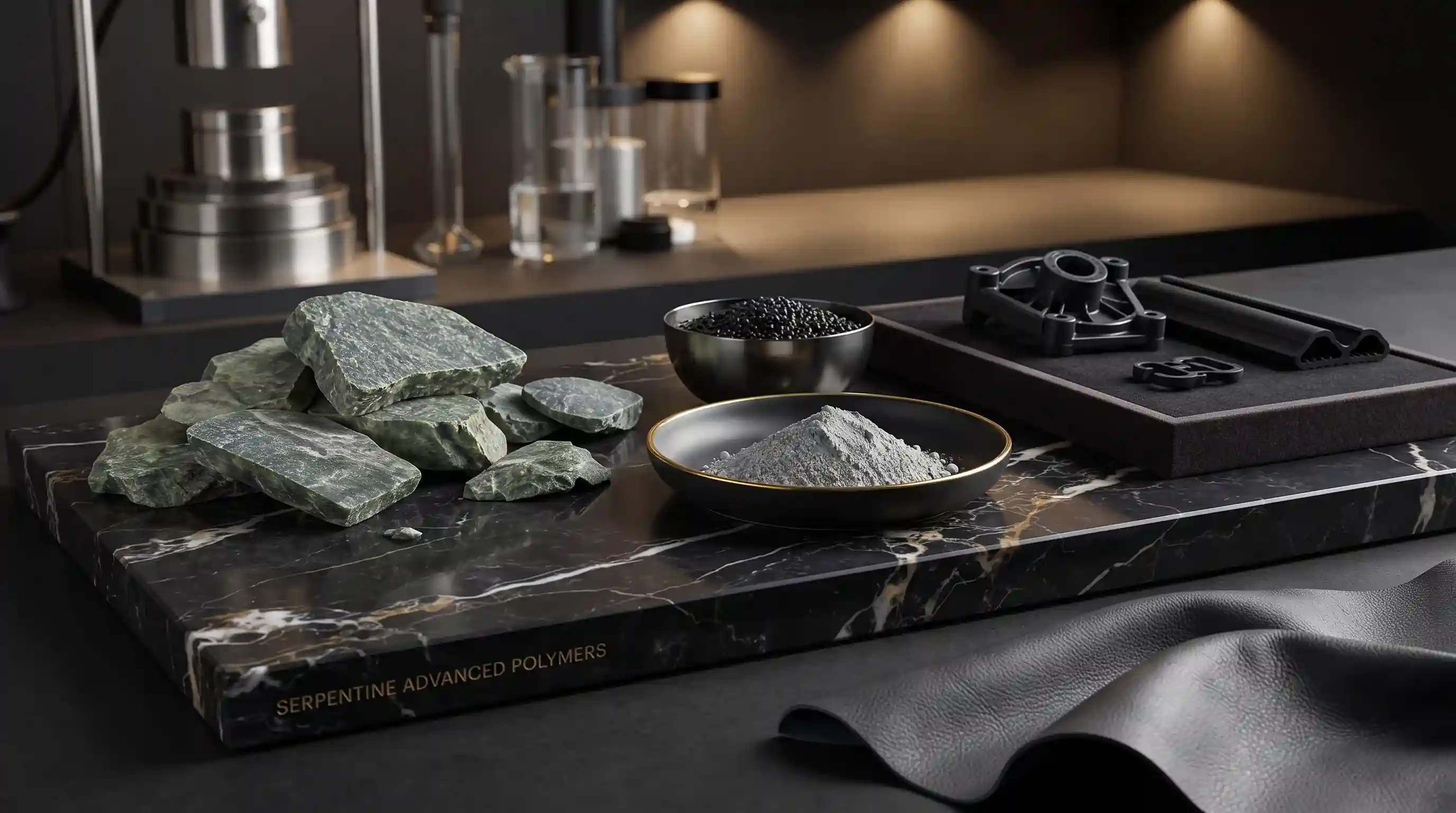
Industrial Talc in the Polymer and Plastics Industry
The largest consumer market for industrial talc in the world is the polymer and plastics industry. In this industry, talc is used both as a filler and as a reinforcing and functional agent. In the production of various polypropylene, polyethylene, PVC, and engineering compound parts, talc is one of the main raw materials.
One of the most important applications of talc in polymers is increasing stiffness and flexural strength. Talc particles are sheet-like, and when properly dispersed in the polymer matrix, they act as a reinforcer and increase the mechanical strength of the part. For this reason, talc is a well-known option in the production of automotive parts, home appliances, engine compartments, and structural parts.
In addition, industrial talc, due to its layered structure, reduces the shrinkage caused by polymer cooling and increases the dimensional stability of the final part. This property is vital in parts that have precise dimensional tolerances. Talc also improves the heat resistance and electrical non-conductivity of polymers, and as a result, the resulting parts become more suitable for electronic and electrical applications.
Another reason for the widespread use of talc in the plastics industry is its effect on production rate. By reducing friction and improving melt flow, talc increases the speed of the production line and consequently raises the overall efficiency of the equipment. Also, the anti-stick property of talc prevents polymer from sticking to molds and extends the life of the molds.
An issue of great importance here is the particle size of talc. The product introduced in this article is industrial talc in the range of 450 to 1000 mesh. In polymer compounds, the finer the particles, the better the dispersion in the matrix and the more uniform the resulting mechanical properties. Finer particles also create a glossier surface and higher visual quality in the final part. On the other hand, choosing the exact mesh depends on the type of polymer, the production method (injection, extrusion, or molding), and the required properties of the final part.
Industrial talc is also used in combination with masterbatch colors and polymeric additives. Its white color causes pigments to disperse better and the final color of the part to look uniform and transparent. This very issue has given talc a special place in the production of light-colored home appliances and decorative parts.
Finally, it should be noted that using talc as a mineral filler can reduce part of the need for pure resin and thus optimize the cost of the formulation. This issue has high economic importance in the mass production of polymeric parts.
Application of Industrial Talc in the Rubber Industry
The rubber industry is another major consumer of industrial talc. In the production of various car tires, hoses, belts, gaskets, foam rubbers, and technical rubber parts, talc is widely used. The reason for this extensive use is a combination of lubricating, filling, and appropriate chemical behavior properties of talc in the vulcanization process.
In the rubber production process, talc particles act as an anti-stick agent. This property has two important applications: first, during the mixing and shaping process, it prevents rubber from sticking to rollers and equipment surfaces, resulting in the production line operating at higher speed and efficiency. Second, in final products like car tires, it prevents the ier surfaces of the tire from sticking together during storage and transportation.
Industrial talc also acts as a filler in rubber, increasing the volume of the product without a severe drop in quality. Talc particles, by creating a reinforced structure in the rubber matrix, improve abrasion and tear resistance to some extent. Although talc is not a reinforcing filler to the extent of silica or carbon black, in combination with these materials it can create a good balance of mechanical properties and formulation cost.
One interesting application of talc in rubber is its use as a surface coating agent on raw rubbers and semi-finished tires. The talc coating keeps the rubber surface dry and non-sticky, allowing it to be easily stored and transported. This application is especially common in the production of radial tires and profiled rubber parts.
Regarding particle size selection, the range of 450 to 1000 mesh is suitable for many rubber applications. Finer particles in this range create better dispersion in the rubber compound and prevent the formation of weak points in the final product. Also, fine particles create a smoother surface and higher visual quality in delicate rubber products like gaskets and thin strips.
In addition, talc plays an important role in foam and sponge rubbers. In these products, talc helps stabilize the cellular structure of the foam and prevents gas bubbles from collapsing during the curing process. The result is a foam product with a uniform cellular structure and suitable mechanical properties.
Since talc is neutral, it does not chemically interfere with sulfur- or peroxide-based vulcanization systems, and as a result, curing parameters such as scorch time and full cure time remain under control. This is very important for tire factories that need process stability.

The Role of Industrial Talc in Paint and Coatings Production
The paint and surface coatings industry is another major area of industrial talc consumption. In the production of architectural paints, industrial paints, oil-based and water-based paints, talc is known as a functional filler and a useful additive. The role of talc in paint goes beyond filling volume and has positive effects on the properties of the paint film and its performance over time.
One of the most important roles of talc in paint is preventing sagging and dripping of paint on vertical surfaces. The sheet-like particles of talc align parallel in the paint film and create a layered structure that prevents the downward movement of oil and solvent. The result is a uniform, drip-free coating on walls and large surfaces. This property is especially important in high-thickness architectural paints.
Industrial talc also increases the paint's resistance to moisture and water. The layered structure of this mineral makes the path of water penetration long and difficult, and as a result, the paint film becomes more resistant to moisture, blistering, and peeling. For this reason, talc is used in exterior building paints, protective industrial paints, and waterproof coatings.
Alongside these cases, talc has a greasy property and helps better dispersion of pigments in the formulation. This makes the final paint look more uniform and increases its covering power. In addition, talc prevents the paint from settling and hardening during storage, thus preserving the paint's re-stirring capability in the can.
In industrial and anti-corrosion paints, talc, due to its chemical neutrality, is compatible with resins and corrosion inhibitors, resulting in protective coatings with a long lifespan. Also, the electrical non-conductivity of talc is utilized in paints for electronic equipment and insulating coatings.
The particle size of talc is very important in the paint industry. The product examined in this article is industrial talc in the range of 450 to 1000 mesh. Particles in this range are suitable for producing high-quality paints; because the finer the particles, the higher the gloss of the paint film, the smoother the surface, and the better the pigment dispersion. Finer particles also prevent scratches on the painted surface and raise the final quality of the coating.
Finally, the white color of talc helps reduce the consumption of expensive pigments like titanium dioxide. This material can take on part of the whitening function of the paint while also improving the physical properties of the paint film. This makes talc a vital material in the formulation of today's paints.
Other Industrial Applications of Industrial Talc
In addition to the polymer, rubber, and paint industries, industrial talc is used in many other fields. This breadth is due to the unique properties of this mineral, which have tued it into a multi-purpose material. In this chapter, we examine the most important of these applications.
1. Adhesives and sealants: Talc is used in the production of adhesives and sealants. Its layered structure improves dispersion, controls viscosity, and increases moisture resistance. In silicone-based sealants and industrial adhesives, talc helps stabilize the formulation and improve mechanical properties after drying.
2. Tiles, ceramics, and gypsum: Talc is used in the ceramic and tile-making industry because it improves the properties of ceramics at high temperatures and increases their heat resistance and dimensional stability. Also in the gypsum and building materials industries, talc plays an important role in improving product properties. If you want to gain more information in this field, read the article The Role of Industrial Talc in the Gypsum and Building Materials Industries.
3. Refractory materials: Due to its high heat resistance and chemical neutrality, talc is used in the production of refractory materials and fire-resistant coatings. This material can maintain its structure at high temperatures and prevent the degradation of parts.
4. Lubrication and dry lubricants: Due to its softness and layered structure, talc is used as a dry lubricant in industrial processes. Where the use of oil and grease is not permitted, talc is a suitable alteative for reducing friction.
5. Papermaking: Talc is used in the papermaking industry as a filler and in paper surface coating. This material increases the stiffness, greasiness, and print quality of the paper, resulting in a product with a desirable appearance.
6. Cables and insulation: Due to its electrical non-conductivity and heat resistance, talc is used in the production of cable coating and insulation compounds. In vinyl cable coatings, talc is used both as a filler and as an anti-stick agent.
7. Agriculture and fertilizers: Talc is used in the production of some types of fertilizers as an anti-caking agent and particle coating. This material prevents fertilizer particles from sticking together, and as a result, their shelf life and usability over time are preserved.
8. Soundproofing and insulation: Talc is also used in some sound and thermal insulation applications. Its layered structure causes sound and thermal energy to be well dissipated within the material.
This list shows that industrial talc is a multi-purpose mineral present anywhere in industry where a combination of softness, chemical neutrality, heat resistance, and white color is needed. The product produced with a mesh range of 450 to 1000 mesh can meet many of the needs of these industries.
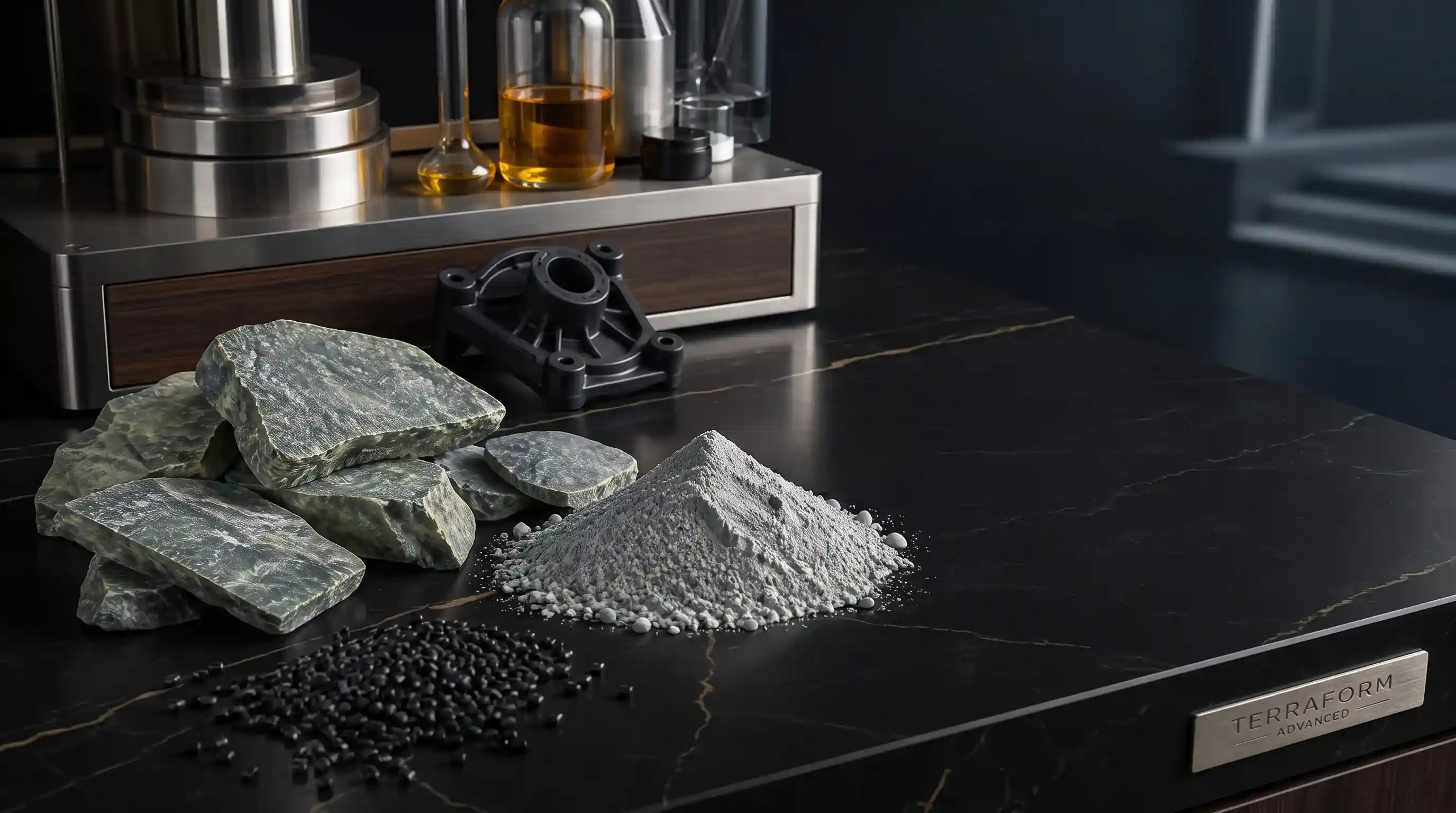
The Importance of Mesh Size and Quality Control of Industrial Talc
One of the most important parameters in choosing industrial talc is the particle size, or the mesh number. This parameter has a direct effect on the behavior of talc in production processes and the quality of the final product. In this chapter, we examine the concept of mesh and its importance.
The mesh unit actually indicates the number of holes in one square inch of the sieve. For example, when we say talc is 450 mesh, it means this material has passed through a sieve with 450 holes per square inch. As the mesh number increases, the particle size becomes smaller. As a result, the range of 450 to 1000 mesh indicates a product made of very fine particles.
But why is particle size so important? The first reason is the cross-sectional area. The finer the particles, the greater their contact surface with other materials. In chemical and physical processes, this means faster reaction and better combination. In the polymer industry, this means better dispersion of talc in the matrix and consequently more uniform mechanical properties.
The second reason is surface quality. In paints and coatings, finer particles create a smooth and glossy surface. In polymeric parts too, finer particles create a smoother final surface and reduce the need for secondary processing.
The third reason is flow and processability. Finer particles in many cases entail better flow in extrusion and injection equipment. Also in paints and adhesives, finer particles show less settling and maintain the uniformity of the formulation over time.
The range of 450 to 1000 mesh specified for this product indicates a high-quality product with precise processing. Producing such a product requires advanced milling equipment and controlled classification systems. Quality control at this level involves continuous checking of particle size distribution, color, moisture, and purity.
In addition to particle size, other factors are also important in the quality control of industrial talc. The color of the product must be uniform and white, because yellow or gray color can affect the quality of the final product. Moisture must also be controlled, because high moisture can cause talc to lump and disrupt the production process. Also, the level of impurities such as iron oxide must be within the permissible limit.
Packaging and transportation are also part of the quality control process. Talc must be packaged in such a way that it does not absorb moisture and contamination during transport and storage. Also, precise labeling stating the product specifications helps the consumer choose the right product for their needs.
Finally, it should be mentioned that choosing the right mesh is a technical decision that must be made based on the needs of each industry and each product. Consulting with experts and experienced suppliers can be a useful guide in this regard.
Industrial Talc Buying Guide and Final Points
If you intend to buy industrial talc, it is better to consider a few key points before deciding. In this chapter, we discuss the most important issues a professional buyer should know.
1. Specify your needs precisely: The first step in purchasing is determining the exact need. You must know which industry you want talc for, at which stage of the process it is used, and what properties you expect from it. For example, talc used for architectural paint might be different from the talc needed in engineering polymer compounds.
2. Choose the right mesh: As we said, particle size has a direct effect on talc's performance. The product introduced in this article is offered in the range of 450 to 1000 mesh, which is suitable for polymer, rubber, and paint applications. If you have doubts about choosing the mesh, consult with technical experts.
3. Check the product quality: Be sure to ask the supplier to provide complete information about the product; including particle size distribution, color, moisture, and production method. A reputable supplier provides this information transparently. To view specifications and submit a purchase request, you can visit the Industrial Talc product page.
4. Submitting an online purchase request: Today, many professional buyers carry out the mineral material purchasing process online. This method is fast and transparent. If you want to get familiar with how to submit an online purchase request, read the article Industrial Barite Online Purchase Request Guide. This guide is also usable for purchasing other minerals including talc.
5. Know the market and price: The mineral market is influenced by various factors. Knowing the market trend helps you make a better purchase. To better understand this, read the article Examining the Industrial Barite Market Trend and Its Export Future. This article provides good insight into how the mineral market moves and the factors affecting it.
6. Choose a reliable supplier: Industrial talc should be bought from a supplier who has advanced production equipment, precise quality control, and industry experience. Kani Sang Amiran Project is one of the mineral material producers that has these characteristics.
7. Storage conditions: After purchase, talc must be stored under suitable conditions. A dry, moisture-free environment is ideal. Also, avoid direct contact with contaminated and chemical materials. Opened packages must be closed well so the product quality is preserved.
In the end, we hope this article has been able to provide you with a comprehensive view of industrial talc, its properties, and applications. This simple but widely used mineral is present in many products we use every day, and knowing it can help make better decisions in the purchasing process.
| Question | Answer |
|---|---|
| What is industrial talc? | Industrial talc is a type of hydrated magnesium silicate mineral processed for industrial applications such as polymers, rubber, and paint. |
| In which industries is industrial talc used? | Its main applications include polymeric products, rubber products, paint, and other industrial uses such as adhesives, ceramics, and papermaking. |
| What is meant by the mesh number in talc? | Mesh indicates particle size; the higher the mesh number, the finer the particles. The range of 450 to 1000 mesh means a fine-grained, high-quality product. |
| What role does industrial talc play in polymers? | Talc acts as a filler and reinforcer, improving the stiffness, dimensional stability, heat resistance, and production speed of polymeric parts. |
| Why is talc used in rubber? | Talc prevents rubber from sticking, improves dispersion, and helps stabilize the cellular structure in foam rubbers. |
| What is the application of industrial talc in paint? | Talc prevents paint from dripping, increases moisture resistance, and improves pigment dispersion. |
| What is the difference between industrial talc and cosmetic talc? | Cosmetic talc requires very high purity and special processing, whereas industrial talc is processed for the technical needs of various industries. |
| How do we choose the right industrial talc? | You must specify the industry, production process, and appropriate mesh, and ask the supplier for complete product specifications. |
| What factors affect the quality of industrial talc? | Particle size, color uniformity, moisture level, and purity are the main quality-determining factors. |
| How should industrial talc be stored? | Talc should be stored in a dry, moisture-free environment, away from contaminated and chemical materials. |
The product specifications in this article are taken from the official product page on the Kani Sang Amiran Project website: https://ksamiran.ir/products/industrial-talc/

برچسب: Industrial Talc,What is Industrial Talc? Learn Its Applications in Various Industries,
نویسنده: رساوب آفرین