
درباره سایت
آخرین مطالب
- انتخاب اکسید آهن قرمز (اخرا) برای بهبود کیفیت پیگمنت و پوششهای رنگی
- تامین کربنات کلسیم با دانهبندی دقیق جهت استفاده در مستربچ
- تأمین تخصصی سیلیس برای مصالح ساختمانی، شیشه و صنایع سرامیک
- ویژگیهای فنی بنتونیت کانی سنگ امیران برای کاربردهای خاص
- فلدسپات کانی سنگ امیران برای شیشه کاشی و سرامیک
- کاربرد تالک سفید درجه یک در فرمولاسیون پیشرفته رنگ و محصولات کاغذی
- اکسید آهن قرمز (اخرا) کاربردی جهت تولید محصولات سرامیکی و پوشش
- مشخصات فنی اکسید آهن قرمز (اخرا) مناسب برای پوشش و تولید پیگمنت
- مشاوره تخصصی خرید کربنات کلسیم بر اساس نیاز دقیق صنعت شما
- انتخاب تالک سفید صنعتی مناسب برای تولیدات کاغذ و مستربچ
امکانات وب
What is Industrial Talc?
Industrial talc is one of the most important non-metallic minerals in today's industry, known chemically as "hydrated magnesium silicate." The chemical formula of this substance is Mg3Si4O10(OH)2, and it has a distinct layered structure. The reason for many of talc's unique characteristics, from its extreme softness to the greasy feel of its surface, lies in this layered structure. In nature, this mineral is found as rock masses in areas with hydrothermal alteration, and after extraction, through crushing, grinding, and classification processes, it is tued into a white powder marketed in various particle size distributions.
The term "industrial talc" actually specifies the commercial grade of this mineral; meaning a product processed based on the technical needs of various industries. The main difference between industrial talc and pharmaceutical/cosmetic grades lies in its purity level, degree of processing, surface treatment method, and of course, final particle size distribution. Industrial talc is produced to optimally meet the technical specifications of polymer, rubber, paint, and other industrial applications, without drastically increasing the final product cost.
After processing, talc exhibits characteristics such as softness, whiteness, high thermal stability, chemical neutrality, and lubricity. This combination of properties has made this mineral a strategic additive in production lines. Industries seeking to improve final product quality, reduce consumption of expensive materials, and increase process efficiency often consider talc as a cost-effective solution.
In the polymer, rubber, and paint industries, industrial talc not only acts as a simple mineral filler but operates as an "active filler," positively altering the mechanical, thermal, and optical properties of the product. This very fact is the main reason for the difference in price and quality among various types of talc in the market; because the more precise the processing and the higher the purity, the greater the performance of the final product.
In Iran, there are significant reserves of talc rock, and multiple production units are active in processing this mineral. "Amiran Stone Mineral Project" is one of the mineral material producers supplying industrial talc with a particle size range of 450 to 1000 mesh, aimed at application in polymer, rubber, paint, and other industrial products. Selecting this particle size range indicates the manufacturer's familiarity with the technical needs of industries that demand very fine and uniform talc particles.
In the rest of this article, we will examine in detail the structure and characteristics of industrial talc, the factors determining its quality, and the role of this material in each of the main industries, so that readers intending to select and purchase this product can make a decision with a technical and precise perspective.
Structure and Basic Characteristics of Industrial Talc
To understand the quality of industrial talc, we must first know its structure. Talc is a layered silicate in which a magnesium hydroxide layer is placed between two silicate layers. Adjacent layers are coected by weak van der Waals bonds, which allows these layers to slide easily over one another. This structural feature is the main reason for talc's greasy and slippery feel, as well as its extreme softness; with a hardness of one on the Mohs scale, talc is considered the softest known mineral on this scale.
One of the most important chemical characteristics of industrial talc is its neutrality. This mineral resists most acids and bases and has low chemical reactivity. This property makes talc an ideal option in formulations where chemical stability is important, such as industrial paints and coatings. Talc is also stable at high temperatures and retains its structure up to relatively high temperatures; a feature of special importance in the polymer and rubber industries where processes are carried out at high temperatures.
Physically, industrial talc is a white powder with hydrophobic properties. The white and bright color of this product is due to low impurities and its high degree of whiteness. The lower the iron impurities and other colored impurities, the whiter the product and the higher its value in color-sensitive applications. This is especially important in the paint industry and light-colored plastics.
The chemical composition of talc includes specific amounts of silica (SiO2), magnesium oxide (MgO), and structural water, but what matters in the industrial talc trade is the amount of impurities such as iron oxide (Fe2O3), calcium oxide (CaO), and aluminum oxide (Al2O3). The presence of these elements in high amounts can affect the whiteness, thermal stability, and behavior of talc in industrial processes. For this reason, chemical analysis is one of the main tools for evaluating talc quality.
Other important characteristics of industrial talc include low density, appropriate specific surface area, desirable oil absorption, and low moisture absorption. Proper oil absorption means that talc particles disperse well in organic matrices and polymer bonds; a matter of great importance in mineral fillers. Also, talc's low moisture absorption allows this material to maintain its stability in moisture-sensitive formulations, such as some paints and adhesives.
To lea more about the characteristics of this premium mineral, you can read the article Investigating the Physical and Chemical Properties of High-Quality White Talc. Overall, the combination of softness, whiteness, thermal and chemical stability, good dispersion, and relatively affordable price has tued industrial talc into a strategic material in industries. In the next chapter, we will examine which factors determine the quality of this product in the market.
Key Factors Determining the Quality of Industrial Talc
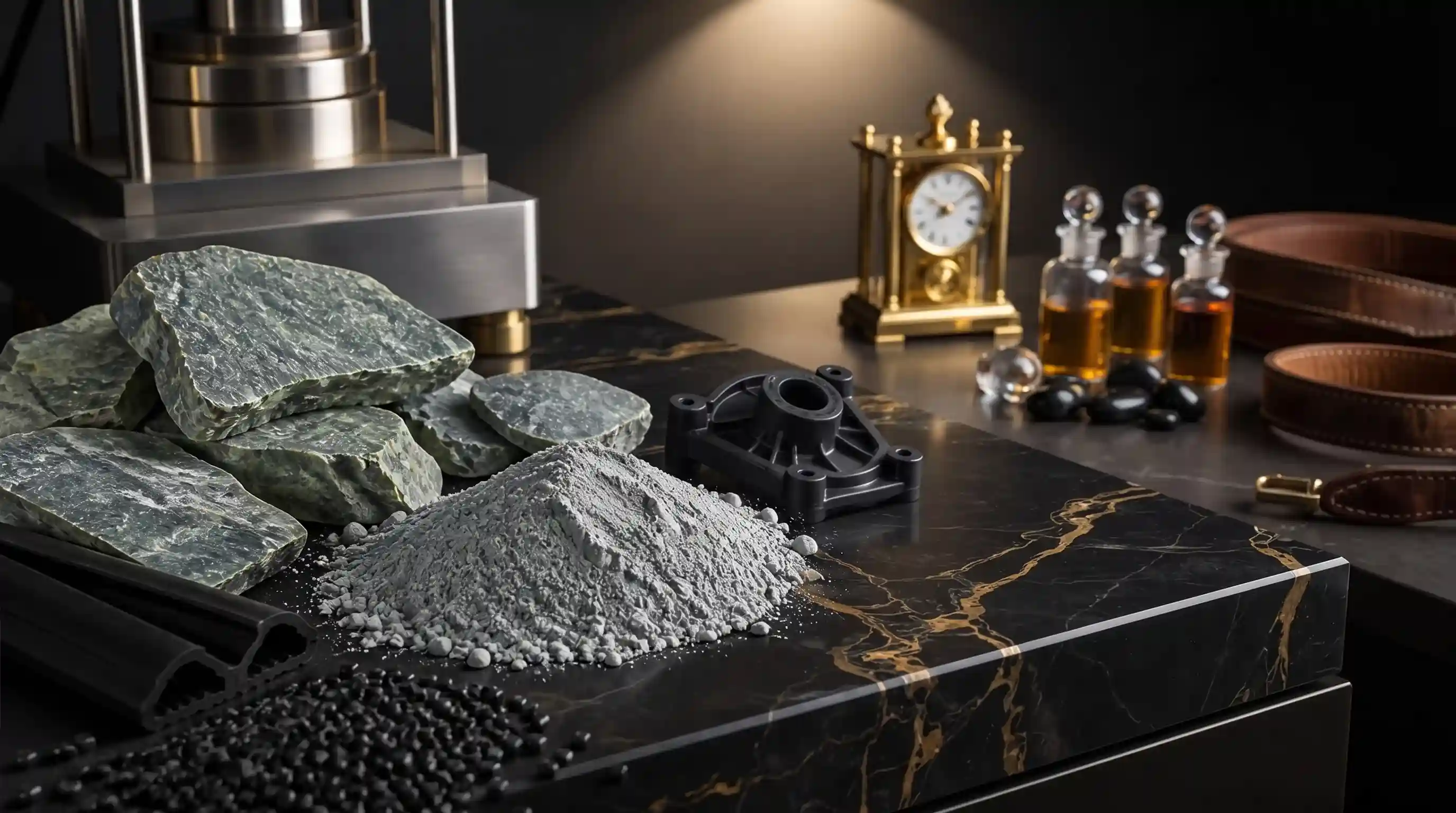
The quality of industrial talc rests on several key factors, the knowledge of which is essential for any industrial buyer and consumer. The first factor is chemical purity. Pure talc must consist mostly of silica and magnesium oxide, with iron, calcium, and aluminate impurities kept to a minimum. The presence of iron oxide, even in small amounts, can reduce whiteness and change the color of the final product, and it becomes clearly visible in applications like white plastic or light-colored paints.
The second important factor is the whiteness and brightness of the powder. The whiteness degree of talc is measured by colorimeters and indicates the amount of light reflected from the particles' surface. The higher the whiteness degree, the more valuable the product for applications where appearance and final color matter. This indicator is directly related to chemical purity, and usually, talcs with low iron impurities also show higher whiteness.
The third factor is granulation, or in other words, particle size, measured in mesh units. The 450 to 1000 mesh range means that talc particles are extremely fine, down to the micron level. Finer granulation increases the contact surface of particles with the polymer matrix or paint, creates better dispersion, and improves the mechanical and surface properties of the final product. Of course, the final application determines which granulation is more suitable; for example, in paints, very fine particles are needed for gloss and surface uniformity, while in some white polymer parts, coarser particles may also be applicable.
In addition to the average particle size, particle size distribution is also very important. A high-quality talc must have a uniform distribution of particles to create predictable behavior in the production process. Improper distribution of particle sizes can cause surface roughness, reduced strength, and defects in the final product.
The fourth factor is particle shape and morphology. Talc particles are plate-like or layered polycrystals, and it is this plate-like shape that provides resistance to warping, reduced shrinkage, and increased stiffness of the polymer product. The broader and thier the particles, the greater their reinforcing effect. This characteristic distinguishes talc from spherical fillers.
Other factors such as moisture, ash content, and abrasiveness also play a role in quality assessment. High moisture can cause bubbles and porosity in high-temperature polymer processes. You can also grasp this concept of the visual quality of mineral powder in the article Investigating the Appearance Characteristics and Quality of White Dolomite Powder. Ultimately, the quality of industrial talc is a balanced combination of chemical purity, high whiteness, precise granulation, appropriate particle distribution, and low moisture, guaranteed by the manufacturer through precise control of the grinding and classification process.
The Role of Industrial Talc in the Polymer Industry
The polymer industry is one of the largest consumers of industrial talc in the world. In this industry, talc is added to the polymer matrix as a mineral filler and reinforcer to improve the mechanical, thermal, and economic properties of the final product. The 450 to 1000 mesh particle size range is exactly the range most polymer formulations require to achieve optimal dispersion in the matrix.
One of the most important applications of talc in polymers is increasing stiffness and mechanical strength. The plate-like talc particles are placed inside the polymer matrix, creating resistance against deformation and warping. The result is the production of parts with higher elastic modulus, better tensile strength, and reduced deformation at high temperatures. For this reason, talc is widely used in the production of automotive parts, household appliances, pipes, and polymer fittings.
Industrial talc also increases the thermal resistance of polymer products. Many plastics deform at high temperatures, but the presence of stable talc particles raises the softening and warping temperature of the product. This feature is very important for parts exposed to heat, such as engine components, interior housings, and electrical products.
In engineering plastics such as polypropylene, polyethylene, PVC, and nylon, talc plays multiple roles: filler, reinforcer, anti-shrinkage agent, and permeability modifier. In the production of polymer films, talc is used as an anti-blocking agent and to improve printability. In these applications, talc's high whiteness helps the final product display the desired color with higher quality.
Economically, using industrial talc allows manufacturers to replace part of the expensive resin with a cost-effective mineral filler without dropping product quality. This issue is of strategic importance, especially in competitive market conditions where reducing production costs is always a priority. Furthermore, talc is an abundant and accessible mineral, proving that its sustainable supply is easier than some synthetic reinforcements.
An important point in polymer talc consumption is selecting the appropriate granulation and dispersion. Inappropriate or impurity-laden particles can cause weak points in the part, reduce impact resistance, and even change the product's color. For this reason, manufacturers of polymer parts always carefully control the formulation and quality of talc entering the production line so the final product consistently maintains its standards.
The Role of Industrial Talc in the Rubber Industry
The rubber industry is another major consumer of industrial talc. In the production of various tires and rubber parts, talc has several vital responsibilities, starting from the production process stage and continuing to the final product's performance. The fine 450 to 1000 mesh particle size range is of special importance to this industry, as finer particles disperse better in the elastomeric matrix and create a more uniform surface.
The first application of talc in the rubber industry is preventing stickiness. The raw rubber mixture is highly sticky during shaping, extrusion, and calendaring processes and can stick to machinery or to itself. Talc powder is dusted onto the surface of these mixtures as a separating and anti-blocking agent so the production process proceeds without problems. This is the oldest and most well-known use of talc in the rubber industry.
The second application is talc's role as a filler and reinforcer. The presence of talc particles in the rubber matrix improves abrasion resistance, increases stiffness, and controls the expansion and contraction of the product. In the production of technical rubber parts like gaskets, belts, rubber bearings, and insulators, these properties are very important. Also, as an economical filler, talc reduces production costs while keeping the physical properties of the product at an acceptable level.
Talc is also used in automotive tire production. Although carbon black and silica play the main reinforcing roles, talc holds its place in specific formulations, especially colored tires and technical rubber parts. In these applications, talc's whiteness allows the production of light or colored rubber products. Talc also improves the rubber's resistance to environmental conditions like ozone and moisture.
Another interesting application of talc in the rubber industry is its use in the production of tubeless tires. In these tires, talc powder is blown inside the tire cavity to prevent the ier surfaces from sticking together while providing a suitable barrier against gas permeation. This application, common in bicycles and vehicles, requires talc with appropriate granulation and low moisture.
As in other industries, the quality of talc used in the rubber industry must be controlled. Impurities can react with chemical systems, coarse particles can create weak points in the rubber part, and high moisture can cause porosity and bubbles in the final product during vulcanization. For this reason, choosing high-quality industrial talc is a determining factor in the quality of rubber products.
The Role of Industrial Talc in the Paint Industry
The paint and coatings industry is an important market for industrial talc. In paint formulations, talc acts as an active mineral filler that simultaneously improves several important paint characteristics. The very fine 450 to 1000 mesh particle size range is critically important to the paint industry, as particle size directly affects the paint's gloss, surface uniformity, and hiding power.
Talc's first function in paint is filling and viscosity control. Due to its plate-like shape and appropriate specific surface area, talc disperses well in the paint matrix and creates the desired pasty consistency in the paint. This property is crucial for paints that must be applied with proper thickness without dripping. Talc also prevents paint particles from settling during storage, increasing the product's shelf life.
The second important effect of talc in paint is increasing adhesion and durability. Plate-like talc particles embed in the dried paint film, reinforcing the structure and increasing its resistance to abrasion, scratching, and environmental conditions. This property is very important for industrial paints, architectural paints, and marine coatings exposed to wear and harsh conditions.
Industrial talc also increases the paint's resistance to moisture and chemicals. Talc's chemical neutrality makes the paint show more stability against acids and bases. Also, talc's layered structure creates a physical barrier against water and gas permeation, which is crucial for anti-rust paints and protective coatings. For this reason, talc is widely used in producing industrial paints and anti-corrosion coatings.
Aesthetically, white talc improves paint's color acceptance and brightness. In light and white paints, talc acts as a white filler, reducing the consumption of expensive pigments like titanium dioxide. This is economically very important for paint manufacturers. In colored paints, talc acts as a transparent base, allowing pigments to be displayed uniformly.
Finally, talc is used in producing water-based paints, solvent-based paints, powder paints, and primers. In each of these formulations, the type of granulation, oil absorption rate, and particle size distribution of talc must be selected according to that specific product's needs. Choosing inappropriate talc can reduce gloss, create a rough surface, reduce durability, and even alter the final product's color; for this reason, controlling the quality of incoming talc is of high importance to paint factories.
How to Choose High-Quality Industrial Talc?
Choosing the right industrial talc requires a precise understanding of the product's needs and matching them to the technical characteristics of the powder. The first step in this path is determining the application need. Different industries have different requirements: the polymer industry usually wants talc with fine granulation and high whiteness, the rubber industry looks for talc with low moisture and good dispersion, and the paint industry needs talc with appropriate oil absorption and uniform particle distribution. Knowing these needs helps you select the right option from available products.
The second step is paying attention to the product's granulation. The product in question is offered in the 450 to 1000 mesh range, which includes very fine particles suitable for sensitive industries. When inquiring, you must specify which application the product is needed for so the exact appropriate granulation can be suggested. Don't forget that in addition to average particle size, the particle size distribution and its uniformity must also be stated by the manufacturer.
The third step is reviewing documentation and samples. A reputable manufacturer must be able to provide technical product information, including chemical analysis, granulation, whiteness degree, and moisture content. If possible, test a sample of the product in your production line before buying in bulk to confirm its performance in your formulation. This greatly reduces the risk of inappropriate purchases.
The fourth step is selecting a reliable supplier. Amiran Stone Mineral Project, as a mineral materials producer, produces this product with the stated technical specifications. To view product information, you can visit the Industrial Talc page on this group's website. Buying directly from a manufacturer rather than intermediaries comes with advantages like better pricing, guaranteed stable quality, and access to precise technical information.
The fifth step is considering talc's effect on final product quality. As examined in the article The Key Role of Industrial Talc in Improving the Quality of Manufactured Products, choosing the right talc can have a significant impact on your final product's quality. Therefore, purchasing decisions should not be based solely on price; rather, its technical value and effects on the production process and final product must be considered.
Finally, it is recommended to also consider storage and shipping conditions. Industrial talc must be stored in a dry environment without contact with moisture so its quality doesn't drop over time. Proper packaging also prevents contamination and moisture from entering the product. Following these simple tips helps you get the most benefit from this valuable mineral.
Conclusion and Market Outlook for Industrial Talc
In this article, we tried to present a comprehensive picture of industrial talc and its quality-determining factors. Industrial talc is a hydrated magnesium silicate with a layered structure that has become a strategic material in polymer, rubber, paint, and other industries due to its softness, whiteness, thermal and chemical stability, and proper dispersion. The 450 to 1000 mesh particle size range also indicates the high level of processing of this product and its alignment with the technical needs of advanced industries.
Key quality factors include chemical purity, high whiteness, precise granulation, uniform particle distribution, plate-like particle shape, and low moisture. Each of these factors can directly impact talc's performance in the production process and final product quality. Therefore, an informed buyer must inquire these parameters from the manufacturer and test samples if needed before deciding.
In terms of the market, demand for industrial talc has trended upward in recent years. The growth of automotive, construction, packaging, and consumer goods industries, especially in developing markets, has increased the consumption of mineral fillers. Also, the growing attention to reducing production costs and replacing expensive materials with high-efficiency mineral fillers paints a bright future for the talc market.
One of this industry's challenges is adapting to increasing technical and quality requirements. Consumer industries are gradually applying stricter standards, and talc producers must adapt to these needs by investing in advanced processing, precise quality control, and product development. Producing talc with very fine and uniform granulation is an example of this adaptation to mode industry needs.
Another challenge is environmental and safety conces. Like any mining process, talc extraction and processing must be done in compliance with environmental and occupational safety standards. Aware manufacturers today pay great attention to this and align their processes with sustainable development principles. This will benefit both producer and consumer in the long run.
In the end, if you too are active in one of the polymer, rubber, paint, or other industrial sectors and seek a high-quality mineral filler, we suggest examining the technical specifications of Amiran Stone Mineral Project's product and consulting with this group's experts. Choosing the right industrial talc can be an effective step in improving your final product's quality and reducing production costs.
| Question | Answer |
|---|---|
| What is industrial talc? | Industrial talc is the commercial grade of the hydrated magnesium silicate mineral, processed for industrial applications like polymers, rubber, and paint. |
| What is the difference between industrial talc and pharmaceutical talc? | The difference lies in purity, processing, and final particle size; industrial talc is processed based on the technical needs of industries. |
| What is the mesh range of industrial talc? | This product is offered in a 450 to 1000 mesh particle size range, including very fine and uniform particles. |
| What are the main applications of industrial talc? | Main applications include polymer products, rubber products, paint, and other industrial products. |
| Why is talc used in plastics? | To increase stiffness, thermal and mechanical resistance, reduce shrinkage, and lower the production cost of polymer parts. |
| What is talc's role in the paint industry? | Talc acts as a filler, viscosity regulator, anti-settling agent, and improver of paint adhesion and durability. |
| Why is talc's whiteness important? | High whiteness indicates chemical purity and matters in applications sensitive to product appearance, like plastics and light-colored paint. |
| How do we measure industrial talc quality? | By checking the product's chemical analysis, whiteness degree, granulation, particle distribution, and moisture content. |
| Is industrial talc safe? | Talc is neutral and stable but must be handled, stored, and used according to mineral material safety instructions. |
| Where should we source industrial talc? | Mineral material producers like Amiran Stone Mineral Project produce this product with stated specifications. |
This article was prepared based on technical information published on the Amiran Stone Mineral Project website (mineral production) and public sources from the mineral materials industry.
برچسب: Industrial Talc,Analysis and Characteristics of Industrial Talc, Quality,Determining Factors,
نویسنده: رساوب آفرین