
درباره سایت
آخرین مطالب
- انتخاب اکسید آهن قرمز (اخرا) برای بهبود کیفیت پیگمنت و پوششهای رنگی
- تامین کربنات کلسیم با دانهبندی دقیق جهت استفاده در مستربچ
- تأمین تخصصی سیلیس برای مصالح ساختمانی، شیشه و صنایع سرامیک
- ویژگیهای فنی بنتونیت کانی سنگ امیران برای کاربردهای خاص
- فلدسپات کانی سنگ امیران برای شیشه کاشی و سرامیک
- کاربرد تالک سفید درجه یک در فرمولاسیون پیشرفته رنگ و محصولات کاغذی
- اکسید آهن قرمز (اخرا) کاربردی جهت تولید محصولات سرامیکی و پوشش
- مشخصات فنی اکسید آهن قرمز (اخرا) مناسب برای پوشش و تولید پیگمنت
- مشاوره تخصصی خرید کربنات کلسیم بر اساس نیاز دقیق صنعت شما
- انتخاب تالک سفید صنعتی مناسب برای تولیدات کاغذ و مستربچ
امکانات وب
What is White Talc? A Complete Introduction to This Mineral
White talc is one of the most recognized and widely used industrial minerals worldwide. This mineral belongs to the phyllosilicate group and is chemically known as "hydrated magnesium silicate" with the formula Mg₃Si₄O₁₀(OH)₂. The layered structure of this mineral is the main reason for its extreme softness; talc, with a hardness of 1 on the Mohs scale, is considered the softest known mineral in nature, and for this reason, it was historically used for stone carving and making talcum powder.
The term "white talc" refers to a category of talc products that have a bright white to off-white color after processing. The light color of this product is due to its high purity and minimal presence of colored impurities. The lower the amount of iron and other coloring elements, the whiter and brighter the final product will be. This characteristic is vital for industries such as paint, paper, and masterbatch, where the transparency and lightness of the product are of strategic importance.
In nature, talc usually results from the metamorphism of dolomitic rocks or magnesium silicates. During this process, in the presence of water and carbon dioxide, dolomite converts into talc. For this reason, talc mines are often found adjacent to dolomite deposits, and there is a close relationship between these two minerals in nature.
In Iran, significant talc deposits have been identified in various provinces, including Yazd, Isfahan, Kerman, and Mazandaran. The high quality of talc extracted from some of these mines has positioned the Iranian product to compete globally. After extraction, crushing, processing, and finally particle classification into different meshes, talc powder enters the industrial market.
Unique properties of white talc include its oleophilic and hydrophobic nature. This characteristic allows talc to be highly compatible with organic and polymeric materials and to disperse easily in a polymer matrix. Additionally, talc is chemically neutral and inert, not reacting with most acids and bases; this chemical stability makes it a safe filler for sensitive applications.
The platy or lamellar structure of talc also imparts specific mechanical properties to the final product. Talc layers slide over each other, providing lubricity and anti-wear properties to the product. These very features make white talc an ideal material for the plastics, paint, paper, and ceramic industries. In the rest of this article, we will fully examine the production method, technical specifications, and applications of white talc in various industries.
Extraction and Processing of White Talc; From Mine to Industrial Powder
The production process of industrial-grade white talc begins with exploration and continues until the packaging of micronized powder. The first step is identifying talc deposits with sufficient purity. Mineralogy and the geological structure of the mine determine whether the extracted rock can be converted into white talc with the brightness level required by industries. Mines with high levels of iron and other coloring impurities are not suitable for producing white talc.
Talc extraction is usually done via open-pit mining. In this method, after removing the overburden layers, talc rock is extracted using controlled explosions or cutting machinery. The extracted blocks are then crushed and transported to the processing plant. At the plant, talc rocks are first sorted and chemically analyzed to determine the quality of each batch.
The next stage is primary and secondary crushing. Rocks are broken into smaller dimensions in jaw and cone crushers, then fed into ball mills or micronizing machines. At this stage, talc powder is ground to very fine particle sizes. Advanced plants use jet mills and air classifiers to produce powders with uniform particle sizes, where particle size uniformity is well controlled.
One of the most important steps in white talc production is physical processing such as flotation and magnetic separation. Flotation helps separate talc from associated minerals like dolomite, chlorite, quartz, and mica. Since talc is naturally hydrophobic, it floats to the surface and is separated during the flotation process. This way, the purity and whiteness of the product can be significantly increased.
After flotation, the powder is dried and classified. Classification is based on particle size, and the final product is categorized by "Mesh". The mesh number indicates the number of holes per unit area of the sieve; the higher the mesh number, the finer the powder particles. For example, 450-mesh powder has coarser particles than 2500-mesh powder. Choosing the mesh size directly depends on the type of application, which will be discussed in the next section.
Quality control is performed at all stages of production. Parameters such as purity percentage, brightness, color, particle size distribution, moisture, and oil absorption rate are accurately measured. To maintain product consistency, reputable plants use periodic testing and continuous inspection.
Finally, the prepared product is packaged in bags or jumbo bags and shipped to industrial consumers. Observing safety and environmental principles, such as dust control and water recycling, is an important part of mode talc processing. To ensure consistent quality, producers operate according to specific standards; reading the article National and Inteational Standards in White Talc Production is helpful for getting acquainted with this topic.
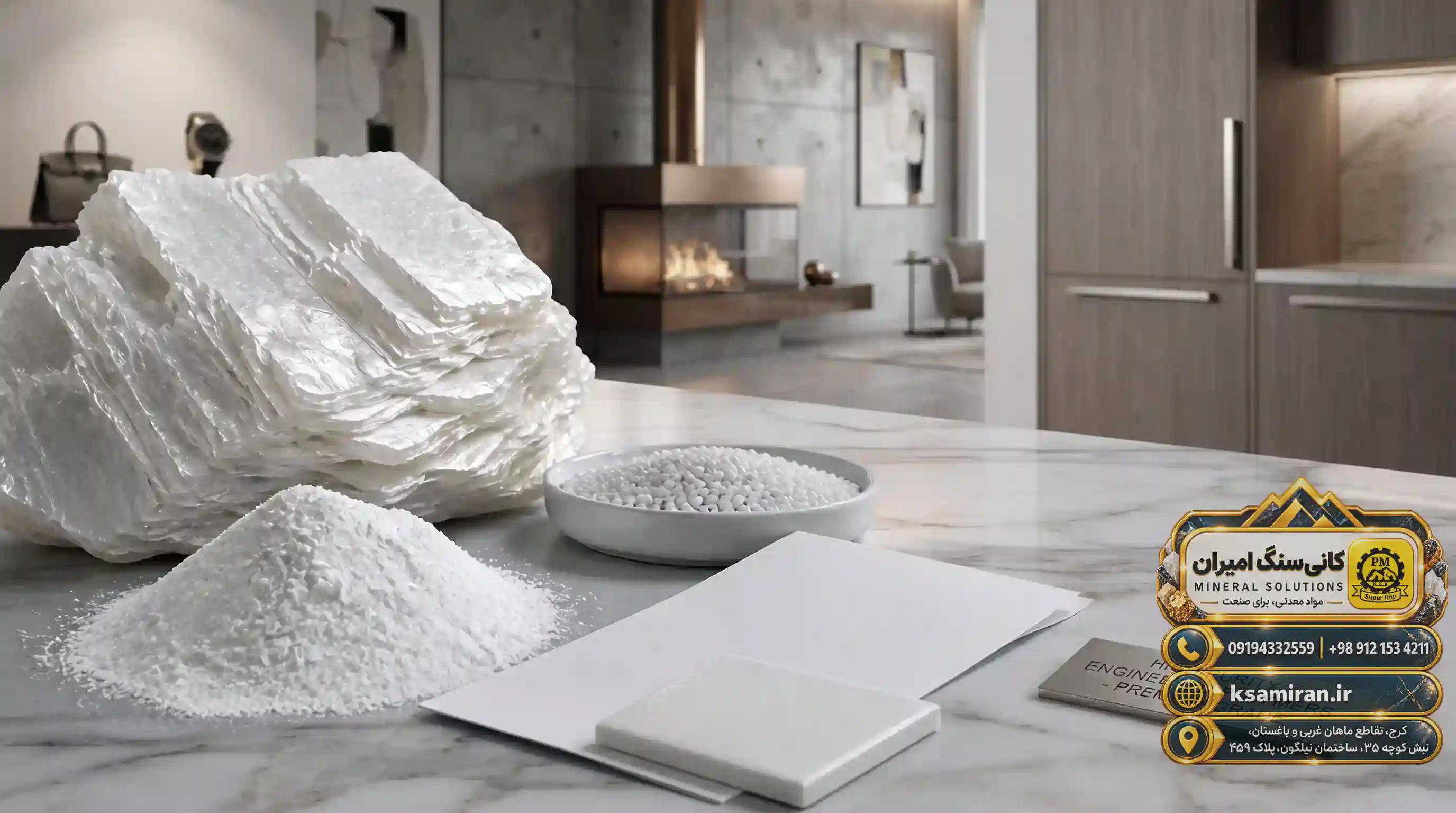
Physical and Chemical Properties of White Talc and the Concept of Mesh Size
In terms of chemical composition, white talc is hydrated magnesium silicate with the formula Mg₃Si₄O₁₀(OH)₂. In the crystalline structure of this mineral, magnesium hydroxide layers are situated between two silicate layers, coected only by weak van der Waals bonds. This layered structure is the main reason for talc's softness, oleophilicity, and slipperiness, distinguishing it from other mineral fillers.
Among the most important physical properties of white talc are: hardness of 1 on the Mohs scale, specific gravity of about 2.7 to 2.8 g/cm³, white to light grayish-white color, high luster, and relative transparency in thin sections. Talc is insoluble in water and organic solvents and has good chemical resistance to weak acids and bases. It also has hydrophobicity, oleophilicity, electrical and thermal insulation properties, and stability at relatively high temperatures.
One of the key specifications of talc powder in industrial applications is its particle size, or in other words, its "mesh size". The term mesh refers to a particle size measurement unit defined based on the number of holes per square inch of a sieve. The larger the mesh number, the smaller the particle size and the finer the powder. For example, 450-mesh powder has coarser particles, while 2500-mesh powder produces very fine particles.
The mesh range of 450 to 2500 mesh offered by the Kani Sang Amiran project allows for precise selection of particle size based on the needs of each industry. In applications like ceramics and compounding, where bulk filling and coarser particles are needed, lower meshes are more suitable; however, in high-quality paint, paper, and masterbatch industries, where dispersion and specific surface area are more important, higher meshes are used.
In addition to particle size, particle shape (platy or lamellar) also plays an important role in talc's performance. Due to their high aspect ratio, platy particles provide better mechanical reinforcement in the polymer matrix and improve the tensile and flexural strength of the final product. On the other hand, the brightness and color of talc are also very important in the paint and paper industries, as they directly affect the transparency and luster of the final product.
Other important parameters include oil absorption, moisture, and particle size distribution (PSD). The more uniform the particle size distribution, the more predictable talc's performance in industrial formulations. For this reason, reputable producers usually provide complete product specifications on the label or analysis sheet so the buyer can make the best choice.
Ultimately, it should be noted that white talc is a neutral and safe mineral filler, and with standard safety precautions, it poses no specific health risks. This fact makes its use in sensitive industries easier.
Application of White Talc in Masterbatch and Compounding
White talc is one of the most important mineral fillers in the plastics industry, especially in the production of masterbatch and compound. Masterbatch is a concentrated mixture of pigments or additives in a polymeric carrier, added in small amounts to the base plastic to alter its properties. Talc plays multiple roles in these formulations and is considered an ideal option due to its excellent compatibility with polypropylene, polyethylene, and polystyrene polymers.
One of the primary applications of talc in white masterbatch is its role as a supplementary pigment and filler. Due to its high brightness and affordable price compared to organic pigments, white talc can replace a portion of titanium dioxide while maintaining the coverage and whiteness of the product. This significantly reduces masterbatch production costs. Also, because of its platy structure, talc creates an antiblock property, preventing plastic film layers from sticking together.
In polypropylene compounds, talc is known as a reinforcing filler. Adding talc increases the stiffness, flexural modulus, heat resistance, and dimensional stability of the plastic part. Car interiors, home appliances, injection-molded parts, and profiles are among the products that use talc-containing compounds. Talc also increases the crystallization rate of polypropylene and acts as a nucleating agent, which improves mechanical properties and faster crystallization during the production process.
Another advantage of talc in compounding is its positive effect on the rheology of the polymer melt. Talc reduces shrinkage, controls viscosity, and improves processability. Additionally, the oleophilic nature of talc creates good dispersion in the polymer matrix, reducing the need for expensive additives. Finer particles (higher mesh) create better dispersion due to higher specific surface area and are used in high-quality masterbatches.
Talc also plays an effective role in the production of plastic films, sheets, and profiles. Adding this material reduces thickness without losing strength, improves packaging capability, and reduces gas permeability. Combining talc with recycled polymers is an effective solution to improve the quality of recycled products, as talc partially restores thermal resistance and mechanical properties in these polymers.
Furthermore, due to its chemical neutrality, talc is favored for sensitive applications and disposable containers. Choosing high-purity white talc with appropriate particle size is crucial to the final quality of masterbatch and compound. This is why masterbatch producers typically source talc in various mesh ranges to find the best balance between price, dispersion, and product brightness.
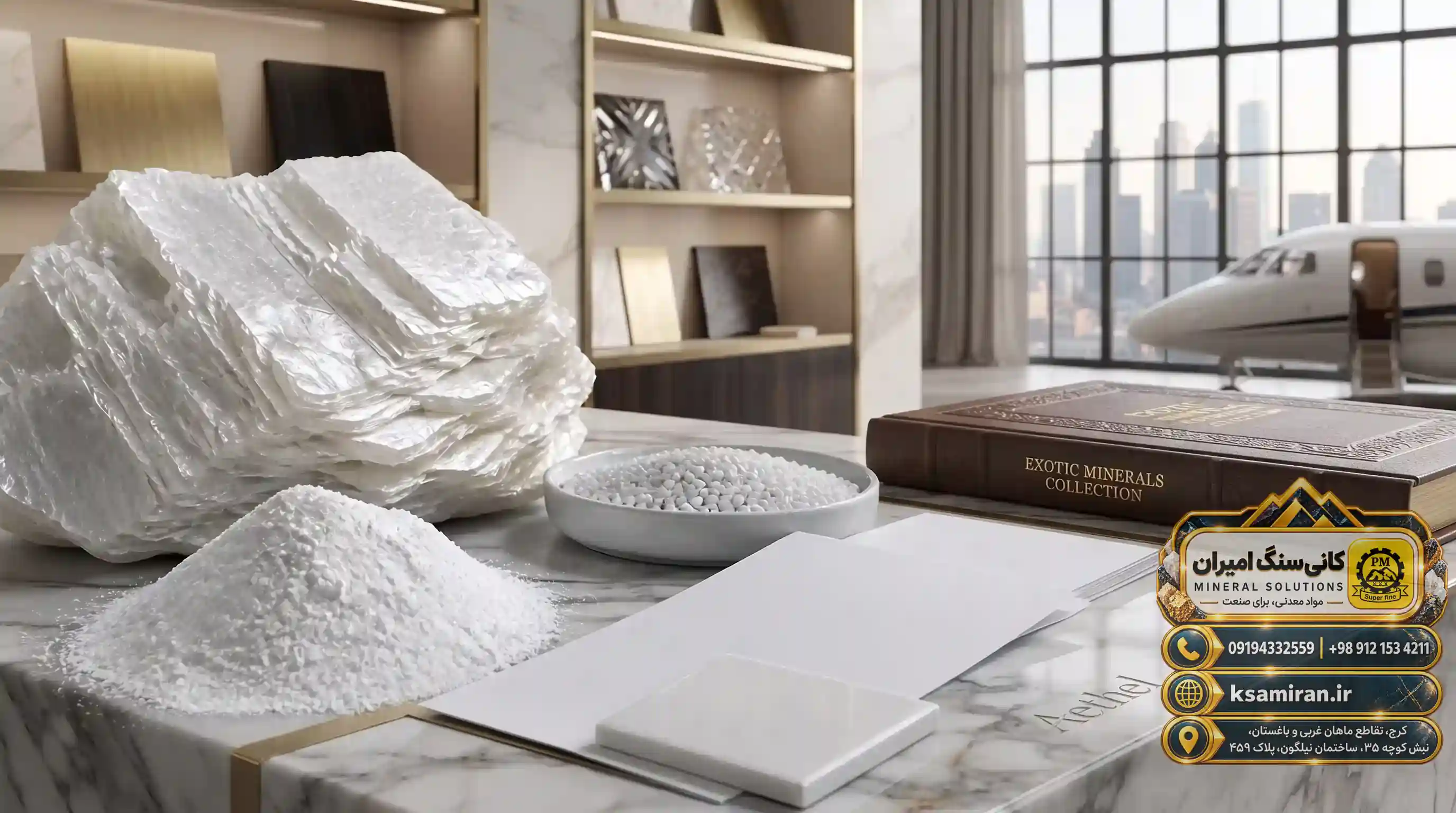
Application of White Talc in the Paint and Coatings Industry
White talc is a fundamental and widely used material in the paint and coatings industry. It is used as an extender pigment in water-based, oil-based, polymeric, and powder paints, constituting a major portion of the paint formulation. The main reason for the widespread use of talc in paint is its combination of suitable price, high brightness, and excellent technical properties.
One of talc's most important roles in paint is improving hiding power and increasing the solids content of the formulation. Talc particles have a high specific surface area and can fill the empty spaces between primary pigment particles like titanium dioxide, creating a uniform and smooth coating on the surface. Thus, the paint provides fuller coverage with less expensive pigment.
In architectural and oil-based paints, talc increases durability and wash resistance. Thin talc layers in the paint film lengthen the path for moisture and gas penetration, thereby improving the paint's resistance to weathering, moisture, and corrosion. For this reason, talc-containing paints are highly suitable for humid environments, exterior building facades, and metal surfaces.
Due to its oleophilic nature and layered structure, talc shows very good dispersion in both water- and solvent-based paint systems. This characteristic allows the paint to be stirred easily and reduces particle settling over time. Paint remaining stable in packaging without separating is one of the most important features of high-quality paints, which talc helps achieve.
In industrial and anti-corrosion paints used for machinery, marine equipment, pipelines, and metal structures, talc increases abrasion resistance and paint adhesion to the surface. Also, for filler paints used to create a smooth surface in the automotive industry, very fine talc with a high mesh is used to achieve a completely uniform and glossy surface.
Talc is also used in the production of electrostatic and powder paints; it is an electrical insulator and creates stable performance in the electrostatic spraying process. Additionally, because it is chemically neutral, talc is compatible with resins and paint additives, causing no unwanted reactions.
Economically, using talc in paint contributes significantly to reducing the final product cost. As an inexpensive and readily available filler, talc replaces a portion of expensive materials while maintaining paint quality. Choosing the right mesh (usually between 1000 and 2500 mesh) depends on the paint type and drying method, directly affecting the appearance and durability of the final coating.
Application of White Talc in the Papermaking Industry
White talc is recognized as one of the most important minerals in the papermaking industry and is widely used in two main areas: "filler" and "coating". Mode papermaking requires large quantities of minerals with precise particle sizes and high brightness to achieve proper print quality, brightness, and thiess, and white talc fulfills these needs perfectly.
As a filler, talc is added during the pulp preparation stage. At this stage, talc particles fill the spaces between cellulose fibers, producing paper with a more uniform density distribution, smoother surface, and higher brightness. Adding talc also makes the paper thier while simultaneously making it more opaque and better suited for printing. Brighter papers provide better printing and higher ink contrast.
One of the very important roles of talc in papermaking is pitch control. Wood contains fatty and resinous materials that are released during the papermaking process, causing spots and deposits on rollers and the paper machine. Due to its special surface structure and oleophilicity, talc absorbs these resinous materials and prevents their deposition on fibers and equipment. This reduces paper machine downtime and increases production efficiency.
In the coating section, talc is applied along with binders and additives to the paper surface to create a thin, uniform layer. This layer improves printability, increases brightness, reduces porosity, and creates a smooth surface for gravure and offset printing. Very fine, high-mesh talc particles are typically used for high-quality printing papers and art papers.
In addition, talc is very important in recycled papers. Waste papers contain amounts of ink and impurities that must be separated during the deinking process. Talc helps collect ink particles in this process and improves the quality of the recycled pulp.
Other advantages of talc in papermaking include reduced energy consumption in paper drying, reduced paper weight per unit area, increased wrinkle resistance, and improved printability. Also, due to its heat resistance, talc is used in resistant papers and electrical insulation papers.
Comparing talc with calcium carbonate shows that talc is superior in brightness, softness, and pitch control, while calcium carbonate is offered at a lower price. Many paper mills use a combination of both materials to achieve optimal results. Choosing talc with a mesh size of 450 to 2500 mesh depends on the paper type and production machine, directly impacting the final product quality.

Application of White Talc in the Ceramic Industry
White talc plays a very important role in the ceramic industry and is used in producing various ceramic bodies, tiles and ceramics, chinaware, dishes, and advanced ceramics. As a raw material combined with clay, feldspar, quartz, and dolomite, talc improves the physical and thermal properties of ceramics.
In ceramic bodies, due to its layered structure and high thermal resistance, talc reduces shrinkage during drying and firing. This feature helps maintain precise dimensions of ceramic pieces and prevents cracking and deformation during production. In addition, talc improves the heating and cooling rate of the piece and increases the ceramic's thermal shock resistance.
In the production of tiles and building ceramics, talc increases mechanical strength and glaze transparency. Talc acts as a flux and clarifier in glazes, helping to create a glossy and uniform surface on the tile. Also, due to its high brightness, talc plays an essential role in increasing the luster and translucency of the body in the production of white ceramics and high-quality chinaware.
In the production of sanitaryware and chinaware, talc increases the whiteness, translucency, and strength of the body, improving the appearance of the final product. Ceramic producers typically use talc with a mesh size of 450 to 800 for bodies and higher meshes for glazes.
In the advanced and technical ceramics industry, talc is used in the production of electrical ceramics, insulators, electronic components, and heat-resistant ceramics. Talc's chemical stability and electrical insulation make it a suitable choice for these sensitive applications. Talc-containing ceramics are used in dielectrics, capacitors, and sensors.
Talc is also used in the production of polymeric and composite ceramics. In these applications, talc particles are added to the polymer matrix, reinforcing the mechanical and thermal properties of the composite. Selecting particles with the right size is very important for dispersion and reinforcement level.
Other advantages of using talc in ceramics include reduced production costs (due to replacing some expensive materials), improved color and glaze receptivity, and increased durability and abrasion resistance. Also, because it is chemically neutral, talc does not create unwanted reactions with other ceramic raw materials. Interestingly, alongside ceramic applications, talc also plays a prominent role in the gypsum and building materials industries; to lea about this topic, you can read the article The Role of Industrial Talc in the Gypsum and Building Materials Industries.
Benefits of White Talc and a Buying Guide from Kani Sang Amiran
Given the various properties examined in previous sections, white talc has become one of the most important industrial minerals. In this section, we review the overall benefits and buying guide for this product.
The most important benefits of white talc are:
- High brightness and luster, which add transparency to final products.
- Affordable price compared to other mineral fillers and pigments.
- Chemical stability and neutrality, compatible with most materials.
- Suitable thermal resistance and electrical insulation.
- Environmental compatibility and non-toxicity.
- Improved mechanical, thermal, and surface properties of products.
- Offered in a mesh range of 450 to 2500 mesh for diverse applications.
The Kani Sang Amiran project, as one of the mineral producers in Iran, supplies high-quality white talc in the 450 to 2500 mesh range for masterbatch, compound, paint, paper, and ceramic industries. To view specifications and place an order, you can visit the White Talc product page on the Kani Sang Amiran project website.
Alongside talc, other minerals also play important roles in industries. For example, dolomite, as a widely used mineral, can help improve formulations and reduce costs; reading the article The Impact of Dolomite on Reducing Production Costs in the Mineral Industries is useful in this regard.
Choosing the right talc depends on your industry's needs. As a general guide, you must first specify which industry your product will be consumed in and which feature (brightness, hardness, dispersion, or price) matters most to you. Then, based on that, select the desired mesh size. If you lack sufficient experience in formulation, consulting with technical experts and requesting samples and an analysis sheet is the best way to avoid purchasing errors.
It is also recommended to source talc from a supplier capable of offering the product across a wide mesh range, so there is no need to change suppliers if formulations change. Quality consistency, proper packaging, and on-time delivery are also important criteria in purchasing industrial minerals.
Ultimately, it can be said that white talc, combining outstanding technical properties with competitive pricing, is a smart choice for a wide range of manufacturing industries. Familiarity with the properties and applications of this material will help you increase the quality of your products through informed purchasing.
| Question | Answer |
|---|---|
| 1. What is white talc? | White talc is a soft mineral from the phyllosilicate group with the chemical formula of hydrated magnesium silicate, which after processing is used as a white powder in various industries. |
| 2. In which industries is white talc used? | The main applications of white talc include masterbatch, compound, paint, paper, and ceramic products. |
| 3. What is the mesh range of white talc? | White talc produced by the Kani Sang Amiran project is offered in the 450 to 2500 mesh range. |
| 4. What does "mesh" mean in talc? | Mesh is a unit for measuring powder particle size; the higher the mesh number, the finer the talc particles and the softer the powder. |
| 5. What role does white talc play in masterbatch? | In masterbatch, talc acts as a filler, supplementary pigment, and antiblock agent, improving the thermal resistance and mechanical properties of the product. |
| 6. How is talc used in the paint industry? | As an extender pigment, talc increases paint's hiding power, wash resistance, and durability, while reducing production costs. |
| 7. What role does talc play in papermaking? | Talc is used in papermaking as a filler and in coating, increasing brightness, surface smoothness, pitch control, and improving paper printability. |
| 8. Is talc used in ceramics? | Yes; in ceramic bodies and glazes, talc reduces shrinkage, increases thermal and thermal shock resistance, and improves the transparency and brightness of the product. |
| 9. What are the benefits of white talc? | High brightness, affordable price, chemical stability, thermal and electrical insulation, environmental compatibility, and availability in various sizes are its most important benefits. |
| 10. How do I choose the right white talc for my industry? | First, specify your industry and required properties, then select the mesh size accordingly, and ask the supplier to provide an analysis sheet and product sample. |
This article has been prepared relying on specialized sources in the mineral industries and information provided on the Kani Sang Amiran project website.

برچسب: White Talc,What is White Talc? Applications and Benefits of This Mineral in Industries,
نویسنده: رساوب آفرین