
درباره سایت
آخرین مطالب
- Review of the Application of Limonite Oxide (Gol Mash) in Various Industries
- دراسة تطبيق أكسيد الليمونيت (غول ماش) في مختلف الصناعات
- بررسی کاربرد اکسید لیمونیت (گل ماش) در صنایع مختلف
- کائولن باکیفیت کانی سنگ امیران برای کاغذ و رنگ مش 450 تا 1500
- استعلام قیمت فلدسپات صنایع لعابسازی از وبسایت کانی سنگ
- تالک صنعتی و کاتالوگ فنی برای صنایع رنگ و لاستیک
- کربنات کلسیم ۲۰۰۰ مش با ذرات کنترلشده برای پروفیل UPVC
- فلدسپات مناسب کانی سنگ با دانهبندی یکنواخت کاشی درجه
- کربنات کلسیم ۱۲۵۰ مش با ترکیب شفاف برای کابل صنعتی
- تالک صنعتی مناسب صنایع پلیمر با دانه بندی دقیق و کنترل شده
امکانات وب
Introduction to Kaolin and Its Position in Manufacturing and Construction Industries
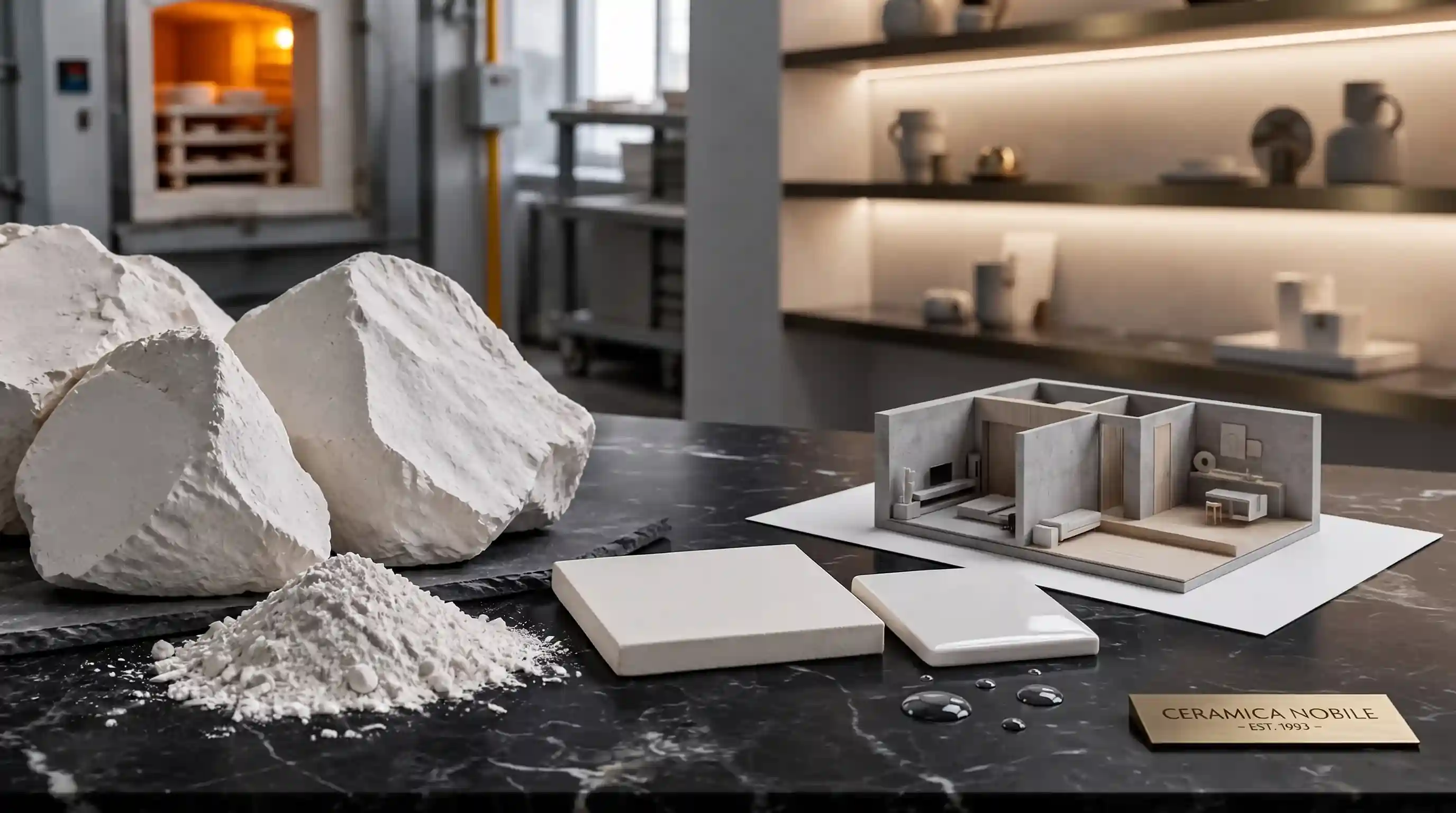
Kaolin, also commonly known as "china clay," is one of the most widely used non-metallic minerals in the world, playing a very important role today in the production of tiles, ceramic products, glaze, paper, and paint. This material, primarily composed of minerals from the kaolinite group, has become one of the vital raw materials in many production lines due to its unique characteristics such as light color, good plasticity, high thermal resistance, and low chemical reactivity. In fact, it can be said that a significant portion of the products we use every day in homes, offices, and factories are coected in some way with kaolin during their production process.
One of the topics that is usually less considered when purchasing and using this mineral is "grading." Kaolin grading refers to the particle size of this material after processing, grinding, and screening, and is measured with a unit called "mesh." In the market, this product is typically offered in a range from 450 to 1500 mesh, and choosing each of these gradings can have a direct impact on the final product quality. For example, kaolin used for tile bodies does not necessarily have the same grading needed for paper or paint production, and these differences are due to the different nature of each production process.
In the construction, tile, and ceramic industries, inappropriate grading can lead to problems such as increased porosity, reduced mechanical strength, loss of adhesion, glaze color variation, and even changes in the appearance of the final product. For this reason, professional manufacturers always examine their exact production process requirements before purchasing and then proceed to buy the appropriate grading. Alongside kaolin, other minerals such as silica, dolomite, and industrial talc are also widely used in these industries, and their grading is of similar importance.
In this article, we try to examine 5 key points about kaolin grading in manufacturing and construction industries with a practical and precise perspective; from the basic concept of "mesh" and particle size measurement methods to the effect of grading on the quality of tiles, ceramics, glaze, paper, and paint. At the end, we will also provide a practical guide for choosing the right grading and purchasing from a reliable supplier. If you are active in the tile, ceramic, paper, or paint production industry, familiarizing yourself with these points can greatly help you reduce waste, improve quality, and control production costs.
What Is Kaolin Grading? Understanding the Mesh Concept and Particle Measurement Methods
To better understand the importance of kaolin grading, we first need to know exactly what this concept means. Grading is actually a process in which mineral particles are ground and screened after extraction to reach a uniform and required size. The raw clay extracted from the mine usually has particles with very different sizes and caot meet industrial requirements without proper processing. For this reason, processing plants use various mills and advanced screening systems to grind and homogenize kaolin particles until reaching the desired mesh grade.
The unit for measuring particle size in industry is called "mesh." Simply put, the mesh number indicates the number of openings in each square inch of a standard sieve; the higher the mesh number, the smaller the particle size and the finer the powder. For better understanding, particles of 450 mesh are coarser than particles of 1500 mesh, and the fineness of the powder increases significantly with increasing mesh number. For kaolin, the supply range in the market is usually between 450 and 1500 mesh, and this wide range enables the use of this product in various industries.
Various methods exist for precisely measuring grading, the most important of which include dry and wet screening, laser diffraction, and sedimentation methods. The laser diffraction method is used today due to its high accuracy and speed and can show the complete particle size distribution. In addition to particle size, other parameters such as particle shape, uniformity of particle distribution, and impurity level also play a role in the final quality of kaolin and should not be overlooked. Reading the particle size distribution curve helps you determine whether this powder is suitable for your production line or not.
Alongside kaolin, the grading of other minerals is also very important. For example, the importance of silica grading in glassmaking and foundry industries is such that the final quality of glass and cast parts directly depends on silica particle size. Similarly, choosing the appropriate kaolin grading also requires precise knowledge of production line needs, the type of final product, and firing or processing conditions. In the following chapters, we will examine each of the main applications of kaolin and the effect of grading on them in detail to clarify why the mesh number is not just a simple number, but a parameter directly related to quality, cost, and production efficiency.

First Point: The Effect of Kaolin Grading on the Quality and Strength of Tiles and Ceramics
The first and perhaps most important point about kaolin grading is its direct effect on the quality and strength of tiles and ceramic products. Kaolin plays multiple roles in tile and ceramic bodies: on one hand, as a plastic and binding material, it improves the formability and adhesion of the body, and on the other hand, during the firing process, it shapes the thermal resistance and ceramic matrix structure. But fulfilling this role is only possible when kaolin particles have the appropriate size and distribution.
When kaolin particles are very coarse (low mesh), the spaces between particles increase and the packing density of particles decreases. This directly leads to increased tile porosity, reduced bending strength, and increased water absorption. As a result, the produced tile becomes more vulnerable to impact, abrasion, and moisture penetration, and its lifespan decreases. In contrast, using very fine particles (high mesh) without attention to body formulation can cause excessive plasticity, sticking to molds, reduced drying speed, and even cracking during drying.
One of the key concepts in this field is "Particle Size Distribution." In a standard ceramic body, particles should be selected so that the spaces between large particles are filled with smaller particles to maximize packing density. For this reason, manufacturers usually use a combination of different gradings in one formulation to achieve desired properties. Common tests such as water absorption measurement, bending strength, and abrasion tests can serve as suitable criteria for evaluating the correctness of the selected grading.
In addition to mechanical strength, kaolin grading also affects the color and appearance of tiles. Finer particles typically create a more uniform and brighter surface after firing, and physicochemical reactions during firing occur more uniformly. This is especially important in wall tiles and decorative ceramics. In the construction industry, using high-quality tiles requires precise control of raw materials; in this regard, the important application of dolomite in construction and manufacturing industries also shows how much the correct selection of minerals and their grading can affect the durability and quality of construction products.
Second Point: The Role of Kaolin Grading in Glaze Transparency and Uniformity
Glaze is a glass-like layer applied to the surface of tiles and ceramics to give the product a more beautiful appearance and make it more resistant to moisture, stains, and wear. Kaolin is one of the main components of glaze formulation; because kaolinite minerals create a stable glassy structure during firing and help uniformly suspend other materials within the glaze. But the quality of this transparent and smooth layer depends heavily on the grading of the kaolin used.
When kaolin particles are coarse, their complete melting during the firing cycle becomes more difficult. The result is a rough, dull surface with raised spots, which is acceptable in certain types of matte glazes but is considered a major defect for glossy and transparent glazes. In addition, coarse particles can cause tiny bubbles in the glaze layer; because gases released during the firing process have difficulty finding their way out through coarse particles. These bubbles not only ruin the product's appearance but also reduce the chemical and mechanical resistance of the glaze.
In contrast, using kaolin with finer grading (higher mesh numbers) causes particles to melt at lower temperatures and more uniformly, forming a completely smooth and glossy surface, and the color coating settles uniformly on the product. This is especially important in the production of wall tiles, ceramic tableware, and high-quality decorative products. Also, particle uniformity reduces variation between products in a production batch, meaning less waste and greater customer satisfaction.
Another point to consider is the effect of grading on glaze viscosity and suspension stability. Very fine particles change the rheological behavior of the mixture and can cause increased viscosity and excessive adhesion of the glaze to the substrate. For this reason, precise adjustment of formulation and selection of grading appropriate to firing temperature, substrate, and final product type is essential. Overall, it can be said that choosing the right mesh for glaze is one of the fastest ways to improve the visual quality and durability of ceramic products.
Third Point: Kaolin in the Papermaking Industry and the Importance of Grading in Brightness and Printability
Papermaking is one of the industries in which kaolin plays a very vital role. This mineral is used in two main areas in the paper industry: first as a filler in the paper itself and second as a coating color on the paper surface. In both cases, kaolin grading has a decisive role in the final quality, brightness, surface smoothness, and printability of the paper.
In the filler section, kaolin is placed between cellulose fibers and increases density, improves surface quality, and reduces production costs (by replacing part of the expensive fibers). But if kaolin particles are not uniform or their size is not selected appropriately, uniform distribution on the paper surface may not be achieved and the paper's resistance to bending and tearing may decrease. Very coarse particles can also cause faster equipment wear and create roughness on the paper surface.
In the coating section, the paper is covered with a thin layer of kaolin and other additives to achieve a completely smooth and bright surface for high-quality printing. Here, the finer and more uniform the particles, the smoother the paper surface, the better ink reception, and the higher the print quality. In fact, high-quality coated papers used for printing magazines, catalogs, and luxury packaging are usually produced from very fine-grained kaolin to achieve the highest level of smoothness and gloss.
One of the most important indicators in the papermaking industry is brightness and gloss. Kaolin, due to its light color and light-scattering property, can significantly increase paper brightness and reduce the need for brightening chemicals. The finer and more uniform the particles, the stronger this light-scattering effect. Also, it should be noted that selecting kaolin grading for paper encompasses variables such as paper type (printer, writing, coated), production line speed, and drying method, and there is no fixed formula for all products.
Fourth Point: Application of Kaolin in Paint Production and the Effect of Grading on Coverage and Durability
In the paint production industry, kaolin is known as an extender and mineral filler; meaning a material that, alongside main pigments, increases paint volume, reduces production costs, and improves the physical properties of the paint film. Kaolin is widely used in architectural paints, industrial paints, primers, and even artistic paints, and like other industries, its grading plays a key role in the final product quality.
One of the most important effects of kaolin grading in paint is its performance in terms of coverage and film uniformity. Finer particles can cover much smaller spaces on the surface and create a more uniform and denser paint layer. This directly leads to reduced paint consumption per unit area, increased coverage, and improved final appearance. In contrast, coarse particles can cause a rough surface, reduced gloss, and even scratches on the paint surface.
Kaolin grading also affects paint viscosity and stability. Very fine particles have a larger specific surface area and absorb more water/solvent, which can cause increased viscosity and even paint lumping. For this reason, paint manufacturers usually employ a combination of different gradings to achieve ideal viscosity, suspension stability, and appropriate pumping power. Suspension stability means that mineral particles do not settle during storage and the paint always maintains its uniform state.
In addition, kaolin particles can increase the durability of the paint film against abrasion, moisture, and light exposure. Choosing the right grading makes architectural paint more resistant to environmental conditions and extends its useful life. Finally, it should be noted that for each type of paint (water-based, solvent-based, industrial, or decorative), the grading and type of kaolin must be selected separately, and quality control tests such as viscosity measurement, coverage power, and abrasion resistance are the main evaluation criteria.

Fifth Point: How to Choose the Right Kaolin Grading and the Right Supplier?
After familiarizing ourselves with the effects of kaolin grading on various industries, the question arises of how to choose the appropriate grading and a reliable supplier. This stage is one of the most sensitive parts of the work; because mistakes in selection directly lead to quality loss, increased waste, and financial damage. The following are some practical guidelines for this choice.
The first step is to know your exact production line needs. You need to know what your final product is (tile, ceramic, glaze, paper, or paint), which stage of production requires kaolin, and what your processing conditions are (temperature, humidity, equipment). In many cases, it is recommended to first prepare a laboratory sample and test it in the production line to observe the real effect of grading on the final product. This may be time-consuming, but in the long run, it reduces significant costs.
The second step is to pay attention to uniformity and quality consistency. A professional supplier must be able to precisely present the particle size distribution of their products and maintain this quality across different shipments. Sudden changes in grading can disrupt your entire formulation. You should also pay attention to the level of impurities (such as iron oxides, titanium, and other associated minerals) that can affect the color and quality of the final product. For example, if you are looking for kaolin with a grading range of 450 to 1500 mesh, you can check the kaolin product page at Kani Sang Amiran.
The third step is consulting with technical experts and requesting technical data. A reputable supplier, in addition to selling the product, provides consulting services and helps you make the right choice. Ultimately, the main focus should be on establishing a long-term partnership; one in which quality, consistency, and competitive pricing are provided simultaneously. By following these tips, you can make a confident purchase appropriate to your industry's needs and prevent quality problems in production.
Conclusion and Best Practices for Using Kaolin in Manufacturing and Construction Industries
In this article, we examined that kaolin grading plays a very vital role in manufacturing and construction industries and caot be considered merely a simple technical specification. From the basic concept of "mesh" and particle size measurement methods to the effect of this parameter on the quality of tiles, ceramics, glaze, paper, and paint, everything shows that choosing the appropriate grading is directly related to final product quality, waste levels, and production costs.
In summary, the 5 key points of this article were: understanding the mesh concept and particle measurement methods, the effect of grading on tile and ceramic strength and quality, the role of fine particles in glaze uniformity and transparency, the importance of grading in paper brightness and printability, and finally the effect of particles on paint coverage, viscosity, and durability. Each of these requires careful attention to production line needs, continuous testing, and informed selection of raw materials.
One of the most important principles to always keep in mind is that a successful formulation is a balanced combination of different gradings. Instead of relying on a specific mesh number, you should examine the particle size distribution as a whole and test different combinations if necessary. Also, documenting test results and creating an inteal purchasing standard helps you make faster and better decisions in subsequent purchases.
Ultimately, kaolin is only one of the widely used minerals in your industries. Success in producing construction and industrial products requires complete knowledge of other minerals and their gradings as well; for example, the role of industrial talc in gypsum and building materials industries shows how the correct selection of minerals can elevate the quality of final products. By choosing a specialized and reliable supplier, you can benefit from stable quality and technical consulting, and increase the competitiveness of your products in the market.

| Question | Answer |
|---|---|
| What does kaolin grading mean? | Kaolin grading indicates the particle size of this material after processing and grinding, which is measured with the "mesh" unit. |
| What effect does the mesh number have in kaolin? | The higher the mesh number, the smaller the particles and the finer the powder, and they find different applications in tiles, glaze, paper, and paint. |
| In what grading range is kaolin typically offered? | In the market, the range of 450 to 1500 mesh is typically offered for kaolin. |
| What is the best kaolin grading for tiles and ceramics? | It depends on the body formulation, but usually a combination of gradings is used to achieve the desired density and strength. |
| What effect does kaolin grading have on glaze? | Finer particles cause transparency, uniformity, and reduced bubbles in glaze, while coarse particles make the surface dull and rough. |
| Why is kaolin used in the papermaking industry? | Kaolin is used as a filler and coating color and increases paper brightness, surface smoothness, and printability. |
| What is the role of kaolin in paint production? | Kaolin acts as an extender and filler and improves the coverage, viscosity, and durability of the paint film. |
| What damages does inappropriate kaolin grading cause? | It can cause increased porosity, reduced strength, quality fluctuations, and increased production waste. |
| How to choose the appropriate grading? | By understanding production line needs, testing samples, and reviewing supplier technical data, the appropriate grading can be chosen. |
| Is kaolin only used in construction industries? | No; in addition to tiles and ceramics, it is also widely used in papermaking, paint, glaze, and chemical industries. |
This article has been prepared relying on the kaolin product information at Kani Sang Amiran — mineral materials production.

برچسب: Kaolin,5 Key Points About Kaolin Grading in Manufacturing and Construction Industries,
نویسنده: رساوب آفرین