
درباره سایت
آخرین مطالب
- تاثیر اندازه ذرات کربنات کلسیم در صنایع
- ما هو الفرق بين الفلسبار والكوارتز؟ مقارنة شاملة بين أكثر مادتيْن معدنيتيْن استخدماً
- دليل شراء أكسيد الليمونيت عالي الجودة (الجول ماش)
- What is the Difference Between Kaolin, Bentonite, and Talc in Industry? A Complete Application Comparison
- کربنات کلسیم یا دولومیت؟ بررسی تفاوتها و کاربردهای کلیدی
- مراجعة معايير التصدير لأكسيد الليمونيت (جول ماش)
- راهنمای نگهداری و انبارداری اکسید لیمونیت (گل ماش)
- National Quality Standards of Limonite Oxide (Gol Mash)
- Guide to Receiving the Catalog and Specifications of Limonite Oxide (Gol Mash)
- کاربرد اکسید لیمونیت (گل ماش) در صنایع چرم و پارچه
امکانات وب
What Is Kaolin and Why Is Its Chemical Analysis Important?
Kaolin is one of the most widely used non-metallic minerals in the world, belonging to the group of aluminum silicates. This mineral is mainly composed of the mineral kaolinite and takes its name from the Kaoling region in China, where Chinese potters first used this white clay to make ceramic vessels. Today, kaolin is known as a base material in the tile, ceramic products, glaze, paper, and paint industries, and the quality of the final products in many cases depends on the quality of this raw material.
But why is the chemical analysis of kaolin so important? The answer can be summed up in one phrase: predictable performance. Kaolin is not a completely constant and uniform material; depending on the mine, geological conditions, and type of processing, its oxide composition, amount of impurities, and particle size distribution can vary. These differences directly affect the firing color, strength, plasticity, glaze behavior, and even the final appearance of the product. Without an accurate understanding of the chemical composition, the manufacturer is essentially formulating blindly.
The chemical analysis of kaolin usually involves determining the percentage of major oxides such as silica (SiO₂), alumina (Al₂O₃), and water of crystallization (H₂O), and then measuring impurities such as iron oxide (Fe₂O₃), titanium oxide (TiO₂), potassium oxide (K₂O), sodium oxide (Na₂O), calcium oxide (CaO), and magnesium oxide (MgO). Each of these impurities can be beneficial or harmful in a specific industry; for example, iron is an unwanted impurity in white ceramics, while in some earthy paints it is of much less importance.
Alongside the chemical composition, two other parameters are decisive: particle size distribution (grading) and whiteness. Very fine-grained kaolins have a higher specific surface area and are more suitable for coating applications, while coarser particles can exhibit different behavior in the ceramic body. This is why manufacturers offer kaolin in different grades and mesh ranges so that each industry can choose the grade appropriate to its needs.
In this article from the Amiran Stone Mineral Project, we intend to take a comprehensive look at the chemical analysis of kaolin, its structure, the importance of its grading, and its role in the tile, ceramic, glaze, paper, and paint industries. The goal is to clarify why a simple chemical test can make the difference between a high-quality product and a defective one. In the following, we answer these questions:
- What is the chemical structure of kaolin?
- What effects do common impurities in kaolin have?
- What does the mesh unit mean and why is it important?
- What role does kaolin play in each of the tile, ceramic, glaze, paper, and paint industries?
- How to control the quality of kaolin and choose the right supplier?
The chemical basis of kaolin is the mineral kaolinite with the chemical formula Al₂Si₂O₅(OH)₄. This formula shows that kaolin consists of alteating layers of tetrahedral silica and octahedral alumina, which is called a "1:1 layered structure". Between these layers are hydrogen bonds that cause kaolin, unlike some other clays, to not swell, to have a low cation exchange capacity, and to exhibit relatively stable behavior in water and electrolytes.
In terms of oxide composition, pure kaolinite theoretically contains about 46.5% SiO₂, about 39.5% Al₂O₃, and about 14% water of crystallization. This structural water is released at temperatures above about 400 to 600 degrees Celsius and causes a decrease in the sample's weight; a phenomenon known in thermal analysis as LOI (Loss on Ignition). Of course, natural kaolins are rarely completely pure, and their actual composition varies depending on the source.
Common Impurities in Kaolin
- Quartz and feldspar: Often present as accompanying particles with kaolinite and affect firing behavior, glazing, and viscosity.
- Iron and titanium oxides: The most important factors causing yellowness and discoloration in white ceramics and usually must be controlled within the permissible range.
- Alkaline oxides (K₂O and Na₂O): Act as fluxes and reduce the firing temperature; they are undesirable in refractory bodies.
- Calcium and magnesium: Can affect firing color, glaze stability, and the thermal behavior of the body.
- Organic matter: Found in kaolins from some sources, releasing gas during firing and causing bubbles and surface defects.
Why Does the Layered Structure Matter?
The 1:1 layered structure is the reason for many of kaolin's functional properties: plasticity and formability in the wet state, the ability to suspend particles in glaze and paint, adhesive and coating properties on surfaces, and even matting properties in paints. All these characteristics ultimately go back to the chemical composition and mineralogical structure.
This is why advanced manufacturers do not evaluate kaolin merely by a number of "silica and alumina percentages"; rather, they examine mineralogy, particle size distribution, and brightness alongside the chemical analysis. The result of this comprehensive view is the selection of the correct grade for each industry: a grade in which the chemical composition aligns with the process needs.
In short, the chemical analysis of kaolin is not just a few numbers on paper; it is a decision-making tool that shows exactly where, with what grade, and with what formulation this material can be used.
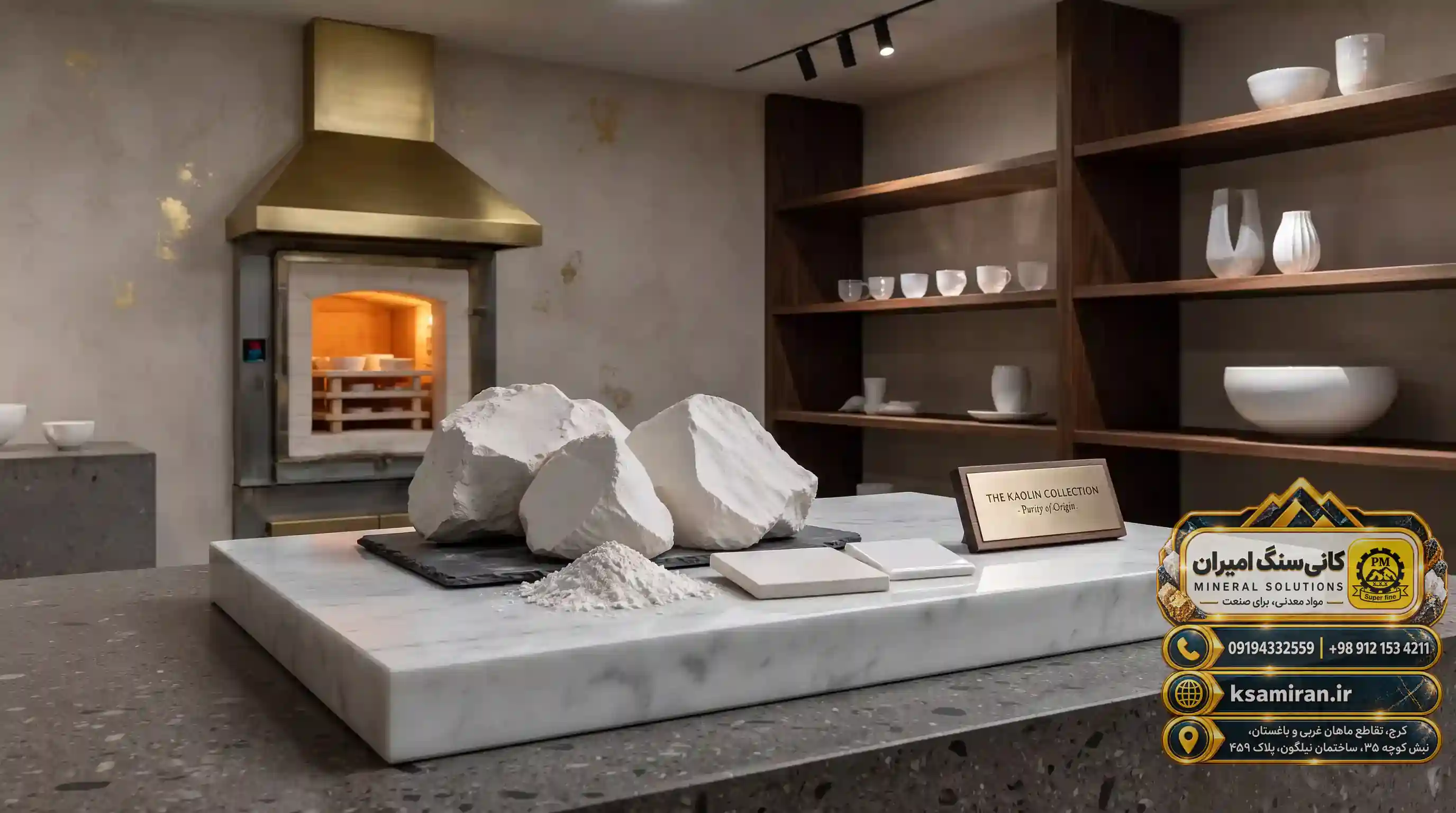
One of the most important technical characteristics of kaolin is its particle size, usually expressed in the mesh unit. The mesh number refers to the number of holes in one square inch of a sieve; the higher the mesh number, the finer the particle that passes through that sieve. So when it is said that kaolin is offered in the range of 450 to 1500 mesh, it means that grades with particles varying from relatively fine to extremely fine are made available to industries.
In the Amiran Stone Mineral Project, kaolin is offered in this wide range so that industries with completely different needs can choose their suitable grade: from ceramic bodies and tiles that need intermediate grades, to coating applications in paper and paint where very fine particles perform better.
Why Is Particle Size So Important?
- Specific surface area: Finer particles have more contact area with the environment; this increases light scattering, reactivity in firing, and covering power.
- Firing behavior: Finer particles react at lower temperatures and show better densification, which is useful for the strength of the fired ceramic.
- Viscosity and rheology: In glaze and paint, particle size directly affects viscosity, suspension stability, and the ability to apply a layer.
- Whiteness and opacity: Very fine particles increase light scattering and improve the opacity of coatings.
- Product uniformity: A narrow particle size distribution leads to process stability and reduced waste on the production line.
It is worth noting that the importance of grading is not exclusive to kaolin, and the same rule applies to other industrial minerals. For example, the article The Importance of Silica Grading in Glass and Foundry Industries shows how controlling particle size affects the quality of the final product in sensitive industries. Also, the article Why Is Granulated Silica Widely Used in Metal Industries? confirms that choosing the right grading range is a strategic decision in the formulation of industrial products.
The conclusion of this section is clear: choosing the right mesh range for kaolin is as important as its chemical analysis. The chemical composition determines what behavior kaolin has, but the grading determines how efficiently and uniformly that behavior appears on the production line.
The tile and ceramic products industry is one of the most important consumer markets for kaolin worldwide. The reason for this is a unique combination of chemical, physical, and thermal properties that kaolin provides to ceramic body designers. In a ceramic body, kaolin plays the role of "bones"; meaning it forms the alumino-silicate skeleton of the product, and other materials such as feldspar, quartz, and secondary clays are adjusted based on it.
Plasticity and Formability
When kaolin is mixed with water, due to its layered structure and hydrogen bonds between the layers, it forms a cohesive and formable paste. This property allows tiles and ceramic products to be produced by various methods such as pressing, extrusion, or molding. The finer and more uniform the particle size distribution, the more uniform the molding and the more controlled the drying shrinkage.
Green and Dry Strength
After drying, kaolin sticks to adjacent particles and creates suitable mechanical strength, which is essential for handling, sanding, and glazing raw tiles. Without this strength, ceramic products would crack before firing or be damaged during handling, increasing line waste.
Thermal Behavior and Formation of New Phases
In the kiln, kaolin undergoes specific chemical changes: at around 550 to 600 degrees Celsius it loses its water of crystallization and tus into metakaolinite; then at higher temperatures the structure is rearranged and phases such as mullite and a siliceous glassy phase are formed. Mullite is the phase that provides thermal resistance, strength, and dimensional stability of the fired ceramic. This is why the alumina percentage in the chemical analysis of kaolin is considered a direct indicator of the thermal potential of the final body.
Whiteness and Impurity Control
In white tiles, fine ceramics, and sanitary ware, the base color is very important. The lower the iron and titanium oxides in the kaolin composition, the higher the whiteness after firing. In colored or stone bodies these restrictions are looser, but even there, color uniformity stems from chemical composition uniformity.
Therefore, choosing kaolin for the tile industry means choosing a raw material that must be chemically stable, controlled in terms of grading, and reliable in terms of color. This is why tile manufacturers usually analyze every new batch of kaolin before accepting it on the production line to ensure it matches the current formulation.

Glaze is a thin, glassy layer fired on the surface of tiles, ceramics, and vessels to create a shiny, hygienic, and moisture- and chemical-resistant surface. The glaze composition consists of glass formers (such as silica, borax, and feldspar), stabilizers (alumina), and auxiliary oxides, and kaolin plays multiple roles in this composition.
Suspending Agent and Suspension Stability
Liquid glaze is actually a suspension of solid particles in water. Due to the colloidal behavior and plate-like shape of its particles, kaolin prevents rapid settling of particles and keeps the glaze in a stable suspension. Without kaolin or with an insufficient amount, particles settle and the density of the glaze changes during the process, resulting in mottling, uneven glazing, and surface defects.
Viscosity and Layer Thickness Control
Kaolin gives "body" to the glaze; meaning it adjusts the viscosity and the ability to form a layer of appropriate thickness on the surface. This directly affects the final glaze thickness, surface gloss, and the degree of spreading in the coers and chaels of the product. A glaze with inappropriate viscosity is either too ruy and doesn't stay on the surface, or too thick and drips.
Supplying Alumina and Silica in the Glassy Network
Kaolin is a natural source of alumina and silica in glaze. The alumina introduced into the glassy network increases the thermal resistance, hardness, and chemical stability of the fired glaze, and silica builds the main glassy network. As a result, the more accurately the chemical analysis of kaolin is known, the more predictable the glaze formulation becomes, and defects such as cracking, crawling, and dullness are controlled.
Effect of Impurities and Grading on Glaze Quality
- Iron and titanium: Cause discoloration of clear glaze and undesirable yellowness or dullness.
- Alkaline oxides: Change the melting temperature and viscosity of the glaze, and if not controlled, cause glaze defects and gloss changes.
- Coarse particles: Create surface roughness, pinholes, and post-firing defects; this is why finer grades are preferred for high-quality glazes.
The bottom line is that kaolin in glaze is not just a filler; it is a suspending agent, a rheology modifier, and a supplier of alumina. This is why its chemical analysis and grading must be carefully selected so the final glaze is clear, uniform, and defect-free.
In the paper industry, kaolin is used in two main forms: as a filler inside the paper web and as a coating pigment on its surface. In both cases, the main goal is to improve the optical and printing characteristics of the paper; a goal that is difficult to achieve without kaolin or with low-quality kaolin.
Brightness and Opacity
Very fine kaolin particles reflect and scatter light at different angles, resulting in an opaque surface. This light scattering increases the paper's brightness and reduces show-through from the opposite side; a feature of great importance in printing and writing paper, without which print quality drops drastically.
Printability and Surface Gloss
The coating layer of extremely fine kaolin creates a smooth and uniform surface that absorbs ink continuously and in a controlled maer. The result is higher image resolution, better text contrast, and optimal performance in high-speed printing machines. This is why coating kaolins are usually offered in fine grades (high mesh) to achieve a perfectly polished and bump-free surface.
Bulk Filling and Process Efficiency
In its filler role, kaolin replaces part of the cellulose fibers, and in addition to helping control production costs, it increases drying speed (by replacing fiber water with mineral particles), improves opacity, and enhances the paper's dimensional stability. At the same time, kaolin must be compatible with fibers and other additives and have low abrasiveness to prevent wear of papermaking equipment.
Why Are Chemical Analysis and Grading Important in Papermaking?
The whiteness of kaolin depends on its iron and titanium content; the viscosity of the paper pulp depends on the specific surface area and particle size distribution; and the final coating ability depends on the particle shape and their uniformity. This is why kaolin consumed in the paper industry is usually carefully controlled in terms of particle size and brightness, and every batch is analyzed before use. An unsuitable chemical composition can affect the entire production cycle, from print quality to energy consumption in the dryers.
In short, kaolin in the paper industry is a material that simultaneously affects appearance, printing performance, and process economics, which is why choosing the right grade is a technical decision, not merely a purchasing one.
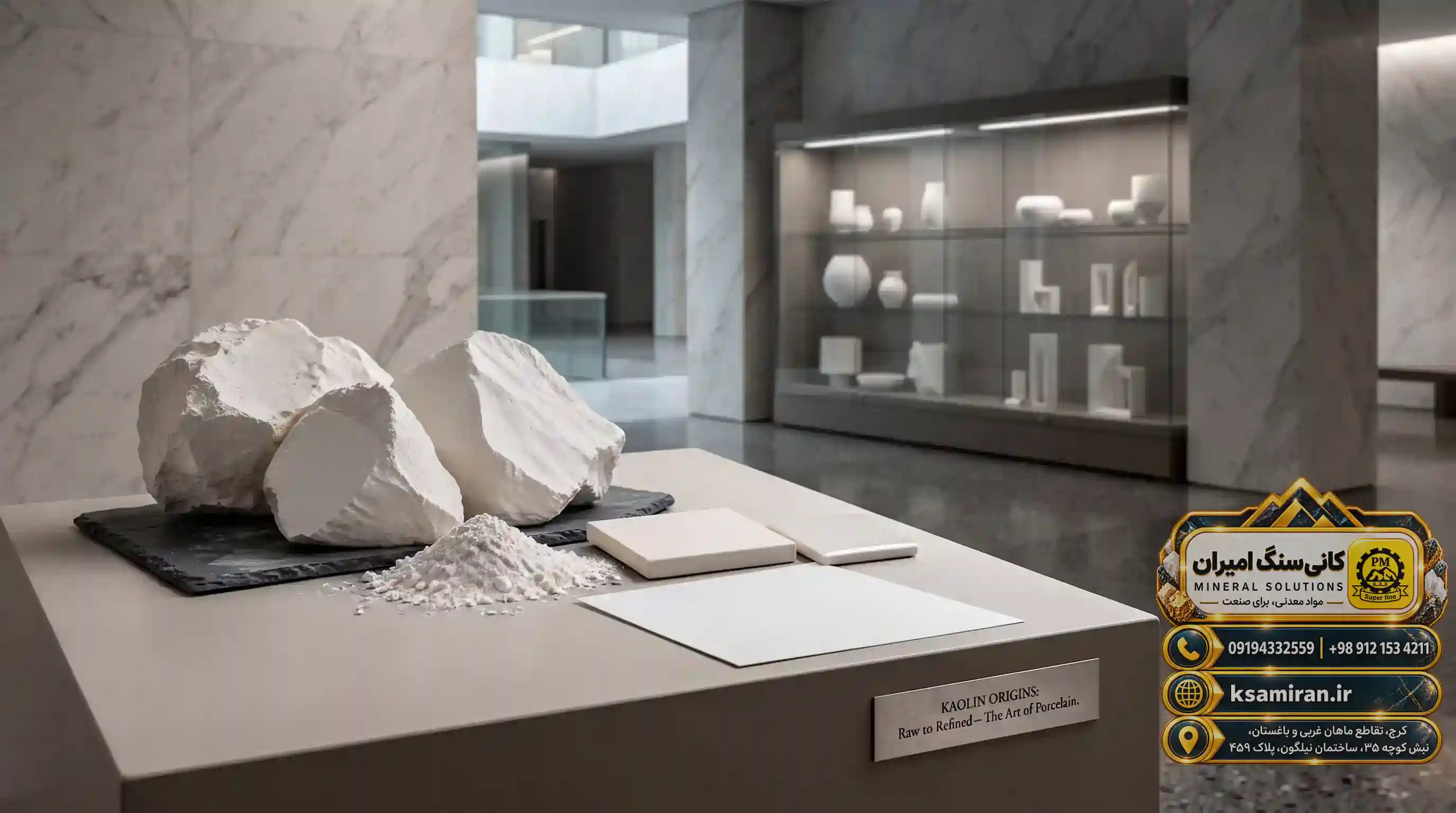
In the paint industry, kaolin is known as an extender pigment; meaning a material that, rather than completely replacing primary pigments like titanium dioxide (TiO₂), fills the spaces between their particles and improves their performance. This is both economically valuable and enhances the technical properties of the paint.
Increased Opacity and Covering Power
Fine kaolin particles of appropriate size scatter light and increase the paint's opacity. When kaolin particles are well distributed among TiO₂ particles, they prevent their agglomeration, allowing each TiO₂ particle to achieve maximum light scattering efficiency. This phenomenon, known as "pigment spacing," is one of the main reasons for using kaolin in mode paint formulations.
Gloss Control and Matting
Depending on whether the paint is matte, semi-matte, or glossy, the grade and amount of kaolin differ. Calcined kaolins, with their porous structure and lower density, are used for matting and gloss control, while very fine, plate-like grades are more suitable for high-quality glossy paints. So the same chemical composition in two different grades can create two completely different products.
Suspension Stability and Rheology
The plate-like structure of kaolin creates a thixotropic property that prevents pigments from settling in the paint can, ensures proper consistency when applied with a roller or brush, and controls sagging on the wall surface. Without this rheological behavior, the paint either settles very quickly or drips onto the surface.
Durability and Chemical Resistance
Kaolin is chemically inert and stable; it resists water, alkalis, and mild acids, which is why it is used in architectural paints, industrial paints, and anti-corrosion coatings. It also improves washability and abrasion resistance in the dried film, directly increasing the useful life of the coating.
Ultimately, choosing the correct kaolin grade for paint—like other industries—requires a precise understanding of its chemical composition, particle size distribution, and rheological behavior. A mistake in grade selection can lead to a drop in covering power, increased TiO₂ consumption, or a decline in final surface quality.
Whether the final product is tile, paper, paint, or glaze; the quality of the final product always starts with the quality of the incoming kaolin. This is why kaolin quality control is a multidimensional process in which chemical composition, mineralogy, particle size, and optical properties are jointly evaluated.
Common Kaolin Analysis Methods
- X-ray Fluorescence (XRF): Rapid and accurate measurement of major oxides and impurities in the chemical composition.
- X-ray Diffraction (XRD): Identification of mineral phases present such as kaolinite, quartz, feldspar, mica, and anatase.
- Particle Size Analysis (Laser PSA): Determination of the grading distribution and average particle size in terms of mesh.
- Brightness and whiteness measurement: Color evaluation with colorimetric devices for whiteness-sensitive applications.
- Moisture, LOI, and viscosity: Supplementary tests for coating applications and sensitive formulations.
Importance of Standards and Batch Uniformity
One key point exists: in industrial minerals, not just the average of specifications, but the stability and uniformity of batches matter. Quality standards in mode manufacturing industries are a systemic approach in which technical specifications, permissible impurity ranges, test methods, and documentation for each batch are defined. This necessity is not limited to kaolin; for instance, silica quality standards in mode manufacturing industries show how controlling the specifications of widely used minerals is the foundation of quality in various industries. Accordingly, a supplier who provides clear documentation and batch analysis is considered a strategic manufacturing partner, not merely a raw material seller.
Kaolin Selection Criteria
- Match of chemical composition with industry needs (especially maximum permissible iron and alkaline oxides)
- Appropriate mesh grade for the intended application, from the 450 to 1500 mesh range
- Quality uniformity in consecutive batches
- Appropriate packaging and continuous supply capability
If you are looking for a suitable material for the tile, ceramic, glaze, paper, or paint industries, the kaolin offered in the Amiran Stone Mineral Project is available in the 450 to 1500 mesh range to meet the diverse needs of these industries. Ultimately, the chemical analysis of kaolin is a tool that tus decision-making about formulation from guesswork into real data.
| Question | Answer |
|---|---|
| What is kaolin chemically? | Kaolin is mainly composed of the mineral kaolinite with the formula Al₂Si₂O₅(OH)₄, consisting of silica, alumina, and water of crystallization. |
| What does the chemical analysis of kaolin involve? | Determining the percentage of SiO₂, Al₂O₃, water of crystallization, and impurities such as Fe₂O₃, TiO₂, K₂O, Na₂O, CaO, and MgO. |
| Why is iron oxide in kaolin important? | Iron oxide causes yellowness and discoloration in white ceramics and glazes and usually must be controlled within the permissible range. |
| What is meant by mesh in kaolin? | Mesh is a unit for expressing particle size; the higher the mesh number, the finer the particles. |
| Which kaolin grade is more suitable for paper and paint? | Coating applications usually require very fine particles, which is why higher mesh grades are preferred in these industries. |
| What is the role of kaolin in the ceramic body? | Kaolin provides plasticity, green strength, and the alumino-silicate skeleton of the product, and converts to phases such as mullite upon firing. |
| How is kaolin used in glaze? | Kaolin is a particle suspending agent, a viscosity modifier, and a supplier of alumina and silica in the glaze's glassy network. |
| What role does kaolin play in the paint industry? | As an extender pigment, it increases opacity and covering power, adjusts gloss, and improves wash and abrasion resistance. |
| How is the quality of kaolin controlled? | With tests such as XRF for chemical composition, XRD for mineralogy, particle size analysis, and brightness measurement. |
| Which industries is the kaolin from the Amiran Stone Mineral Project suitable for? | This kaolin is offered in the 450 to 1500 mesh range for the tile, ceramic products, glaze, paper, and paint industries. |
This article has been compiled based on general mineralogical sources and the technical specifications of the kaolin product on the Amiran Stone Mineral Project website.
برچسب: Kaolin,Chemical Analysis of Kaolin, Why Is It So Important for Industries?,
نویسنده: رساوب آفرین