
درباره سایت
آخرین مطالب
- تاثیر اندازه ذرات کربنات کلسیم در صنایع
- ما هو الفرق بين الفلسبار والكوارتز؟ مقارنة شاملة بين أكثر مادتيْن معدنيتيْن استخدماً
- دليل شراء أكسيد الليمونيت عالي الجودة (الجول ماش)
- What is the Difference Between Kaolin, Bentonite, and Talc in Industry? A Complete Application Comparison
- کربنات کلسیم یا دولومیت؟ بررسی تفاوتها و کاربردهای کلیدی
- مراجعة معايير التصدير لأكسيد الليمونيت (جول ماش)
- راهنمای نگهداری و انبارداری اکسید لیمونیت (گل ماش)
- National Quality Standards of Limonite Oxide (Gol Mash)
- Guide to Receiving the Catalog and Specifications of Limonite Oxide (Gol Mash)
- کاربرد اکسید لیمونیت (گل ماش) در صنایع چرم و پارچه
امکانات وب
What Is Feldspar and Why Is It So Important in the Ceramic and Construction Industries?
Feldspar is a family of silicate minerals that makes up a large portion of the Earth's crust, and it is difficult to imagine the ceramic, glass, and building-material industries operating without it. After quartz, feldspar is the most abundant mineral in igneous rocks and is found abundantly in rocks such as granite, syenite, rhyolite, and their associated deposits. In terms of chemical composition, this mineral mainly contains silica (SiO₂), alumina (Al₂O₃), and alkali oxides such as potassium oxide (K₂O) and sodium oxide (Na₂O), along with varying amounts of calcium oxide (CaO).
Feldspars are divided into three main groups based on chemical composition and crystal structure:
- Potassium feldspar (orthoclase and microcline): contains potassium and is usually seen in pink, red, or white colors.
- Sodium feldspar (albite): contains sodium and is mostly white to opaque.
- Calcium feldspar (anorthite): contains calcium and, in combination with albite, forms the plagioclase series.
In the ceramic and glass industries, mainly alkali feldspars (potassium and sodium) are used, because these types of feldspar melt at relatively lower temperatures and exhibit a stronger fluxing property (reducing the melting temperature of the mixture). The hardness of feldspar on the Mohs scale is between 6 and 6.5, its density is about 2.55 to 2.76 g/cm³, and its melting temperature typically ranges from 1100 to 1250 degrees Celsius depending on composition.
But why is feldspar so important in the ceramic and construction industries? The main answer lies in its role as a flux or “melting-temperature reducer.” When feldspar is included in the formulation of a tile body, porcelain, glaze, or glass, it melts during firing and forms a liquid phase. This liquid phase bonds quartz and clay particles together, reduces the porosity of the body, and allows the product to be vitrified at a lower temperature than it would be without a flux. The result of this process is significant savings in kiln fuel consumption, increased production speed, and improved product quality.
In addition to its fluxing role, the alumina in feldspar enhances the mechanical strength, dimensional stability, and chemical resistance of ceramic and glass products, while the presence of alkali oxides helps reduce melt viscosity and improve behavior in the kiln. These very characteristics have made feldspar one of the most strategic industrial raw materials; a large portion of the world's consumed feldspar goes to the glass industry, while the other major portion is consumed in the tile, ceramic, porcelain, glaze, and building-material industries.
In the rest of this article, we examine 9 important applications of feldspar in the ceramic and construction industries in detail, so you can make a clearer decision about purchasing and selecting this mineral.
First Application: Feldspar in Tile and Ceramic Product Manufacturing
One of the most important and largest markets for feldspar is the tile and ceramic products industry. In the body of various wall tiles, floor tiles, pressed ceramics, and fully vitrified tiles, feldspar acts as the main flux. A classic tile-body formulation usually includes clay (for plasticity and formability), quartz (as a filler and skeleton builder), and feldspar (as a flux and high-temperature binder).
The most important functions of feldspar in tile and ceramic bodies are:
- Lowering the firing temperature: the presence of feldspar lowers the vitrification temperature and allows the tile to reach final density in a shorter temperature range. This directly leads to reduced energy consumption and increased productivity on production lines.
- Densification and reduced porosity: the liquid phase produced by feldspar fills the empty spaces between particles, reduces the body's water absorption, and increases the frost resistance of floor tiles.
- Increased mechanical strength: the glassy phase formed around quartz particles creates a cohesive network that increases the flexural, abrasive, and impact strength of the tile.
- Controlling the thermal expansion coefficient: the amount of feldspar in the body must be adjusted so that the body's thermal expansion matches the glaze's thermal expansion; otherwise, glaze cracking (crazing) occurs.
- Effect on whiteness and color: low-iron feldspars produce a lighter body, which is vital for white and light-colored tiles.
An interesting point is that the higher the degree of vitrification in a tile, the higher feldspar's share in the formulation. For example, in pressed tiles and fully vitrified tiles that have very low water absorption, feldspar makes up a higher percentage of the body formulation so that complete density is achieved at the proper temperature. On the other hand, in ordinary wall tiles with higher water absorption, feldspar's share is lower and the share of clay and carbonates is higher.
In tile production, feldspar particle size is also very important. Finer particles create more contact area, raise feldspar's reactivity during firing, and improve body uniformity. That is why feldspar is offered in different meshes, so each manufacturer can choose the suitable mesh according to its own production process.
The feldspar needed for producing glass, tile, ceramic products, and glaze is offered in the 10 to 450 mesh range, and manufacturers can choose the desired size based on their product type and milling process.
Second Application: Feldspar in the Glassmaking Industry
The glassmaking industry is the world's largest consumer of feldspar. In the glass batch, feldspar is used as a source of alumina and alkali oxides and plays a very important role in improving the quality and durability of glass products. Glassmakers usually use sodium or potassium feldspar of suitable grade and low iron content to produce transparent, high-quality glass.
The most important reasons for using feldspar in glass production are:
- Supplying alumina (Al₂O₃): alumina increases glass resistance to physical damage, scratching, and chemical attack, and controls the energy required for shaping molten glass.
- Supplying alkali oxides: feldspar contains K₂O and Na₂O, which lower the glass batch's melting temperature and reduce melt viscosity. This helps save kiln energy and increases melting speed.
- Improved chemical durability: glasses containing feldspathic alumina show greater resistance to water, detergents, and chemicals, which is very important for packaging liquids and food products.
- Increased thermal resistance: in specialty glasses such as borosilicate glass and thermal-shock-resistant glass, the presence of alumina derived from feldspar is important.
Feldspar is used in producing all kinds of glass products: packaging glass (bottles and beverage containers), flat glass (windows, mirrors, and architectural glass), fiberglass (glass fibers for reinforcing building materials and insulation), household and kitchen glassware, and specialty glasses such as opal glass, lead crystal glass, and optical glass.
In the glass industry, the uniformity of feldspar's chemical composition and particle size is highly important. Fine and uniform particles increase reaction speed in the fuace and prevent the formation of stones and impurities in the final glass. Also, feldspar's iron content must be controlled, because iron causes a green or bluish tint in glass and is undesirable for producing fully transparent glass.
Ultimately, using feldspar as a natural mineral can supply part of the soda ash needed in the glass batch, thereby helping reduce production costs. These advantages have made feldspar one of the main and irreplaceable raw materials in the glassmaking industry.
Third Application: Feldspar in Glaze and Surface Coatings
Glaze is a thin glassy coating fired onto the surface of tiles, porcelain, ceramics, and tableware, and feldspar is one of the most important components of glaze formulation. In fact, feldspar acts as the main flux in glaze and brings the glaze firing temperature to a range compatible with the body's firing temperature. Without feldspar, producing a glaze with a suitable firing range and a uniform surface would be very difficult.
The most important functions of feldspar in glaze production are:
- Lowering the glaze firing temperature: feldspar lowers the melting temperature of the glaze mixture so that the glaze melts at a temperature the product body can withstand and forms a smooth, glossy surface.
- Creating a glossy and smooth surface: the glassy phase derived from feldspar creates a transparent and regular surface, ensuring the shine and beauty of the final product.
- Increased hardness and scratch resistance: feldspar's alumina raises the hardness of the glaze surface and makes it resistant to mechanical damage.
- Excellent chemical resistance: feldspar-containing glazes have high resistance to acids, alkalis, detergents, and food pigments, which is vital for kitchenware and sanitary fixtures.
- Controlling the thermal expansion coefficient: feldspar helps adjust the glaze's thermal expansion relative to the body, preventing fine cracks (crazing) or glaze popping off.
Feldspar is used in producing all kinds of glazes: transparent and glossy tile glazes, matte glazes, colored glazes, salt glazes and underglazes, engobes, and also frits, which are pre-melted glasses used as semi-finished materials in glaze production. In frit production, too, feldspar is used as a source of alumina and alkalis.
For glaze production, feldspar must be ground very fine so its particles dissolve and react quickly in water and create a completely smooth surface. For this reason, very fine feldspar meshes are normally used in glaze production. In this industry, just as the application of kaolin in the paint industry and the production of industrial coatings matters for creating a uniform surface and proper covering, feldspar, as a flux and alumina source, guarantees the quality of ceramic and glassy coatings.
Another point in glaze production is feldspar's whiteness and purity. The presence of iron and titanium changes the color of transparent glaze and creates unwanted tints. For this reason, manufacturers of sanitary fixtures and food-grade porcelain usually order feldspar with a very low iron percentage.
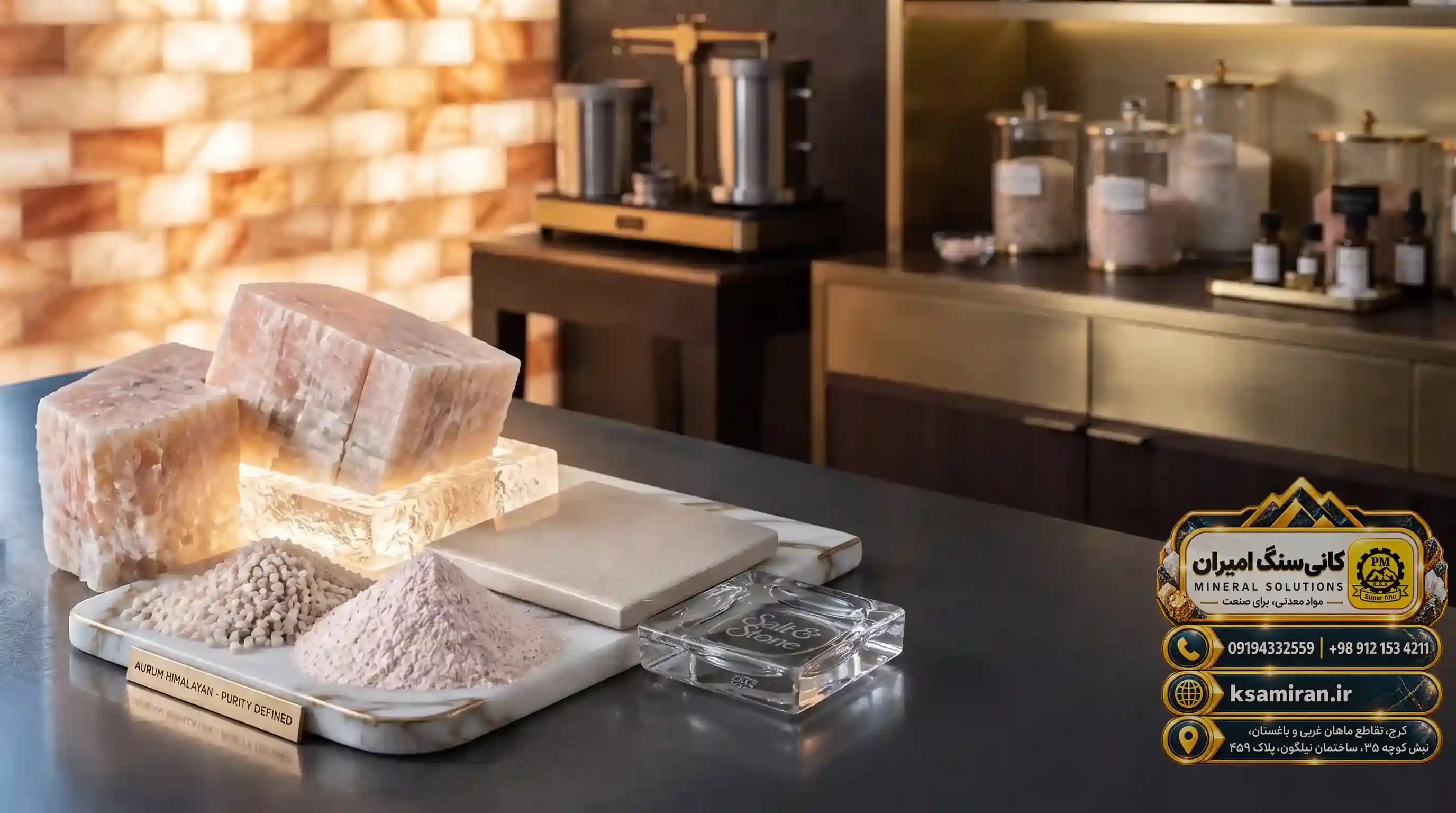
Fourth and Fifth Applications: Feldspar in Porcelain, Earthenware, and Sanitary Ware
Porcelain is one of the oldest yet most mode ceramic products, in which feldspar plays a key role. The classic porcelain formulation is a three-component (triaxial) system consisting of kaolin (supplier of alumina and formability), quartz (filler and skeleton builder), and feldspar (flux and vitrification agent). In fact, without feldspar, it is impossible to achieve the characteristic density, translucency, and strength of porcelain.
Feldspar's role in porcelain production includes the following:
- Complete vitrification: feldspar lowers the vitrification temperature and allows the porcelain body to become fully vitrified and non-porous at temperatures between 1200 and 1400 degrees Celsius.
- Special translucency: the abundant glassy phase derived from feldspar makes thin porcelain appear somewhat translucent to light, which is one of the signs of high-quality porcelain.
- Whiteness and beauty: low-iron feldspar helps the whiteness of the porcelain body and provides a suitable background for decorative colors and pattes.
- Mechanical and thermal resistance: vitrified porcelains have high resistance to impact, abrasion, and thermal shock, making them suitable for everyday use.
Such products include porcelain and earthenware (plates, glasses, bowls, teapots, and home and hotel dierware sets), decorative and artistic porcelain (statues, vases, and decorative objects), and technical and laboratory porcelain (acid- and heat-resistant containers).
The fifth application of feldspar is in the sanitary ware industry. Toilets, washbasins, bidets, bathtubs, and kitchen sinks made of “sanitary porcelain” or “vitreous china” must be fully vitrified and non-porous so they do not absorb water, odors, or contamination. In these products, feldspar is the main agent for vitrification and reduced water absorption, and it also creates a smooth, transparent surface for easy hygiene.
In sanitary-ware production, a glossy glaze resistant to detergents and disinfectants is very important, and feldspar, as noted in the previous section, plays the main role in forming this glaze. Also, the body of these fixtures must resist the thermal shock of hot and cold water, and again feldspar's alumina contributes to this resistance.
It is interesting to know that kaolin, which is used in porcelain body structure, is also employed in very diverse industries; for example, the application of kaolin in the car tire industry and improving tire resistance is one of the clearest examples of the versatility of industrial mineral applications.
Sixth and Seventh Applications: Feldspar in the Cement and Building Materials Industries
Feldspar also has a special position in the cement industry. Although ordinary Portland cement clinker is produced from raw materials such as lime, clay, and sand, in some cement types feldspar is used as a very important raw material or flux. The most important examples are:
- White cement: in producing white Portland cement, the iron and manganese oxide content must be kept very low so the final color remains completely white. Low-iron feldspar is an excellent source of alumina and silica that, while supplying the needed composition, does not darken the cement's color.
- Aluminous and special cements: in producing aluminous cements (such as calcium aluminate cement), which have high early and heat resistance, feldspar can be used as an alumina source.
- Flux in clinker buing: in some cement raw mixes, the presence of feldspar as a flux lowers the temperature at which clinker phases form and reduces the energy consumption of rotary kilns.
The seventh application of feldspar is in the building materials industry and its other broad sectors. The first case is building stone: granite, one of the strongest and most beautiful building stones, consists mainly of feldspar and quartz. Granite facade panels, floorings, stairs, sills, and countertops are used in buildings, exterior facades, and high-traffic spaces because of their high hardness and durability.
The second case is mineral-fiber insulations such as fiberglass and rock wool, in which feldspar-containing glasses are used to produce thermal and acoustic insulation fibers. These insulations are widely used in walls, roofs, and building installations and help optimize building energy consumption.
The third case is lightweight building blocks and panels and materials made from foamed glass or porous glasses, in which feldspar forms part of the glassy composition. Also, in producing some gypsum products and building mortars and related products, various minerals are used as additives or fluxes; just as the role of industrial talc in the gypsum and building materials industries shows, minerals affect the improvement of mechanical properties, processability, and durability of building materials, and feldspar is part of this same value chain.
Overall, feldspar is present in the construction industry both directly (in building stone) and indirectly (in architectural glass, insulation, cement, and mortars), and it is considered one of the pillars of raw-material supply for this industry.
Eighth and Ninth Applications: Feldspar in Brick, Earthenware, Refractory Products, and Electrical Insulators
The eighth application of feldspar is in the brick, earthenware, and refractory products industry. In producing some facade bricks, engineering bricks, roof tiles, clay sewer pipes, and decorative clay products, feldspar is added to the formulation as a flux to lower the firing temperature and let the product reach the desired density and strength. This is especially important in producing clay bricks with a smooth, low-porosity surface used in building facades.
Feldspar also has applications in the refractory products and kiln fuiture industry:
- Kiln shelves and fuiture: in producing some kiln shelves and inteal equipment for ceramic firing kilns, feldspar is used as a binding phase and flux to obtain a structure resistant to heat and thermal shock.
- Refractory clay products: in producing melting bottles, metal melting crucibles, and shaped refractory products, feldspar can work alongside other refractory raw materials to create desirable thermal behavior.
- Porcelain and tile firing kilns: the kiln fuiture on which tiles and porcelain wares are fired itself contains feldspar so it remains stable at high temperatures.
The ninth and very important application of feldspar is in producing electrical insulators and technical ceramics. Porcelain insulators for power transmission lines (transformer and tower insulator bases), automotive spark plug insulators, fuse bodies, thermocouple sheaths, and other ceramic insulating parts are all produced from feldspar-containing porcelain. In these products, feldspar has three main functions:
- Excellent electrical insulation: vitrified porcelain containing feldspar is a very good electrical insulator against high voltages.
- Thermal resistance: these parts must work at high temperatures (for example, inside a car engine or next to power lines), and feldspar contributes to their strength and thermal stability.
- Resistance to moisture and chemicals: fully vitrified porcelain does not absorb moisture or contaminants and therefore retains its insulating property over time.
Besides this, feldspar is used as a raw material or flux in producing some technical and advanced ceramics. The range of feldspar applications, from tiles and glass to electrical insulators and kiln fuiture, shows that this mineral is one of the most widely used industrial minerals in the ceramic and construction industries.
Feldspar Purchasing Guide: Choosing the Right Mesh and Conclusion
One of the most important questions for buyers in the ceramic, glass, and construction industries is: which mesh of feldspar is suitable for our application? In fact, choosing the feldspar particle size (mesh) depends on the product type, production process, and the reaction speed needed in the kiln. Generally, feldspar is offered in the 10 to 450 mesh range, and this wide range covers the needs of different industries.
General guide for choosing the mesh based on application:
- Glass industry: finer feldspar meshes are usually used (typically in the range of 30 to 120 mesh and finer) so the reaction in the fuace happens quickly and a uniform glass free of stones is produced. In specialty and crystal glasses, finer particles matter even more.
- Tile and ceramic body: intermediate meshes (around 100 to 200 mesh) are common to balance mill behavior, body uniformity, and firing reaction speed.
- Glaze and frit: for glaze production, feldspar must be ground very fine (usually 250 mesh and above, up to 325 and finer) to create a completely smooth and glossy surface.
- Porcelain and sanitary ware: fine and uniform meshes are recommended to achieve the desired translucency and density.
In addition to mesh, the following are also important in purchasing feldspar:
- Chemical composition: the levels of K₂O, Na₂O, Al₂O₃, SiO₂, and CaO must match your formulation's requirements.
- Iron oxide content: for white products and transparent glass, low-iron feldspar is essential.
- Batch uniformity: consistent quality across shipments is the key to fluctuation-free production in the ceramic industries.
- Particle size and grind distribution: besides the final mesh, the particle size distribution also affects firing behavior.
To view the specifications and order this mineral, you can visit the Kani Sang Amiran feldspar product page.
Conclusion: In this article, we examined 9 applications of feldspar in the ceramic and construction industries: 1) tile and ceramic product manufacturing, 2) the glassmaking industry, 3) glaze and surface coating production, 4) porcelain and earthenware production, 5) sanitary ware and vitreous china, 6) the cement industry (especially white and aluminous cement), 7) building materials and building stones such as granite, 8) brick, earthenware, and refractory products, and 9) electrical insulators and technical ceramics. In all these applications, the fluxing role, alumina supply, and creation of a glassy phase are the main reasons for using feldspar. Choosing the right mesh and chemical composition will help improve the final product's quality and reduce your production costs.
| Question | Answer |
|---|---|
| What is feldspar and what role does it play in the ceramic industry? | Feldspar is a silicate mineral containing alumina, silica, and alkali oxides, used as a flux (melting-temperature reducer) in tile bodies, porcelain, glaze, and glass. |
| Which type of feldspar is suitable for tile production? | Alkali feldspars (potassium and sodium), due to their lower melting temperature and stronger fluxing property, are more suitable for tile and ceramic production. |
| What is feldspar's application in the glass industry? | In the glass batch, feldspar supplies alumina and alkali oxides, raises the glass's chemical durability and hardness, and lowers its melting temperature. |
| What is the difference between potassium and sodium feldspar? | Potassium feldspar (orthoclase/microcline) contains K₂O and sodium feldspar (albite) contains Na₂O; the main difference lies in their firing behavior, melting temperature, and final application. |
| What is the suitable feldspar mesh for glaze and tile body? | For tile body, 100 200 mesh is usually used, and for glaze, 250 to 325 mesh and finer; feldspar in the 10 to 450 mesh range covers the needs of various industries. |
| Why is feldspar used in glaze production? | Feldspar lowers the glaze firing temperature, creates a glossy and smooth surface, and increases the surface's chemical resistance and hardness. |
| What role does feldspar play in the cement industry? | It is used in white cement and aluminous cement production as a low-iron alumina source and as a flux to reduce the clinker-buing temperature. |
| Is feldspar suitable for producing porcelain and sanitary ware? | Yes; in porcelain's three-component formulation (kaolin + quartz + feldspar), feldspar is the vitrification, translucency, and whiteness agent of the body, and in sanitary ware it minimizes water absorption. |
| Why does feldspar's iron content matter? | Iron oxide causes discoloration in white products, transparent glass, and glaze; therefore, low-iron feldspar is needed for light tiles, transparent glass, and porcelain. |
| Where should we order feldspar in the 10 to 450 mesh range? | To order feldspar for glass, tile, ceramic, and glaze, you can visit the product page on the Kani Sang Amiran website. |
Kani Sang Amiran — mineral material production: https://ksamiran.ir/products/feldspar/
برچسب: Feldspar,9 Applications of Feldspar in the Ceramic and Construction Industries You Should Know,
نویسنده: رساوب آفرین