
درباره سایت
آخرین مطالب
- انتخاب اکسید آهن قرمز (اخرا) برای بهبود کیفیت پیگمنت و پوششهای رنگی
- تامین کربنات کلسیم با دانهبندی دقیق جهت استفاده در مستربچ
- تأمین تخصصی سیلیس برای مصالح ساختمانی، شیشه و صنایع سرامیک
- ویژگیهای فنی بنتونیت کانی سنگ امیران برای کاربردهای خاص
- فلدسپات کانی سنگ امیران برای شیشه کاشی و سرامیک
- کاربرد تالک سفید درجه یک در فرمولاسیون پیشرفته رنگ و محصولات کاغذی
- اکسید آهن قرمز (اخرا) کاربردی جهت تولید محصولات سرامیکی و پوشش
- مشخصات فنی اکسید آهن قرمز (اخرا) مناسب برای پوشش و تولید پیگمنت
- مشاوره تخصصی خرید کربنات کلسیم بر اساس نیاز دقیق صنعت شما
- انتخاب تالک سفید صنعتی مناسب برای تولیدات کاغذ و مستربچ
امکانات وب
Introduction: Getting to Know Kaolin and Calcium Carbonate
In today's advanced world, minerals form the foundation of many industries, and choosing the right raw material can have a significant impact on the quality, cost, and performance of the final product. Two minerals that are often compared in various industries are kaolin and calcium carbonate. Both materials are used as fillers, pigments, and raw materials in numerous industries, but their inherent differences make each more suitable for specific applications.
Kaolin, also known as "china clay," is a clay mineral from the hydrous aluminum silicate group. This material is known for its bright white color, high plasticity, good thermal resistance, and chemical inertness. Kaolin forms in nature through the weathering and decomposition of feldspar-bearing rocks and is found abundantly throughout the world. Today, kaolin is widely used in the tile and ceramic, glaze, papermaking, and paint industries, and due to its unique properties, it is irreplaceable in many of these applications.
Calcium carbonate is another widely used mineral that is found naturally in limestone, marble, and chalk. Like kaolin, this material is white and is used as a filler and pigment in various industries including plastics, paint, paper, and adhesives. Calcium carbonate is produced in two main forms: light (precipitated) and heavy (natural), and its coated form has gained special importance in polymer applications.
The key question is: which of these two materials is more suitable for your industry? The answer to this question is not simple, because each material has its own advantages and limitations. In the tile and ceramic industry, kaolin plays a crucial role due to its plasticity and thermal resistance. In the paper industry, both materials are used as fillers and coating pigments, but they offer different properties. In the paint industry as well, both materials are used as extender pigments.
In this article, we intend to compare kaolin and calcium carbonate from various angles including chemical composition, physical properties, industrial applications, cost, and performance. By the end, you will have the information you need to make the best decision for your industrial needs. We will also examine in detail the kaolin mesh range of 450 to 1500 mesh and its main applications in the tile, ceramic, glaze, paper, and paint industries.
What is Kaolin? Chemical Composition and Physical Properties
Kaolin is known scientifically as "kaolinite" and its chemical formula is Al₂Si₂O₅(OH)₄. In other words, kaolin is a hydrous aluminum silicate composed of alteating layers of silica and alumina. This layered structure gives kaolin its plasticity property — meaning that when water is added to it, it can be shaped and it retains its form. This property makes kaolin a vital material in the ceramic and tile industry.
One of the most important properties of kaolin is its white and bright color. The whiteness of kaolin depends on the level of impurities present in it (such as iron oxide and titanium). The lower the impurities, the higher the whiteness of kaolin. Kaolin with a high whiteness grade is very valuable for applications where the product's appearance matters, such as colored paper, white paint, and glaze.
Another outstanding property of kaolin is its high thermal resistance. Kaolin remains stable at high temperatures, and for this reason it is used in the production of refractory ceramics and tiles that are fired at high temperatures. When kaolin is heated, its combined water evaporates and its structure changes, but it maintains its stability at high temperatures.
Kaolin is chemically very inert. This material does not react with acids and remains stable in the presence of various chemicals. This property is very important for applications where the product is exposed to chemicals, such as industrial paints and coatings. In contrast, calcium carbonate reacts with acids and releases carbon dioxide gas, which can create limitations in some applications.
The hardness of kaolin on the Mohs scale is about 2 to 2.5, which indicates its softness. This property causes kaolin to produce less abrasion during milling and processing operations and to damage equipment less. In addition, kaolin has a low expansion coefficient and shows minimal volume change at high temperatures.
In the papermaking industry, kaolin provides excellent coating properties due to its platy (plate-like) particle shape. These particles adhere to the paper surface and create a smooth and bright surface, which provides better print quality. Also, kaolin is used as a filler in paper and paint due to its fine particle size and uniform distribution, improving the mechanical and visual properties of the product.
Applications of Kaolin in the Tile and Ceramic Industry
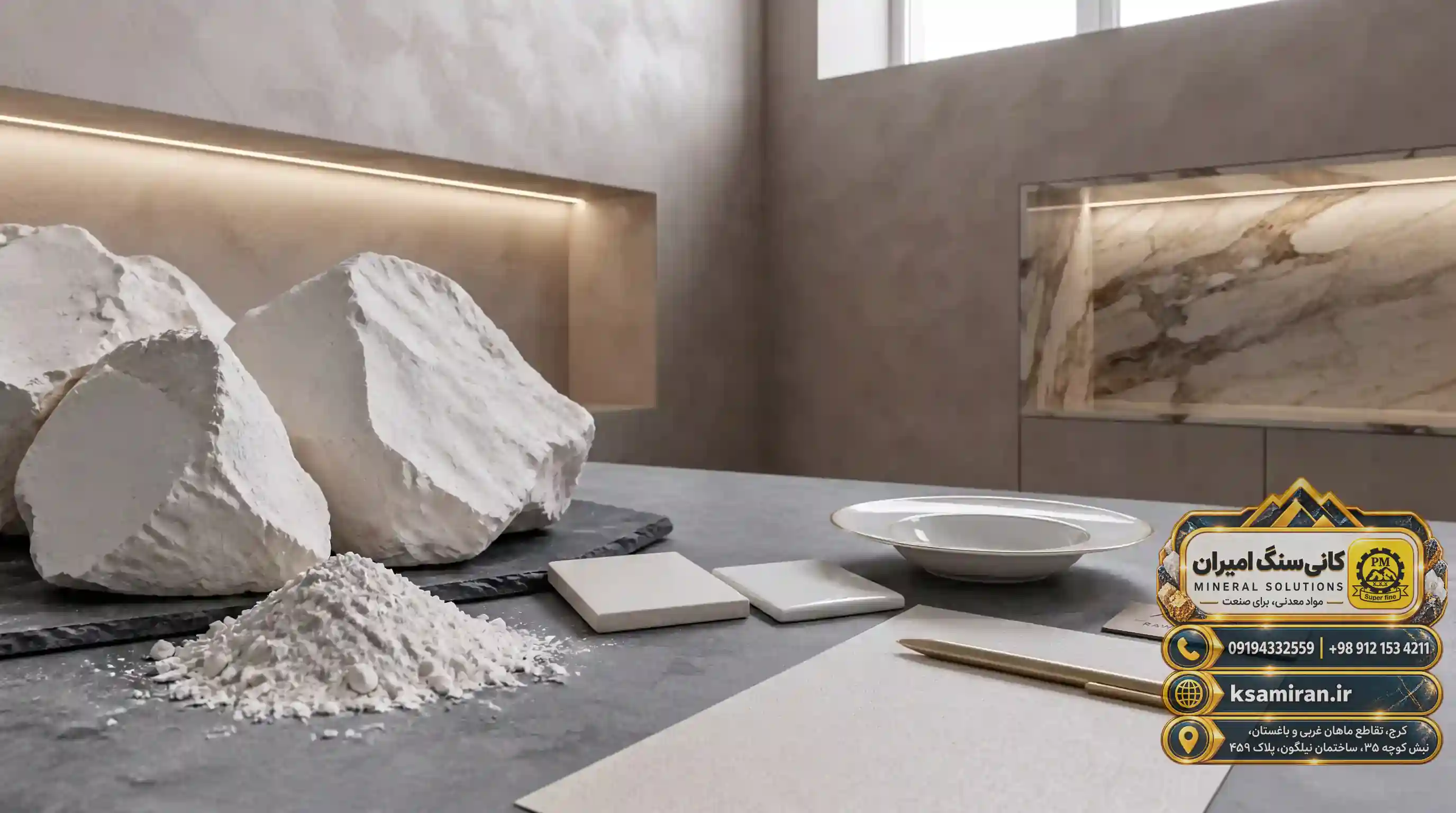
The tile and ceramic industry is one of the largest consumers of kaolin in the world. In this industry, kaolin is used as the main raw material of the ceramic body and plays a very important role in determining the properties of the final product. In the tile and ceramic production process, kaolin, due to its plasticity property, helps other materials mix well together and be shaped.
The plasticity property of kaolin means that when water is added to it, it becomes flexible and shapeable, and after drying, it retains its form. This property is vital for producing tiles in various shapes and sizes. Without kaolin, formulating a ceramic body for shaping becomes very difficult, because other minerals such as silica and feldspar alone do not provide sufficient plasticity.
During the firing stage, kaolin undergoes important changes. At high temperatures, the combined water of kaolin is released and mullite forms. Mullite is a highly resistant mineral phase that gives ceramics strength and thermal stability. This process gives ceramic tiles high resistance to impact, abrasion, and temperature changes. Kaolin also helps reduce shrinkage during drying and firing.
Another advantage of using kaolin in tile and ceramic production is its white color. Tiles produced from high-quality kaolin have a light and uniform color, which is very important for white and light-colored tiles. This property also allows glazes to display their true color.
In the ceramic industry, kaolin is used in a variety of products including chinaware, sanitary ware (such as toilets and washbasins), technical ceramics, and electrical insulators. In the production of chinaware, kaolin makes up a large share of the body composition and gives the final product strength, translucency, and a beautiful appearance.
The kaolin mesh range for the tile and ceramic industry varies depending on the product type and production process. For tile bodies, kaolin with a medium mesh is typically used to strike a proper balance between plasticity and drying speed. For finer applications such as chinaware and technical ceramics, kaolin with a higher mesh is used to achieve a more uniform surface and higher quality.
The Role of Kaolin in the Glaze Industry
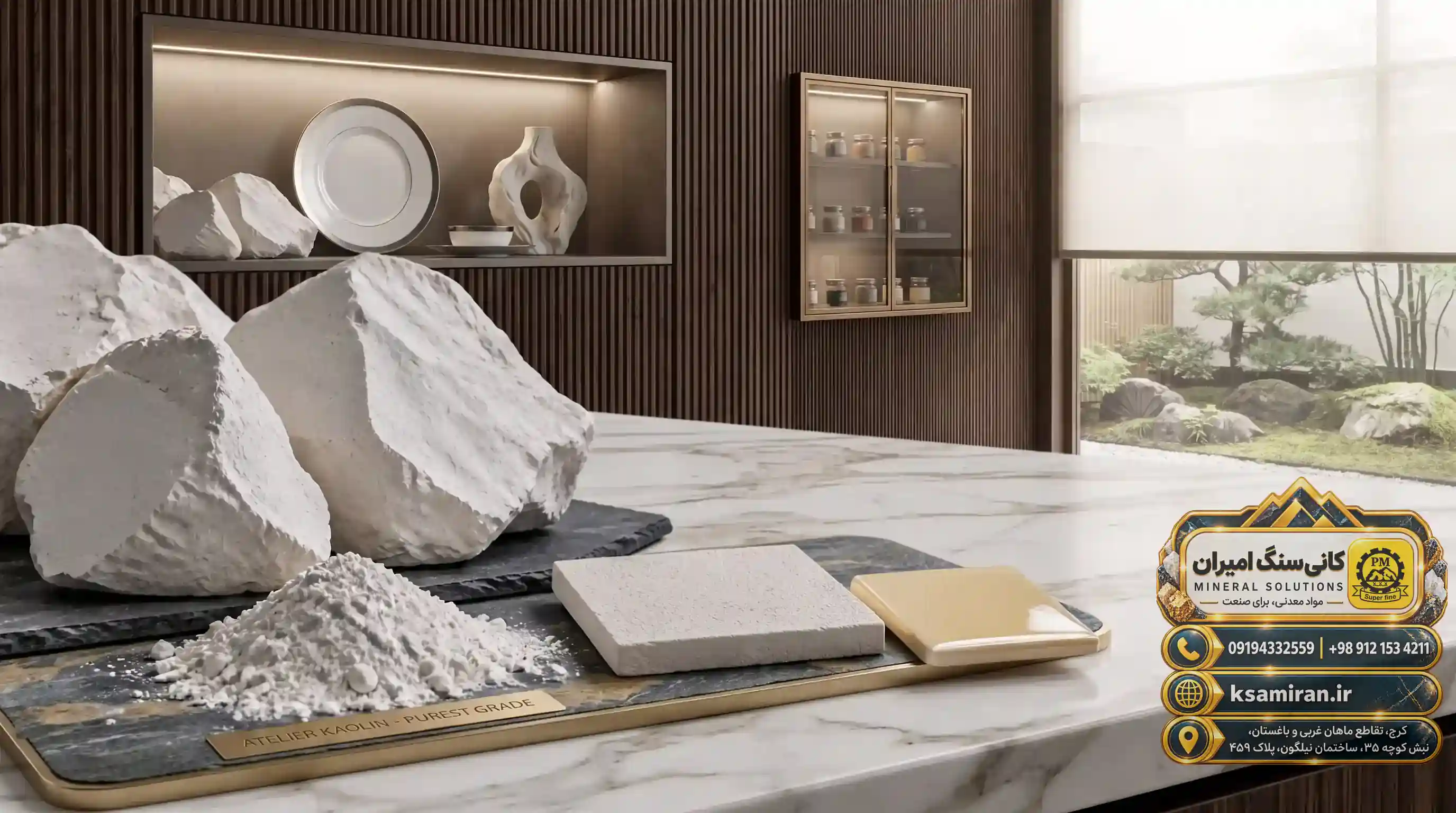
Glaze is a thin glassy coating applied to the surface of ceramics and tiles, giving the product a glossy appearance, moisture resistance, and durability. Kaolin is one of the main components in glaze formulation and plays a very important role in the quality and performance of the glaze. In fact, without kaolin, producing high-quality glaze is nearly impossible.
One of the most important functions of kaolin in glaze is acting as a suspending agent. Kaolin particles, due to their platy shape and fine size, remain suspended in the glaze composition and prevent the settling of other components. This property keeps the glaze homogeneous and uniform during the application process and creates a high-quality coating on the surface.
In addition, kaolin introduces alumina (Al₂O₃) into the glaze composition. Alumina is one of the vital components in glaze, giving it strength, scratch resistance, and chemical stability. Without sufficient alumina, the glaze becomes soft and is easily damaged. As a natural source of alumina, kaolin provides this element in an accessible and cost-effective form.
Kaolin also helps control the viscosity and fluidity of the glaze. By adjusting the amount of kaolin in the formulation, the glaze's fluidity can be set for different application methods (such as spraying, dipping, or splashing). This flexibility allows manufacturers to optimize the glaze for different products.
During the firing stage, kaolin helps form the glassy structure of the glaze. At high temperatures, kaolin melts with other glaze components (such as silica, feldspar, and pigments) and creates a coherent and transparent glassy layer. Kaolin also helps reduce glaze shrinkage during drying and prevents the glaze from cracking and detaching from the surface.
For glaze applications, kaolin with a high (finer) mesh is typically used, because finer particles create a smoother and glossier surface. High-mesh kaolin also melts better at lower temperatures and helps reduce the firing temperature, which ultimately results in energy savings.
Kaolin in the Paper and Paint Industries
The papermaking industry is one of the largest consumers of kaolin in the world. In this industry, kaolin has two main roles: as a filler and as a coating pigment. Both roles are very important and help improve the quality of the final paper.
As a filler, kaolin is placed among the cellulose fibers of the paper and fills the voids. This makes the paper smoother, brighter, and better for printing. Kaolin also helps increase the opacity of the paper and prevents text from showing through from the back side. In addition, using kaolin instead of wood fibers saves production costs, because kaolin is cheaper than paper pulp.
As a coating pigment, kaolin is applied to the paper surface to create a thin and smooth layer. This layer prepares the paper surface for printing and significantly improves print quality. High-quality papers such as magazine paper, photographic paper, and high-quality printing paper all use kaolin coating. The platy particles of kaolin align parallel to the surface and create a very smooth and glossy surface.
In the paint industry, kaolin is used as an extender pigment. Extender pigments are mineral materials added to paint to increase its volume while imparting useful properties. Kaolin, due to its white color, low abrasiveness, and affordable price, is one of the most popular extender pigments in the paint industry.
Kaolin imparts useful properties to paints. First, it acts as a matting agent and reduces the paint's gloss, which is desirable for matte paints. Second, it helps control the viscosity of the paint and makes it easier to apply. Third, it helps cover the surface better and makes the paint spread uniformly on the surface. Fourth, it increases the paint's resistance to moisture and chemicals.
In water-based (latex) paints, kaolin is widely used due to its good dispersion in water and compatibility with other components. In industrial paints and anti-corrosion coatings as well, kaolin is a suitable option due to its chemical stability and inertness. For high-quality paints, high-mesh kaolin is used to achieve a smoother and more uniform surface.
Kaolin vs. Calcium Carbonate: Key Differences
Both kaolin and calcium carbonate are widely used minerals in numerous industries, but there are fundamental differences between them that determine the correct choice. In this section, we examine these differences in detail.
The first and most important difference is the chemical composition. Kaolin is a hydrous aluminum silicate, while calcium carbonate is a calcium salt of carbonic acid. This chemical difference causes them to behave differently under various conditions. The most important consequence of this difference is the reaction with acids. Calcium carbonate reacts with acids and releases carbon dioxide gas, while kaolin is completely stable against acids. This property makes kaolin superior for applications where the product is exposed to acidic environments.
The second important difference is the plasticity property. Kaolin, due to its layered structure, has plasticity — meaning that when wetted, it can be shaped and retain its form. Calcium carbonate lacks this property. This difference makes kaolin irreplaceable in the tile and ceramic industry, because without plasticity, shaping the ceramic body becomes impossible.
The third difference is thermal resistance. Kaolin remains stable at high temperatures and preserves its structure even at very high temperatures. Calcium carbonate decomposes at high temperatures (around 800 to 900 degrees Celsius) and converts to calcium oxide and carbon dioxide. This property makes kaolin more suitable for thermal applications such as ceramics, refractories, and glass.
The fourth difference is whiteness and color. Both materials are white, but kaolin typically has a slightly yellowish-white whiteness, while calcium carbonate can achieve very high whiteness. In applications where absolute whiteness matters, calcium carbonate may hold the advantage. But in applications where other properties are more important, kaolin is the better choice.
The fifth difference is price and availability. Calcium carbonate is typically cheaper than kaolin, because it is naturally and abundantly available and requires less processing. However, in applications where kaolin's technical properties are vital, its higher cost is justified. For more information about the economic benefits of calcium carbonate in production, you can read the article Examining the Economic Benefits of Using Coated Calcium Carbonate in Production.
The sixth difference is the application in polymer industries. In the plastics industry, coated calcium carbonate is widely used due to its good dispersion and improvement of mechanical properties. To lea about the technical benefits of coated calcium carbonate in polymer processes, see the article Examining the Technical Benefits of Coated Calcium Carbonate in Extrusion.
In summary, kaolin is more suitable for applications that require plasticity, thermal resistance, chemical stability, and high coating performance, while calcium carbonate is a better option for applications that require high whiteness, low price, and good dispersion in polymers.
Guide to Choosing the Right Kaolin Mesh
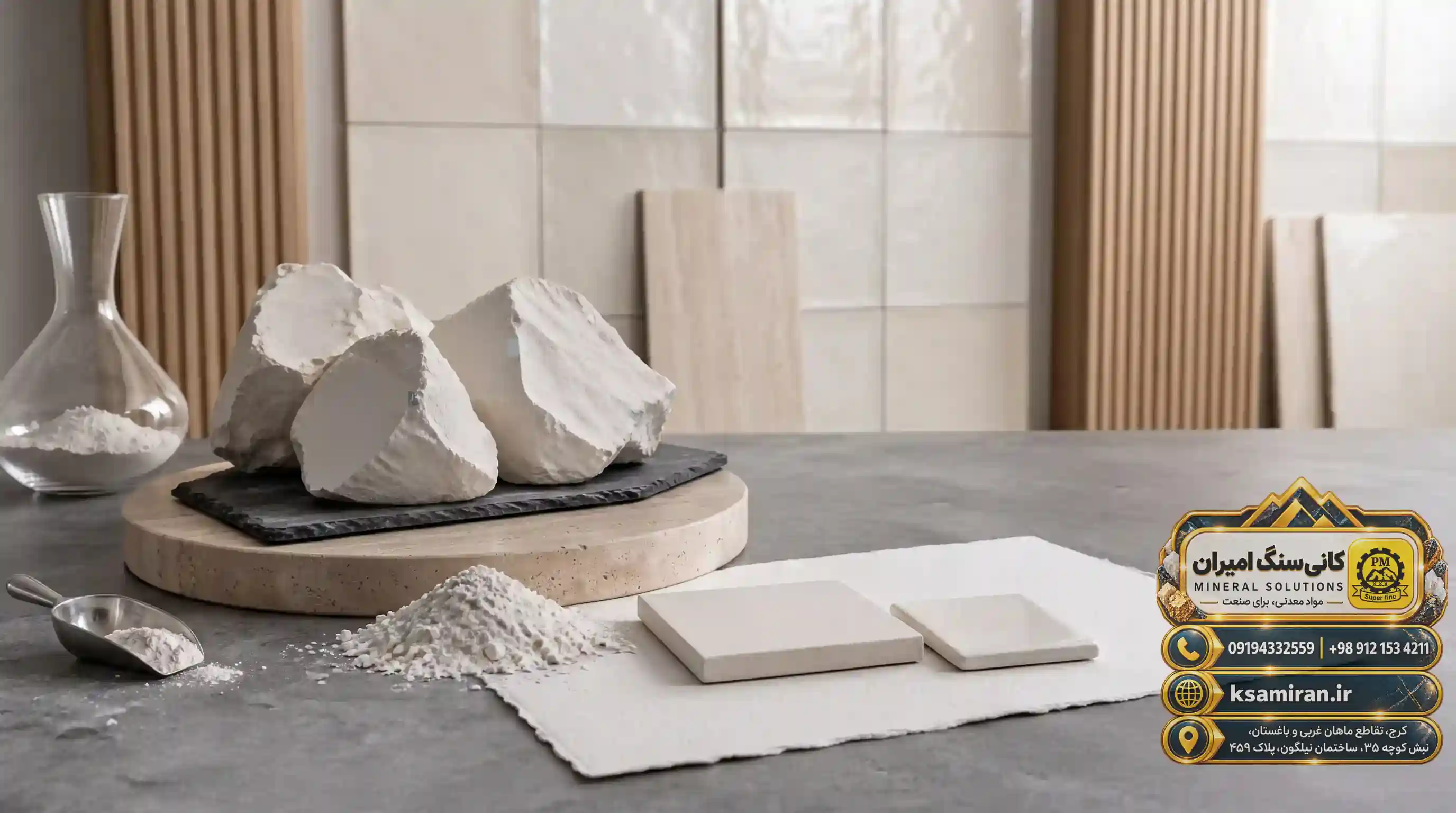
One of the most important factors in choosing kaolin is its mesh size. Mesh refers to the particle size of kaolin and has a direct impact on its performance in various industries. Kaolin available on the market is typically offered in different mesh ranges, and choosing the right mesh can make a significant difference in the quality of the final product.
Kaolin from the Kani Sang Amiran mineral project is offered with a mesh range of 450 to 1500 mesh. But what does this range mean, and how can you choose the right mesh for your industry?
A higher mesh number means finer particles. For example, 1500-mesh kaolin has much finer particles than 450-mesh kaolin. Finer particles cover a larger surface area and offer different properties. Choosing the right mesh depends on your industry and application:
Tile and ceramic industry: In tile body production, kaolin with a medium mesh (around 450 to 800 mesh) is typically used. This mesh range provides a good balance between plasticity and drying speed. For higher-quality ceramic products such as chinaware, kaolin with a higher mesh is used to achieve a more uniform surface.
Glaze industry: For glaze, kaolin with a high mesh (800 to 1200 mesh and above) is typically used. Finer particles allow the glaze to create a smoother and glossier surface. Also, finer particles melt better at lower temperatures, which helps save energy.
Paper industry: In the papermaking industry, medium-mesh kaolin is typically used for filler, but for coating, high-mesh kaolin (1200 to 1500 mesh) is used to make the paper surface very smooth and bright.
Paint industry: In the paint industry as well, high mesh (1200 to 1500 mesh) is used for high-quality paints to create a smooth and uniform surface. For industrial and architectural paints, a lower mesh may be used.
In addition to the industry type, other factors also influence mesh selection. Production speed, available equipment, firing temperature, and the required properties of the final product all play a role in mesh selection. For further guidance on choosing the mesh for minerals in polymer applications, you can read the article Guide to Choosing the Right Coated Calcium Carbonate Mesh for Plastic Injection.
Conclusion: Which Material is More Suitable for Your Industry?
After carefully examining the properties and applications of kaolin and calcium carbonate, we can now answer the question of which material is more suitable for your industry. The answer to this question depends on several factors, which we briefly review below.
If you are in the tile and ceramic industry: Kaolin is your definitive choice. The plasticity property of kaolin is vital for shaping the ceramic body, and there is no substitute for it. Kaolin gives your products strength, thermal resistance, and white color. Calcium carbonate caot fulfill this role, because it lacks plasticity and decomposes at high temperatures.
If you work in the glaze industry: Kaolin is an essential component in glaze formulation. Its role as a suspending agent and alumina supplier has made kaolin an irreplaceable material in glaze production. Without kaolin, high-quality glazes caot be produced.
If you are in the paper industry: Both materials have applications. Kaolin is superior for paper coating and improving print quality, while calcium carbonate is a more economical option as a cheaper filler. Many manufacturers use a combination of both materials to benefit from the advantages of each.
If you are in the paint industry: Kaolin is a popular option due to its chemical stability, matting effect, and affordable price. But if you need very high whiteness, calcium carbonate may be the better option. The final choice depends on your formulation and required properties.
If you are in the plastics industry: Coated calcium carbonate is the more common option, because it disperses well in polymers and improves mechanical properties. Kaolin is also used in some specific polymer applications, but calcium carbonate has broader applications in this industry.
Ultimately, the choice between kaolin and calcium carbonate is a technical and economic decision that must be made based on the specific needs of your industry. Kaolin, with a mesh range of 450 to 1500 mesh and wide-ranging applications in the tile, ceramic, glaze, paper, and paint industries, is a valuable and versatile material. If you are looking for high-quality kaolin for your industry, you can explore Kaolin from the Kani Sang Amiran Mineral Project and consult with our experts.

| Question | Answer |
|---|---|
| What is kaolin? | Kaolin is a hydrous aluminum silicate clay mineral used in numerous industries due to its white color, plasticity, and thermal resistance. |
| What is the difference between kaolin and calcium carbonate? | Kaolin is an aluminum silicate and has plasticity, while calcium carbonate is a calcium salt and lacks plasticity. Kaolin is resistant to acids, but calcium carbonate reacts with acids. |
| In which industries is kaolin used? | Kaolin is widely used in the tile and ceramic, glaze, papermaking, and paint industries. |
| What is the kaolin mesh range? | Kaolin is offered in the mesh range of 450 to 1500 mesh. |
| Which kaolin mesh is suitable for the tile industry? | For tile bodies, kaolin of 450 to 800 mesh is typically used. |
| Why is kaolin used in glaze? | Kaolin acts as a suspending agent and alumina supplier in the glaze composition. |
| Does kaolin react with acid? | No, kaolin is chemically inert and does not react with acids. |
| Is kaolin or calcium carbonate better for the paper industry? | For paper coating, kaolin is superior, but as a cheaper filler, calcium carbonate is the more economical option. |
| What benefits does kaolin offer the paint industry? | As an extender pigment, kaolin imparts matting, viscosity control, and chemical resistance to paint. |
| Which material is more suitable for the ceramic industry? | Kaolin is essential for the ceramic industry due to its plasticity and thermal resistance, and there is no substitute for it. |
Kani Sang Amiran Mineral Project - Mineral Materials Production, https://ksamiran.ir/products/kaolin/
برچسب: Kaolin,Kaolin or Calcium Carbonate? Which is More Suitable for Your Industry?,
نویسنده: رساوب آفرین