
درباره سایت
آخرین مطالب
- تاثیر اندازه ذرات کربنات کلسیم در صنایع
- ما هو الفرق بين الفلسبار والكوارتز؟ مقارنة شاملة بين أكثر مادتيْن معدنيتيْن استخدماً
- دليل شراء أكسيد الليمونيت عالي الجودة (الجول ماش)
- What is the Difference Between Kaolin, Bentonite, and Talc in Industry? A Complete Application Comparison
- کربنات کلسیم یا دولومیت؟ بررسی تفاوتها و کاربردهای کلیدی
- مراجعة معايير التصدير لأكسيد الليمونيت (جول ماش)
- راهنمای نگهداری و انبارداری اکسید لیمونیت (گل ماش)
- National Quality Standards of Limonite Oxide (Gol Mash)
- Guide to Receiving the Catalog and Specifications of Limonite Oxide (Gol Mash)
- کاربرد اکسید لیمونیت (گل ماش) در صنایع چرم و پارچه
امکانات وب
Introduction to Limonite Oxide (Gol Mash) and Its Industrial Importance
Mining and mineral processing have always been one of the main pillars of industrial development in countries. Among the wide range of mineral pigments and compounds, limonite oxide (gol mash) holds a special place. Due to its unique physical and chemical properties, this valuable mineral plays an irreplaceable role in various industries. Focusing on the principled extraction and processing of this material, the Kani Sang Amiran project has taken an important step toward supplying the needs of domestic industries. A precise understanding of the nature of this compound is the first step for its optimal utilization in industrial formulations.
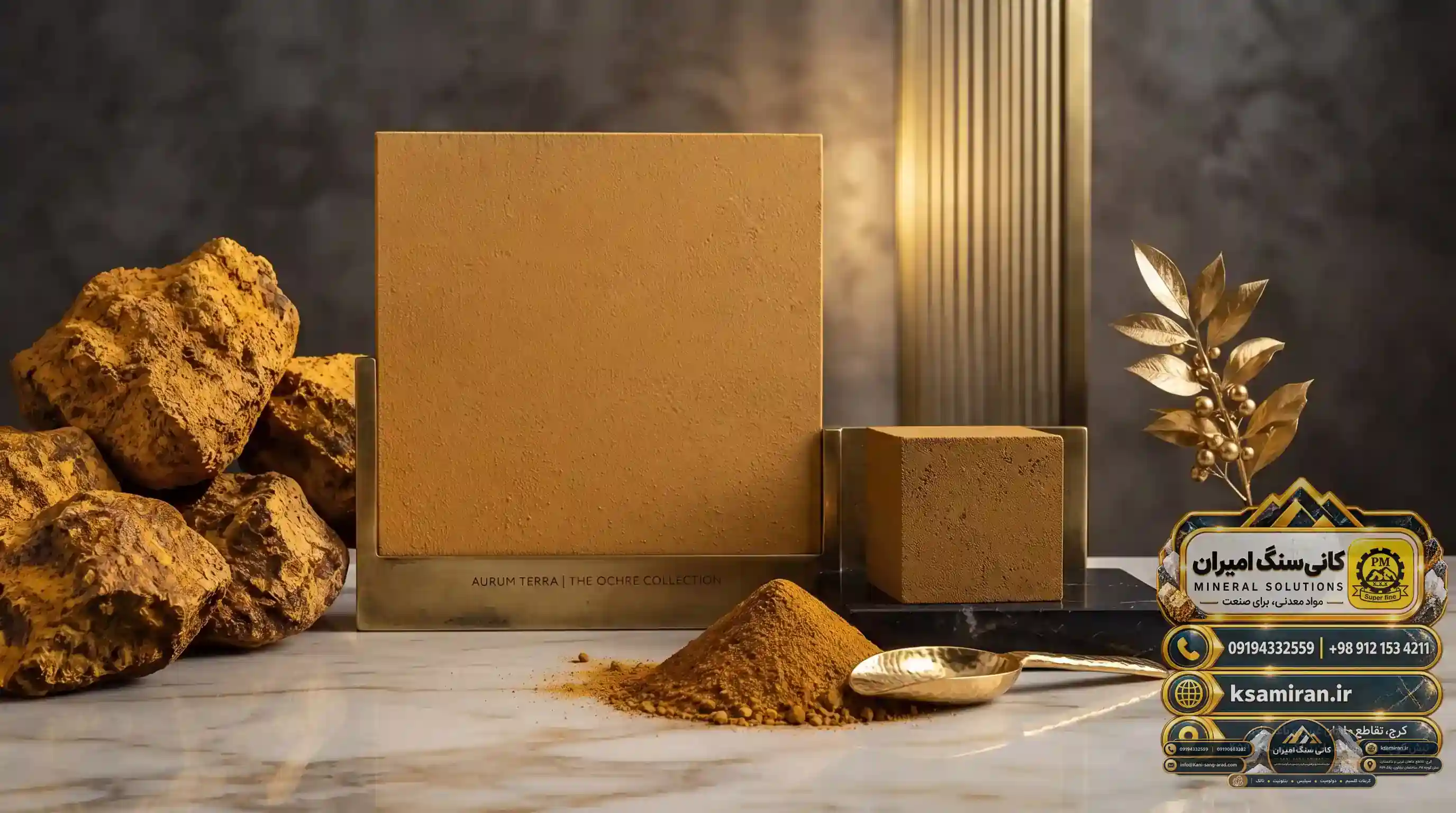
The yellowish-brown color of this material makes it an ideal option for paint and coating production. On the other hand, the structural stability of this compound against environmental factors makes it highly efficient in civil and construction projects as well. To better understand the appearance quality of this mineral, you can read the article Review of Appearance Characteristics of High-Quality Limonite Oxide (Gol Mash) to become more familiar with its quality evaluation criteria.
The production and processing process of limonite oxide (gol mash) involves complex stages of extraction, crushing, sizing, and micronization, which will be discussed in detail below. As a natural pigment, this material is considered a very suitable substitute for chemical and synthetic pigments, offering high durability in addition to being environmentally friendly.
Geological Understanding and Mineral Resources of Limonite Oxide (Gol Mash)
Limonite is an iron oxide hydroxide compound that typically forms in an amorphous state. This mineral is recognized as an important iron ore and has a strong presence in the oxidation zones of iron deposits. The formation of limonite oxide (gol mash) is the result of weathering and the decomposition of other iron-bearing minerals such as pyrite, magnetite, or hematite. This geological process creates diverse structures within the ore texture, which affects the quality of the final product.
This mineral is found in nature in various forms, including massive, earthy, or crusty. Its characteristic color, which ranges from earthy yellow to dark brown, is caused by the presence of water of crystallization and natural impurities in its structure. Mining engineers select the best parts of the iron ore for the extraction of this valuable material by accurately identifying mineral deposits.
After initial extraction, the mined ore is transported to processing plants to prepare for the next stages, namely crushing and micronization. Quality control at the geological and mining stage guarantees the purity and uniformity of the final product, which is of vital importance in industrial production lines.
Crushing Stages and Initial Ore Preparation
The first step after ore extraction is reducing the dimensions of large pieces to sizes suitable for entering the mills. In this stage, equipment such as jaw and hammer crushers is used. The goal of primary crushing is to break large lumps and prepare the materials for subsequent processes. Precision in this stage prevents premature wear and tear of the equipment and machinery in the production line.
After primary crushing, the materials enter the separation and preliminary sizing section. In this part, fine dust and coarse impurities are separated as much as possible to increase the purity of the mineral. This process is the main prerequisite for achieving the desired quality in advanced milling stages.
Observing engineering standards in the design of the crushing circuit has a direct impact on the overall efficiency of the plant. Utilizing mode equipment in the primary crushing section, the Kani Sang Amiran project has provided a suitable foundation for producing high-quality micronized powders to best meet the needs of consuming industries.
Micronization Technologies and Achieving a Mesh Range of 450 to 1500
One of the most important parts of limonite oxide (gol mash) processing is achieving the particle sizing and fineness required by the market. This product is processed and supplied in the mesh range of 450 to 1500, which indicates high precision in milling. Advanced roller mills, jet mills, and precise separators are used to produce powders with this degree of fineness.
Particle Size Distribution control is of utmost importance in the production of pigments and coatings. Finer particles lead to increased tinting strength, improved coverage, and a more homogeneous final product in various matrices. To examine the thermal behavior of these micronized powders at various processing temperatures, reading the article Investigation of Thermal Stability of Mineral Limonite Oxide (Gol Mash) provides very useful information for researchers.
In this mesh range, uniform particle distribution guarantees the optimal performance of the material in specialized applications. Intelligent quality control systems on the production line continuously measure particle dimensions to ensure that a fully standard and homogeneous product reaches the customers.
Application in Mineral Pigments and the Paint and Coating Industry
One of the primary applications of limonite oxide (gol mash) is its use as a mineral pigment in the paint, resin, and industrial coatings industries. Due to their excellent resistance to sunlight, weather conditions, and chemicals, mineral pigments are the first preference of many paint manufacturers. By creating warm and natural color spectra, this material gives a beautiful and lasting appearance to products.
High tinting strength and extraordinary coverage make this pigment an economical and efficient option. Compared to organic pigments, the light stability of this compound is significantly higher and it does not fade or undergo phase change under continuous ultraviolet radiation. This feature is extremely vital for building facade paints and metal protective coatings.
Paint manufacturing companies combine this mineral powder with water-based and solvent-based resins to produce coatings with high adhesion and corrosion resistance that successfully elevate the industry's quality standards.
The Role of Limonite Oxide (Gol Mash) in Construction and Concrete Products
The construction industry is one of the largest consumers of colored mineral materials. Limonite oxide (gol mash) is widely used in the production of construction products such as colored concrete, facade bricks, grouting powders, and concrete flooring. Due to its stability in alkaline cement environments, this material does not react adversely with other concrete components and creates a consistent and uniform color.
For professionals in the concreting and prefabricated parts industry, using a pigment that does not cause a drop in strength is very important. To gain more specialized information regarding the use of this material in one of the most widely used civil engineering fields, reading the article The Role of Limonite Oxide (Gol Mash) in the Mosaic Manufacturing Industry is recommended, as it addresses the technical details of this field.
High color durability against abrasion and foot traffic has justified the use of this mineral powder in the production of sidewalk mosaics and industrial flooring. Civil engineers impart beauty and strength to concrete structures by utilizing this natural additive.
Quality Control, Standardization, and Industrial Packaging
Quality assurance in the mineral processing industry is of high importance. Careful examination of purity levels, moisture percentage, thermal loss, and particle size distribution are among the tests performed in quality control laboratories. By establishing rigorous quality control systems, the Kani Sang Amiran project maintains the stability of the technical specifications of its products at the level of national and inteational standards.
After final quality approval by the laboratory unit, the product is ready for packaging. The type of packaging plays an important role in maintaining the health of the powder during transportation and warehousing. Using multi-layer moisture-resistant bags or standard palletization prevents caking and the absorption of environmental moisture by the micronized powder.
Complete technical information, including the percentage of iron oxide, impurity levels, and mesh range, is printed on the product labels so that industrial consumers can proceed with full confidence in purchasing and utilizing this material in their production lines.
Conclusion and Future Outlook of Mineral Supply
As a strategic mineral material, limonite oxide (gol mash) plays a key role in the development of the paint, coating, and construction materials industries. The precise processing of this material with a mesh range of 450 to 1500 has successfully met the rigorous demands of mode industries. The combination of geological knowledge with advanced crushing and micronization technologies has created high added value for the country's mineral resources.
Utilizing rich mines and standard production lines, the Kani Sang Amiran project is recognized as one of the reputable suppliers of this product in the country. To view exact specifications, place an order, and lea more about our products, be sure to visit the dedicated page Limonite Oxide (Gol Mash) to obtain complete information on how this product is supplied.
The future outlook of the mineral market indicates an increasing demand for natural and environmentally friendly pigments. Investment in advanced processing and upgrading the quality of micronized powders paves the way for the growth of this industry and promises even greater self-reliance for domestic industries.
| Question | Answer |
|---|---|
| What is limonite oxide (gol mash)? | It is a natural iron oxide hydroxide compound used as a mineral pigment. |
| What are the main applications of this material? | Mineral pigments, paint and coating industries, and construction and concrete products. |
| What is the mesh range of this product? | This mineral powder is processed and supplied in the mesh range of 450 to 1500. |
| What is the appearance color of this pigment? | It includes a spectrum from yellowish-brown to earthy yellow. |
| Is this material resistant to sunlight? | Yes, as a mineral pigment, it has extraordinary light stability. |
| Which construction industries use this material? | Manufacturers of mosaics, colored concrete, facade bricks, and grouting powders. |
| Which entity is the main manufacturer of this product? | Kani Sang Amiran Project — Mineral Production. |
| How can this product be purchased? | By visiting the product page on the Kani Sang Amiran website. |
| Is the thermal stability of this compound suitable? | Yes, its mineral structure is stable against standard processing temperatures. |
| Why are natural pigments preferred over synthetic ones? | Due to environmental friendliness, high durability, and no color change over the long term. |
Kani Sang Amiran Specialized Reference for Geological and Mineral Information
برچسب: Limonite Oxide (Gol Mash),Review of Production and Processing Methods of Limonite Oxide (Gol Mash),
نویسنده: رساوب آفرین