
درباره سایت
آخرین مطالب
- تاثیر اندازه ذرات کربنات کلسیم در صنایع
- ما هو الفرق بين الفلسبار والكوارتز؟ مقارنة شاملة بين أكثر مادتيْن معدنيتيْن استخدماً
- دليل شراء أكسيد الليمونيت عالي الجودة (الجول ماش)
- What is the Difference Between Kaolin, Bentonite, and Talc in Industry? A Complete Application Comparison
- کربنات کلسیم یا دولومیت؟ بررسی تفاوتها و کاربردهای کلیدی
- مراجعة معايير التصدير لأكسيد الليمونيت (جول ماش)
- راهنمای نگهداری و انبارداری اکسید لیمونیت (گل ماش)
- National Quality Standards of Limonite Oxide (Gol Mash)
- Guide to Receiving the Catalog and Specifications of Limonite Oxide (Gol Mash)
- کاربرد اکسید لیمونیت (گل ماش) در صنایع چرم و پارچه
امکانات وب
Introduction to the Importance of Granulation in Industrial Talc
Granulation is one of the most critical parameters in determining the quality and performance of micronized minerals. Among these materials, industrial talc holds a special place in various industries due to its unique structural and physical characteristics. Precise knowledge of particle size and their dimensional distribution helps engineers and manufacturers produce the final product with the highest efficiency. In today's mode industries, precise control of micronization and achieving the standard mesh range play a direct role in improving the mechanical, optical, and physical properties of products.
Processed mineral products by the Kani Sang Amiran project are produced with high precision to best meet the needs of various industries. Examining the effect of granulation on the behavior of this material in various polymeric or paint-making matrices shows how particle size can influence viscosity, coverage, and tensile strength. To better understand the importance of these parameters, it is suggested to read the article on How to identify industrial talc purity and quality? to gain a more comprehensive perspective on the quality standards of this mineral.
In addition, detailed examination of granulation in other applied minerals has a similar level of importance. For example, studying the Comprehensive guide to industrial barite granulation can reveal the similarities and differences of particle dimensional control among widely used industrial minerals. Overall, mastering granulation topics lays the foundation for superior quality in industrial formulations.
The Role of the 450 to 1000 Mesh Range in Final Properties
The mesh range is one of the most important technical specifications when purchasing and using minerals. For industrial talc, the 450 to 1000 mesh range is recognized as one of the most practical limits, creating an unmatched balance between physical properties and production cost. Particles in this range have controlled micron dimensions that disperse well in various industrial formulations without agglomerating or causing processing issues.
To supply their production lines, manufacturers can visit the dedicated industrial talc page and obtain more detailed information about this high-quality product. When particles fall within the 450 to 1000 mesh range, their contact surface with the base material (such as resin, rubber, or polymer) increases dramatically, which leads to improved interfacial adhesion, increased modulus of elasticity, and reduced gas and moisture permeability in the final product.
Controlling this mesh range requires the use of advanced classification and milling equipment, which is employed in the Kani Sang Amiran project to ensure particle size uniformity in every production batch. This quality stability allows formulation engineers to use this material in sensitive manufacturing processes with greater peace of mind.
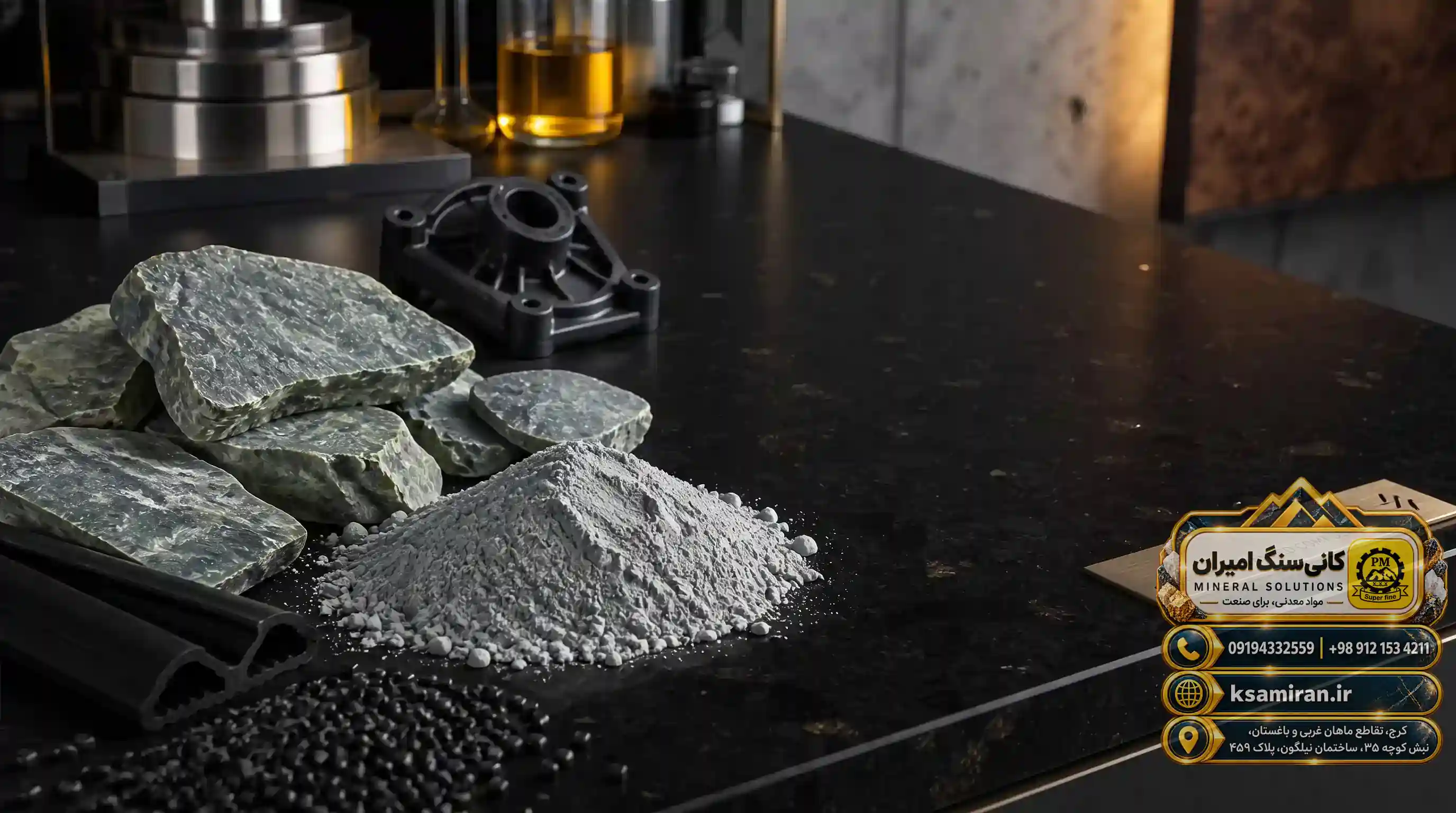
Application of Industrial Talc in Polymeric Products and Improvement of Mechanical Properties
The polymer industry is one of the largest consumers of micronized minerals. Adding industrial talc to polymer matrices has a profound effect on improving their mechanical and thermal properties. The flaky particles of this material orient well within the polymer structure and act as a reinforcement, resulting in increased hardness, heat resistance, and improved dimensional stability of polymeric parts.
Compared to other mineral fillers, using this material in the 450 1000 mesh range helps observe a smaller drop in polymer impact resistance while simultaneously increasing the flexural and tensile strength of the part. This feature is of utmost importance especially in the production of automotive parts, home appliances, and packaging containers. The process of uniform particle distribution in the polymer melt reduces part shrinkage during cooling and consequently improves the appearance and dimensional quality of the product.
Technical knowledge regarding how minerals affect thermal and acoustic properties is also applicable in other products; so that reviewing the Application of industrial barite in the production of acoustic and thermal insulation can provide similar engineering perspectives on optimizing the physical properties of composite materials. The optimal combination of these additives paves the way for producing lighter, stronger, and higher-quality parts.
Improving the Quality of Rubber Products with Proper Granulation
The rubber manufacturing industry requires raw materials that, in addition to being inexpensive, can enhance elastomeric properties, abrasion resistance, and product lifespan. Industrial talc plays a key role as an active and semi-active filler in rubber compounds. The layered structure of this mineral improves barrier properties against air and moisture penetration in rubber products such as various hoses, gaskets, and sealing strips.
When particles with precise granulation in the 450 to 1000 mesh range are added to the rubber compound, a more uniform and optimal vulcanization takes place. This prevents local particle agglomeration and does not create structural weak points in the part. Furthermore, using this material improves the flowability of the rubber compound in injection and extrusion molds, which increases production speed and minimizes waste.
Focusing on mineral production standards, the Kani Sang Amiran project offers products that are fully suitable and reliable for rubber manufacturing industries. Careful selection of the appropriate mesh ensures that the tensile properties and elongation at break of the rubber remain at a desirable level while its hardness and elastic modulus are reinforced to the desired degree.

The Role of Industrial Talc in the Paint and Surface Coatings Industry
In the paint and coating industry, optical properties, matting effects, and paint film durability are of special importance. The use of industrial talc in the formulation of various architectural and industrial paints is common as an extender pigment and thiing filler. The flaky particles of this mineral create a parallel, layered structure in the paint film after drying, which significantly reduces the penetration of water and corrosive agents to the underlying surface.
In addition to anti-corrosion properties, proper granulation in the 450 to 1000 mesh range greatly helps control gloss and create a uniform matte or semi-matte surface. These particles disperse well in the resin and minimize paint settling during storage. The excellent dispersibility and suitable whiteness of this mineral make it possible to reduce the consumption of expensive titanium dioxide without sacrificing the quality of the final paint, which is economically very significant for manufacturers.
Paint manufacturers can create better coverage on metal and concrete surfaces by using high-quality processed products. Long-term durability of the coating against various weather conditions and ultraviolet radiation are other prominent benefits of this material's presence in paint and coating systems.
Diverse Industrial Applications and the Importance of Particle Size Control
Beyond the polymer, rubber, and paint industries, industrial talc also plays a role in a wide range of other industrial applications. Among these applications are the production of industrial ceramics, papermaking, adhesives and sealants, and advanced composites. In each of these areas, particle size and dimensional distribution are the primary determinants of the fluid behavior and mechanical properties of the final product.
For example, in paper production, this material is used as a filler and coating to improve surface smoothness, opacity, and ink absorption, in which case the fineness of the granulation plays a direct role in print quality. In the ceramics industry, the presence of micronized particles reduces the firing temperature and improves the mechanical strength of the ceramic body. Precise control of the micronization process by the Kani Sang Amiran project ensures that the final product is free of coarse and harmful impurities.
Accurate understanding of each industry's needs and aligning them with the 450 1000 mesh range allows maximum utilization of the potential of this valuable mineral. By considering the rheological and surface characteristics of the particles, engineers can design more optimal formulations for harsh working conditions.

Formulation Optimization Methods Using Micronized Talc
To achieve the highest efficiency in production lines, simply purchasing high-quality raw material is not enough; rather, how it is applied and formulated is also of paramount importance. When using industrial talc in various compounds, paying attention to items such as loading percentage, mixing method, and the use of coupling agents can make a dramatic difference in the quality of the final product.
Particles in the 450 to 1000 mesh range have a specific surface area that may agglomerate if not distributed properly. Therefore, using high-shear mixers and observing optimal mixing time to break down agglomerates and achieve complete wetting of particles by the base resin or matrix is essential. This precision in preparation ensures that the mechanical properties predicted in engineering design are fully realized in the final part.
By offering superior products, the Kani Sang Amiran project has provided a suitable platform for engineers to reduce production costs by precisely adjusting process parameters while simultaneously upgrading the functional quality of polymeric, rubber, and manufactured paint parts. Optimizing formulation based on the scientific understanding of micronized particle behavior is the key to success in today's competitive markets.
Conclusion and Future Outlook of the Industrial Talc Market
This article provided a comprehensive review of the impact of granulation on final product performance, and it became clear to what extent the precise selection of industrial talc in the 450 1000 mesh range can influence the quality of polymer, rubber, paint, and other industrial applications. Particle size control, as a key factor, improves the mechanical, optical, thermal, and processing properties of products.
With advances in manufacturing technologies and increasing demand for higher quality and lighter products, the importance of using standard micronized minerals will grow day by day. Committed to providing high-quality and controlled mineral products, the Kani Sang Amiran project has always stood beside dear manufacturers and industrialists to cover their supply chain needs in the best possible way.
The future outlook of the market shows that the tendency toward specialized minerals with engineered granulations is growing. Investing in formulation technical knowledge and using premium raw materials will guarantee the survival and success of manufacturing units in domestic and inteational markets.

| Question | Answer |
|---|---|
| What is industrial talc and what are its applications? | It is a layered mineral selected and used for polymer, rubber, paint, and other industrial applications. |
| What is the mesh range of Amiran talc products? | The products of this collection are produced and supplied in the 450 to 1000 mesh range. |
| Why is granulation important in industrial talc? | Granulation directly affects the viscosity, mechanical properties, coverage, and processing behavior of the final product. |
| Is this material used in the paint industry? | Yes, it is used as an extender pigment, matting agent, and paint film durability improver. |
| What is the role of talc in the rubber industry? | It improves barrier properties, abrasion resistance, and uniform vulcanization of rubber compounds. |
| How can the quality and purity of this material be identified? | Through laboratory tests, whiteness level, absence of impurities, and particle dimensional distribution. |
| Is this material used in polymers? | Yes, it is used to increase hardness, dimensional stability, and thermal resistance of polymeric parts. |
| How can this product be purchased? | By visiting the dedicated product page on the Kani Sang Amiran website, order registration is provided. |
| What is the effect of the 450 to 1000 mesh range? | This range creates an ideal balance between physical properties and dispersibility in industrial matrices. |
| Which industries are the largest consumers? | Polymer industries, rubber manufacturing, paint making, and various industrial productions are the largest consumers of this material. |
Kani Sang Amiran Project — The reference for production and processing of mineral and industrial materials in Iran.

برچسب: Industrial Talc,The Impact of Industrial Talc Granulation on Final Product Performance,
نویسنده: رساوب آفرین