
درباره سایت
آخرین مطالب
- تاثیر اندازه ذرات کربنات کلسیم در صنایع
- ما هو الفرق بين الفلسبار والكوارتز؟ مقارنة شاملة بين أكثر مادتيْن معدنيتيْن استخدماً
- دليل شراء أكسيد الليمونيت عالي الجودة (الجول ماش)
- What is the Difference Between Kaolin, Bentonite, and Talc in Industry? A Complete Application Comparison
- کربنات کلسیم یا دولومیت؟ بررسی تفاوتها و کاربردهای کلیدی
- مراجعة معايير التصدير لأكسيد الليمونيت (جول ماش)
- راهنمای نگهداری و انبارداری اکسید لیمونیت (گل ماش)
- National Quality Standards of Limonite Oxide (Gol Mash)
- Guide to Receiving the Catalog and Specifications of Limonite Oxide (Gol Mash)
- کاربرد اکسید لیمونیت (گل ماش) در صنایع چرم و پارچه
امکانات وب
Introduction to Calcium Carbonate and its industrial importance
Calcium carbonate mineral is known as one of the most abundant and practical minerals on the planet, playing a vital role in various industries. Due to its unique physical and chemical properties, this valuable material holds a special place in the production of diverse industrial products. Examining the reasons for its popularity reveals that easy availability, favorable mechanical properties, and affordable price are the main factors behind its preference among engineers and manufacturers.
In mode industries, the use of processed minerals with precise particle sizing is of great importance. Calcium carbonate produced by the Kani Sang Amiran project is processed with high precision and well covers the needs of various industries. This material acts as an efficient filler and, in addition to reducing production costs, brings about improvements in the final product's properties. Having a precise understanding of this material's characteristics helps industries achieve the best efficiency in their production processes.
The production and preparation process of this mineral requires advanced equipment and strict quality control to achieve the particle sizing desired by various industries. To lea more about how to procure this material, reading the Calcium Carbonate Online Inquiry Guide provides useful information for procurement managers and industrial professionals. This material is recognized as a standard base in industrial formulations and plays an unparalleled role in the development of the industrial economy.
The role of Calcium Carbonate in polymer and PVC pipe industries
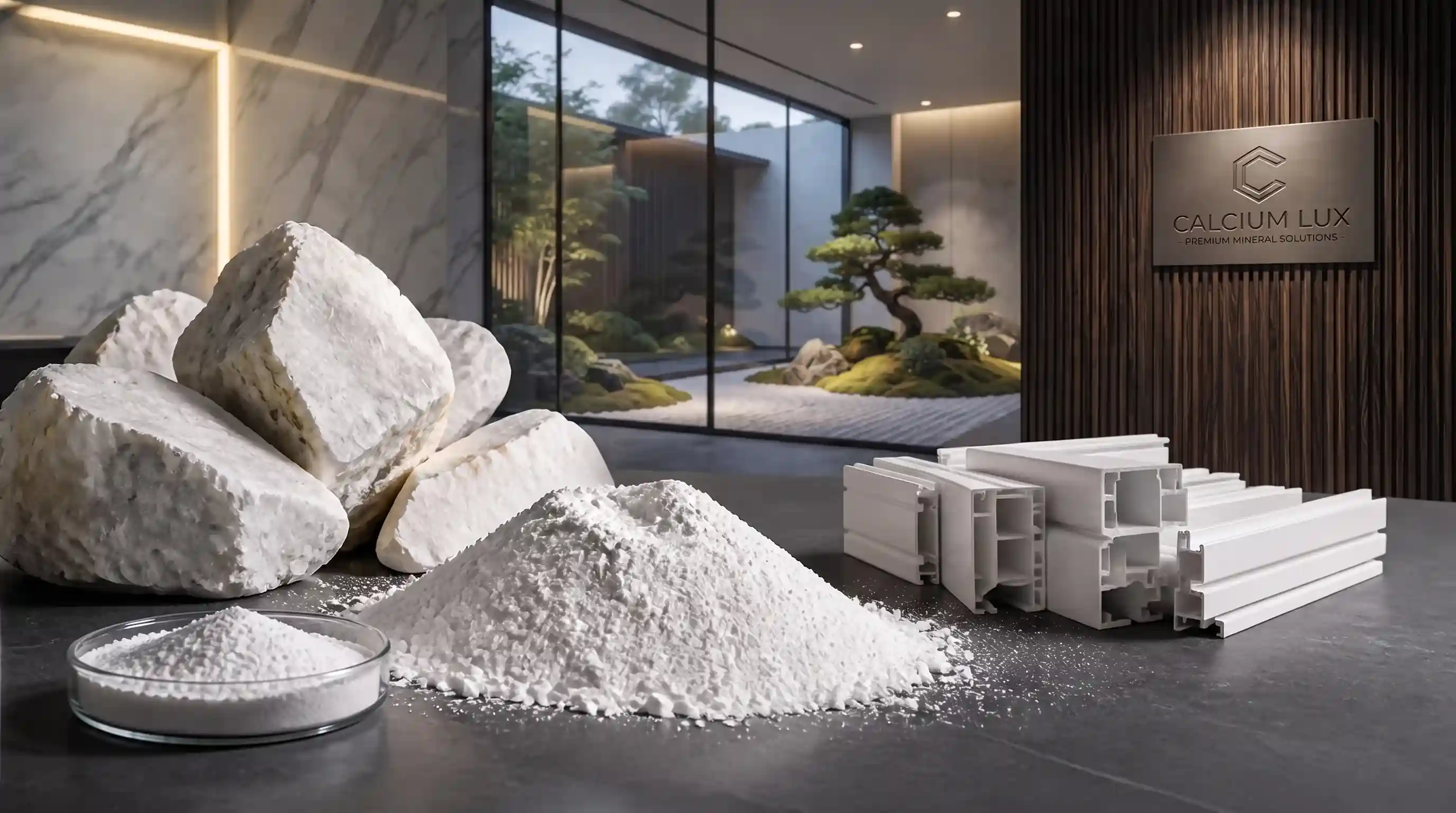
The polymer industry is one of the largest consumers of minerals, and among them, calcium carbonate holds a special place. The use of this material in the production of PVC/UPVC profiles and pipes increases mechanical strength, improves dimensional stability, and reduces the shrinkage of the final product. The uniform distribution of these particles in the polymer matrix significantly helps optimize the thermal properties and rigidity of the pipes.
In addition to pipes and profiles, the application of this material in the production of masterbatch and industrial cables is very extensive. Adding this mineral powder to polymer compounds improves the electrical and mechanical properties of cable insulation. Also, in the production of artificial leather, this material acts as an ideal filler that, by creating an appropriate texture, significantly increases the flexibility and durability of the leather, helping manufacturers offer high-quality products.
Choosing the appropriate mesh size for polymer applications is of high importance. The mesh range of the offered products varies from 100 to 3500 mesh, allowing for precise selection based on formulation requirements. By utilizing this wide mesh range, polymer engineers can achieve the highest level of dispersion and compatibility in their products and maximize the efficiency of production lines.
Application of Calcium Carbonate in the paint and industrial coatings industry
In the paint manufacturing industry, the choice of fillers has a direct impact on labelability, coverage, and paint durability. Due to its high whiteness and appropriate refractive index, calcium carbonate acts as a reinforcing pigment and filler, helping to improve the hiding power of water-based and oil-based paints. This material also plays an effective role in controlling gloss and improving the paint film's resistance against atmospheric factors.
Technical reviews show that the use of coated types of this material can noticeably enhance its performance in paint systems. To better understand this subject, reading the Examination of the impact of stearic acid in coated calcium carbonate provides precise scientific details about improving the powder's compatibility with organic resins. This coating process leads to better particle distribution and prevents their aggregation in the paint formulation.
Also, the specialized information available in the Comprehensive Guide to Using Coated Calcium Carbonate in Paint Making helps formulators select binders and additives with greater precision. The presence of this material in paints, in addition to improving aesthetic features, helps reduce the consumption of expensive resins, thereby significantly optimizing the final product price.
The importance of particle size and mesh range in industrial efficiency
One of the most important factors in determining the quality and efficiency of calcium carbonate is the mesh range, which is the measurement of its particle dimensions. The mesh range from 100 to 3500 mesh covers a wide spectrum of particle sizes, each of which is optimized for a specific industrial application. Coarser particles are usually used in applications requiring high volume filling with minimum viscosity, while very fine or micronized particles are used in advanced industries.
In the adhesive and sealant production industries, the use of high-mesh and micronized powders leads to improved rheological properties, increased adhesion, and control of product viscosity. The particle size distribution must be such that no lumps are created in the adhesive matrix, ensuring the final product has complete integrity. The precise control of the micronization process by the Kani Sang Amiran project guarantees the purity and uniformity of the products.
The paper industry is also heavily dependent on micronized powders with high whiteness. Using this material as a filler and surface coating for paper improves whiteness, brightness, print clarity, and surface smoothness. The variety in mesh range allows paper factories to choose the most suitable grain size according to the type of paper produced (writing, glossy, or packaging), thereby increasing production line efficiency.

The role of Calcium Carbonate in the production of engineered stone and mode materials
Engineered stone, as one of the mode and widely used building materials, has a high dependence on mineral fillers. Calcium carbonate acts as the main structural component in the production of engineered stone, Corian, and synthetic quartz. By filling the voids between the resin and other aggregates, this material significantly increases the structural density of the product and improves resistance to impact and abrasion.
The use of this high-purity mineral powder in the construction industry is very important due to its chemical stability and resistance to temperature changes. Engineered stones made with this formulation have a beautiful appearance, very low water absorption, and long-term durability against environmental factors. These features have led interior designers and builders to prefer engineered stones containing standard fillers.
The Kani Sang Amiran project, by supplying high-quality mineral powders for the engineered stone industry, plays an important role in improving the quality of mode building materials. Precision in particle sizing and the absence of unwanted mineral impurities in these powders ensure that the final product is free from inteal cracks and possesses complete mechanical integrity, which is vital for construction applications.
Comparison of Calcium Carbonate with other mineral fillers
In materials engineering, choosing the right filler depends on numerous factors, including price, density, whiteness, hardness, and compatibility with the base matrix. Compared to other mineral fillers such as talc, barite, silica, and clay, calcium carbonate has prominent economic and performance advantages that have made it the most widely used mineral in the world.
One of the key advantages of this material compared to silica is its lower hardness. The lower hardness of this powder reduces the wear of extruder equipment, molds, and mixing equipment in polymer and paint industries. Furthermore, the exceptional inherent whiteness of this material allows for the production of light and colored products without the need for large quantities of expensive titanium dioxide pigments.
In terms of environmental and worker safety, this material carries fewer risks compared to fillers containing free silica. These features, alongside the abundant access to rich mines, have made the final cost of this material highly competitive. Various industries have been able to maintain or improve product quality while reducing the final weight of parts and achieving energy consumption optimization by replacing heavier fillers with this material.

Processing, quality control, and production standards for mineral powder
Converting mineral stone extracted from mines into high-quality micronized powders requires complex crushing, classification, and quality control processes. The Kani Sang Amiran project, using mode milling equipment and air classification systems, produces powders with completely controlled particle size distribution in accordance with industrial standards.
Quality control is applied at all stages of production, from the extraction of raw stone to final packaging. Quality control laboratories use advanced particle measurement equipment (such as laser diffraction) to continuously examine chemical purity, moisture content, whiteness, and the mesh range of the products. This precise monitoring ensures that the powder delivered to customers has the highest level of compliance with the required technical specifications.
Adherence to packaging and warehousing standards also plays an important role in maintaining powder quality to prevent moisture absorption and caking. Providing products with resistant and standard packaging allows for safe transportation across the country and has brought peace of mind to industrial consumers in various polymer, paint, paper, and construction industries.
Prospects for Calcium Carbonate consumption in the sustainable development of industries
With the increasing development of new technologies and stricter environmental standards, the role of nature-friendly minerals has gained double importance. As a natural, non-toxic, and recyclable material, calcium carbonate plays a key role in moving industries toward sustainable development. Using this material helps industries reduce their carbon footprint and implement greener production processes.
Research in the field of surface modification of particles and nanocomposites has opened new perspectives for the advanced applications of this material. Using nanoparticles of this material in advanced engineering polymers can create extraordinary mechanical and thermal properties, which have numerous applications in the automotive, aerospace, and electronics industries. These iovations show that the traditional mineral still has high potential to meet the technological needs of the future.
The Kani Sang Amiran project, by monitoring the daily needs of the industry and upgrading its production lines, has always tried to provide the best products with a diverse mesh range from 100 to 3500 mesh to various industries. Continuous development of the product portfolio and providing expert advice to customers is a step toward the advancement of the country's industry and the optimal use of the rich mineral resources of our dear Iran.

| Question | Answer |
|---|---|
| What is calcium carbonate? | It is a widely used natural mineral that is used as a filler in the polymer, paint, paper, and engineering industries. |
| What is the mesh range of Kani Sang Amiran products? | The products of this collection are produced and supplied in the mesh range of 100 to 3500. |
| What are the main applications of this mineral? | PVC/UPVC profiles and pipes, masterbatch, cables, artificial leather, paint, paper, adhesive, and engineered stone. |
| Why is this material the most widely used mineral? | Due to its high whiteness, low hardness, affordable price, and improvement of mechanical properties in industrial products. |
| Is this material used in the paint industry? | Yes, it is used as a reinforcing pigment and filler to increase coverage and reduce resin consumption. |
| What is the role of calcium carbonate in PVC pipes? | It increases mechanical strength, dimensional stability, and reduces product shrinkage. |
| Is the coated powder of this material also available? | Yes, types coated with stearic acid are used to improve compatibility with resins. |
| How can one get an online price inquiry? | It can be done through the Calcium Carbonate Online Inquiry Guide on the Amiran website. |
| Is this material used in the paper industry as well? | Yes, it is used to improve the whiteness, brightness, and surface smoothness of paper. |
| How can the best mesh be selected? | It is selected based on the type of industrial formulation and the need for micronized or coarser particles. |
Specialized reference for minerals and industrial materials, Kani Sang Amiran.
برچسب: Calcium Carbonate,Why is Calcium Carbonate the most widely used mineral?,
نویسنده: رساوب آفرین