
درباره سایت
آخرین مطالب
- نقش اکسید لیمونیت (گل ماش) در صنایع تولید موزاییک
- دور أكسيد الليمونيت (الجيلماش) في صناعات إنتاج الفسيفساء (الموزاييك)
- چگونه کاربرد اکسید لیمونیت (گل ماش) را بهینه کنیم؟
- Company Limonite Oxide (Gol Mash) Price Comparison Guide
- بررسی ویژگیهای ظاهری اکسید لیمونیت (گل ماش) مرغوب
- کاربرد اکسید لیمونیت (گل ماش) در صنایع الکترودسازی
- دراسة الخصائص المظهرية لأكسيد الليمونيت (جول ماش) عالي الجودة
- دراسة الثبات الحراري لأكسيد الليمونيت المعدني (أكسيد الحديد الأصفر)
- The Role of Limonite Oxide (Gol Mash) in Mosaic Manufacturing Industries
- استخدام أكسيد الليمونيت (جول ماش) في صناعة الأقطاب الكهربائية
امکانات وب
Introduction to the Role of Coated Calcium Carbonate in the PVC Profile Industry
The polymer profile production industry, especially for PVC profiles, is constantly seeking high-quality and efficient raw materials to enhance the physical and mechanical properties of final products. In this regard, the use of high-quality mineral fillers has caused a significant evolution in optimizing industrial formulations. A material known today as a key component in this industry is coated calcium carbonate, which, due to advanced surface modification, performs differently compared to conventional samples.
The structural characteristics of this mineral are such that it leads to improved processability of polymer compounds. In mode profile production lines, the presence of such compounds can ensure the integrity of the product structure and minimize potential defects caused by extrusion. To lea more about specialized options for this material, you can visit the coated calcium carbonate page to obtain more comprehensive information about grain size variety and its applications.
Precise selection of raw materials is the foundation for producing products with a long lifespan and optimal resistance to environmental stress. Engineering studies show that using fillers modified with fatty acids significantly increases the ability of particles to distribute uniformly within the polymer matrix. This is especially important in the production sector of door and window profiles and other PVC building components.
Coating Technology and Structural Characteristics of Coated Calcium Carbonate
The main difference between coated calcium carbonate and uncoated or conventional types lies in its surface coating layer. The particles of this material are usually coated with stearic acid or similar substances to reduce the surface energy of the particles and improve their compatibility with various polymer matrices such as PVC. This process prevents the accumulation and clumping of particles during mixing.
From a surface chemistry perspective, investigating the impact of stearic acid in coating coated calcium carbonate shows that this hydrophobic coating creates a better bond between the mineral and polymer phases. As a result, water repellency increases and the thermal stability of the compound improves at high processing temperatures.
These structural changes cause the particles to disperse well throughout the polymer compound. Homogeneous dispersion is the tuing point for achieving desirable mechanical properties such as impact resistance and tensile strength in final PVC parts and prevents the creation of local weak points in the profile structure.
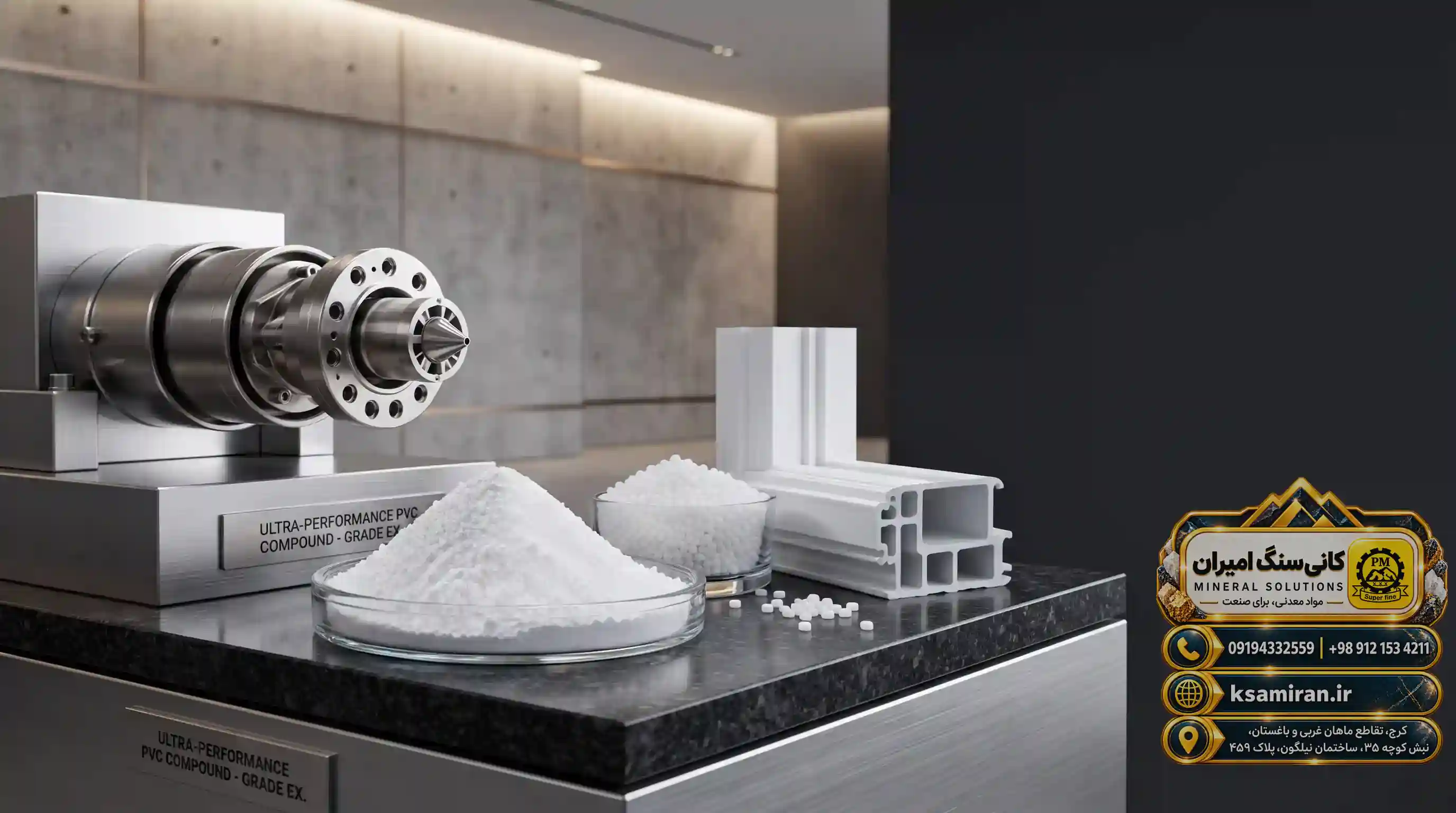
Mesh Ranges and the Importance of Choosing the Right Particle Size
One of the key parameters in determining the quality and efficiency of this mineral is its mesh range. Coated calcium carbonate is produced and supplied in the 450 to 3500 mesh range, each size of which is suitable for specific applications in polymer, compound, granule, cable, flooring, and PVC parts industries. Precise mesh selection is based on the type of machinery and the specifications of the final product.
Particles with coarser meshes are usually used in systems that require high volume and specific flowability, while very fine meshes (such as the ranges above 1500 to 3500 mesh) are used for sensitive parts that require excellent surface quality and high mechanical resistance. This grain size variety allows production engineers to fully optimize their formulations.
Precise particle size management also has a direct impact on melt viscosity during the extrusion process. Using the appropriate mesh range prevents a sharp drop in the melt flow index (MFI) and ensures the dimensional stability of the PVC profile along the production line.
The Role of Coated Calcium Carbonate in the PVC Profile Extrusion Process
The extrusion process is one of the most sensitive stages in the production of PVC profiles, where the polymer compound is shaped under pressure and heat. The presence of coated calcium carbonate in these formulations reduces the inteal friction of the melt and facilitates the movement of materials inside the extruder cylinder and screw, which reduces machine wear.
To better understand the technical details of this process, it is recommended to read the article regarding the review of technical benefits of coated calcium carbonate in extrusion to familiarize yourself with the precise mechanisms of viscosity reduction and improvement of the exit cross-section. These studies help industrialists manage temperature and machine speed settings more effectively.
In addition to improving flowability, the presence of this modified material prevents buing or thermal degradation of the polymer during its residence time in the machine. This technical advantage increases production rates and significantly reduces extrusion line waste.
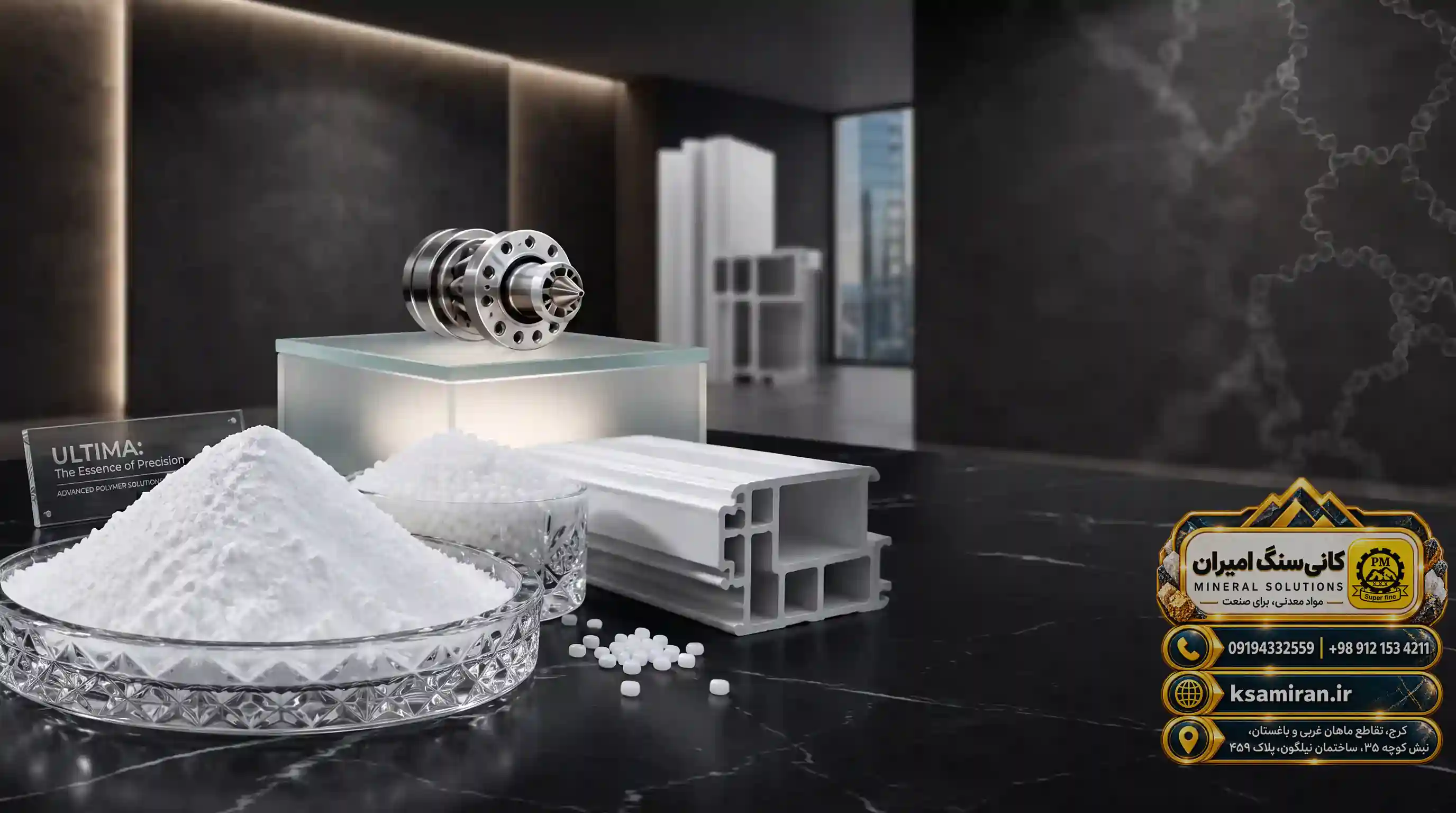
Economic Benefits and Optimization of Profile Production Costs
Alongside technical and engineering benefits, economic justification is one of the main drivers for manufacturers to use mineral fillers. Utilizing coated calcium carbonate significantly helps reduce the final product cost due to its more favorable price compared to pure PVC resin, without causing a noticeable drop in quality.
You can read more detailed financial analyses in the article review of economic benefits of using coated calcium carbonate in manufacturing. These studies show how reducing the consumption of expensive resin, along with increasing production efficiency and reducing machine energy consumption, enhances the profitability of the industrial unit.
Optimizing costs without lowering quality standards provides a competitive advantage in domestic and foreign markets. Manufacturers can intelligently manage their formulations to offer a high-quality and affordable product to the market that meets stringent standard requirements.
Widespread Applications in Compounds, Granules, and Polymer Parts
Although the main focus of this discussion is on PVC profiles, the scope of application for coated calcium carbonate goes far beyond this, including compounds, polymer granules, cables, flooring, and various PVC parts. This material holds a special place as a multi-purpose filler in the plastics industry.
In the production of polymer granules, the uniform distribution of coated particles prevents the creation of heterogeneous lumps and makes the quality of the grain entering the injection molding or extruder uniform. Also, in the production of cable coatings, electrical insulation properties and physical resistance are improved by the optimal addition of this material.
In the field of flooring and PVC injection parts, flexibility and wear resistance are critical factors that the presence of this mineral with appropriate mesh helps to realize. This versatility has made it a popular option among material engineers.
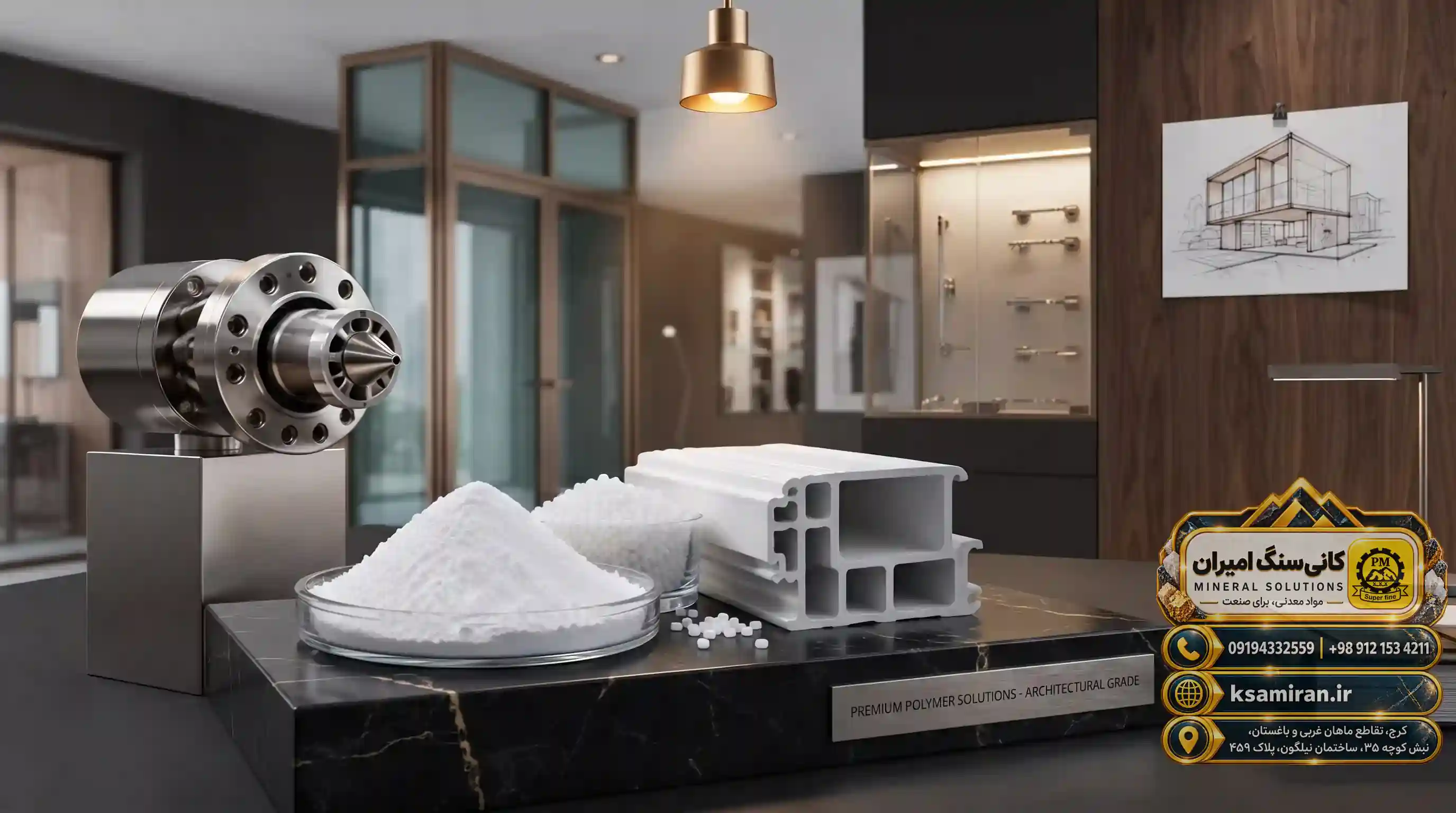
Effect on Mechanical Properties, Dimensional Stability, and Environmental Resistance of Profiles
The mechanical properties of a PVC profile determine its durability in structures. Using coated calcium carbonate, due to the strong bonding of particles with polymer chains, increases the modulus of elasticity and prevents unwanted deformation of the profile under mechanical loads.
Dimensional stability against environmental temperature changes (thermal contraction and expansion) is another obvious advantage of this compound. Sturdy mineral particles control the linear thermal expansion coefficient of the profile and prevent warping or deformation of parts under various weather conditions.
Furthermore, resistance to moisture penetration and corrosive chemical factors is improved thanks to the water-repellent nature of the particle surface. This significantly increases the useful life of profiles installed in building facades or humid environments.
Key Points in Selection, Storage, and Formulation of PVC Compounds
To maximize the benefits of coated calcium carbonate, it is essential to observe technical principles in selecting mesh, storage, and primary mixing (Dry Blend). Selecting a mesh suitable for the profile wall thickness and production line speed is the first step in achieving a flawless product.
The storage conditions of this material are also important; storage in dry environments away from extreme moisture prevents potential clumping and maintains the quality of the stearic acid coating. Also, during mixing in hot and cold mixers, observing precise time and temperature is mandatory for homogeneous particle distribution.
Finally, cooperation with reputable mineral suppliers such as the Kani Sang Amiran project will guarantee access to a product with standard graining and consistent quality. This professional approach allows manufacturers to maintain the quality of their final products at the highest possible level.

| Question | Answer |
|---|---|
| What is coated calcium carbonate? | It is a mineral material whose particle surface has been modified with special coatings (such as stearic acid) to have better compatibility with polymers. |
| What is the mesh range of coated calcium carbonate? | This product is produced and supplied in the 450 to 3500 mesh range. |
| What is the difference between the coated type and the conventional one? | The coated type has a surface coating that prevents clumping and makes its dispersion in the polymer matrix easier. |
| What are the main applications of this material? | Compound, polymer granules, PVC profile, cable, flooring, and various PVC parts. |
| Why is this material used in PVC profiles? | Due to improved processability, cost reduction, increased mechanical resistance, and dimensional stability. |
| Does this material have a positive effect on profile extrusion? | Yes, it reduces inteal friction and facilitates melt flow in the extrusion line. |
| What is the role of stearic acid in coating? | It creates water repellency and a stronger bond between mineral particles and the polymer matrix. |
| How do we choose the appropriate mesh? | Mesh selection depends on the type of machinery, profile thickness, and the technical specifications of the final product. |
| What are the storage conditions for coated calcium carbonate? | It should be stored in dry, covered environments away from moisture to maintain particle quality. |
| How can this product be purchased? | You can visit the Kani Sang Amiran product page. |
Kani Sang Amiran Project — Mineral Production (https://ksamiran.ir/)

برچسب: Coated Calcium Carbonate,The Vital Role of Coated Calcium Carbonate in the PVC Profile Industry,
نویسنده: رساوب آفرین