
درباره سایت
آخرین مطالب
- دليل اختيار تحبيب أكسيد الحديد الأحمر (المغرة)
- نقش کلیدی اکسید آهن قرمز (اخرا) در تولید محصولات بتنی
- Getting to Know the Types of Meshing in Industrial Talc Powder
- دور السيليكا الميكرونية في الصناعات المتقدمة اليوم
- نقش کائولن در تولید محصولات فایبرگلاس باکیفیت
- مراجعة متخصصة للخصائص الفيزيائية لمسحوق السيليكا الأبيض
- Why Do Paper Industries Need Industrial Talc?
- چگونه از کربنات کلسیم کوتد برای بهبود پخششوندگی استفاده کنیم؟
- مقایسه پودر اکسید آهن قرمز (اخرا) با سایر پیگمنتها
- دور الكاولين في إنتاج منتجات الألياف الزجاجية عالية الجودة
امکانات وب
An Introduction to the Importance of White Talc in Mode Industries and Pipe Manufacturing
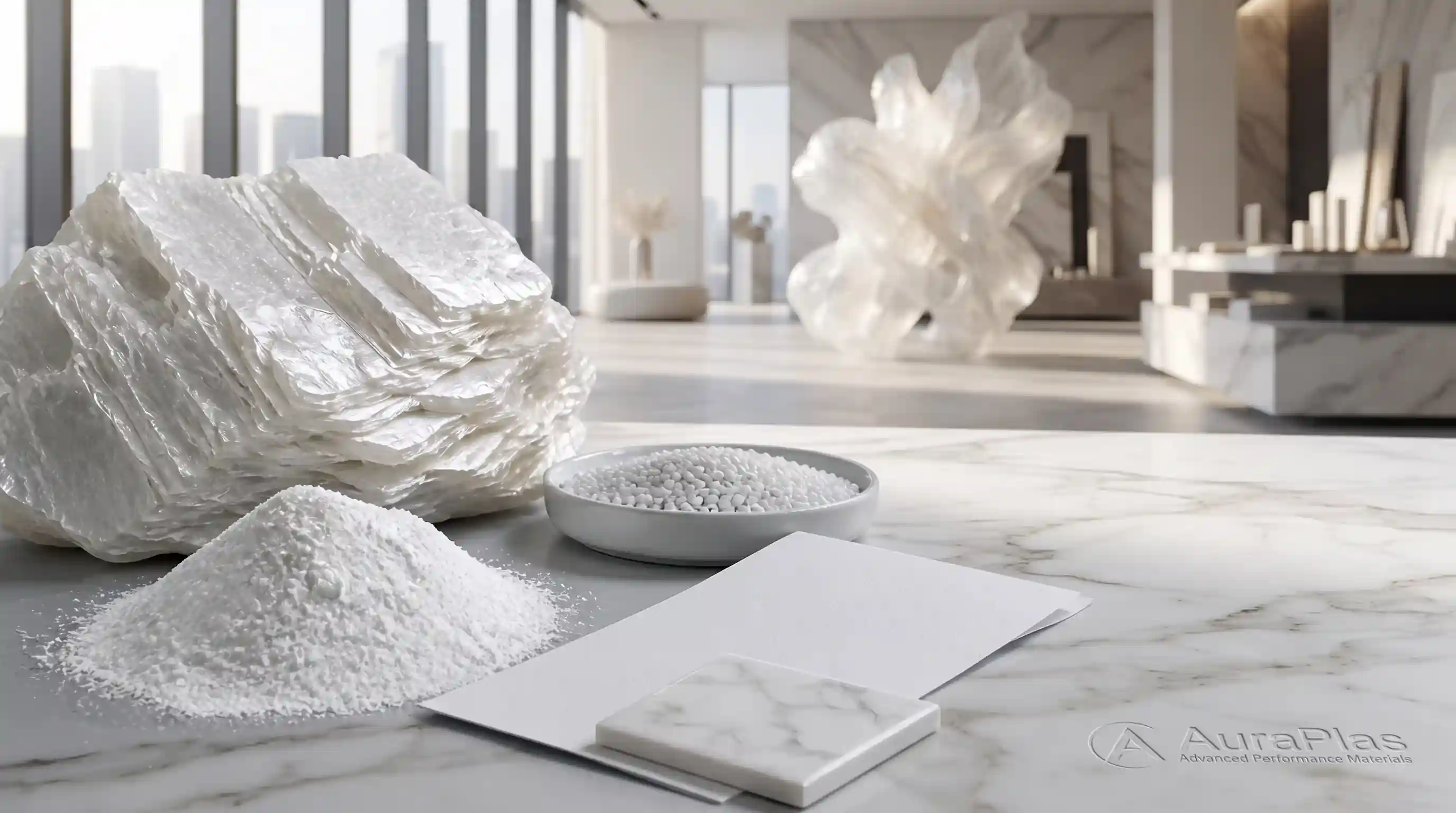
Manufacturing industries and materials engineering are constantly seeking solutions to enhance quality, reduce finished costs, and improve the sustainability of final products. In this regard, industrial minerals serve as the backbone of many formulations. The mineral white talc, due to its layered structure, extraordinary softness, and high purity, has found a special place in various industries. This material is processed in a variety of mesh sizes ranging from 450 to 2500, which allows for its precise use in diverse sectors.
Although the primary applications of this mineral powder include masterbatch, compounding, paint, paper, and ceramic products, its profound effects on improving the physical and mechanical properties of polymer products and pipes are also highly significant. The Kani Sang Amiran project, by producing high-quality minerals, plays a key role in meeting the needs of this sector. To lea more about this product and its technical details, you can visit the White Talc introduction page to obtain complete information about its mesh sizes and industrial applications.
Alongside this mineral, examining other industrial raw materials is also attractive to engineers in this field. For example, reading articles about what is the important application of dolomite in construction and manufacturing industries helps in gaining a more comprehensive view of widely used minerals. In the remainder of this article, we will examine various aspects of using this valuable powder in manufacturing processes.
Understanding the Physical and Chemical Properties of White Talc
To better understand the behavior of white talc in industrial formulations, it is necessary to take a closer look at its physical and chemical specifications. This material is a hydrated magnesium silicate that has a layered crystalline structure. This layered structure causes the particles to slide over each other easily, resulting in a powder that appears very soft and slippery. The hardness degree of this material on the Mohs scale is 1, making it one of the softest minerals known.
In addition to softness, high chemical stability, neutrality against weak acids and bases, and relative hydrophobicity are other prominent features of this mineral. The 450 to 2500 mesh range allows producers to use coarser or micronized particles based on their needs. Finer particles create more surface contact, which is ideal for improving mechanical properties and preventing the penetration of gas and moisture in final products.
Strict quality control in the mineral production process is of great importance. Adhering to standard parameters in purity and particle size distribution, similar to what is discussed in the review of silica quality standards in mode manufacturing industries, guarantees the flawless performance of minerals in advanced production lines. The pure white color of this powder also plays a decisive role in the paint and paper industries.

The Role of White Talc in Masterbatch and Polymer Compounding Industries
The polymer and plastic industry is one of the largest consumers of micronized mineral powders. In this regard, the use of white talc in the production of various masterbatches and polymer compounds is very common due to the positive effects it has on mechanical and thermal properties. When this powder is added to a polymer matrix, it acts as an efficient filler and significantly increases the flexural modulus and hardness of the final piece.
Polymers reinforced with this mineral show better resistance to deformation at high temperatures. Furthermore, the layered structure of the particles leads to improved dimensional stability and reduced shrinkage of injection-molded parts. In the production of colored and white masterbatches, the whiteness and brightness of this powder act as a strong covering agent and help significantly reduce the consumption of titanium dioxide, which is very cost-effective.
Just as materials like kaolin play an enhancing role in the rubber industry—as discussed in the article examining the application of kaolin in the automotive tire manufacturing industry—choosing the right mineral fillers in the polymer industry is the key to achieving the highest quality standards. Uniform distribution of different mesh sizes of this material in polymer mixtures guarantees the quality of the final product.
Improving Pipe Quality and Durability Using White Talc
Although the primary applications of white talc include masterbatch, compounding, paint, paper, and ceramic products, its application effects are also indirectly and directly visible in industries related to pipe manufacturing. Polymer and industrial pipes require stable mechanical properties, resistance to inteal pressure, and stability against environmental factors. Adding this micronized powder to pipe compounding can help improve the tensile properties and hardness of the pipe body.
In addition to improving mechanical properties, the presence of layered mineral particles in the pipe wall structure can reduce the permeability of gases and liquids and improve the thermal stability of the pipe during the extrusion process. The 450 to 2500 mesh range allows production engineers to choose the best particle size for uniform distribution based on the type of polymer used (such as polypropylene or polyethylene) and the thickness of the pipe.
The Kani Sang Amiran project, by providing high-quality mineral products, has created a platform where production units can supply their required raw materials with the highest purity and physical standards. This significantly contributes to reducing production waste and increasing the service life of industrial pipes and fittings.

Application of White Talc in Paint, Paper, and Ceramic Industries
In addition to polymer applications, white talc has a special place in the paint, paper, and ceramic industries. In the paint industry, this material acts as an extender pigment and filler. Matting properties, improving paint adhesion to the surface, resistance to abrasion, and preventing pigment settling are the main advantages of using this material in the formulation of architectural and industrial paints.
In the paper industry, this powder is used as a filler and surface coating for paper. Adding it to paper pulp improves whiteness, smoothness, print clarity, and reduces excess ink absorption. Also, in ceramic industries, this material is used in the manufacture of tile, ceramic, and glaze bodies to maintain dimensional stability during firing and prevent cracking.
The variety in mesh sizes (from 450 to 2500 mesh) allows the paint and paper industries to precisely adjust the roughness or smoothness of their desired surface. The high purity and brilliant white color of this material greatly enhance the appearance quality of final products.
Economic and Technical Advantages of Using the 450 to 2500 Mesh Range
Selecting the appropriate particle size is one of the most vital steps in designing industrial formulations. The 450 to 2500 mesh range provides manufacturers with a wide spectrum of particle sizes, each optimized for a specific application. Coarser meshes are usually used for applications requiring volumetric filling at a reasonable price, while very fine meshes (such as 2500 mesh) create a very high surface contact and are used for thin coatings, sensitive masterbatches, and high-strength compounds.
Economically, using white talc as a cost-effective mineral filler helps reduce finished production costs without compromising the quality of the final product. Even in many cases, adding this material improves processability in extruders and plastic injection machines, reducing energy consumption.
The Kani Sang Amiran project, by strictly controlling the micronization process, offers products with standard and homogeneous particle size distribution to the market. This precision in production ensures the long-term quality consistency of customers' products.

Safety, Storage, and Handling Tips for White Talc in Production Units
Proper storage management and observing safety tips when working with micronized mineral powders are of high importance. Due to its very fine particles (especially in high meshes like 2500 mesh), white talc has the ability to become airboe. Therefore, the use of appropriate personal protective equipment, such as anti-dust masks, is mandatory for workers who deal with this material.
Regarding storage, this material should be kept in a dry, covered environment away from direct moisture to prevent the powder from clumping. The standard packaging of the Kani Sang Amiran project is designed to prevent moisture penetration and facilitate transport and unloading in manufacturing plants.
Observing workplace safety principles not only guarantees the health of employees but also significantly helps in preserving the quality of raw materials and preventing material waste in production lines.
Conclusion and Future Outlook for the Use of White Talc in Industry
In total, white talc as a strategic mineral plays an irreplaceable role in improving quality, durability, and optimizing production costs across various industries. From its primary application in masterbatch, compounding, paint, paper, and ceramic products to its positive effects in pipe and polymer-related industries, all demonstrate the versatility of this valuable mineral.
Advances in mineral processing technologies and achieving more precise mesh ranges (450 to 2500 mesh) have provided a bright outlook for the development of new applications for this material. Relying on technical knowledge and production standards, the Kani Sang Amiran project is always striving to supply the best and highest quality minerals to the country's industries.
Given the growing trend in demand for higher quality and more sustainable products, the intelligent use of this mineral powder can provide a major competitive advantage for manufacturers and bring the production industry one step closer to mode global standards.

| Question | Answer |
|---|---|
| What is white talc? | It is a hydrated and soft magnesium silicate that is used in various industries due to its high purity and layered structure. |
| What is the mesh range of Amiran white talc? | This product is processed and supplied in a 450 to 2500 mesh range. |
| What are the main applications of this material? | Masterbatch, compounding, paint, paper, and ceramic products are its main applications. |
| Is it also used in pipe manufacturing? | Yes, it is used as a filler in polymer compounds and to improve the mechanical properties of pipes. |
| How can this product be obtained? | It can be ordered through the dedicated product page on the Kani Sang Amiran website. |
| What impact does it have on the polymer industry? | It increases the flexural modulus, hardness, and thermal stability of polymer compounds. |
| What is its role in the paint industry? | It acts as an extender pigment, matting agent, and adhesion improver. |
| Why are high meshes important? | Meshes up to 2500 create a high surface contact area and are more suitable for sensitive applications. |
| What are its storage conditions? | It must be stored in a dry, covered environment away from moisture. |
| What is the economic advantage of using it? | It helps reduce the finished price of the product and reduces the consumption of expensive pigments. |
Kani Sang Amiran Project — Specialized reference for supplying and processing industrial minerals.
برچسب: White Talc,Guide to the Application of White Talc in the Pipe Manufacturing Industry,
نویسنده: رساوب آفرین