
درباره سایت
آخرین مطالب
- التعرف على الخصائص الفيزيائية لكربونات كالسيوم الصناعية
- Examining the Rising Demand for High-Quality Industrial Talc
- بررسی ویژگیهای ظاهری و کیفیت پودر سفید دولومیت
- Guide to Choosing the Best Type of Red Iron Oxide (Ochre)
- دليل شراء أكسيد الحديد الأحمر (أخيرا) عالي الجودة والنقاء
- دراسة المعايير الوطنية والدولية في إنتاج التلك الأبيض
- دراسة الاتجاه التصاعدي للطلب على التالك الصناعي عالي الجودة
- بررسی استانداردهای ملی و بینالمللی در تولید تالک سفید
- راهنمای انتخاب بهترین نوع اکسید آهن قرمز (اخرا)
- دليل اختيار أفضل نوع من أكسيد الحديد الأحمر (المغرة)
امکانات وب
Introduction to the Importance of Industrial Talc in Mode Industries
Today, in advanced industries, the selection of high-quality mineral raw materials plays a highly decisive role in improving the final properties of products. Industrial talc is recognized as one of the most widely used mineral powders in the world, which, with its unique structural characteristics, has created a major revolution in manufacturing processes. Kani Sang Amiran Project, focusing on the supply of high-grade minerals, provides this product with precise technical specifications for various industries.
The physical and chemical properties of this material have enabled engineers and industrial designers to achieve improved product performance in their new formulations. In many mode production lines, the use of complementary mineral materials such as reviewing the benefits of using kaolin in architectural paints is also common alongside this powder to maximize the ultimate efficiency of coatings.
Accurate understanding of the characteristics of this material helps industrialists achieve the best results in their production lines by utilizing the appropriate mesh range. With its flake-like structure, this mineral material has gained a special position in the polymer, rubber, and paint-making industries, successfully covering the complex technical needs of manufacturers.
The Role of Industrial Talc in Polymer and Plastic Industries
Polymer industries are constantly seeking compounds that can improve the mechanical and thermal properties of manufactured parts. The use of industrial talc in polymer formulations brings multiple advantages due to its flaky structure and relative softness. This material acts as a mineral filler that, in addition to reducing production costs, enhances the performance characteristics of plastics.
When this mineral powder is added to the polymer matrix, it significantly helps improve flexural modulus, dimensional stability, and heat resistance of the parts. For more familiarity with more specialized options of this material, you can visit the dedicated page industrial talc to obtain complete information about its specifications.
The appropriate mesh range for polymer applications plays a key role in the uniform distribution of particles. In this industry, engineers can raise the quality of polymer products to higher levels through careful material selection and improve the overall efficiency of extrusion and plastic injection processes.
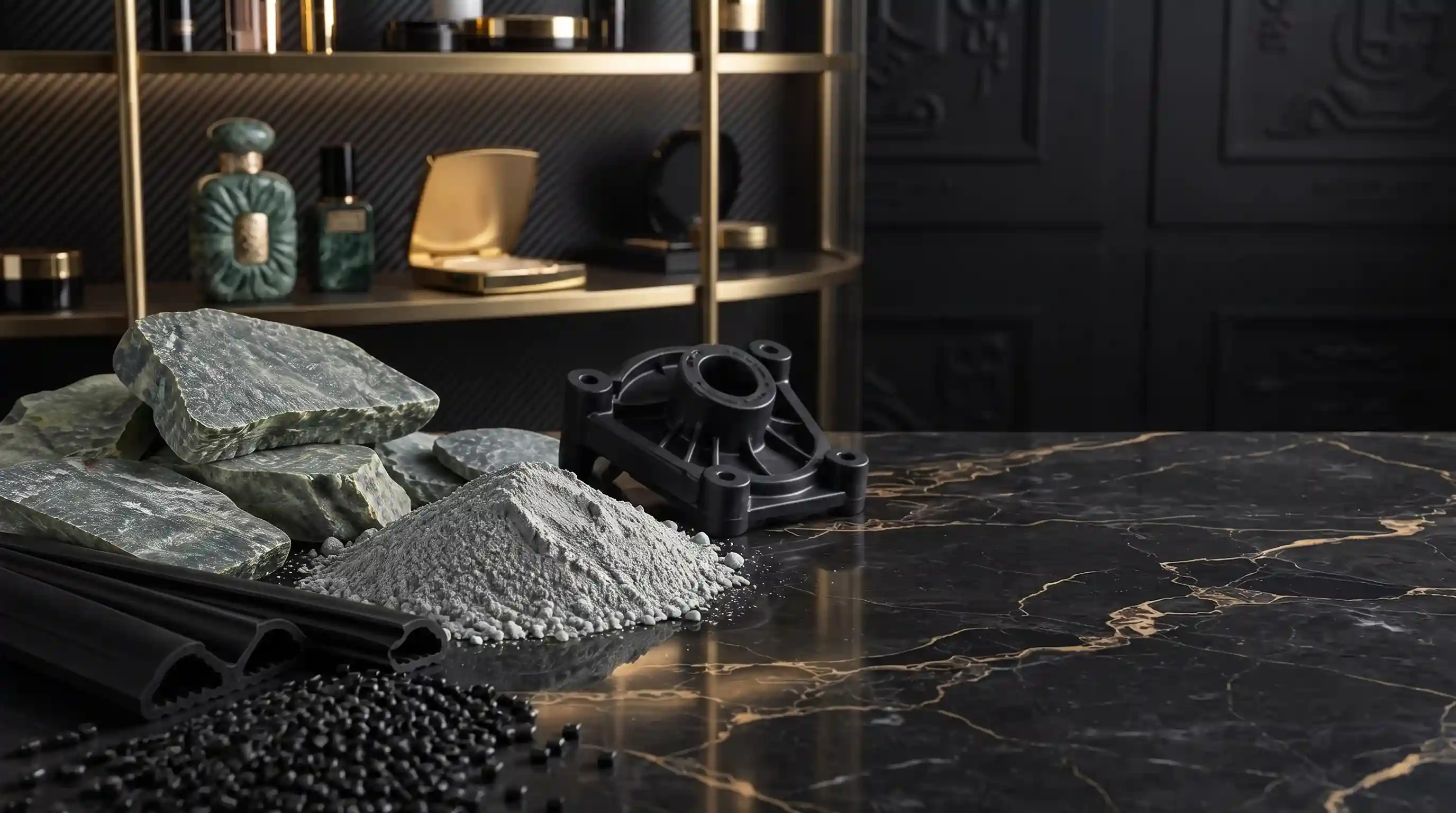
Application of Industrial Talc in Rubber Manufacturing Industries
In the rubber manufacturing industry, controlling the elastic properties, tensile strength, and durability of final products is of vital importance. Industrial talc is used as an active or semi-active agent in rubber compounds and helps improve the processability of raw materials. This mineral powder prevents the adhesion of rubber layers and shows very high efficiency in calendering and extrusion processes.
Rubber product manufacturers can significantly optimize the physical properties of parts by utilizing high-quality mineral powders. Applying this material in the fabrication of industrial rubber parts increases resistance to wear and environmental factors.
Compared to other mineral fillers, due to the proper distribution of particles within the standard mesh range, this material easily disperses in the rubber matrix and prevents particle agglomeration. This results in the structural integrity of rubber products and increases their useful lifespan in harsh industrial applications.
Improving the Quality of Paint and Industrial Coatings with Industrial Talc
The paint and industrial coatings industry is another domain that benefits the most from the chemical and physical properties of this material. The use of industrial talc in paint formulations helps improve characteristics such as hiding power, weather resistance, and gloss control. The flaky structure of the particles of this material prevents the rapid settling of pigments inside the container.
In addition to this material, a careful examination of the effects of other functional minerals such as the application of kaolin in paint-making and industrial coatings industries shows what a profound impact the intelligent combination of these fillers has on the final quality of paint.
Choosing powder with a mesh range of 450 to 1000 mesh allows paint formulators to achieve an excellent balance among viscosity, flowability, and coating durability. This ultimately leads to the production of high-quality paints for construction and industrial uses.
The Importance of the 450 to 1000 Mesh Range in the Efficiency of Industrial Talc
One of the most important parameters in selecting and purchasing minerals is particle size and their mesh range. Industrial talc supplied in the mesh range of 450 to 1000 mesh has precise gradation characteristics suitable for a wide range of engineering applications. This mesh range guarantees that the particles are fine enough to disperse well in sensitive formulations.
Particles in this mesh range create an appropriate contact surface with other formulation components, which leads to improved mechanical and appearance properties of final products. In polymer, rubber, and paint-making industries, using particles of appropriate size prevents issues such as particle agglomeration and quality loss.
Kani Sang Amiran Project, with careful attention to the granulation and micronization process, provides this product in the standard mesh range so that industrialists can use it seamlessly in their continuous production lines and achieve the highest level of productivity.
Economic Role and Optimization of Industrial Formulations
Cost management in industrial production is one of the primary conces of managers and industrial engineers. The use of industrial talc as a cost-effective mineral material enables the reduction of final production costs without dropping product quality. This material can act as an efficient filler to replace a portion of more expensive raw materials.
Alongside this material, examining other economic solutions such as reviewing the economic benefits of using coated calcium carbonate in manufacturing helps industrialists address resource and raw material management with a more comprehensive perspective.
The optimal combination of mineral fillers in production lines reduces energy consumption in mixing and extrusion processes while preserving the final quality of products. This economic approach helps companies maintain their competitive advantage in the market and experience sustainable profitability.

Environmental and Safety Benefits of Using Industrial Talc
Attention to environmental issues and sustainability is of high importance in mode industries. Industrial talc, as a natural mineral material, has good compatibility with the environment, and its extraction and processing procedures cause minimal damage to nature. Using this material instead of certain synthetic chemical compounds reduces the carbon footprint of products.
This material is non-toxic and, under standard processing conditions, poses no hazard to the health of operators and production line workers. However, observing general safety tips and using personal protective equipment when working with micronized powders is always recommended.
The chemical stability of this material against atmospheric factors and non-reactivity with other components of the formulation leads to a longer lifespan for final products and consequently reduces industrial waste. This feature plays an important role in achieving sustainable development goals across various industries.
Conclusion and Future Outlook of Industrial Talc Applications
Overall, industrial talc as a strategic mineral material has secured its position as a key component in polymer, rubber, paint, and other industrial sectors. The unique properties of this mineral powder within the 450 to 1000 mesh range allow for the precise optimization of mode formulations.
Relying on quality standards, Kani Sang Amiran Project offers this product to meet the growing demands of various industries. Industrialists seeking to improve quality, increase durability, and manage their production costs optimally can achieve their commercial and technical goals by relying on this mineral material.
With the advancement of production technologies and the increasing demand of industries for advanced raw materials, the importance of using high-quality mineral fillers becomes even more evident, and this product will remain one of the primary choices for engineers.
| Question | Answer |
|---|---|
| What is industrial talc? | It is a powdered mineral material used for polymer, rubber, paint, and industrial applications. |
| What is the mesh range of this product? | This mineral powder is supplied in a mesh range of 450 to 1000 mesh. |
| What are the main applications of industrial talc? | Polymer products, rubber products, paints, and various industrial products. |
| Is this material used in paint-making industries? | Yes, it is used to improve the hiding power and stability of paints. |
| Why is this material used in plastics industries? | It helps improve the flexural modulus, dimensional stability, and thermal resistance of parts. |
| What is the role of this material in rubber industries? | It acts as a filler to improve the mechanical properties and processability of rubber compounds. |
| Who is the supplier of this product? | Kani Sang Amiran Project is a manufacturer and supplier of mineral materials. |
| How can one obtain more information? | By visiting the industrial talc product page on the Kani Sang Amiran website. |
| Is this mineral powder cost-effective? | Yes, it helps reduce production costs and optimize formulations. |
| Is the particle structure of this material flaky? | Yes, the flaky structure of particles is one of the main features of this mineral material. |
Specialized mineral resources and technical data of Kani Sang Amiran Project
برچسب: Industrial Talc,Benefits of Using Industrial Talc in New Formulations,
نویسنده: رساوب آفرین