
درباره سایت
آخرین مطالب
- راهنمای ثبت سفارش آنلاین و استعلام قیمت کائولن
- چگونه بهترین اکسید آهن قرمز (اخرا) را برای پروژه انتخاب کنیم؟
- بررسی جامع خواص اکوستیک و وزن مخصوص باریت سفید صنعتی
- نقش کائولن در کاهش هزینههای تولید در صنایع معدنی
- نقش سیلیس در افزایش مقاومت حرارتی مواد نسوز
- چرا اکسید آهن قرمز (اخرا) قدرت پوشانندگی بالایی دارد؟
- The role of industrial barite in the papermaking and specialty coatings industries
- How to find the best kaolin supplier in the country?
- How to properly examine feldspar analysis?
- ما هي استخدامات التالك الصناعي في صناعة البلاستيك والمطاط؟
امکانات وب
Introduction to White Talc and Its Position Among Mineral Powders
White talc is one of the most well-known and widely used natural mineral powders in today's industries, extracted from talc ore. Chemically classified as a hydrated magnesium silicate, this material has attracted the attention of many manufacturers across various industries due to its extreme softness, appropriate whiteness, and unique layered structure. After extraction, the ore is converted into a uniform powder through crushing, classification, and purification processes, offered in different particle size distributions; the white talc product produced by the Kani Sang Amiran Project is offered in the 450 to 2500 mesh range for applications such as masterbatch, compound, paint, paper, and ceramic products.
The main reason for talc's industrial importance is its unique combination of properties, which are rarely found together in another mineral: softness, slip, whiteness, chemical inertness, and a platy particle structure. These characteristics allow talc to act both as a filler and as a functional additive in industrial formulations. This is why comparing white talc with other widely used industrial and mineral powders has become an important topic for professionals in the plastics, paint, and ceramic industries.
Alongside talc, other mineral powders such as white barite, calcium carbonate, kaolin, mica, and wollastonite also hold their places in industries. Each of these materials has its specific advantages and limitations, and the choice between them depends on factors like the industry type, desired properties of the final product, processing equipment, and economic conditions. For instance, barite is superior in applications requiring high density due to its very high specific gravity, while calcium carbonate is considered a general filler in the plastics industry because of its lower price and greater abundance.
The purpose of this article is to provide a precise and practical review of white talc alongside its main competitors, enabling readers to make the right choice for their production line by better understanding the properties of each material. In the following, the fundamental properties of white talc are first examined, then a step-by-step comparison with white barite, calcium carbonate, kaolin, and other mineral powders is conducted, and finally, its industrial applications along with selection and purchasing tips are presented. Such a perspective on this mineral helps ensure that purchasing decisions are shaped by the actual needs of the formulation and the quality of the final product.
Physical and Chemical Properties That Distinguish White Talc
To better understand the position of white talc among other industrial powders, familiarity with its fundamental properties is essential. Chemically, talc is a hydrated magnesium silicate with the general formula Mg₃Si₄O₁₀(OH)₂. This composition, along with its layered crystalline structure, forms the basis of many of talc's unique physical properties. Talc has a very low Mohs hardness (around one), making it the softest known mineral on this scale; this same characteristic gives talc high slip and greasy properties, allowing it to act as a solid lubricant in friction processes.
One of the most important properties of white talc for the paint, paper, and masterbatch industries is its high degree of whiteness and brightness. Appropriate whiteness allows talc to be used in formulations where the final appearance of the product matters, without causing undesirable color changes. Additionally, talc's chemical inertness increases its resistance to many chemicals, acids, and bases, making it suitable for applications exposed to corrosive environments.
The layered or platy structure of talc particles is another key distinguishing factor. This special structure allows talc to improve the mechanical and thermal properties of products when combined with polymers. Platy talc particles embed within the polymer matrix, creating a reinforcing effect that increases the thermal resistance, dimensional stability, and stiffness of the final product. Moreover, the layered structure gives talc anti-block properties, preventing plastic film layers from sticking together, which is extremely important in the production of polyethylene films.
Other notable features of talc include its relative oil and water absorption, lower density compared to barium (barite), and good dispersibility in various matrices. Also, the wide particle size range in the white talc product (450 to 2500 mesh) allows for selecting a gradation suited to the final application: coarser meshes for general and filling applications, and finer meshes for cases requiring a smoother surface, better dispersion, and higher mechanical properties. Understanding these properties helps us to make a more precise comparison between talc and other mineral powders in the following chapters, and to comprehend why in some applications talc is the superior choice, while in others, materials like barite or calcium carbonate make more sense.
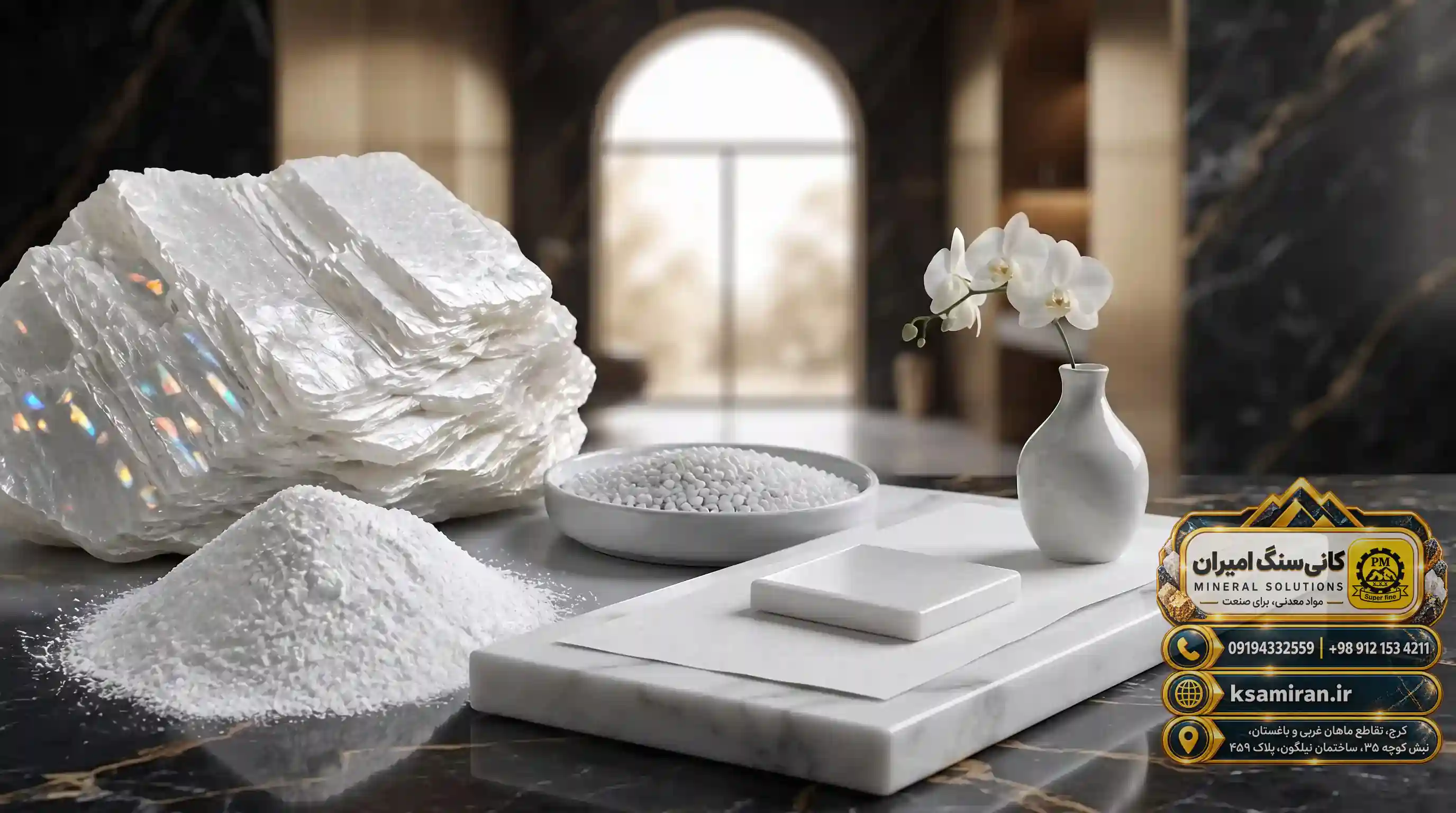
Comparing White Talc with White Barite
White barite and white talc are both widely used mineral powders in the paint, plastics, and compounding industries, but they have very different properties that distinguish their applications. Understanding these differences helps manufacturers select more suitable raw materials for their final products. Barium sulfate (barite) with a very high specific gravity (about 4.5 g/cm³) compared to talc with a lower specific gravity (about 2.7) demonstrates the fundamental difference between these two materials.
The first and most important difference is density. Due to its high density, barite is the superior option in applications that require increasing product weight or providing sound and radiation insulation properties. In contrast, talc is lighter and is a more logical choice where excessive weight gain of the product is not desired. For example, in the production of lightweight plastic parts, compounds, and masterbatches, talc performs better due to its lower weight and platy reinforcing properties.
The second difference lies in mechanical properties. The layered structure of talc makes it a good reinforcer in polymers, increasing the thermal resistance and dimensional stability of parts. Barite lacks such a structure and mostly plays the role of a heavy filler. On the other hand, in the paint industry, white barite is widely used due to its whiteness and durability in exterior environments, as well as for creating protective coatings. If you want to know why using white barite is essential in paint production, the specialized article on the Kani Sang Amiran Project website provides comprehensive information on this topic.
The third difference is in the price and final value of the product. Generally, calcium carbonate is cheaper than talc, and talc is cheaper than high-purity barite. Therefore, projects facing budget constraints might use a combination of these materials in their formulation. The table below provides a general comparison of these two materials:
| Feature | White Talc | White Barite |
|---|---|---|
| Specific gravity | Lower (around 2.7) | High (around 4.5) |
| Particle structure | Layered and platy | Non-layered |
| Main role | Reinforcer and light filler | Heavy filler and insulator |
| Characteristic application | Masterbatch, compound, film | Industrial paints, weighting |
Ultimately, the choice between talc and barite depends on the product's needs: if the goal is lightness, thermal resistance, and preventing layer adhesion, talc is appropriate; but if high weight, outdoor durability, and insulation are desired, barite is superior. To lea about the storage conditions of this heavy material, the Comprehensive Guide to Warehousing and Storage of Industrial White Barite Powder is a useful resource containing good practical tips.
Comparing White Talc with Calcium Carbonate
Calcium carbonate (CaCO₃) is the most widely used and best-known mineral filler in the plastics, paint, adhesive, and paper industries, and is usually the first option compared alongside white talc. The main reason for calcium carbonate's popularity is its low price, very high abundance, and wide variety in the market. However, there are fundamental differences between these two materials that affect the final choice.
The first key difference is the particle structure. Calcium carbonate particles typically have a spherical or irregular structure, while talc has a platy and layered structure. This very difference allows talc to impart better mechanical properties to polymers and improve the thermal and dimensional stability of products. Calcium carbonate acts mostly as a simple filler, increasing the volume and weight of the product without creating significant reinforcing properties.
The second difference is in thermal and chemical behavior. Calcium carbonate decomposes at high temperatures, releasing CO₂ gas, which creates limitations in some polymer and ceramic processes. Talc is more inert and shows better stability at high temperatures; therefore, it performs better in technical compounds and parts exposed to temperature. Also, calcium carbonate has a greater tendency to react with acids, while talc has higher chemical resistance.
In terms of price, calcium carbonate is usually the cheapest option among fillers, and projects with high consumption volumes and price sensitivity often choose calcium carbonate. White talc has a higher price, but given its functional properties, the higher prices are justifiable in technical applications. In many formulations, a combination of calcium carbonate for volume and talc for properties yields the best result. Ultimately, the choice between the two depends on factors such as product type, required properties, finished cost, and processing equipment. For a more systematic choice, the Industrial Talc Buying Guide with the Best Quality and Reasonable Price provides buyers with useful practical tips.
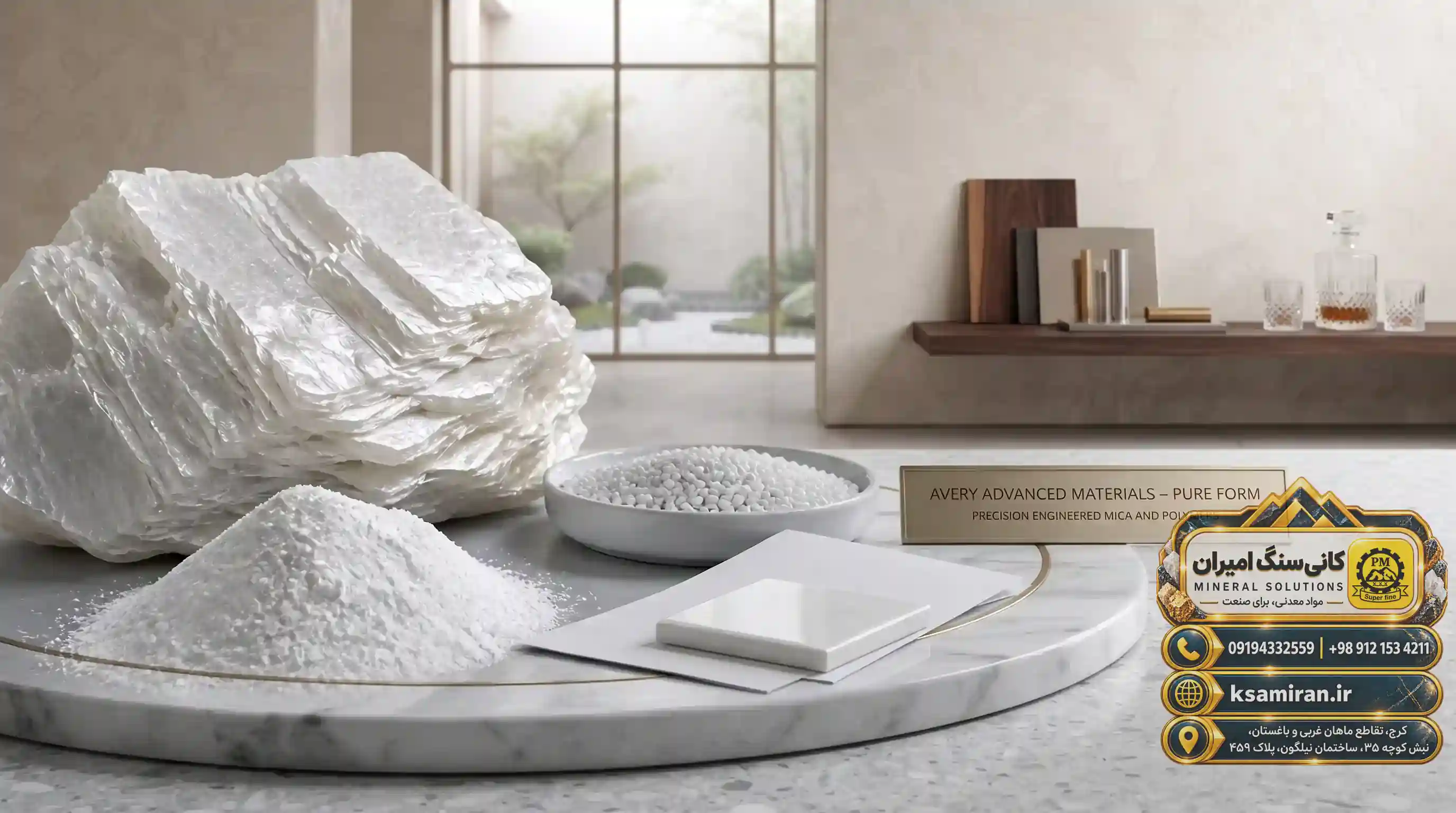
Comparing White Talc with Kaolin, Mica, and Other Mineral Powders
In addition to barite and calcium carbonate, other mineral powders are used in the paint, plastics, paper, and ceramics industries, and understanding their differences from white talc is essential for correct raw material selection. In this chapter, we briefly compare kaolin, mica, wollastonite, and other silicates with talc.
Kaolin (china clay), like talc, has a layered structure and is used in the ceramics, paper, and paint industries. The main difference between kaolin and talc lies in their chemical structure and thermal behavior. Kaolin undergoes structural changes at high temperatures, transforming into other minerals in the ceramics industry, whereas talc has higher thermal stability. Kaolin has very high whiteness but lacks the greasy and slip properties of talc. In paper production, both materials are used for coating and filling, but talc performs better in controlling wood resins (pitch control).
Mica is known for its platy structure and special luster in the paint and cosmetics industries. Both mica and talc have platy structures, but mica lacks talc's softness and slip, and its particles are harder and more polished. In applications requiring a beautiful appearance and luster, mica is superior, but in industrial applications requiring slip and easy processing, talc is more suitable.
Wollastonite is an acicular (needle-like) mineral used in the plastics and ceramics industries. The needle-like structure of this material creates special mechanical properties in polymers, but its higher price and lower abundance compared to talc limit its use. In contrast, given the abundance of mines and its suitable price, talc is a more economical option for large projects. Ultimately, the choice among these materials depends on the specific needs of each industry, the desired physical properties, and the project budget; in many cases, a combination of several minerals provides the best result in the final formulation.
Applications of White Talc in the Plastics, Masterbatch, and Compounding Industries
One of the most important markets for white talc is the plastics industry, particularly masterbatch and compound production. In these industries, talc plays multiple roles due to its platy structure, appropriate specific gravity, and balanced price: improving mechanical properties, increasing thermal resistance, preventing layers from sticking together (anti-block), reducing finished costs, and in some cases, clarifying or matting the final product. Masterbatches are generally divided into two broad categories: color and additive, and talc can be used in both.
In white masterbatch production, talc acts as a light, white mineral filler, helping to reduce the consumption of expensive pigments while contributing to color uniformity in the final part. In additive masterbatches, talc is used as a carrier for other additives. Also, in polyethylene films, fine talc particles create a rough surface on the film layers, preventing them from sticking together and improving the film's opening capability. This anti-block property of talc is one of the main reasons for its high consumption in the packaging industry.
In technical and engineering compounds, talc is used as a mineral reinforcer. Platy talc particles are positioned within the polymer matrix and, during processing, increase the flexural strength, stiffness, and dimensional stability of the parts. This advantage is particularly important in the production of automotive parts, household appliances, and technical parts exposed to temperature and loads. Additionally, by reducing shrinkage caused by temperature changes, talc improves the surface quality of molded parts.
Choosing the right talc mesh is very important for these applications: in technical compounds, talc of 1000 mesh and above (finer particles) is usually used to achieve better dispersion and higher mechanical properties, while in general masterbatches and more economical applications, coarser meshes can also be used. The 450 to 2500 mesh range of the Kani Sang Amiran Project's white talc product gives manufacturers the ability to choose the option suited to their production line. A finer mesh has a higher specific surface area and thus a greater reinforcing effect, but at the same time is more expensive and harder to mix.
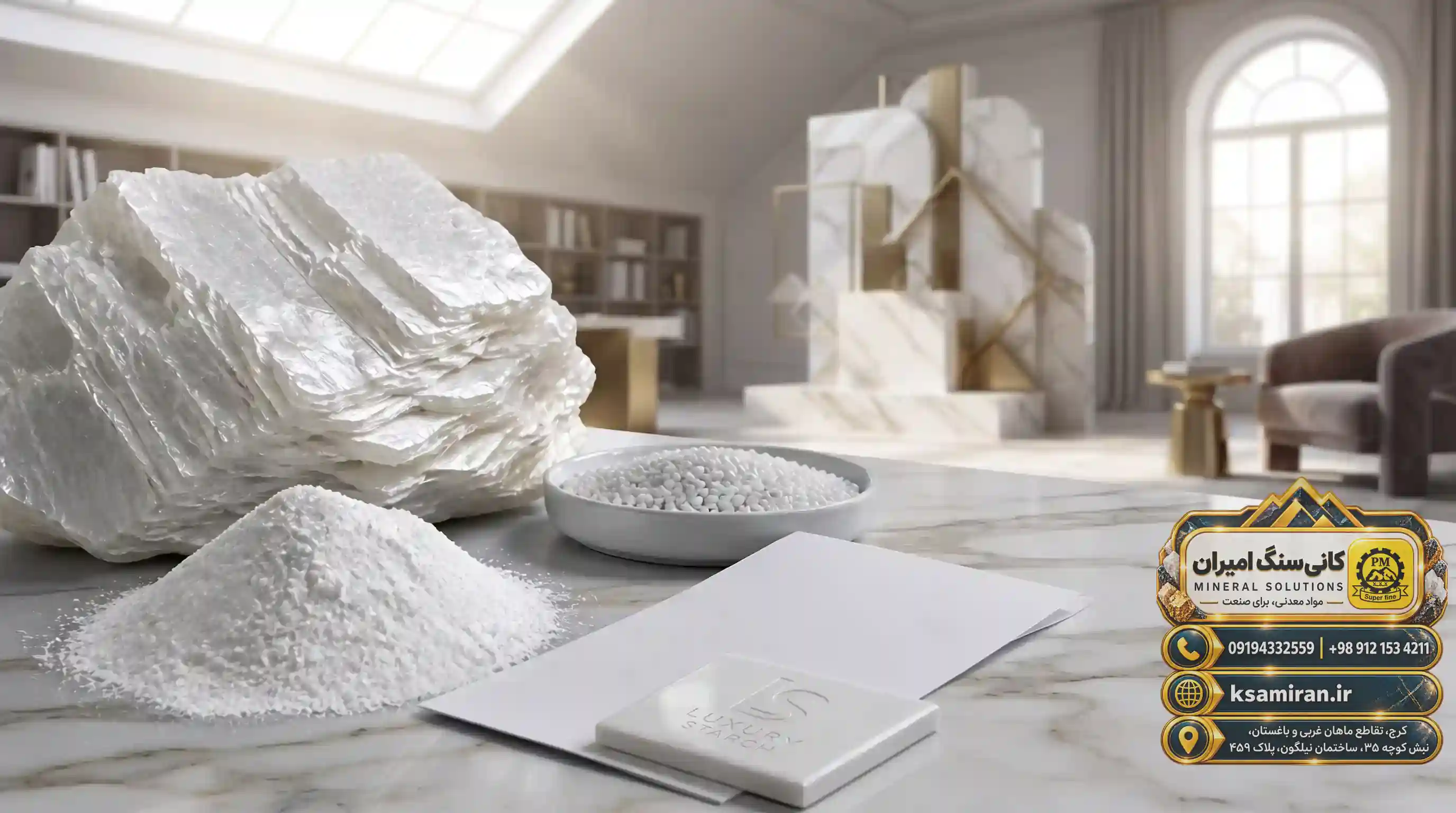
Applications of White Talc in the Paint, Paper, and Ceramics Industries
In the paint industry, white talc acts as a filler and film extender. The platy structure of talc causes its particles to align as overlapping layers in the paint film, which contributes to greater film durability and reduced moisture penetration to the substrate. Talc also regulates the paint's slip and improves its sprayability with appropriate oil absorption. In water-based and solvent-based paints, talc is used to reduce the finished cost and increase the percentage of solids in the paint. Talc's appropriate whiteness does not have an adverse effect on the final color, a matter of great importance to paint manufacturers.
In the papermaking industry, talc is used in two main areas: as a filler and as a coating pigment. As a filler, talc replaces part of the cellulose fibers, reducing costs while improving the paper's opacity and printability. In the coating process, talc is used alongside kaolin and calcium carbonate to create a smooth, bright, and printable surface on the paper. One of the special advantages of talc in the paper industry is its ability to absorb and control wood resins (pitch control), which prevents resin spots from appearing on the paper and machinery.
In the ceramics industry, talc is an important raw material in the production of ceramic bodies, porcelain, and refractory wares. In the ceramic body, talc alters the firing cycle and facilitates the formation of desirable crystalline phases. In fine ceramics and porcelain, talc helps produce low-expansion crystalline phases, increasing the thermal and mechanical resistance of the final product. Also, in refractory bodies and thermal insulators, talc is widely used due to its stability at high temperatures. In tiles and building ceramics, talc helps reduce shrinkage during firing and improves the tile's surface quality. These diverse applications show why white talc has become one of the most important industrial minerals.
Guide to Selecting, Buying, and Storing White Talc
Choosing the right white talc for any industry requires attention to several key factors. The first factor is particle size (mesh), which must be selected according to the application. For technical compounds and high-quality masterbatches, finer meshes (1250 to 2500 mesh) usually provide better results in dispersion and mechanical properties, while for general and more economical applications, 450 to 1000 mesh are also suitable. The second factor is the whiteness degree and purity of the material, which is more important in the paint and paper industries. The third factor is the material's moisture content, which must be controlled so as not to cause problems in the mixing process with polymers.
When buying from a supplier, attention should be paid to factors such as the variety of meshes offered, the possibility of sending samples, appropriate packaging (bags or jumbo bags), labeling, and the ability to supply consistently throughout the year. Also, directly examining the product through simple tests like color, odor, and preliminary tests on the production line helps to evaluate the shipment's quality. The white talc product is introduced on the Kani Sang Amiran Project website with a mesh range of 450 to 2500 and applications in masterbatch, compound, paint, paper, and ceramics, and complete information on its specifications is available on the product page.
Storing white talc is also important: the powder must be kept in a dry, covered environment, away from moisture and rain. High humidity can cause the powder to clump and reduce its quality during processing. Also, storing the powder adjacent to other contaminated or colored materials must be avoided to minimize cross-contamination. Packages must be handled carefully to prevent tearing and powder spillage. Following these simple tips preserves the product's shelf life and guarantees the quality of the final formulation.
Ultimately, collaborating with a supplier who has sufficient technical knowledge about the various applications of talc is very valuable. Such a supplier can recommend the appropriate mesh for each application and provide further technical information if needed. For this purpose, viewing the Industrial Talc Buying Guide with the Best Quality and Reasonable Price helps buyers to register their purchasing decisions with a broader perspective and more precise knowledge. By following these principles, white talc can significantly contribute to improving the quality of the final product and reducing production costs.
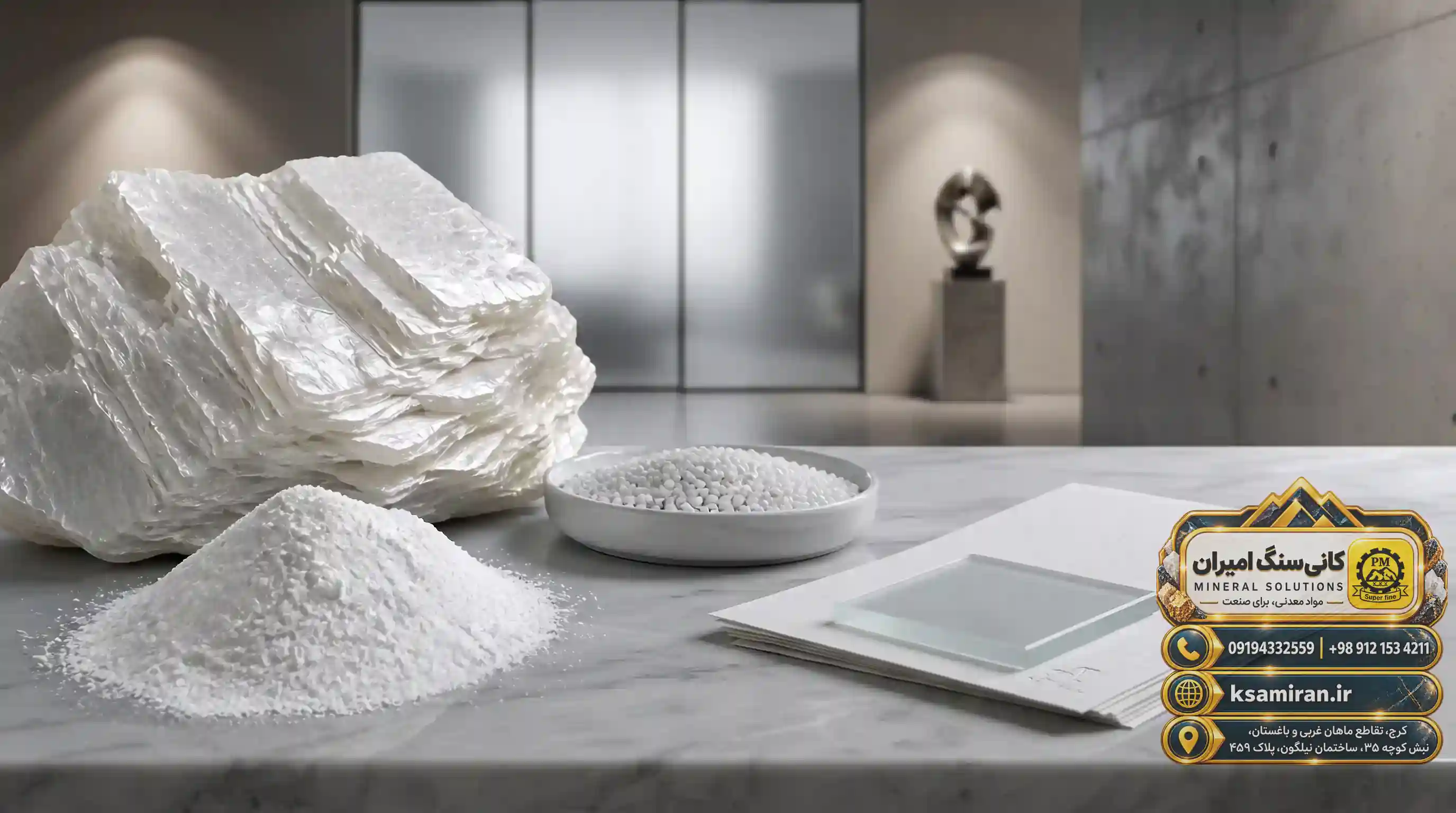
| Question | Answer |
|---|---|
| What is white talc? | White talc is a hydrated magnesium silicate mineral powder with high softness, whiteness, and a layered structure, used in the plastics, paint, paper, and ceramics industries. |
| What is the mesh range of white talc? | The white talc product is offered in the 450 to 2500 mesh range, and the choice of mesh depends on the final application. |
| What is the difference between white talc and calcium carbonate? | Calcium carbonate is a cheaper filler with spherical particles, but talc has a platy structure and imparts better mechanical and thermal properties to polymers. |
| What is the difference between white talc and white barite? | Barite has a much higher specific gravity and is suitable for heavy and insulating applications, while talc is lighter and a better reinforcer for compounds and masterbatches. |
| Why is talc used in masterbatch? | Talc acts as a white filler, an additive carrier, and an anti-block agent in films in masterbatch, reducing the finished cost. |
| What is the role of talc in paint? | Talc acts as a filler, film extender, and slip regulator in paint, increasing film durability. |
| What is the application of talc in paper? | Talc is used in paper as a filler, coating pigment, and wood resin controller (pitch control). |
| What is its role in ceramics? | Talc regulates the firing cycle in ceramic, porcelain, and refractory bodies, improving the product's thermal and mechanical resistance. |
| How should white talc be stored? | Store in a dry, covered environment away from moisture and contaminated materials to prevent clumping and loss of quality. |
| How to buy the right talc? | Choose the mesh according to the application, check the whiteness and purity, and buy from a supplier with mesh variety and technical support. |
Specifications and applications of white talc (450 2500 mesh range) based on the Kani Sang Amiran Project product page: https://ksamiran.ir/products/white-talc/

برچسب: White Talc,Comparison of White Talc with Other Widely Used Industrial and Mineral Powders,
نویسنده: رساوب آفرین