
درباره سایت
آخرین مطالب
- نقش اکسید لیمونیت (گل ماش) در صنایع تولید موزاییک
- دور أكسيد الليمونيت (الجيلماش) في صناعات إنتاج الفسيفساء (الموزاييك)
- چگونه کاربرد اکسید لیمونیت (گل ماش) را بهینه کنیم؟
- Company Limonite Oxide (Gol Mash) Price Comparison Guide
- بررسی ویژگیهای ظاهری اکسید لیمونیت (گل ماش) مرغوب
- کاربرد اکسید لیمونیت (گل ماش) در صنایع الکترودسازی
- دراسة الخصائص المظهرية لأكسيد الليمونيت (جول ماش) عالي الجودة
- دراسة الثبات الحراري لأكسيد الليمونيت المعدني (أكسيد الحديد الأصفر)
- The Role of Limonite Oxide (Gol Mash) in Mosaic Manufacturing Industries
- استخدام أكسيد الليمونيت (جول ماش) في صناعة الأقطاب الكهربائية
امکانات وب
Introduction to Limonite Oxide (Gol Mash) and Its Position in the Ceramic Industry
The ceramic industry has long had an unbreakable bond with mineral colorants; from the pottery of ancient civilizations to mode tiles and porcelains, color has always been one of the most determining aesthetic and functional features of ceramic products. Among natural mineral colorants, limonite oxide (Gol Mash) holds a special position: a stable, economical, and warm source that creates a range of light straw-yellow to dark brown colors in the ceramic body and glaze.
Limonite is actually the name of a group of natural iron oxides and hydroxides, mainly composed of the mineral goethite, and is known in the Iranian mineral market under the commercial name “Gol Mash”. Due to its natural origin, suitable final cost, and high compatibility with ceramic firing processes, this material has been used for years by manufacturers of tiles, ceramics, pottery, and decorative pieces.
The product introduced by the Limonite Oxide (Gol Mash) offered by Kani Sang Amiran Project for mineral pigment, coating, and building product applications is, in fact, a continuation of this ancient tradition; with the difference that today this mineral is processed with stricter quality control and standard particle dimensions in the 450 to 1500 mesh range to fully meet the needs of mode production lines.
In the mode ceramic industry, limonite oxide (Gol Mash) has two major responsibilities: first, coloring the ceramic body before firing, which results in products with a uniform and penetrating color throughout the entire thickness; and second, coloring glazes, engobes, and surface coatings that shape the final appearance of the product. In both applications, color consistency, uniform particle distribution, and stability at high temperatures are paramount.
What distinguishes this natural pigment from many synthetic colorants is its color grace and variety; the friendly and earthy tones of yellow, ochre, and brown that warm up interior spaces and facades, while easily blending with other mineral pigments.
In the rest of this article, we will comprehensively examine the structure and basic characteristics of limonite oxide (Gol Mash), how it works in the ceramic body and glaze, the importance of particle size in the 450 to 1500 mesh range, quality control tips, and practical solutions for its use.
Structure and Basic Characteristics of Limonite Oxide (Gol Mash)
To better understand the application of limonite oxide (Gol Mash) in ceramics, it is essential to be familiar with its structure and basic characteristics. Limonite is a natural mineral chemically known as hydrous iron oxide-hydroxide with the general formula FeO(OH)·nH₂O; meaning a combination of iron oxide and hydroxide that contains some structural water. Goethite makes up the bulk of this mineral, and impurities such as silica, alumina, and manganese compounds may be present in small amounts, which are exactly the factors that create the color variety of natural products.
The yellow to brown color of this material is due to the presence of iron ions in the +3 oxidation state (Fe³⁺) in its crystal structure. This same structure makes limonite oxide (Gol Mash) highly resistant to UV light and atmospheric conditions; a feature that is very valuable for floor, facade, and outdoor ceramics.
One of the most important thermal characteristics of this pigment is its behavior when exposed to heat. During ceramic firing, the goethite present in limonite loses its structural water at relatively low temperatures (around 250 to 400 degrees Celsius) and gradually transforms into a hematite structure (red iron oxide). For this reason, the final color of the ceramic after firing may shift more towards yellow-red or red-brown compared to the raw state, and this must be taken into account in formulation design.
Other important characteristics include high relative density (around 3.3 to 4 g/cm³), low hardness and easy grindability, and adequate covering power. These features make limonite oxide (Gol Mash) perform acceptably not only in the body but also in coatings and glazes.
In the pigment production process, oil absorption and pH are two key parameters that determine the material's behavior in aqueous and non-aqueous environments. Due to its active particle surface, limonite disperses well in glaze suspensions, and by precisely adjusting suspenders and binders, a desirable color consistency can be achieved in the final product.
In addition to the ceramic industry, this mineral has broad applications in other sectors; for example, you can read more about the role of limonite oxide (Gol Mash) in the chemical industry and become familiar with another angle of this pigment's application.
Coloring the Ceramic Body with Limonite Oxide (Gol Mash)
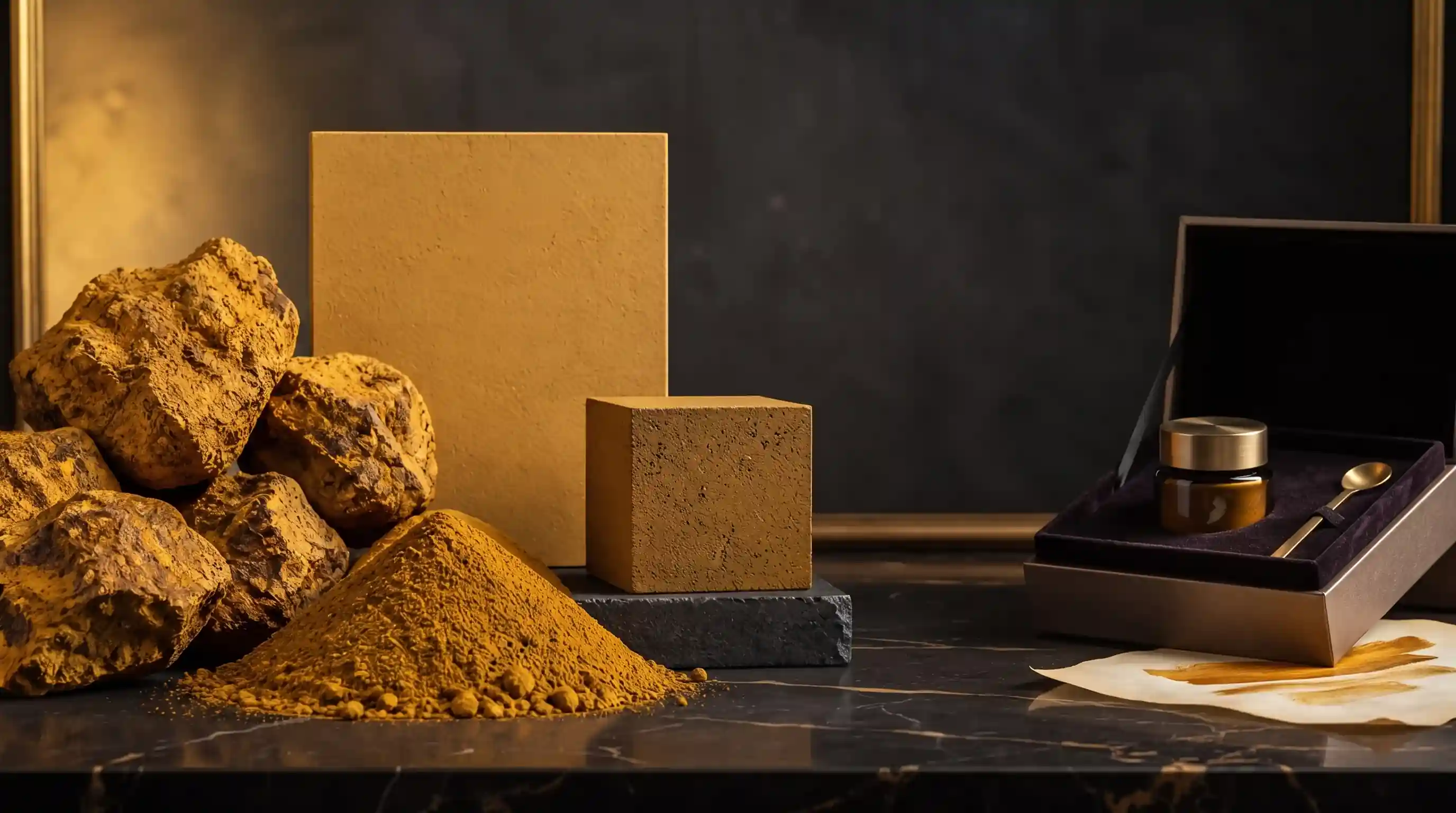
One of the main applications of limonite oxide (Gol Mash) in the ceramic industry is body coloring. In this method, the pigment is directly added to ceramic clay, porcelain paste, or body slip so that the color penetrates the entire thickness of the product, and even if the surface is scratched, the product's color will not change. This feature is very important for porcelain floor ceramics, rustic tiles, decorative bricks, and pottery.
The coloring mechanism in the body is simple but requires precision: pigment particles must be completely dispersed among clay and other raw material particles so that color spots or uneven streaks do not form after firing. For this reason, it is always recommended that limonite oxide (Gol Mash) first be dissolved in a portion of water or slip as a pre-dispersion, and then gradually added to the main mixer.
The final color intensity depends on several factors: the percentage of pigment used, firing temperature, body chemical composition, and even the pressing method (dry or wet). Generally, increasing the pigment percentage deepens the color, but beyond a certain limit, the color effect reaches saturation and can negatively affect mechanical strength and water absorption of the body; therefore, finding the optimal point through laboratory tests is essential.
One of the advantages of a colored body with limonite oxide (Gol Mash) is creating a “natural and earthy” look, which is very popular in rustic and classic products. Unlike synthetic colorants that sometimes look overly uniform and plastic, these colors have a variable and lively state that enhances the product's design value.
Another important point is the effect of firing temperature on the final color. In lower-temperature firings (below 1000 degrees Celsius), limonite's yellow-ochre color is largely preserved, but in high-temperature firings (above 1150 degrees), with the gradual transformation of goethite to hematite, the color shifts towards red-brown or smoky. This behavior can be both a challenge and a design tool; you just need to account for the temperature factor in the formulation.
Also, combining limonite oxide (Gol Mash) with other mineral pigments enables creating a wide range of colors; for example, combining it with manganese oxide produces dark brown and smoky colors, and combining it with chromite produces olive-green colors. This combining capability is a powerful tool in the hands of ceramic designers.
Application of Limonite Oxide (Gol Mash) in Glaze, Engobe, and Ceramic Coatings
Alongside the body, limonite oxide (Gol Mash) is a popular pigment for coloring glazes, engobes, and ceramic coatings. In glaze-making, this material is used as a stable colorant in frits and glassy coatings, creating a range of transparent or semi-transparent straw, honey, smoky, and brown colors.
One reason for this pigment's popularity in glazes is its thermal behavior. Glaze is typically fired at 1000 to 1200 degrees Celsius, and the pigment must maintain its stable state at these temperatures without complete decomposition or severe color change. Due to its hydroxide structure, limonite oxide (Gol Mash) dehydrates at these temperatures, and its color shifts towards warmer undertones; a behavior deliberately utilized in designing “smoky” and “rustic” glazes.
In engobe, which is a coating between the body and glaze, this material creates a uniform color on brick or pottery surfaces due to its easy distribution and good adhesion. Also in decorative ceramic coatings, underglaze colors based on limonite give designs a special depth and softness.
The pigment consumption rate in glaze is usually lower than in the body and must be determined at the laboratory stage. The key point here is the importance of particle size: finer particles (higher mesh) disperse better in the glaze and create less sedimentation in the spray tank; an issue we will fully examine in the next section.
Outside the ceramic industry, the application of limonite oxide (Gol Mash) in coatings is also very broad; for instance, the application of limonite oxide (Gol Mash) in powder coatings shows that this pigment holds a stable position in industrial coatings as well and exhibits similar thermal behavior in coating curing.
Ultimately, all these applications have one common denominator: the final color quality's heavy dependence on pigment consistency. Even the best formulation, if the pigment is not properly dispersed, will result in a blotchy and unsellable outcome.
The Importance of the 450 to 1500 Mesh Size Range in Ceramic Processes
One of the most important characteristics of any mineral pigment is its particle dimensions, or “mesh size”. The limonite oxide (Gol Mash) product is offered in the 450 to 1500 mesh range; a range selected based on the final application (body, glaze, or coating) and directly impacts color quality, consistency, and process behavior.
In the mesh measurement system, a higher number indicates a finer particle. In a ceramic production line, this choice equates to an engineering equation: coarser particles have lower processing costs and are perfectly suited for body applications requiring macro-scale consistency; whereas finer particles are a better choice for glazes and coatings requiring microscopic consistency.
Why are fine particles important in glazes? Because coarse particles quickly settle in a glaze tank, cause blockages in the spray nozzle, and after firing appear as visible “color specks” on the surface. In contrast, 1200 to 1500 mesh particles remain suspended in the glaze, provide high consistency, and leave a uniform and transparent surface.
On the other hand, in the ceramic body, using very fine particles is not always the best choice; finer particles retain more water in the slip, increase viscosity, and may lead to excessive consumption of additives (deflocculants and lubricants). For this reason, many manufacturers use 450 to 800 mesh particles for the body and 1000 mesh and above for glaze and engobe.
Another point to note is the particle size distribution. A high-quality product is not limited to a single mesh number but encompasses a range of dimensions, the maximum of which falls within the defined range. This distribution affects slip viscosity, dewatering rate, and ultimately color consistency.
Finally, it is recommended to sample before bulk use of any batch, and examine the particle size distribution along with color testing on a laboratory scale. This ensures that the mesh size selection aligns with the actual needs of the production line.
Comparison of Limonite Oxide (Gol Mash) with Other Iron Pigments
The iron pigment family includes a complete spectrum of colors: hematite (red iron oxide) for reds and oranges, magnetite (black iron oxide) for grays and blacks, and limonite oxide (Gol Mash) for yellows, straws, ochres, and browns. Recognizing the differences between these members helps you make the right choice.
The most important difference is color and thermal behavior. Hematite is very stable at high temperatures and retains its red color, while limonite dehydrates at 300 to 500 degrees Celsius and its color shifts towards orange-red. For this reason, limonite is ideal for low- and medium-temperature firings, whereas for very hot firings (like high-temperature porcelain), one should expect an undertone shift or control it with proper blending.
Another difference is price and availability. Limonite oxide (Gol Mash) is a completely natural product processed directly from mines; unlike synthetic colorants that require multi-stage chemical processes. This makes limonite a more economical option for large building projects and high-volume production.
From an aesthetic standpoint, there is also a significant difference. Synthetic colorants often look uniform, saturated, and artificial, while natural limonite, due to the presence of mineral impurities, creates softer and more variable tones that are highly attractive for rustic, traditional, and classic products.
Technically, due to their low hardness, limonite particles grind more easily and cause less damage to equipment (pumps, nozzles, and spray lines); a significant advantage in high-volume production lines.
Ultimately, the final application determines the choice: if you want bright red at high temperatures, hematite; if deep black, magnetite; and if a warm yellow-to-brown spectrum at medium firing, limonite oxide (Gol Mash) is the right choice.
Practical Tips, Quality Control, and Storage of Limonite Oxide (Gol Mash)
Successful use of limonite oxide (Gol Mash) in a ceramic production line does not end with buying a good product; rather, it requires a set of quality control and process measures, the most important of which we mention below.
1. Laboratory testing before mass production: Never run a new product directly on the main production line. First, take a small sample, test the desired color on a laboratory scale with the same formulation and firing temperature as the production line, and examine the result for color, consistency, and surface defects.
2. Pre-dispersing the pigment: Before adding it directly to the main mixer, stir the pigment in some water or slip along with suspending agents (dispersants) to break up initial lumps. This plays a key role in the final product's color consistency.
3. Precision in weighing: Pigment is a material with a strong color effect; a small error in weighing can lead to a significant color difference between two production runs. Use precise scales and a consistent weighing protocol.
4. Moisture control and storage: Due to its porous and hydrophilic structure, limonite absorbs moisture. Store the product in a dry environment, on pallets, and away from ground moisture, and keep bags closed to prevent caking and a loss of consistency.
5. Batch management: In large projects, always order batches with identical specifications and compare samples from each batch. Variation between batches is completely natural in natural minerals and must be managed with proper plaing.
6. Common defects and solutions: Color spots (due to caking), color change along the kiln (due to temperature fluctuation), and tank sedimentation (due to improper particle size) are the most common defects, each preventable with the simple measures mentioned above.
Conclusion and Guide to Choosing Limonite Oxide (Gol Mash) for Ceramics
In this article, we examined the role of limonite oxide (Gol Mash) in the ceramic industry from various angles: from chemical structure and thermal behavior to body and glaze coloring, the importance of particle dimensions, comparison with other iron pigments, and quality control tips. What ties all these discussions together is the simple principle that a high-quality colored ceramic is the result of choosing the right material, appropriate particle size, and a principled execution process.
The limonite oxide (Gol Mash) product introduced for mineral pigments, coatings, and building products, with its 450 to 1500 mesh size range, provides a flexible answer for all kinds of ceramic needs: from porcelain bodies and decorative bricks to smoky glazes and traditional engobes.
Beyond ceramics, this mineral also has a place in other industries; for example, the specialized application of limonite oxide (Gol Mash) in concrete demonstrates the expansion of this pigment's use in building and architectural products. This variety of applications clearly shows the value and versatility of this natural pigment.
To choose the right product, first define your needs: What is the firing temperature? What is the desired final color? Is the product for the body or glaze? Then, considering the mesh size range, prepare a laboratory sample and perform a complete test before mass production. This professional approach both guarantees your product quality and prevents extra costs.
Also, keep in mind that this natural pigment yields the best results when designed as part of an integrated system (clay, glaze, temperature, and process), rather than just a simple additive. A systemic view of formulation determines the difference between an ordinary product and an exceptional one.
Finally, sourcing raw materials from a reputable supplier is the key to long-term success. The Kani Sang Amiran Project (mineral production) stands by you on the path to producing high-quality ceramic products by offering this mineral product with standard quality control and particle size range.
| Question | Answer |
|---|---|
| What is the application of limonite oxide (Gol Mash) in the ceramic industry? | This mineral pigment is used to color ceramic bodies, glazes, engobes, and coatings, creating a range of colors from straw yellow to brown. |
| What is the final color of this pigment in ceramics? | Its base color is yellow-ochre to earthy; but depending on the firing temperature, it may shift towards red-brown or smoky. |
| What difference does the 450 to 1500 mesh size range make? | Lower meshes are more suitable for bodies, and higher (finer) meshes for glazes and coatings, as they provide better consistency and less sedimentation. |
| Is limonite oxide (Gol Mash) suitable for glazes? | Yes; this material is used in straw, honey, and smoky glazes and exhibits stable behavior at typical glaze firing temperatures. |
| What is the difference between this material and red iron oxide (hematite)? | Hematite has a red color and higher thermal stability, while natural limonite offers a more economical warm yellow-brown color with a more natural feel. |
| At what temperatures is this pigment more stable? | In low- and medium-temperature firings (below about 1100 degrees), the yellow-ochre color is better preserved; at higher temperatures, the color shifts towards warmer undertones. |
| Can it be blended with other mineral pigments? | Yes; blending it with manganese produces smoky colors, and with chromite produces olive-green colors. |
| What is the proper way to store this product? | It should be stored in a dry environment, on pallets, and away from ground moisture to prevent caking and loss of consistency. |
| Why is pre-dispersing the pigment important? | Pre-dispersing opens up lumps and ensures uniform particle distribution, preventing color spots in the final product. |
| Where can this product be obtained? | The limonite oxide (Gol Mash) product is offered by the Kani Sang Amiran Project (mineral production) for mineral pigments, coatings, and building products. |
Source: Limonite Oxide (Gol Mash) product information, Kani Sang Amiran Project (mineral production) — ksamiran.ir
برچسب: Limonite Oxide (Gol Mash),The Role of Limonite Oxide (Gol Mash) in the Ceramic Industry,
نویسنده: رساوب آفرین