
درباره سایت
آخرین مطالب
- نقش اکسید لیمونیت (گل ماش) در صنایع تولید موزاییک
- دور أكسيد الليمونيت (الجيلماش) في صناعات إنتاج الفسيفساء (الموزاييك)
- چگونه کاربرد اکسید لیمونیت (گل ماش) را بهینه کنیم؟
- Company Limonite Oxide (Gol Mash) Price Comparison Guide
- بررسی ویژگیهای ظاهری اکسید لیمونیت (گل ماش) مرغوب
- کاربرد اکسید لیمونیت (گل ماش) در صنایع الکترودسازی
- دراسة الخصائص المظهرية لأكسيد الليمونيت (جول ماش) عالي الجودة
- دراسة الثبات الحراري لأكسيد الليمونيت المعدني (أكسيد الحديد الأصفر)
- The Role of Limonite Oxide (Gol Mash) in Mosaic Manufacturing Industries
- استخدام أكسيد الليمونيت (جول ماش) في صناعة الأقطاب الكهربائية
امکانات وب
Introduction to Silica and Its Strategic Role in Industries
Silica, with the chemical formula SiO2, is one of the most abundant and widely used mineral compounds in the Earth's crust, found in the form of quartz, sand and other natural forms. Due to its stable chemical structure, high hardness, suitable thermal resistance and availability, it has become one of the basic raw materials in many industries. From the glass and ceramic industries to foundries and building materials, all are somehow dependent on this mineral, and the quality of their final product depends on choosing it correctly.
The importance of choosing this material correctly stems from the fact that not all silica is of equal quality. The level of chemical purity, granulation, color, moisture content and accompanying impurities all affect its performance in the production process. For example, silica used to produce clear glass must have the highest purity and lowest iron content, while in building materials, fineness and mortar adhesion become more important. Therefore, a complete understanding of your industry's needs and matching them with the product's technical specifications is essential.
In the mineral market, there is a great variety of this product, and choosing without awareness can lead to a decline in final product quality, increased waste, higher energy consumption and ultimately increased production costs. For this reason, obtaining accurate information about the technical specifications and permitted applications of each product before purchase is an absolutely essential step.
One of the reputable products in this field is the silica product belonging to Kani Sang Amiran Project, a mineral producer that offers this product with a granulation range of 10 to 450 mesh for the glass, foundry, ceramic and building materials industries. The diverse mesh range of this product allows users to choose the option suitable for their needs. In the rest of this article, we will fully examine the different dimensions of choosing this mineral so that you can make the best decision for your production line.
This guide is compiled in eight chapters; first you will become familiar with the nature and characteristics of silica, then we will review the selection criteria, specialized applications in each industry, the role of granulation, and finally quality control and purchasing tips. The goal is that by the end of the article, you will have a complete and practical perspective for choosing a product matched to your industry's precise needs.
The Nature of Silica and Its Key Characteristics
To choose the right silica, we must first become familiar with its nature. Silica, or silicon dioxide, is a compound in which each silicon atom is bonded to four oxygen atoms, forming a continuous three-dimensional structure. This network structure is the main reason for this material's unique properties, including high hardness, chemical stability against most acids and significant thermal resistance. In nature, this material is found mainly as quartz and quartz sand, and after extraction, through washing, crushing, grinding and granulation processes, it is transformed into the final industrial product.
One of the most important key characteristics is the level of chemical purity. High-purity silica typically contains more than 98 to 99 percent SiO2, with impurities such as iron oxide (Fe2O3), aluminum oxide (Al2O3), calcium oxide and magnesium oxide present in very small amounts. The presence of iron is especially critical for the glass industry, since even small amounts of iron can cause undesirable coloring of the glass. Alumina is also permitted and even beneficial in some applications such as ceramics, but in glassmaking it must be carefully controlled.
The second characteristic is the color and whiteness degree of the product. In applications where the appearance of the final product matters, such as clear glass, light-colored ceramics and some decorative materials, the whiteness and transparency of the raw material play a decisive role. The color of the product usually indicates the amount of metallic impurities, especially iron, and through this, the initial quality can be quickly assessed.
The third characteristic is the particle shape and size distribution. Silica particles can be round, angular or a combination of both. Angular shape is usually preferred in applications requiring more friction and adhesion (such as mortars and ceramics), while in glassmaking, particle uniformity and equal reactivity during melting are of higher importance. The particle size distribution must also be coordinated with the process needs so that melting, mixing and firing proceed uniformly.
The fourth characteristic is the thermal behavior of the product. Silica shows good resistance at high temperatures, and with high purity, its phase changes within common industrial temperature ranges are controlled and predictable. This issue is of great importance especially in foundries and ceramics where the product is exposed to high temperatures. Also, its chemical stability prevents undesirable reactions upon contact with most other raw materials, providing good compatibility with formulation compounds. Understanding these characteristics forms the foundation upon which we will build more precise selection criteria in the following chapters.
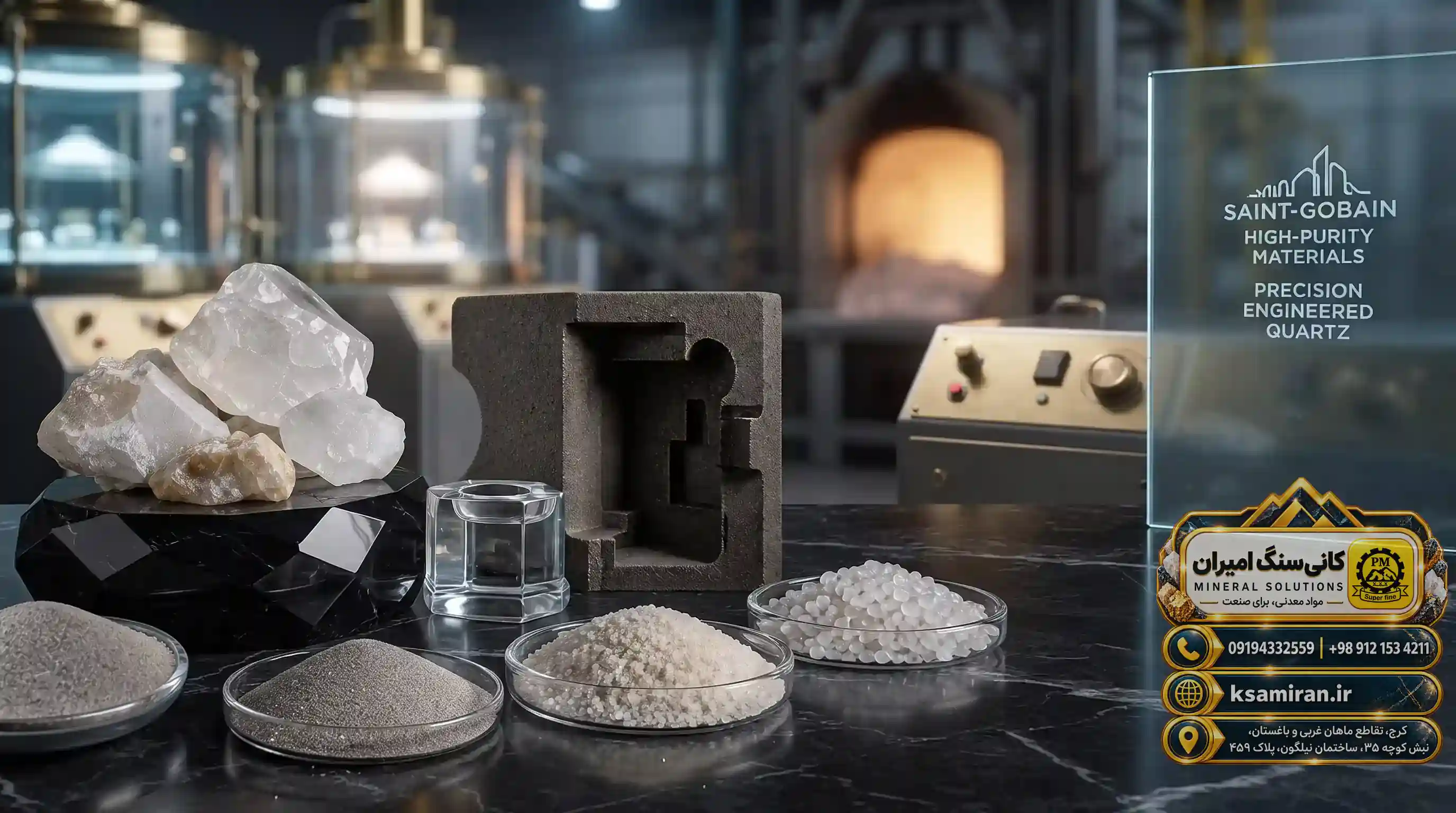
Key Criteria in Choosing the Right Silica for Your Industry
Choosing the right silica is a multi-dimensional decision and should not be made based solely on price or availability. Below, we examine the most important criteria to consider in the selection process, one by one. The first and most important criterion is chemical purity. As previously mentioned, the percentage of SiO2 and the level of impurities, especially Fe2O3 and Al2O3, have a direct impact on the final product quality. Before purchasing, you should request the product's chemical analysis from the supplier and match it with your industry's needs. For glassmaking, high purity and low iron are vital, but in building materials, extremely high purity is not necessarily a priority.
The second criterion is the product's granulation and mesh range. Each industry requires specific particle sizes, and using inappropriate granulation disrupts the production process. For example, in glassmaking, both very fine and very coarse particles can be problematic; very fine particles cause clumping and asymmetric melting, while coarse particles prolong melting time. Choosing the right mesh requires knowing the precise needs of the production line. In this regard, reading specialized guides such as the Guide to Choosing the Right Granulation for Industrial Kaolin can give you a clear perspective on the importance of mineral granulation.
The third criterion is uniformity and quality consistency throughout supply. Many production line problems stem from sudden changes in raw material specifications. A reputable supplier provides a product with consistent specifications across different shipments, and this consistency greatly helps production plaing and waste reduction. To examine this, the supplier's track record, processing facilities and pre-purchase laboratory samples must definitely be checked.
The fourth criterion is moisture and physical impurities. High moisture can interfere with weighing, transportation and mixing, and in some processes may require additional drying. Also, the presence of foreign particles, organic matter and metallic impurities affects product quality. A product that has undergone proper washing and quality control steps is more reliable in this regard.
The fifth criterion is permitted application and matching with needs. Each product is introduced and processed for specific applications, and using it outside this framework will not yield satisfactory results. The silica product of Kani Sang Amiran Project is introduced for the glass, foundry, ceramic and building materials industries, and its 10 to 450 mesh range covers a wide spectrum of needs. Ultimately, evaluating the supplier's facilities, sustainable supply capability, packaging and transportation conditions, as well as technical consulting, are complementary criteria that, alongside technical factors, complete your final decision-making. Paying simultaneous attention to all these criteria guarantees a choice that is both technically correct and economically optimal.
Application of Silica in the Glass Industry
The glass industry is one of the largest consumers of silica in the world, and this material is the most fundamental component of glass formulation. In the glass structure, SiO2 acts as a Network Former; that is, it forms the main framework of the glass, and other materials such as soda, lime, dolomite and additives are placed within this network. Without the presence of high-quality silica, producing clear, durable and homogeneous glass is practically impossible, and for this reason, choosing it correctly is of special importance in this industry.
The most important factor in glassmaking is the chemical purity of the raw material. The presence of iron impurities, even in very low percentages, causes green or blue coloring in the glass and severely reduces its transparency. For clear and architectural glass, tumblers and container glass, and display glass, silica with a very high percentage of SiO2 and extremely low iron is used. In contrast, for colored glass, packaging glass and glass fibers, the iron restriction is somewhat more flexible, and more economical grades can be utilized.
The second factor is appropriate granulation. Silica particles must be selected in a way that guarantees melting homogeneity. Very fine particles have a high surface area, which increases their reactivity during melting, but at the same time they tend to clump, absorb moisture and stick together, which disrupts uniform mixing. On the other hand, coarse particles bring longer melting times and higher energy consumption. Therefore, choosing the right mesh establishes a balance between melting speed, uniformity and energy consumption.
The third factor is shipment uniformity. Sudden changes in particle size or chemical composition can disrupt fuace and production line settings and cause defects in the final product. A supplier with proper quality control over granulation and chemical composition is a reliable partner for the glass industry.
In terms of application, the 10 to 450 mesh range of the Kani Sang Amiran Project silica product covers a broad spectrum of glassmaking needs; from coarser grades for packaging glass and glass fibers to very fine grades for clear glass and specialized products. Ultimately, it should be noted that choosing the right grade must be determined based on the glass type, fuace equipment, melting temperature and formulation, and if necessary, laboratory-scale test samples must be tested before purchase. This professional approach minimizes selection risk and ensures that the raw material is precisely matched with the production line's needs.
Application of Silica in the Foundry Industry
Foundry is one of the oldest yet most advanced industries in which silica plays a key role. In this industry, silica sand is used as the main material for making molds and cores; the mold into which molten metal is poured to create the final shape of the part. The reasons for choosing silica for this task are its high thermal resistance, chemical stability against molten metals, appropriate hardness, availability and economical price. This combination of properties has made silica the industry standard for foundries.
In foundry mold-making, several technical factors are critically important. First, the thermal resistance and reactivity of the sand with the melt. Silica sand must resist the temperature of the molten metal (which is very high for metals like cast iron and steel) and maintain the mold without undesirable chemical reactions. Reaction between the sand and melt can cause weak spots, scabbing and part defects. Higher SiO2 purity reduces this risk.
The second factor is particle shape and size distribution. Angular-shaped particles interlock with each other and create a mold with higher mechanical strength. The particle size distribution must also be such that it provides the necessary strength while having sufficient permeability for gas escape. Proper permeability prevents gas cavities in the final part and improves casting quality. Very fine granulation reduces gas permeability, and very coarse granulation makes the part surface rough and uneven.
The third factor is moisture content and binders. In green sand molding, moisture must be precisely controlled, since excessive moisture causes gas generation during casting and creates gas defects. In other methods such as cold sand and chemical processes, the binder type and its performance with silica must be coordinated to guarantee mold strength.
The 10 to 450 mesh granulation range of the Kani Sang Amiran Project silica product provides foundries with diverse options; from coarse grades for large parts and high-permeability molds to fine grades for delicate parts, smooth surfaces and precision cores. Choosing the right grade depends on the alloy type, part size and thickness, molding method and available equipment. Also, granulation uniformity across different shipments is very important for maintaining consistent quality of cast parts, since any change in particle size affects binder settings, moisture and mold performance. By considering these factors, a sand can be selected that reduces waste while improving foundry line productivity.
Application of Silica in the Ceramics and Building Materials Industries
In the ceramic industry, silica is one of the main components of the ceramic body and glaze. In the ceramic body, this material acts as one of the main structural components, providing strength, formability during pressing and appropriate thermal behavior in the final product. During the firing process, silica enters complex reactions with other components such as kaolin and feldspar, forming strength-giving crystalline and glassy phases. If you need more information in this field about choosing related minerals, reading the Specialized Guide to Choosing the Right Feldspar for Industry gives you a more complete perspective on how minerals function in the ceramic body.
In ceramics, silica granulation has a direct effect on the density, strength and uniformity of the fired product. Finer particles have a higher surface area and help reactivity during firing, while coarser particles can help control shrinkage and prevent deformation at high temperatures. Choosing the optimal particle combination requires laboratory testing and matching with the product's precise formulation. Also, the whiteness and purity of the product are highly important in light-colored ceramics and clear glazes and must be controlled.
In building materials, this mineral also has very wide application. Silica sand is used in the production of various concretes, mortars, plasters, building panels, silica bricks, refractory products and decorative materials. In concrete and mortar, silica acts as a fine aggregate, filling the space between coarser particles while contributing to adhesion and final strength. In refractory products and silica bricks, high thermal resistance and dimensional stability at high temperatures double the value of this material.
In building materials, in addition to particle size, particle shape and purity are also important. Angular particles create better interlocking with cement and more desirable adhesion, while rounded particles may slightly reduce early strength. Also, the absence of organic matter, clay and swelling impurities under heat is essential to prevent cracking and reduced product durability. For this reason, a product that has undergone proper processing and washing performs better in building materials.
The 10 to 450 mesh granulation range provides great flexibility in choosing the right grade for both industries; from coarse grades for concrete and building sands to micronized grades for delicate ceramics and glazes. Properly combining this material with other minerals such as kaolin, feldspar and calcium carbonate creates the optimal formulation. Ultimately, selection based on the product's precise needs, sample testing and coordination with other formulation components guarantees the desired result in the ceramic and building materials industries.
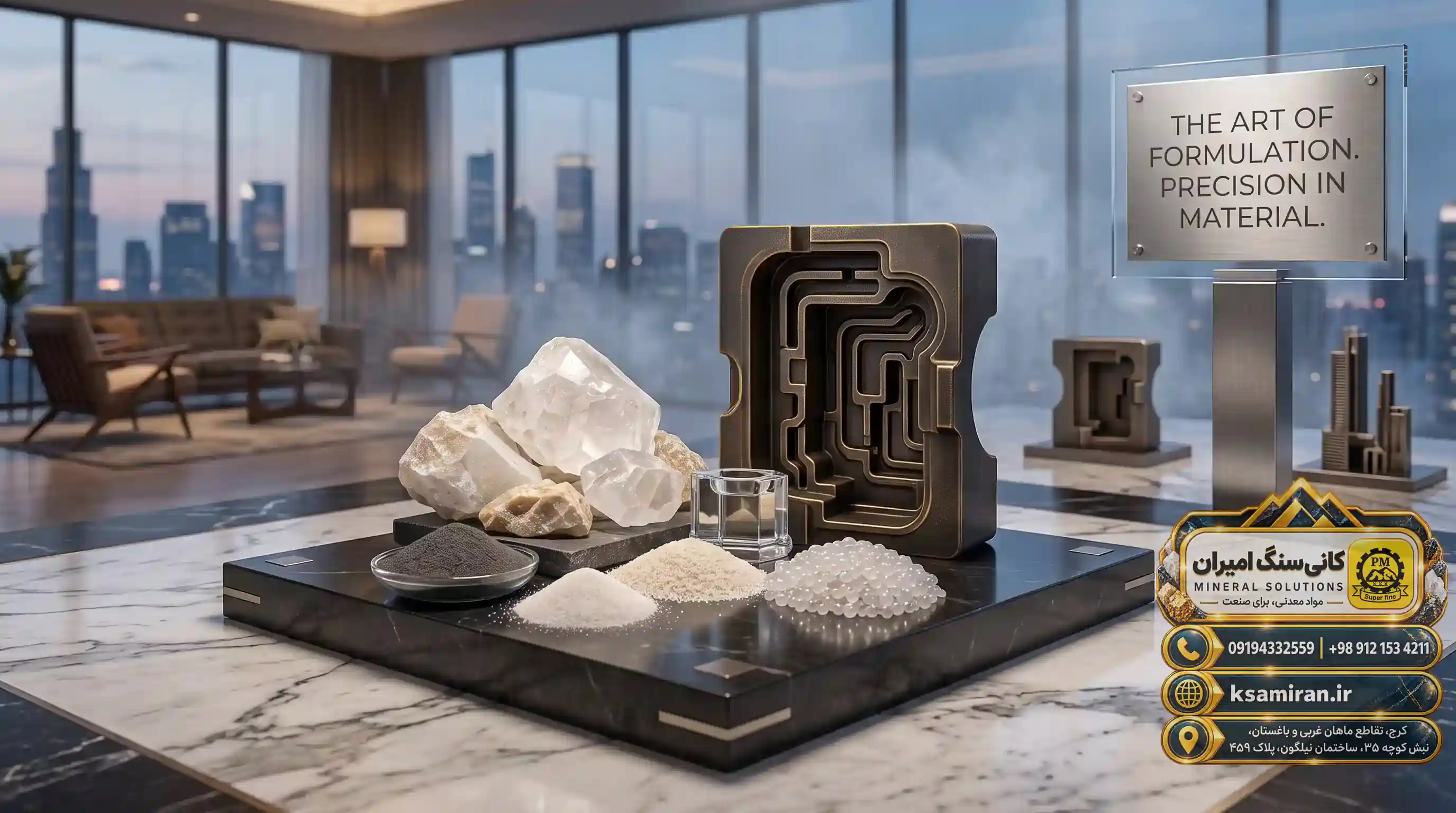
Granulation and the 10 450 Mesh Range; Key Impact on Selection
One of the most important concepts in choosing silica is understanding granulation and the mesh measurement system. The term "Mesh" refers to the number of openings in a standard unit area of a screen; such that a higher mesh indicates finer particles. For a better understanding of unit conversion, a 10 mesh is considered equivalent to particles of about 2000 microns, and a 450 mesh equivalent to particles of about 32 microns or less. Therefore, the 10 to 450 mesh range covers a very broad spectrum from coarse building particles to very fine industrial particles.
The importance of granulation differs in each industry. In glassmaking, particles must be uniform so that balanced melting occurs; middle meshes are usually the most widely used. In foundries, coarser grades increase gas permeability and finer grades create a smoother surface. In ceramics, finer particles help better firing and higher strength. In building materials, coarser grades are more suitable for concrete and building sand. If you want to become familiar with how to choose mesh in another sensitive industry, reading the Guide to Choosing the Right Mesh for Coated Calcium Carbonate in Plastic Injection helps you better understand the logic of mesh selection.
One of the key concepts is Particle Size Distribution. A product containing only one particle size performs differently from a product that is a combination of different sizes. The presence of fine particles alongside coarse particles usually helps fill voids better, increases density and improves behavior in firing and melting processes. However, in some applications, the presence of very fine particles is undesirable due to increased moisture absorption and reduced permeability. Therefore, you must select the particle size distribution exactly according to your industry's needs.
In addition to particle size, attention must be paid to shipment uniformity. Significant changes in granulation between different shipments disrupt production line settings. A supplier that uses precise grinding and screening equipment with continuous quality control can maintain this consistency. This issue is of great importance especially in industries with high sensitivity to uniformity, such as glass and ceramics.
Also, keep in mind that very fine (micronized) particles require special handling, storage and packaging to prevent clumping, contamination and moisture absorption. In fine-grade shipments, packaging type and transport conditions have a direct impact on preserving product quality. Choosing the right grade along with proper transport and storage conditions means that the product retains its initial quality until the moment of use on the production line, and as a result, your process efficiency and final product quality improve.
Quality Control, Purchasing Tips and Product Introduction
The final step in choosing the right silica is paying attention to quality control issues, supply conditions and supplier credibility. Before final purchase, be sure to request a test sample and check the chemical analysis, granulation, moisture and color of the product in your own laboratory or at a reputable authority. Matching the results with your industry's needs is the most important step before decision-making. Also, request that the supplier periodically provides you with test results so you can be assured of quality consistency in subsequent shipments.
Transport, packaging and storage conditions are also of great importance. The product must be packaged and transported in a way that protects it from contamination, moisture absorption and clumping. Especially in fine and micronized grades, moisture and excessive pressure in storage can rapidly degrade product quality. The warehouse must be dry, covered and away from contact with contaminants. Also, clear labeling including product specifications, granulation, production date and shipment number makes your inventory management easier.
Choosing a reliable supplier is the key to success in long-term supply. Kani Sang Amiran Project, a mineral producer, offers a product with defined specifications and for defined applications. This transparency in product introduction helps you make an informed decision. If your industry needs silica, the product page provides you with a complete reference of specifications, through which you can review the 10 to 450 mesh range and its applications for the glass, foundry, ceramic and building materials industries and get in touch with experts.
Finally, a short checklist can help your decision-making: 1) Determine your industry's precise needs (glass, foundry, ceramics or building materials); 2) Determine the required chemical purity, especially the maximum permissible iron; 3) Choose the appropriate granulation and particle size distribution based on your equipment and process; 4) Take pre-purchase test samples seriously; 5) Monitor shipment uniformity throughout the supply period; 6) Provide proper transport and storage conditions. Following these steps minimizes the risk of inappropriate selection.
In this article, we have tried to present a complete and practical picture of how to choose this mineral. The key point is that no silica is optimal for all industries; rather, a product must be chosen whose specifications precisely match your industry's needs. By considering purity, granulation, uniformity and processing quality, and by collaborating with a transparent and specialized supplier, you can choose a product that, while improving final product quality, also increases your production line productivity.
| Question | Answer |
|---|---|
| What is silica and in which industries is it used? | It is the mineral compound SiO2, found mainly as quartz, and has extensive application in the glass, foundry, ceramic and building materials industries. |
| What is the mesh range of the Kani Sang Amiran Project silica product? | This product is produced and offered in a granulation range of 10 to 450 mesh. |
| Why is silica purity so important in the glass industry? | Because impurities, especially iron, reduce glass transparency and severely affect the final product quality. |
| What is the most important factor in choosing silica for foundries? | High thermal resistance, chemical stability against the melt, angular particle shape and appropriate granulation for gas permeability and mold strength. |
| How is the appropriate granulation for ceramics chosen? | Finer particles usually help better firing and higher strength, but they must be coordinated with the formulation and thermal behavior of the ceramic body. |
| What is the effect of high moisture in silica? | High moisture causes disruption in weighing, mixing and transportation, and in foundries it can cause gas defects in the part. |
| Why is the uniformity of silica shipments important? | Sudden changes in granulation or chemical composition disrupt fuace and production line settings and cause quality decline and increased waste. |
| What is the difference between high mesh and low mesh? | A higher mesh indicates finer particles and a lower mesh indicates coarser particles; each industrial application requires its own specific granulation. |
| Should a test sample be requested before purchase? | Yes, checking the chemical analysis and granulation of a sample before final purchase minimizes the risk of inappropriate selection. |
| Where can the specifications of the Kani Sang Amiran silica product be viewed? | The specifications of this product can be viewed and inquired about on the Kani Sang Amiran Project silica product page. |
The information in this article is compiled based on the specifications of the Kani Sang Amiran Project silica product (10 450 mesh range and applications in glass, foundry, ceramics and building materials).

برچسب: Silica,How to Choose the Right Silica for Your Industry? A Complete Guide,
نویسنده: رساوب آفرین