
درباره سایت
آخرین مطالب
- How to Identify High-Quality Feldspar Using Chemical Analysis
- دليل استعلام سعر الكاولين وطلب هذا المنتج المعدني عبر الإنترنت
- ما هو الفلسبار؟ مقدمة شاملة لهذا المعدن واسع الاستخدام في الصناعات
- معايير جودة الكاولين: دليل مراقبة جودة المسحوق المعدني
- ۹ کاربرد فلدسپات در صنعت سرامیک و ساختمان که باید بدانید
- فلدسپات یا کربنات کلسیم؟ کدام ماده برای صنعت شما مناسبتر است
- الفلدسبار أم كربونات الكالسيوم؟ أي مادة أنسب لصناعتك
- 9 تطبيقات للفلدسبار في صناعة السيراميك والبناء يجب أن تعرفها
- آنالیز شیمیایی کائولن: چرا برای صنایع اهمیت زیادی دارد؟
- ما هو الكاولين؟ مراجعة كاملة للتطبيقات الصناعية لهذه المادة المعدنية شائعة الاستخدام
امکانات وب
Introduction to Kaolin's Position in the Mineral Supply Chain
Kaolin is one of the widely used mineral materials that plays an important role in the supply chain of manufacturing industries. Due to its structural characteristics, light color, and proper behavior in thermal and chemical processes, this material is valued in various industrial sectors. In the current market, buyers mostly search for this product for tile, ceramic, glaze, paper, and paint; because kaolin can serve as a filler, substitute, or functional formulation component in these products.
This guide is prepared based on the product information provided by the Kani Sang Amiran project. The aim of this article is to address two essential buyer needs: first, a correct understanding of kaolin's specifications and applications, and second, familiarity with the price inquiry and online order registration process. Along this path, approximate price figures or definite promises about inventory and delivery have been avoided, as these depend on daily market conditions, contract type, and final request specifications.
For industrial buyers, knowing kaolin is not limited to just knowing the product name. The quality of this mineral is related to factors such as particle size distribution, production consistency, impurities, moisture, and processing method. Therefore, a professional price inquiry usually includes information about the consuming industry, the required mesh range, end application, and delivery conditions. The more precise this information, the more reliable the supplier's response will be.
In the tile and ceramic industries, kaolin can contribute to body structure, surface characteristics, and firing behavior. In glaze production, its importance lies more in controlling surface properties, adhesion, and stability. In the paper industry, kaolin is known as a mineral with suitable physical properties, and in paint, its application relates to particle behavior, covering power, and formulation stability. These differences in applications show that a single type of this product caot meet all buyers' needs.
One of the most important messages of this guide is that purchasing kaolin should be based on process needs, not merely on the claimed price. Differences in mesh, processing quality, and packaging can have a direct impact on production line performance. Therefore, the buyer should first define their needs, then compare supply options, and finally obtain up-to-date information through the official inquiry process. In the following chapters, each of these topics is examined in a more practical maer.
What is Kaolin and Why is it Important in Manufacturing Industries?
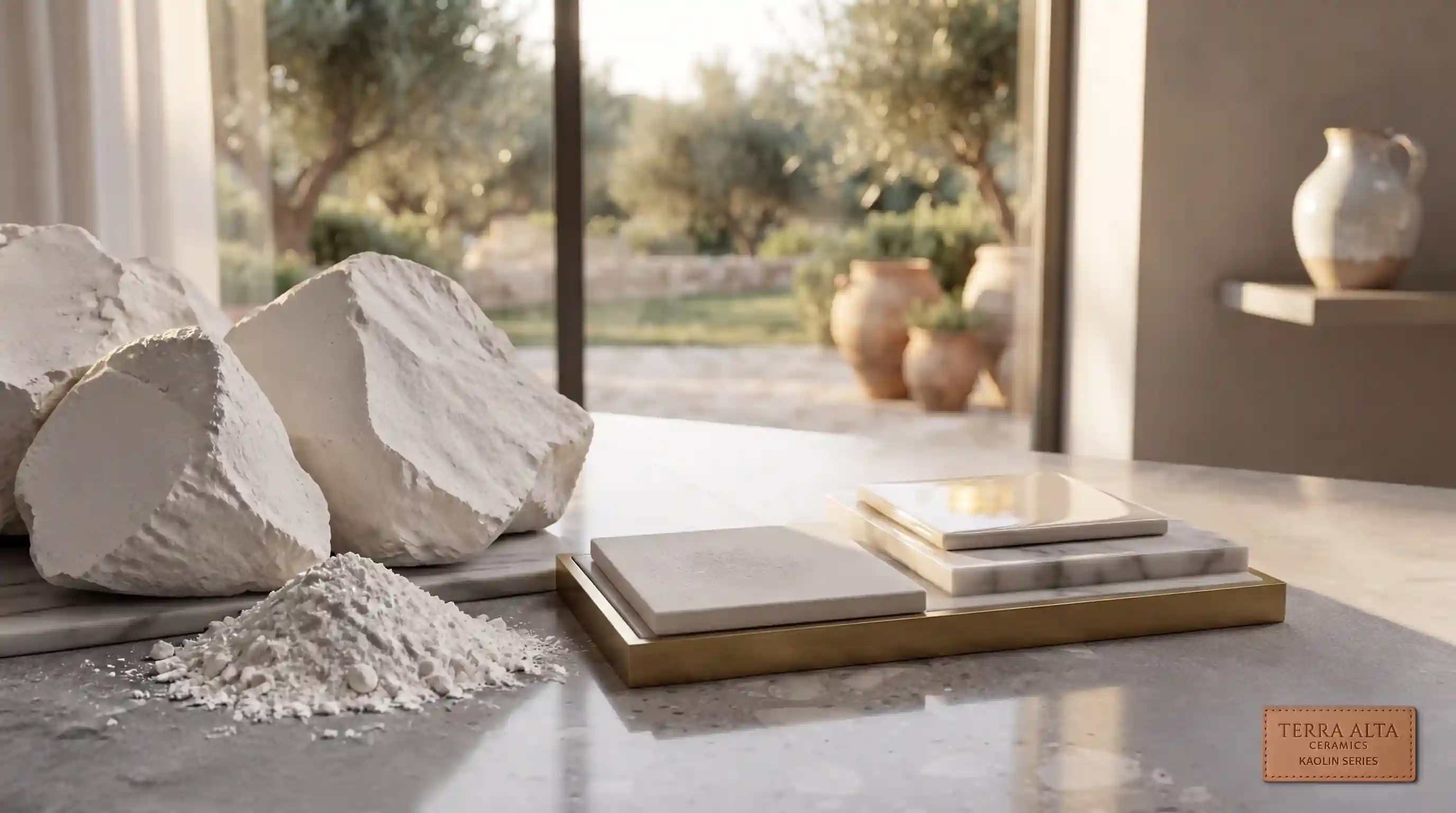
Kaolin is a mineral material classified among industrial clays, and it is valued in many applications due to its light color, layered structure, and low reactivity. This material forms in nature through long-term geological processes, and after extraction, it is offered in various forms through processing, classification, and particle sizing steps. The way kaolin is processed significantly affects its final performance in different industries.
The distinctive feature of kaolin is a combination of white to light color, fine particle size, and proper behavior in thermal processes. These characteristics have made this product a strategic material in the production of tile, ceramic products, glaze, paper, and paint. Each of these industries utilizes a different aspect of kaolin's properties. For example, in a ceramic body, the clay's behavior against heat is important, while in paint and paper, particle distribution and surface properties play a more prominent role.
In examining kaolin, the concept of "quality" is not a unified concept. In other words, kaolin suitable for a tile factory is not necessarily the best option for a paint manufacturer. Parameters such as particle dimensions, size distribution, impurity levels, moisture, and batch consistency determine whether a shipment is compatible with the buyer's production line. For this reason, technical documentation and requesting technical information from the supplier are important parts of a professional purchasing process.
From a commercial perspective, the importance of kaolin lies not only in its applications but also in its impact on the quality of final products. Using incompatible kaolin can lead to product surface issues, increased waste, or changes in process behavior. In contrast, choosing an option with appropriate particle sizing and quality can contribute to production stability and reduce the frequency of machine adjustments. This issue is especially critical for applications where the appearance of the final product surface is of high importance.
Another key point is the distinction between "natural kaolin" and "processed kaolin." In many industrial markets, the product offered under the name kaolin can differ in terms of particle sizing, degree of processing, and final application. As a result, the buyer must determine what mesh range they need and whether the supplier's processing and quality control align with their requirements. The product range offered in this guide is between 450 and 1500 mesh, which is examined in more detail in the next chapter.

Main Applications of Kaolin in Tile, Ceramic, Glaze, Paper, and Paint
Kaolin's applications are very extensive, but this guide focuses on the five main applications mentioned in the product introduction: tile, ceramic products, glaze, paper, and paint. Understanding the role of this material in each of these industries helps the buyer provide appropriate technical information relevant to their needs at the time of price inquiry.
In the tile industry, kaolin is typically used as one of the body components. The presence of this material can help with structure formation, reducing inappropriate shrinkage, and improving behavior during drying and firing. Also, in ceramic products, kaolin plays a similar role in structure formation and creating appropriate mechanical properties. In these applications, particle size uniformity and blend stability are of equal or even greater importance than the price per ton, because quality instability can cause technical problems for the production line.
In glaze production, kaolin acts mostly as a suspending and binding agent. Its fine particles can help distribute other components uniformly in the glaze formulation and prevent rapid settling of materials. In this application, in addition to particle size, the impurity level and kaolin's effect on the color and transparency of the final surface must also be considered. Any change in initial quality can lead to small but effective changes in the glaze output.
The paper industry is one of the traditional consumers of mineral materials, and kaolin is known there as a filler with suitable physical properties. The use of this material can help improve paper surface, control opacity, and enhance printability. In this application, particle size distribution and product purity are of high importance, as inappropriate particles can cause equipment abrasion or reduced surface quality.
In the paint industry, kaolin also has extensive applications. In paint formulation, this material can act as a filler and help control viscosity, covering power, and the mechanical stability of the dried film. Also, choosing the correct mesh range in paint is very important; coarser particles may negatively affect the final surface, while very fine particles can change the flow behavior of the formulation. For this reason, it is recommended that the sample be examined in the paint laboratory before purchasing in bulk.
In summary, kaolin is not merely a "bulk" product; rather, it is a functional material that must be adapted to the conditions of each production line. Preparing a list of technical requirements, including end application, mesh range, packaging method, and quality specifications, is the first step in correctly purchasing this product.
Guide to Kaolin Mesh Range 450 1500 and Choosing the Appropriate Size
One of the most important characteristics of kaolin is its particle size, or "mesh." In the market, this product is offered in various ranges, and the range presented for the product in this guide is 450 to 1500 mesh. The higher the mesh number, the finer the particle size. This may seem simple, but it has a direct impact on kaolin's behavior in industrial processes.
At lower mesh numbers, particles are coarser and are typically used in applications that do not require a highly polished surface or ultra-fine coverage. In tile and ceramic bodies, such particles can affect flow behavior, water consumption, and slip density. However, at higher mesh numbers and finer particles, kaolin exhibits different behavior; for example, in glaze and paint, fine particles can contribute to surface quality, covering power, and formulation uniformity.
Mesh 450 to 1500 is a wide range and indicates that this product can cover diverse needs. However, choosing the exact mesh number should not be done randomly. The buyer must first determine what they expect from kaolin in their process: is the main goal the ceramic structure? Is the product being designed for a viscosity-sensitive formulation? Or is the visual appeal of the final surface more important? Answering these questions clarifies the selection path.
In wet processes, increasing particle fineness typically increases contact surface area and changes suspension behavior. This change can be beneficial in some applications and challenging in others. For example, excessive fineness may cause increased viscosity and reduced water absorption rate, while coarse particles may reduce suspension stability. Therefore, mesh selection is a balance between technical performance and process conditions.
In the paper and paint industries, particle size distribution is typically of equal importance to its average. That is, in addition to the mesh number, we should know how much of the particles fall in a range close to the average and how much is outside the range. This information is usually obtained through particle sizing tests in the laboratory and is also effective in pricing and supplier selection. For this reason, it is recommended to also request particle size distribution information in your price inquiry.
The practical point is: the mesh number alone does not reveal the whole truth about the product. Two products with similar average mesh can have different particle distributions, impurities, and process behavior. As a result, the best approach is combining the specified mesh with a laboratory sample and evaluation under real production conditions. This significantly reduces the risk of bulk purchasing.

Criteria for Evaluating Kaolin Quality Before Ordering
Evaluating kaolin quality before purchase is an essential step for reducing production errors. Since this product is used in various industries such as tile, ceramic, glaze, paper, and paint, the definition of "appropriate quality" differs in each industry. Nevertheless, there are several general criteria that are common in most industrial purchases.
The first criterion is the product's particle sizing. As mentioned, the product is offered in the 450 to 1500 mesh range. But alongside the average particle size, attention must also be paid to the uniformity of size distribution. A product with irregular particle distribution can cause continuous changes in process parameters on the production line. This issue is more serious in sensitive applications such as glaze and paint.
The second criterion is the impurity level. The presence of mineral impurities, foreign particles, or dark spots can negatively affect the surface quality and transparency of final products. In tile and ceramic, impurities can lead to uneven appearance or color changes. In paper and paint, even small amounts of impurities can disrupt print quality or film surface. For this reason, requesting information related to impurity control and processing method is important.
The third criterion is moisture and packaging conditions. High moisture can cause particle clumping, changes in flow behavior, and problems in automatic feeding lines. Also, improper packaging may introduce contamination into the product during transportation. Consequently, examining the packaging type, storage conditions, and loading method is part of quality evaluation, even if not directly mentioned in technical documents.
The fourth criterion is shipment consistency. Many industrial buyers, due to their consumption volume, require stable supply. Under such conditions, quality differences between shipments are more dangerous than price differences. Requesting samples from different shipments, examining quality control certificates, and agreeing on fixed specifications are common methods for managing this risk. If facilities are available, conducting incoming tests at the buyer's factory is recommended.
The fifth criterion is compatibility with existing formulations. In many industries, replacing a mineral material requires product development testing. It is better that before bulk ordering, the sample be evaluated at laboratory scale and then at semi-industrial scale. This stage may be time-consuming, but compared to the cost of production line stoppage or product retus, it is a rational investment.
Ultimately, transparent communication with the supplier is the buyer's most important tool. A supplier that transparently provides technical information, particle sizing, applications, and product conditions helps the buyer make reality-based decisions. In the price inquiry, ask your questions precisely; because a specialized inquiry usually leads to a more accurate response.
Steps for Kaolin Price Inquiry and Online Order Registration
The process of kaolin price inquiry in the online space is based on the exchange of precise information between buyer and supplier. The more complete the buyer's request, the more realistic and comparable the proposed price will be. For this reason, you should first specify your needs: product application, mesh range, desired packaging, destination, and approximate request volume.
Before submitting a request, to better understand the structure of mineral material inquiry and ordering, it is recommended to read related content such as White Talc Purchase Order and Price Inquiry Guide and Industrial Barite Online Purchase Request Guide. These guides help you know what information should be provided in a professional inquiry and how you can bring your request closer to an industrial standard.
At the request submission stage, product specifications must be clearly stated. For example, your request could include kaolin with specifications for tile, ceramic, glaze, paper, or paint, and the 450 to 1500 mesh range. This information allows the supplier to suggest an option compatible with your needs. Also, mentioning delivery conditions, destination, and sample requirements speeds up the evaluation process.
Kaolin prices in mineral markets are not fixed and are influenced by factors such as particle sizing, processing quality, order volume, shipping conditions, and market fluctuations. For this reason, to better understand this topic, it is recommended to read the article Analysis of Kaolin Price Trends in the Mining Market. This study helps you evaluate proposed prices within a more logical framework.
After completing the inquiry and receiving proposals, the next step is evaluating the proposals based on two axes: price and technical quality. In many cases, choosing the cheapest option without regard to particle size uniformity and process compatibility is a short-term decision. Instead, combining competitive price, quality stability, and on-time delivery capability is a more comprehensive criterion for selection.
To start the inquiry process and examine the product, you can use the Kaolin product page. On this page, you can find information about the product and the contact path for the Kani Sang Amiran project. In your communication, use the information previously reviewed in this guide so that your inquiry is processed faster and more professionally.
Ultimately, a successful online order is one where the technical requirement has been correctly defined beforehand. This approach not only makes the price more transparent but also reduces the likelihood of receiving a product incompatible with the production line.

Packaging, Transportation, and Storage of Kaolin
After going through the inquiry and product approval steps, one of the most important stages is receiving and managing kaolin under appropriate conditions. Although this stage is often neglected compared to price and quality, its impact on final performance is significant. Kaolin is a powdery material, and its main sensitivities are moisture absorption, clumping, contamination by foreign particles, and mixing with other products.
At the time of receiving the shipment, the packaging condition must be checked. Tears, pallet damage, or powder leakage can be signs of transportation problems or failure to observe environmental conditions. Also, the labels on the packages should include basic information such as the product name and technical specifications. This information plays a role in warehouse management and product quality tracking.
In storage, the humidity of the environment is very important. The storage space must be dry, enclosed, and free from dust. Direct contact with the ground, damp walls, or open spaces can degrade the product's quality over time. It is best to store kaolin on pallets in a well-ventilated environment and avoid placing it near scented, colored, or contaminated chemicals.
During transportation, damage to the packages must be prevented. Load securing, using appropriate pallets, and avoiding excessive pressure in stacking help maintain package integrity. If the shipment is transported in bulk, the cleanliness of the tank or truck is of high importance; because residual previous cargo can be a serious source of contamination for kaolin. This issue is more serious for industries sensitive to final surface quality, such as paint, glaze, and paper.
When unloading and transferring the product to silos or tanks, appropriate transfer equipment must be used to prevent fine particles from dispersing into the environment. Also, observing safety instructions, including the use of masks and goggles, is essential to prevent powder inhalation. Although kaolin is a common mineral material, long-term inhalation of powder in enclosed spaces must be controlled in accordance with safety instructions for powdered materials.
An important point in supply chain management is recording shipment information. Contract number, production or receipt date, technical specifications, and inspection results should be recorded in a simple system. This facilitates access to information in case of quality disputes or the need to extend the order. Also, if shipments are supplied periodically, these records help compare the quality of each shipment with the previous one.
In summary, proper management of kaolin after delivery is part of the overall cost of purchase. Savings at this stage can lead to a decline in final product quality, while a simple system for controlling moisture, contamination, and recording information greatly contributes to production line stability.
Summary and Kaolin Purchasing Checklist
Purchasing kaolin is a technical-commercial process that should not be done merely based on price. In this guide, an effort was made to practically examine the various dimensions of this purchase, from knowing the product and its applications to choosing the appropriate mesh, quality evaluation, online inquiry, and receipt management. These topics can now be summarized in the form of a simple checklist.
First, determine the end application. If the product is being procured for tile and ceramic, body and firing behavior are important. For glaze, paper, and paint, surface characteristics, particle distribution, and formulation stability become more important. Mentioning this application in the price inquiry makes proposals closer to your actual needs.
Second, specify the mesh range. The product is offered in the 450 to 1500 mesh range. This wide range means you should make your precise selection based on process needs. Higher meshes have softer particles and are typically preferred in applications where surface and uniformity are important, while lower meshes can be suitable for structural applications.
Third, request technical information. Before bulk ordering, receive information about particle sizing, impurity control, processing conditions, and packaging. If the supplier provides this information transparently, it is a sign of a defined quality control process. In sensitive cases, laboratory samples and evaluation under real conditions are recommended.
Fourth, complete your inquiry. A professional buyer provides information about application, mesh, packaging, volume, and destination. This makes the proposed prices comparable to each other and also prevents unworkable proposals. To facilitate this process, you can also model your approach on other mineral material guide pages.
Fifth, plan the post-delivery conditions. The storage space must be dry, enclosed, and free from contamination. Packages must be placed on pallets and contact with contaminated materials avoided. For bulk shipments, the cleanliness of vehicles and transfer equipment must be verified. Management of this stage has a direct impact on the stability of the final product's quality.
Sixth, view the price as a complete package. Kaolin's price is not only per ton; rather, it relates to particle sizing quality, shipment consistency, packaging type, shipping conditions, and after-sales service. A lower-priced proposal with unstable quality can create many hidden costs through increased production waste.
Finally, for buyers seeking a transparent and professional path, it is recommended to first document their needs, then register the inquiry, and if possible, test the sample before a full order. This approach transforms kaolin purchasing from a price-based decision to a technical-need-based decision and reduces the risk of the entire production chain.
| Question | Answer |
|---|---|
| What is kaolin? | It is a mineral material from the industrial clay category with a light color and fine particles that has many applications in manufacturing industries. |
| What are the main applications of this product? | According to the product introduction, the main applications include tile, ceramic products, glaze, paper, and paint. |
| What is the mesh range of this product? | The product's mesh range is aounced as 450 to 1500 mesh. |
| What is the difference between low mesh and high mesh? | The higher the mesh, the softer the particles, and they become more suitable for applications where surface, coverage, and uniformity are important. |
| How to choose the appropriate mesh? | The mesh should be selected based on the end application, formulation, and production line conditions, and in sensitive cases, confirmed with a test sample. |
| How to inquire about the kaolin price? | Register the inquiry through the product page by providing the application, mesh range, volume, packaging, and destination. |
| What information is important in a price inquiry? | The end application, particle sizing, requested volume, shipping conditions, and your desired packaging. |
| Is the kaolin price fixed? | No, the price depends on quality, particle sizing, order volume, and market conditions, and must be inquired on a daily basis. |
| What should be done if the shipment becomes clumped or contaminated? | You should avoid using it in sensitive processes, document the issue, and contact the supplier to examine the shipment's condition. |
| What are the proper storage conditions for kaolin? | Storage in a dry and enclosed space, on pallets, away from moisture and contaminated materials, along with recording shipment specifications. |
The data in this article is prepared based on the kaolin product information from the Kani Sang Amiran project.

برچسب: Kaolin,Guide to Kaolin Price Inquiry and Online Ordering of This Mineral Product,
نویسنده: رساوب آفرین