
درباره سایت
آخرین مطالب
- راهنمای ثبت سفارش آنلاین و استعلام قیمت کائولن
- چگونه بهترین اکسید آهن قرمز (اخرا) را برای پروژه انتخاب کنیم؟
- بررسی جامع خواص اکوستیک و وزن مخصوص باریت سفید صنعتی
- نقش کائولن در کاهش هزینههای تولید در صنایع معدنی
- نقش سیلیس در افزایش مقاومت حرارتی مواد نسوز
- چرا اکسید آهن قرمز (اخرا) قدرت پوشانندگی بالایی دارد؟
- The role of industrial barite in the papermaking and specialty coatings industries
- How to find the best kaolin supplier in the country?
- How to properly examine feldspar analysis?
- ما هي استخدامات التالك الصناعي في صناعة البلاستيك والمطاط؟
امکانات وب
Introduction to Feldspar and the Importance of Quality Identification
Feldspar is one of the most abundant groups of rock-forming minerals in the Earth's crust, which, due to its unique properties, has become a strategic industrial mineral. This mineral is widely used for glass, tiles, ceramics, and glaze, and has applications in various industries. The Kani Sang Amiran Project, as a producer of mineral materials, supplies high-quality feldspar for these industries.
However, in today's competitive market, merely having a rich mineral reserve is not enough; rather, the quality, purity, and uniformity of the product will ultimately determine its value. For this reason, the method of identifying high-quality feldspar using chemical analysis has become one of the most important conces for producers and consumers.
In the ceramic and glassmaking industries, feldspar plays the role of a "flux" or a melting point reducer. If the feldspar contains undesirable impurities, in addition to a drop in the quality of the final product, energy and production costs also increase significantly. Therefore, precise chemical analysis is a scientific tool for ensuring quality, optimizing the production process, and reducing waste on the production line.
Chemical Composition of Feldspar and Its Main Types
Chemically, feldspars are aluminosilicates containing potassium, sodium, or calcium. Their general formula is expressed as X(Al,Si)4O8, where X can be potassium (K), sodium (Na), or calcium (Ca). Based on these cations, feldspars are divided into three main groups:
- Orthoclase or Potassium Feldspar: It has high potassium oxide (K2O) with the chemical formula KAlSi3O8. Due to its suitable melting temperature and the formation of a stable molten phase, this type is widely used in the ceramic and glaze industries.
- Albite or Sodium Feldspar: It contains sodium (NaAlSi3O8) and is mostly used in the glass industry because it provides transparency and reduces the melting temperature.
- Anorthite or Calcium Feldspar: It contains calcium (CaAl2Si2O8), which has more limited industrial applications but is used in certain specific formulations.
In fact, most natural feldspars exist as a solid solution between these three endmembers. Precise chemical analysis can determine the percentage of each of these components and their distribution, which is crucial for predicting the behavior of feldspar in the kiln.

Chemical Analysis Methods for Feldspar
To accurately identify the quality of feldspar, several chemical analysis methods are used, each with its own strengths and limitations:
- X-ray Fluorescence (XRF): This method is the fastest and most common technique for determining the percentage of major and minor oxides in mineral samples. Using this method, the amounts of SiO2, Al2O3, Na2O, K2O, Fe2O3, and CaO can be measured in a matter of minutes with minimal need for complex preparation.
- Inductively Coupled Plasma Spectroscopy (ICP-OES/ICP-MS): This method is highly suitable for the accurate measurement of trace elements and impurities present at the ppm (parts per million) level. Chemical digestion of the sample is mandatory in this method.
- Wet Chemistry: Classical methods such as titration and gravimetry, although time-consuming, are still used for calibrating mode instruments and achieving the highest accuracy, especially in determining alumina.
- Electron Microprobe (EPMA) and SEM-EDX: These are used to examine the distribution of elements on the surface of individual feldspar grains and to identify secondary phases.
Combining these methods allows producers to gain a complete picture of the product's quality.
Key Quality Indicators in Feldspar Chemical Analysis
In the chemical analysis of feldspar, there are several key indicators that determine its quality for industrial uses:
- Alkali Oxides (Na2O + K2O): This indicator represents the fluxing power of feldspar. The higher this value, the lower the temperature at which the feldspar melts, and the less energy consumed in the firing process.
- Alumina (Al2O3): Alumina increases the strength, hardness, and dimensional stability of ceramic products. High-quality feldspar must have an appropriate and uniform alumina percentage.
- Silica (SiO2): It acts as a network former in glass and ceramics, but it must be within a standard and constant range.
- Iron Oxide (Fe2O3) and Titanium (TiO2): These are the two most important impurities in feldspar. Iron causes undesirable colors, yellowness, or darkness in glass and ceramics. To produce white and bright products, feldspar must have the lowest possible iron content.
- Loss on Ignition (LOI): This parameter indicates the presence of volatile materials, moisture, and carbonates. A high LOI can cause bubbling in glass and glaze.
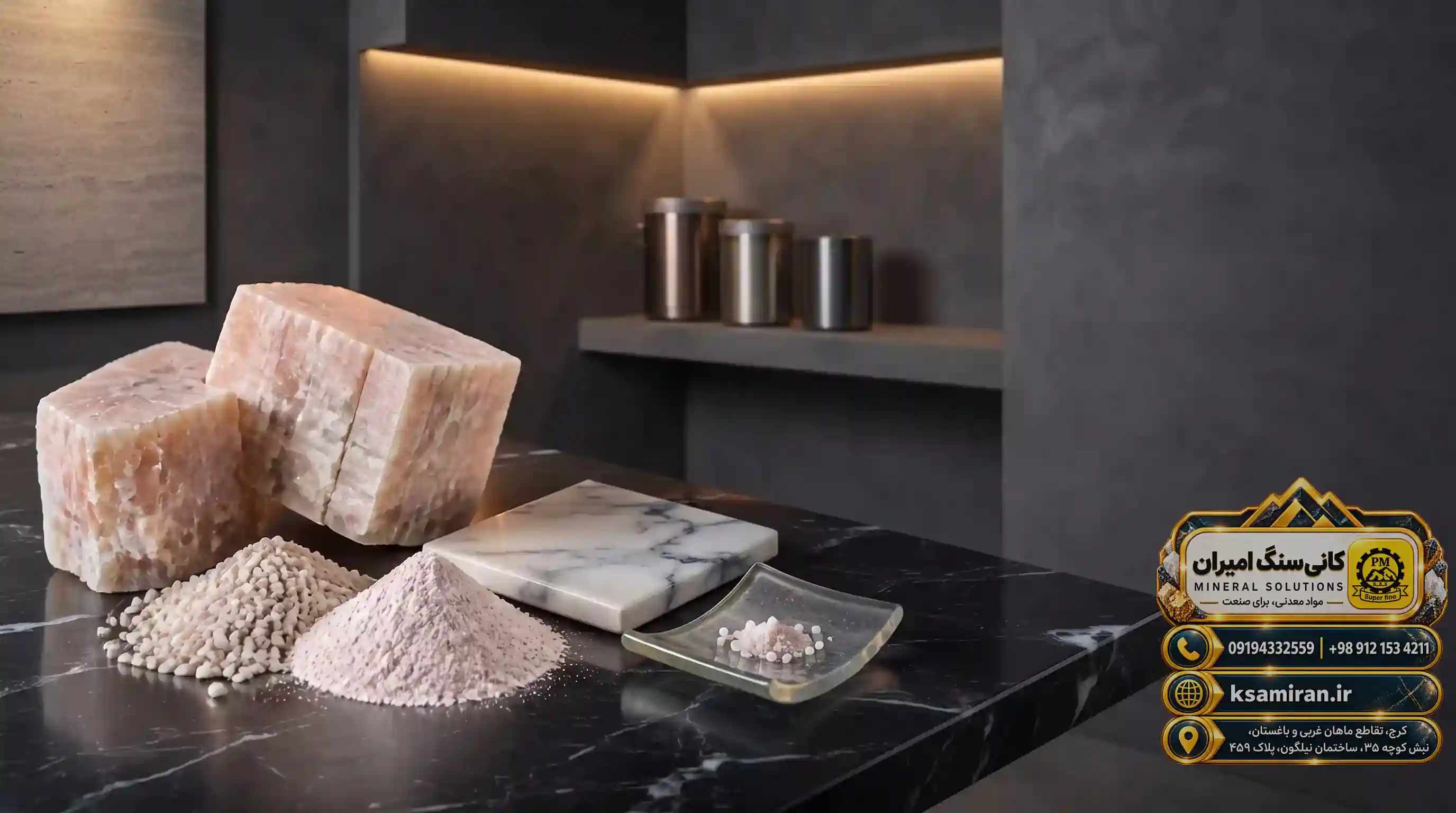
Applications of Feldspar in the Glass and Ceramic Industries
The main applications of feldspar include glass, tiles, ceramic products, and glaze. In the glass industry, feldspar acts as a source of alumina and alkali oxides, helping to reduce the melting temperature and improve the chemical and mechanical resistance of glass. In the tile and ceramic industries, feldspar creates a molten phase in the kiln, paving the way for the formation of appropriate crystalline phases, which leads to reduced porosity and increased body strength.
Another very important parameter is the particle size or "mesh". Feldspar is offered in the 10 to 450 mesh range for various applications. For example, in glass production, coarser meshes are typically used to reduce dust and improve mixing, while in glazing and fine ceramics, very fine particles (325 mesh and higher) are required to achieve surface uniformity.
Since the quality and purity of feldspar directly affect its market price, to better understand the market for this mineral, you can refer to the article Feldspar Price Review in the Iranian Mineral Market.
Impurities and Their Impact on Final Product Quality
Impurities in feldspar can severely affect the quality of final products. The most important of these impurities is iron oxide, which even in small amounts can cause color change, staining, and reduced strength in glass and ceramics. One way to identify quality in the factory is to examine the color and whiteness of the sample after firing at high temperatures.
However, understanding the importance of purity and white color is not exclusive to feldspar. In the paint industry, iron oxides such as limonite oxide are known as natural pigments, while for the production of high-quality white paints, other minerals are used; just as the use of white barite in paint production is essential due to its high whiteness and covering power. This comparison shows that each industrial mineral must be employed in its appropriate industry based on its chemical composition.
Sampling and Sample Preparation for Accurate Analysis
The accuracy of chemical analysis depends heavily on how sampling and preparation are done. An invalid sample can lead to misleading results. The general steps include the following:
- Sampling: Multiple samples must be taken from different points of the stockpile or extraction face and combined to obtain a representative sample of the entire mineral body.
- Size Reduction and Crushing: The samples must be crushed and then reduced to the appropriate volume for the laboratory using the "quartering" method or with sample splitters.
- Milling and Sieving: For XRF analysis, the sample typically must be milled to a 200 or 400 mesh size to ensure homogeneity. Care must be taken during milling to prevent the introduction of iron (which is measured as an impurity) into the sample.
- Drying and De-agglomeration: Moisture and sticky substances must be removed before analysis so they do not introduce errors into the results.
Conclusion and Introduction to the Kani Sang Amiran Project
Ultimately, the method of identifying high-quality feldspar using chemical analysis involves a comprehensive process from proper sampling to precise instrumental analyses and the examination of key indicators such as alkali oxides, alumina, and iron. For the glass, tile, ceramic, and glaze industries, selecting feldspar with a controlled chemical composition and appropriate mesh range (10 to 450 mesh) can significantly improve the quality of the final product and reduce production costs.
The Kani Sang Amiran Project, understanding this industrial need, has focused on the production and supply of uniform, standard-quality feldspar. With a better understanding of the principles of chemical analysis, consumers can make more informed choices regarding the raw materials they need and be more successful in producing high-quality products.
| Question | Answer |
|---|---|
| 1. What is feldspar? | Feldspar is a group of aluminosilicate minerals containing potassium, sodium, or calcium, mainly used in the glass, ceramic, and glaze industries. |
| 2. Why is the chemical analysis of feldspar important? | To determine the amount of impurities (such as iron) and useful oxides, which directly affect the quality and color of the final product. |
| 3. What is the main method of feldspar analysis? | The XRF (X-ray fluorescence) method is the most common technique for determining the percentage of feldspar oxides due to its high speed and accuracy. |
| 4. What effect does iron oxide have on the quality of feldspar? | Iron oxide is an impurity that causes color change, yellowness, and darkness in glass and ceramics. |
| 5. What is the difference between sodium and potassium feldspar? | Potassium feldspar (orthoclase) is mostly used in ceramics and glaze, while sodium feldspar (albite) is mostly used in the glass industry. |
| 6. What is the mesh range of feldspar? | Feldspar is offered in the 10 to 450 mesh range, which varies depending on the application in glass, tiles, or glaze. |
| 7. What is LOI in feldspar analysis? | LOI (Loss on Ignition) indicates the amount of volatile materials and moisture in the sample, which can cause bubbling in glass. |
| 8. Where is feldspar used? | The main applications of feldspar include the glass, tile, ceramic, and glaze industries. |
| 9. Why is sampling important before analysis? | Because the sample must be representative of the entire mineral body; otherwise, the analysis results will not be accurate. |
| 10. What role do alkali oxides play in feldspar? | Na2O and K2O act as fluxes and reduce the melting temperature in the kiln. |
Source: Kani Sang Amiran Project — Mineral Materials Production | https://ksamiran.ir

برچسب: Feldspar,How to Identify High,Quality Feldspar Using Chemical Analysis,
نویسنده: رساوب آفرین